Showing 100 Result(s)
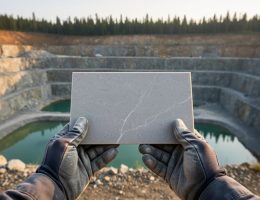
Gloved hands hold a polished natural stone countertop sample with subtle veining at the edge of a terraced mountain quarry, with blurred quarry walls and clear settling ponds behind in soft morning light, symbolizing responsible sourcing
Culinary Stone Applications

What Sustainable Sourcing Really Means When Your Kitchen Countertop Comes from a Mountain

Sustainable sourcing means extracting, processing, and distributing natural stone products in ways that minimize environmental harm, support fair labor practices, and ensure economic viability for mining communities. The term has become ubiquitous in marketing materials, yet remains poorly understood by most consumers and even some industry professionals who specify these materials daily.
At its core, sustainable sourcing in the natural stone industry requires three verifiable components: environmental stewardship through responsible quarrying that preserves ecosystems and manages water usage, social responsibility that guarantees …

Close-up of water cascading over dark granite and basalt blocks in a commercial fountain, with crisp edges and water beading, set against a softly blurred urban plaza and landscaping.
Commercial Applications

Why Your Commercial Water Feature Keeps Failing (And Which Stone Will Actually Last)

Evaluate your water feature project parameters before committing to any stone type—water chemistry, freeze-thaw cycles, and traffic patterns will eliminate unsuitable options faster than aesthetic preferences. Dense, low-porosity stones like granite and certain basalts consistently outperform porous alternatives in commercial fountain applications because they resist water absorption, minimize algae growth, and withstand chemical treatments without degradation.
Prioritize absorption rate testing over visual appeal when comparing stone samples. Request ASTM C97 data from suppliers showing water absorption percentages below 0.5% for…

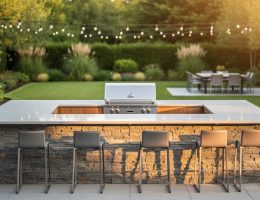
Modern outdoor kitchen island clad in stacked stone veneer with stainless steel grill and bar seating, photographed at golden hour with a softly blurred landscaped backyard and string lights.
Exterior and Landscaping

Why Veneer Stone Transforms Outdoor Kitchens (Without the Weight or Cost of Solid Stone)

Veneer stone delivers the luxurious appearance of natural stone at a fraction of the weight and cost, making it an increasingly popular choice for outdoor kitchen construction. This engineered product consists of thin stone slices—typically one to two inches thick—that adhere directly to prepared surfaces, eliminating the need for extensive structural reinforcement required by full-thickness stone installations.
The material offers exceptional versatility for outdoor …

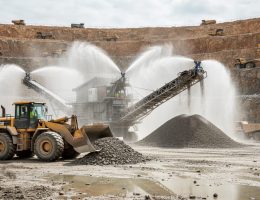
Active stone quarry with mist cannons spraying at a crusher and conveyor to control dust, wheel loader operating in foreground, terraced rock walls and haul trucks in the background under overcast light.
Sustainability and Environmental Impact

Why Stone Quarries Face Stricter Dust Rules Than Other Construction Sites

Construction site dust poses serious health risks, regulatory compliance challenges, and operational disruptions that demand immediate attention. Airborne particulate matter from stone cutting, grinding, and material handling can cause respiratory diseases among workers, reduce visibility for heavy equipment operators, and trigger costly citations from OSHA and EPA inspectors. Stone operations face particularly acute dust control challenges due to the crystalline silica content in materials like granite, marble, and limestone, which generates respirable dust particles capable of causing silicosis with prolonged exposure.
Effective …

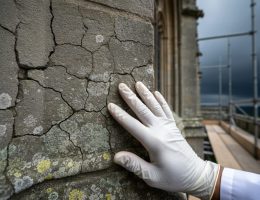
Conservator’s gloved hand examining cracks, flaking, and salt efflorescence on a weathered limestone cathedral facade, with scaffolding and storm clouds softly blurred behind.
Stone in Cultural Heritage

How Climate Change is Cracking Your Stone Heritage (And What You Can Do About It)

Climate change is accelerating the deterioration of stone heritage at unprecedented rates. Historic buildings, monuments, and architectural treasures that have endured centuries now face intensified threats from extreme weather events, increased moisture cycles, freeze-thaw damage, salt crystallization, and biological colonization. For conservation professionals and property owners, the challenge is clear: traditional preservation approaches must evolve to address these rapidly changing environmental conditions.
Stone structures respond differently to climate stressors depending on their geology, porosity, and existing condition. …

Hands of a professional installer attaching an undermount stainless steel sink to the underside of a polished granite countertop with epoxy and metal brackets; shims, clamps, and a faint laser line visible in a blurred modern kitchen background.
Granite Countertops

How to Install Granite Countertops with an Undermount Sink Without Costly Mistakes

Installing granite countertops with undermount sinks demands precision at the planning stage: measure your cabinet layout three times, accounting for the sink’s precise dimensions plus the required lip overhang of typically 1.5 to 2 inches. Order your granite slab with cutouts templated by a professional, as DIY sink hole cutting risks catastrophic cracking in this brittle material that can exceed thousands of dollars in replacement costs.
Secure the undermount sink to the granite underside using a two-part epoxy specifically formulated for stone, applying support brackets every 6 to 8 inches around the sink perimeter to …

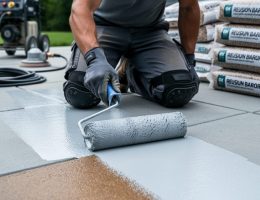
Contractor kneeling and rolling moisture barrier primer onto a cleaned, patched concrete slab, with pressure washer, grinder, and bags of stone aggregate softly blurred in the background.
Home Improvement and DIY

Why Resin Stone Substrate Preparation Determines Your Installation Success (Or Failure)

Clean the concrete substrate thoroughly with a degreaser and pressure washer, removing all oils, dirt, and loose debris that would prevent proper resin adhesion. Any contamination left behind creates weak points where the resin stone coating will eventually delaminate or fail. Allow the surface to dry completely for at least 24 hours before proceeding.
Repair all cracks, holes, and surface imperfections using a high-quality concrete patching compound rated for outdoor use. Resin stone installations magnify rather than hide substrate flaws, so address even minor damage now. Grind down high spots and fill low areas to create a level …

Macro photo of polished biotite-rich granite showing glossy black mica flakes touched by a fine microprobe, under cool lab lighting with blurred glassware and a faint circuit board in the background.
Natural Stone Applications in Technology

Why Biotite-Rich Granite Could Power the Next Generation of Bio-Computing

Biotite mica, the dark crystalline mineral speckled throughout granite, stands at an unexpected intersection of ancient geology and emerging technology. This iron-magnesium silicate, responsible for granite’s distinctive salt-and-pepper appearance, possesses layered molecular structures and electrical properties that researchers are now investigating for bio-computing interfaces—systems where biological materials facilitate information processing.
Within granite’s igneous matrix, biotite forms during slow magnesium-rich magma crystallization at temperatures between 700-900°C. Its perfect basal cleavage creates atom-…

Modern kitchen with white and gray veined quartz island and perimeter countertops, visible edge profile, tape measure and quartz sample chips on the surface, soft natural daylight, matte cabinetry and stainless appliances subtly blurred in the background.
General Comparison and Selection

What You’ll Really Pay for Quartz Countertops (And Whether They’re Worth It)

Quartz countertops cost between $50 and $150 per square foot installed, with most homeowners paying $75 to $100 per square foot for mid-range options. This pricing positions quartz as a premium countertop material, typically costing 10-30% more than granite but offering distinct advantages that justify the investment for many buyers.
The total cost depends on four primary factors: material quality and brand selection, where entry-level options like basic patterns start at $50 per square foot while luxury collections featuring realistic veining can exceed $150; edge profile complexity, with standard edges included in base pricing but…

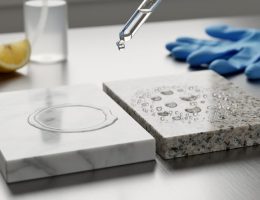
Close-up of marble and granite samples on a stainless workbench as a glass dropper applies liquid; marble shows slight etching while granite beads droplets, with a lemon wedge and unlabeled spray bottle softly blurred in the background.
Technical Properties

Why Some Stones Survive Chemicals While Others Crumble

Examine the stone’s mineral composition first—calcium-based stones like marble and limestone show higher vulnerability to acidic substances, while silica-rich materials such as granite and quartzite offer superior chemical resistance for demanding environments like kitchens and laboratories. Request acid sensitivity ratings and porosity measurements from suppliers before specifying any natural stone for areas exposed to cleaning products, food acids, or industrial chemicals.
Test samples with your specific use-case chemicals before committing to large orders. Apply common substances you’ll encounter—lemon juice, …