Showing 8 Result(s)
Seven polished gemstones—deep red jasper, royal blue sapphire, vivid green emerald, banded agate, purple amethyst, black onyx, and orange-red carnelian—arranged on a carved limestone altar edge in a historic chapel, warmly side-lit with stained-glass color and blurred stone arches in the background.
Stone-Inspired Architectural Legacies

These Seven Biblical Stones Still Shape How We Build Sacred Spaces Today

From the foundation stones of the New Jerusalem to the gems adorning the high priest’s breastplate, stones in Scripture carry profound meaning that transcends their physical beauty. Seven specific stones appear repeatedly throughout biblical texts, each chosen deliberately to convey spiritual truths while serving practical purposes in sacred architecture and ceremonial objects.
These seven stones—jasper, sapphire, emerald, agate, amethyst, onyx, and carnelian—weren’t selected randomly. Ancient civilizations valued them for durability, workability, and symbolic resonance. The same properties that made them suitable …


"Renovated historic stone warehouse with modern glass-and-steel extension and rooftop greenery at golden hour, set on a city street with a softly blurred skyline and pedestrians in the background"
Stone-Inspired Architectural Legacies

Why Historic Stone Buildings Are Solving Modern Cities’ Biggest Design Problems

Old stone buildings represent some of the most compelling opportunities for adaptive reuse in contemporary architecture. Their thick walls, solid foundations, and inherent durability provide a structural advantage that modern construction often struggles to replicate, while their historical character adds irreplaceable aesthetic value to any redevelopment project. Rather than demolition and replacement, transforming these structures into new uses preserves cultural heritage, reduces construction waste by up to 95%, and typically costs 10-20% less than new construction.
The robust nature of stone masonry makes these buildings …

Low-angle view of a Roman stone road with tightly fitted paving stones and side drainage, extending through rolling countryside at golden hour.
Stone-Inspired Architectural Legacies

How Ancient Stone Roads Built the Foundation of Modern Engineering

The roads beneath our feet tell a 5,000-year story of human ingenuity, where ancient engineers solved problems that modern civil engineering still grapples with today. Long before asphalt and concrete dominated transportation infrastructure, civilizations built stone roads that have outlasted empires, withstood millions of footsteps, and continue teaching contemporary engineers valuable lessons about durability and design.
Roman engineers perfected techniques for stone road construction that remain foundational to modern civil engineering principles. Their layered approach—combining large foundation stones, smaller aggregate …

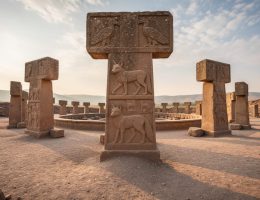
Low-angle wide view of T-shaped stone pillars at Göbekli Tepe with animal relief carvings, lit by golden hour sunlight, with additional stone circles and distant Anatolian hills in the background
Stone-Inspired Architectural Legacies

These Ancient Stone Carvings Changed Temple Architecture Forever

Long before architects conceived soaring cathedrals or sculptors shaped Renaissance masterpieces, ancient craftsmen were transforming raw stone into humanity’s earliest three-dimensional art. The oldest stone sculptures, dating back over 30,000 years, reveal not just artistic ambition but sophisticated understanding of geology, tool-making, and material properties that continue to inform how we work with natural stone today.
These prehistoric carvings represent more than historical curiosities. They demonstrate stone’s unique capacity to preserve human expression across millennia, a permanence that explains why …

Modern kitchen with a textured limestone wall and polished marble island lit by side-grazing accent lights, warm cove lighting, and pendant task lights; sharp focus on stone texture, softly blurred cabinets and seating behind.
Stone-Inspired Architectural Legacies

How Interior Lighting Transforms Stone Architecture From Cold to Captivating

Position light sources at grazing angles—30 to 45 degrees—to accentuate the texture and veining patterns inherent in marble, granite, and limestone surfaces. This technique creates dramatic shadows that reveal dimensional qualities invisible under flat, overhead illumination.
Layer three distinct lighting types to achieve professional results: ambient lighting establishes baseline visibility, accent lighting highlights specific stone features like book-matched slabs or architectural details, and task lighting serves functional needs in kitchens and bathrooms where stone surfaces require adequate illumination for daily activities…

A montage of iconic ancient stone monuments, including the Great Pyramid of Giza, Petra's carvings, and the Great Wall of China, illuminated by a golden sunset, symbolizing their eternal durability and cultural significance.
Stone-Inspired Architectural Legacies

Stone Marvels That Survived Time: Ancient Wonders Still Standing Today

Standing defiantly against time, seven ancient monuments continue to captivate our imagination and reveal cultural stories carved in stone. These architectural marvels—from the towering Great Pyramid of Giza to the intricate stonework of Petra—demonstrate humanity’s mastery over stone and our enduring drive to create lasting legacies.
While countless ancient structures have crumbled, these seven wonders persist through millennia thanks to revolutionary engineering techniques and the …

A modernized stone quarry site using factor technology, featuring advanced machinery precisely extracting stone blocks with digital monitoring systems, highlighting technological advancements in quarrying.
Stone-Inspired Architectural Legacies

Factor Technology: The Secret Behind Modern Stone Quarrying’s Efficiency Boom

Factor technology revolutionizes modern stone quarrying by merging advanced materials science with precision engineering. This groundbreaking approach transforms traditional extraction methods through controlled micro-fracturing, delivering superior efficiency while preserving stone integrity.
In quarries worldwide, factor technology has redefined productivity benchmarks by reducing waste by up to 40% compared to conventional methods. The system employs specialized expansive compounds that work in harmony with the stone’s natural grain patterns, enabling precise blocks to be extracted with minimal environmental impact.

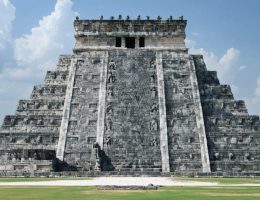
Image of an ancient Aztec temple featuring towering stone sculptures, intricately carved reliefs, and free-standing figures, showcasing the blend of artistry and architectural design, set against a Mesoamerican cityscape.
Stone-Inspired Architectural Legacies

Ancient Power in Stone: How Aztec Temple Sculptures Changed Architecture Forever

Towering above ancient Mesoamerican cities, Aztec stone sculptures stand as masterpieces of stone artistry in architecture, embodying both divine reverence and imperial might. These monumental works, carved from volcanic basalt and precious serpentine, transformed raw stone into powerful symbols of Aztec cosmology and political authority. Master sculptors wielded obsidian tools to create intricate reliefs and free-standing figures, demonstrating unprecedented precision in stone craftsmanship…