Showing 18 Result(s)
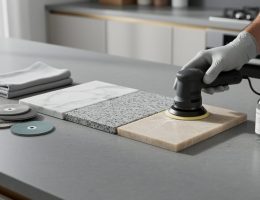
Gloved hand buffing a scratch on a stone sample beside unlabeled polishing pads, microfiber cloth, and clear sealer bottle on a kitchen island, with marble, granite, and quartzite pieces in focus and a modern kitchen softly blurred in the background.
General Comparison and Selection

Why Your Stone Surface Deserves a Repairability Score Before You Buy

Every material investment deserves a transparent roadmap for long-term maintenance, yet natural stone has lacked the objective evaluation framework common in other industries. When consumers purchase electronics, they consult iFixit’s repairability scores to understand how easily products can be serviced, upgraded, or restored. This same logic applies to natural stone surfaces, where the ability to repair scratches, refresh finishes, and extend lifespan directly impacts total ownership costs and sustainability.
Natural stone selections shouldn’t rely solely on aesthetic appeal or initial price points. Marble may …

Water truck spraying fine mist to control dust at a stone quarry in Kern County, California, with crusher, conveyor belts, aggregate piles, and arid hills under warm late-afternoon light.
Sustainability and Environmental Impact

How Kern County’s Air Quality Rules Will Impact Your Stone Business

Operating a stone quarry, fabrication facility, or installation business in Kern County means navigating one of California’s most stringent air quality regulatory environments. The Kern County Air Pollution Control District (KCAPCD) enforces comprehensive rules targeting particulate matter emissions from stone operations, with penalties for non-compliance reaching thousands of dollars per violation and potential operational shutdowns.
Stone industry professionals face specific challenges in this jurisdiction. Kern County’s geographic position in the San Joaquin Valley creates a natural bowl effect that traps pollutants, …

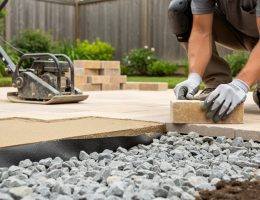
Gloved hands place a natural stone paver onto a screeded sand bed over compacted crushed stone, with a visible geotextile edge; a plate compactor and stacked pavers are in the background of a backyard patio build.
Home Improvement and DIY

Why Your Stone Pavers Keep Failing (And How Proper Substrate Preparation Fixes It)

Transform your outdoor space with natural stone pavers by mastering the foundation work that separates professional-quality installations from those that crack, sink, or shift within months. The difference between a patio that lasts decades and one that fails in its first winter comes down to what happens beneath the surface, before you ever set the first stone.
Excavate to a depth of 8-12 inches below your finished paver height to accommodate the complete base system. Remove all organic material, roots, and unstable soil that will decompose and create voids. Compact the native soil at the bottom of your excavation using a plate …

Quarry engineer in hard hat and safety vest applying an ultrasonic probe to a white marble block, with sunlit quarry benches, wire saw, and excavator softly blurred in the background.
Origins and Extraction

How Quarries Ensure Your Marble Block Is Perfect Before It Ever Leaves the Ground

Before a single stone block leaves the quarry, it undergoes rigorous examination to detect internal flaws invisible to the naked eye. Non-destructive testing (NDT) methods have revolutionized quality control in natural stone extraction, allowing quarry operators to assess structural integrity, identify hidden fractures, and predict long-term performance without damaging the material. These sophisticated techniques—ranging from ultrasonic pulse velocity measurements to ground-penetrating radar—serve as the critical gateway between raw extraction and architectural application.
For architects specifying stone façades, …

Close-up of a marble floor tile with white efflorescence, edge spalling, and moisture beads along the grout line, lit by soft natural daylight with a blurred wet entryway behind.
Technical Aspects

Why Your Beautiful Stone Is Crumbling (And How Salt and Moisture Are Really to Blame)

That white, crusty deposit creeping across your marble floor isn’t just unsightly—it’s a warning sign that salt and moisture are actively damaging your stone. When water carries dissolved salts through natural stone and evaporates at the surface, it leaves behind crystalline deposits that can fracture the stone from within, causing spalling, flaking, and permanent deterioration that costs thousands to repair.
Understanding this destructive partnership between salt and moisture is essential whether you’re installing new stonework, managing existing installations, or troubleshooting visible damage. The process, …

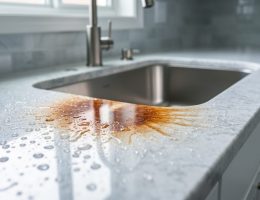
Close-up photograph of a light granite or marble countertop with a rust-brown oxidation stain around the base of a stainless steel faucet and water droplets, softly lit by natural daylight; blurred sink and tile backsplash in the background.
Natural Stone Fundamentals

Why Your Stone Countertops Are Changing Color (And What You Can Do About It)

Inspect your stone surfaces for telltale rust-colored or brown staining, particularly around metal fixtures, fasteners, or areas exposed to moisture—this discoloration signals oxidation, a chemical reaction between iron-bearing minerals in natural stone and oxygen or water. Stone oxidation affects marble, granite, limestone, and travertine differently depending on their mineral composition, with some varieties containing higher concentrations of iron pyrite or other reactive compounds that accelerate the process.
Prevent oxidation in new installations by selecting low-iron stone varieties, applying penetrating sealers to block …

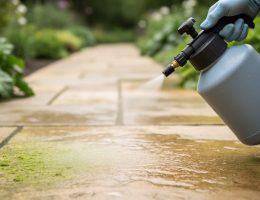
Close-up of a gloved hand spraying a clear biological solution from a pump sprayer onto a lightly green-stained limestone patio under soft overcast light, with blurred garden plants and the stone path receding in the background.
Maintenance and Care

Stop Biological Growth on Natural Stone Before It Starts (The Smart Way)

Biological solutions harness natural organisms and enzymes to break down organic growth on natural stone surfaces, offering a safer alternative to harsh chemical treatments. These products contain beneficial bacteria or natural compounds that digest algae, moss, lichen, and biofilm without damaging the stone’s surface or surrounding environment.
The science is straightforward: biological cleaners work by introducing microorganisms that consume the organic matter causing discoloration and deterioration. Unlike bleach or acidic cleaners that simply kill surface growth while potentially etching stone, biological treatments …

Two workers in high-visibility PPE operate a tripod-mounted laser scanner in front of a tall quarry highwall at golden hour, with safety cones marking an exclusion zone and quarry benches and equipment fading into the background.
Safety and Risk Management

Why Quarry Highwalls Fail (And How Natural Stone Extraction Stays Safe)

Highwall safety represents one of the most critical considerations in modern stone quarrying, where towering rock faces can reach heights exceeding 100 feet and present significant risks to workers, equipment, and operational continuity. Understand that highwall instability accounts for approximately 30% of serious quarry incidents, making proactive management essential rather than optional. Implement daily visual inspections by trained personnel who can identify warning signs like rock displacement, water seepage, and vegetation changes that indicate potential failure zones. Establish clear exclusion zones at the base of highwalls, …

Contemporary interior with a curved sculptural stone partition, backlit translucent onyx wall, radius staircase wrapped in flexible stone veneer, and water-jet patterned marble floor, lit by soft daylight with warm backlighting; minimalist living area and indoor plants in the background.
Cultural and Regional Stone Usage

Stone Interior Design That Makes Architects Rethink Everything They Know

Stone interior design has evolved from conventional countertops and flooring into a transformative design language that redefines spatial experiences. Today’s designers are pushing boundaries by integrating stone as three-dimensional sculptural elements, backlit feature walls, and even flexible stone veneers that wrap curved surfaces—applications once considered impossible with this ancient material.
The shift toward innovative stone applications stems from advances in fabrication technology and a growing demand for biophilic design that connects interior spaces with nature. Ultra-thin stone panels now allow for vertical …

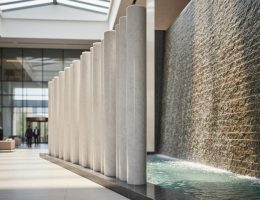
Kinetic stone installation in a modern corporate lobby with rotating polished marble columns and a shimmering textured stone water wall, photographed at eye level with soft daylight and blurred visitors in the background.
Stone Art and Design

When Stone Comes Alive: The Art and Engineering Behind Moving Stone Installations

Stone transforms from static material into living sculpture through kinetic art—installations that harness movement to create ever-changing visual experiences. Movement breathes life into marble, granite, and limestone through carefully engineered systems: rotating elements catch and redirect light across polished surfaces, water cascades over textured stone to create shifting patterns, wind activates suspended stone panels that pivot and sway, and mechanical systems orchestrate precise choreography of stone components. These dynamic installations represent the convergence of ancient craftsmanship and modern engineering, where the …