Showing 17 Result(s)
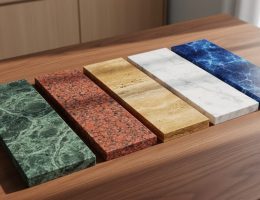
Five stone samples—green serpentine, red granite, golden travertine, white marble with grey veining, and deep blue marble—arranged on an oak tabletop with blurred wooden cabinetry in the background.
Aesthetic and Style Trends

Why Five Element Stones Transform Interior Spaces Better Than Marble Alone

Harmonizing natural stone with wood through the five element system transforms ordinary spaces into balanced, intentional environments that resonate with ancient design wisdom while meeting contemporary aesthetic demands. The five elements—wood, fire, earth, metal, and water—each correspond to specific stone types that, when thoughtfully paired with wooden materials, create interiors and exteriors that feel both grounded and dynamic.
Fire element stones like red granite and carnelian marble bring warmth and energy to wooden frameworks, ideal for statement fireplaces or kitchen islands where activity centers. Earth element stones…
Close-up of a honed gray stone countertop meeting warm oak cabinetry in natural side light, with a blurred slate floor, walnut wall paneling, and an indoor plant in the background.
Aesthetic and Style Trends

Why Stone and Wood Create Spaces That Feel Right

Stone and wood have shaped human shelter for millennia, yet their partnership transcends mere tradition. These materials share fundamental qualities that create visual and tactile harmony: both emerge from earth’s slow transformations, display organic patterns unique to each piece, and age gracefully while developing character. When designers unite stone’s cool permanence with wood’s warm resilience, they tap into biophilic design principles that resonate deeply with human psychology…

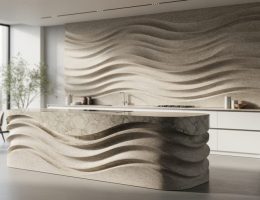
Eye-level view of a sinuous marble kitchen island and wave-inspired stone wall in a minimalist modern room, softly side-lit, with blurred large windows, indoor plants, and minimal furnishings in the background.
Aesthetic and Style Trends

How Curved Stone Designs Bring Natural Flow into Modern Spaces

Organic shapes in three-dimensional stone design transform rigid architectural elements into flowing, natural forms that echo landscapes, water movement, and biological structures. These curved, asymmetrical designs—ranging from sinuous countertops to wave-inspired wall cladding—require mastering fundamental drawing techniques before fabrication begins.
Start by sketching flowing contours using continuous line exercises, allowing your hand to trace smooth, uninterrupted curves that mimic natural erosion patterns and biological growth. Study reference materials like river rocks, shells, and wind-carved formations to understand …

Curved limestone and fieldstone foundation wrapping a modern home at golden hour, sharp stone detail with softly blurred facade and native grasses in the background from a low ground-level perspective
Aesthetic and Style Trends

How Curved Stone Foundations Transform Rigid Architecture into Living Art

Foundation decorative stone transcends its structural purpose when shaped into organic, curved designs that mirror nature’s inherent geometry. Rather than accepting the conventional straight-edged foundation treatment, today’s most compelling architectural projects embrace fluid stone arrangements that soften building perimeters, create visual movement, and establish harmonious transitions between structure and landscape.
The shift toward curved stone foundations reflects a broader design evolution where rigidity yields to natural forms. Limestone, sandstone, and fieldstone become sculptural elements when installed in …

Curved stone veneer feature wall wrapping a corner in a modern minimalist interior, side-lit by tall windows, showing continuous veining and precise grout lines with blurred furniture and greenery in the background.
Aesthetic and Style Trends

How Curved Stone Veneer Brings Nature’s Flow into Modern Spaces

Curved stone veneer transforms rigid architectural elements into flowing sculptural statements that blur the boundary between built environment and natural landscape. This technique involves wrapping thin stone panels around radiused walls, columns, and features to create seamless transitions that capture light and shadow in constantly shifting patterns throughout the day.
The appeal extends beyond pure aesthetics. Curved installations solve specific design challenges in contemporary architecture: softening harsh corners in open-concept spaces, creating focal walls that draw the eye without visual heaviness, and introducing tactile …

Modular natural stone wall panel being lifted to reveal concealed aluminum rail and mechanical clips in a modern office, illustrating a reconfigurable, sustainable installation system.
Aesthetic and Style Trends

How Modular Stone Design Transforms Spaces Without Demolition

Architecture no longer demands permanence. The traditional view of stone as an immovable, forever-fixed material is being revolutionized by modular design systems that transform natural stone into adaptable, reconfigurable building elements. These innovations allow spaces to evolve with changing needs—walls become partitions, facades shift to accommodate new functions, and interiors reorganize without demolition or waste.
Design modular stone panels with concealed mechanical fastening systems that enable disassembly and reconfiguration without damaging the material. Specify standardized dimensional units that create …

Curved stone kitchen island with subtle veining in a sunlit modern organic interior, with an arched doorway, rounded fireplace, natural wood accents, and indoor plants softly blurred in the background.
Aesthetic and Style Trends

Why Curved Stone Designs Are Transforming Modern Organic Interiors

Modern organic style represents the evolution of design thinking—where the raw, tactile beauty of natural materials meets the clean sophistication of contemporary architecture. This emerging aesthetic abandons rigid geometries in favor of flowing, curved forms that echo patterns found in nature, particularly through the sculptural use of stone. Curved stone applications—from sweeping kitchen islands and arched doorways to rounded fireplace surrounds and wavelike bathroom walls—create spaces that feel both grounded and ethereal, balancing minimalist principles with warmth and sensory richness.
The appeal extends beyond …

Conceptual illustration of a futuristic building made from modular smart stone, showcasing dynamic geometric patterns and integrated sensor technology for environmental adaptability.
Aesthetic and Style Trends

How Smart Stone Design is Revolutionizing Adaptable Architecture

At the intersection of architecture and experimental design, the Unstable Design Lab revolutionizes how we approach modern stone design principles through its groundbreaking modular construction methods. Founded at the University of Colorado Boulder, this innovative research facility challenges traditional architectural paradigms by exploring the dynamic relationship between material instability and structural integrity.
Led by Laura Devendorf, the lab’s pioneering work transforms our understanding of…

A majestic Classical Revival building featuring towering Corinthian columns, a symmetrical marble façade, and a prominent triangular pediment adorned with intricate stone carvings, exemplifying the enduring influence and timeless elegance of Greco-Roman-inspired architecture.
Aesthetic and Style Trends

Natural Stone Brings Timeless Elegance to Classical Revival Architecture

Classical Revival architecture stands as one of history’s most enduring and influential design movements, seamlessly blending ancient grandeur with modern functionality. Born from the 18th and 19th centuries’ renewed fascination with Greco-Roman aesthetics, this architectural style transformed cityscapes across Europe and America with its commanding presence and timeless elegance.
Characterized by imposing columns, symmetrical facades, and dramatic porticos, Classical Revival buildings communicate power, permanence, and cultural refinement through their masterful use of natural stone. From state capitols to private …

Interior space featuring a sophisticated floor of hexagonal stone tiles, showcasing the natural beauty and geometric precision of the hexagon pattern with varied marble and granite finishes.
Aesthetic and Style Trends

Transform Your Space with Timeless Hexagonal Stone Patterns

Hexagonal geometric patterns stand as one of architecture’s most enduring and versatile design elements, merging mathematical precision with natural beauty. Found everywhere from ancient Islamic mosques to modern urban installations, these six-sided formations create a mesmerizing visual rhythm that captivates both designers and observers. The pattern’s inherent strength – derived from its efficient space-filling properties and structural stability – makes it particularly valuable in stone applications, where durability meets aesthetic appeal. Whether expressed through delicate marble inlays or bold granite pavers, …