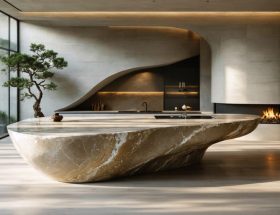
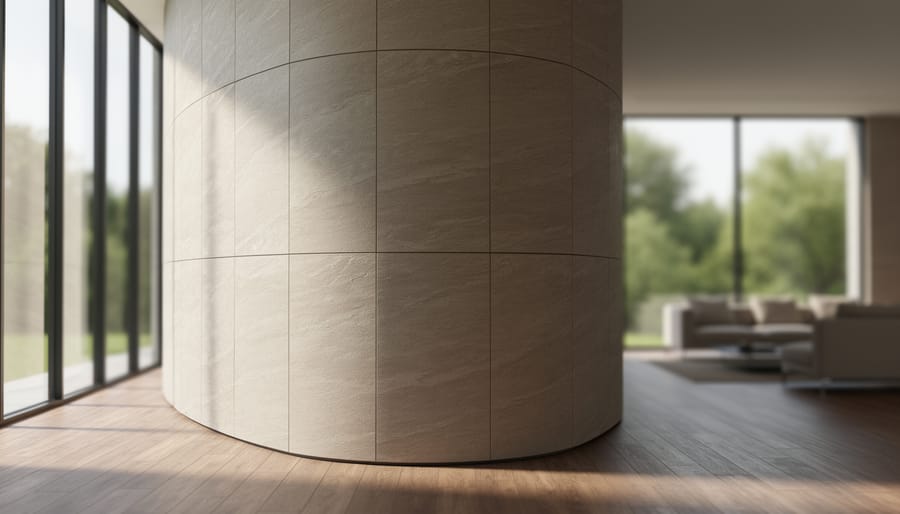
Curved stone veneer transforms rigid architectural elements into flowing sculptural statements that blur the boundary between built environment and natural landscape. This technique involves wrapping thin stone panels around radiused walls, columns, and features to create seamless transitions that capture light and shadow in constantly shifting patterns throughout the day.
The appeal extends beyond pure aesthetics. Curved installations solve specific design challenges in contemporary architecture: softening harsh corners in open-concept spaces, creating focal walls that draw the eye without visual heaviness, and introducing tactile warmth to modern minimalist interiors. Unlike flat stone applications, curved veneer requires precise material selection, specialized cutting techniques, and installation methods that accommodate the structural demands of radius work while maintaining consistent grout lines and stone alignment.
Three factors determine success in curved stone projects. First, stone selection must account for material flexibility and natural veining patterns that either enhance or fight the curve. Second, substrate preparation becomes critical as even minor imperfections amplify across curved surfaces. Third, installer expertise separates ambitious failures from stunning successes, as curved work demands understanding of both traditional masonry principles and contemporary adhesive technologies.
This guide explores the complete spectrum of curved stone veneer applications, from subtle interior accent walls to dramatic exterior columns, providing architects and designers with practical knowledge to specify these installations confidently while helping homeowners understand what distinguishes exceptional curved stonework from conventional flat installations.
Understanding Curved Stone Veneer
What Makes Stone Veneer Bendable
The ability to bend natural stone around curved surfaces represents a remarkable advancement in stone veneer technology. Unlike traditional thick stone slabs that remain rigid and inflexible, bendable stone veneer achieves its flexibility through precision cutting and innovative backing systems.
The foundation of this technology lies in ultra-thin cutting techniques. Manufacturers slice natural stone into extremely thin sheets, typically ranging from 1 to 3 millimeters in thickness. At this reduced dimension, the stone maintains its authentic appearance and natural characteristics while becoming surprisingly pliable. This thin profile allows the material to flex without fracturing, enabling it to conform to gentle curves and rounded surfaces.
The backing system plays an equally critical role in creating bendable stone veneer. Most products feature a flexible substrate layer, often made from fiberglass mesh, textile reinforcement, or polymer composites. This backing bonds to the thin stone layer, providing structural support while maintaining flexibility. The combination creates a material that behaves more like a flexible sheet than a rigid tile, allowing installers to work with curved architectural elements.
Material properties also influence bendability. Certain stone types naturally lend themselves better to thin-cut applications. Slate, mica-based stones, and some sedimentary varieties possess natural grain patterns and layering that make them easier to cut thin and more forgiving when flexed. The stone’s mineral composition, density, and natural cleaving properties all impact how successfully it can be transformed into a bendable veneer product while maintaining its structural integrity and visual appeal.
Types of Stone Best Suited for Curves
Not all stone varieties adapt equally well to curved applications. The ideal choices combine flexibility in thin veneer form with visual characteristics that enhance flowing designs.
Marble stands out as a premium choice for curved installations. Its relatively soft composition allows for precise cutting and shaping, while veining patterns create dramatic movement that complements organic forms. Calacatta and Carrara varieties particularly shine in contemporary curved designs, with their flowing veins emphasizing architectural fluidity.
Slate offers exceptional workability for curves due to its natural layered structure. The material’s grain patterns can be oriented to follow curves naturally, and its matte finish provides subtle sophistication. Darker slate varieties create striking contrast in modern spaces while maintaining the organic aesthetic.
Quartzite combines durability with visual drama. Though harder than marble, modern cutting techniques allow it to form elegant curves. Its crystalline structure catches light beautifully on curved surfaces, adding depth and dimension.
Limestone and travertine also perform well in curved applications, offering softer tones and natural texture variations. Their uniform grain patterns create seamless transitions around bends, while their moderate hardness facilitates precise fabrication. The key consideration across all varieties is selecting stones with consistent grain patterns that won’t create visual disruption when following architectural curves.
The Organic Fluidity Design Philosophy
Biophilic Design Meets Natural Materials
Curved stone veneer represents a powerful expression of biophilic design principles, bringing the organic geometry of nature into built environments. This design approach taps into our innate connection to natural forms, creating spaces that resonate with human psychology on a fundamental level.
In nature, stone rarely appears in straight lines. Water erodes rock into smooth, flowing curves. Cave walls undulate with organic irregularity. Mountain formations rise in sweeping arcs. Curved stone veneer installations mirror these natural patterns, transforming interior spaces into environments that feel instinctively familiar and calming. This connection to natural formations has measurable benefits for occupants, including reduced stress levels, improved cognitive function, and enhanced overall well-being.
The application of curved stone surfaces creates visual and tactile experiences that engage multiple senses simultaneously. The interplay of light across undulating stone surfaces mimics the dappled patterns found in forests and along riverbeds. Natural variations in stone color and texture further enhance this effect, creating depth and movement that flat surfaces cannot achieve.
From reception areas that welcome visitors with the embrace of a stone grotto to residential spaces that incorporate the serenity of natural rock formations, curved stone veneer serves as a bridge between the built environment and the natural world. This integration doesn’t simply decorate spaces; it fundamentally transforms how people experience and interact with their surroundings, fostering environments where human beings instinctively feel more connected, grounded, and at ease.
Breaking Away from Rigid Geometry
For decades, stone veneer followed predictable patterns—straight lines, rectangular panels, and uniform grids that emphasized order and symmetry. While these traditional installations served their purpose, they often felt static and formulaic. Today’s design landscape is witnessing a dramatic transformation as curved stone designs break free from these rigid constraints.
This evolution reflects a broader shift toward biophilic design principles, where spaces incorporate natural, flowing forms that resonate with how we experience the world around us. Rather than forcing stone into predetermined shapes, designers now work with the material’s inherent qualities to create undulating walls, sinuous columns, and sculptural features that appear to ripple and flow.
The technical advancement of fabrication tools, including waterjet cutting and CNC technology, has made these organic installations increasingly feasible. Stone can now be cut into curved segments that fit together seamlessly, creating continuous flowing surfaces that were once impossible or prohibitively expensive to achieve.
These dynamic installations transform stone from a mere building material into an architectural statement. A curved stone accent wall can guide movement through a space, while a spiral column draws the eye upward with natural grace. The interplay of light and shadow across these three-dimensional surfaces adds depth and drama throughout the day, creating living installations that continuously evolve with changing conditions.
Applications That Showcase Curved Stone Veneer
Feature Walls with Wavelike Movement
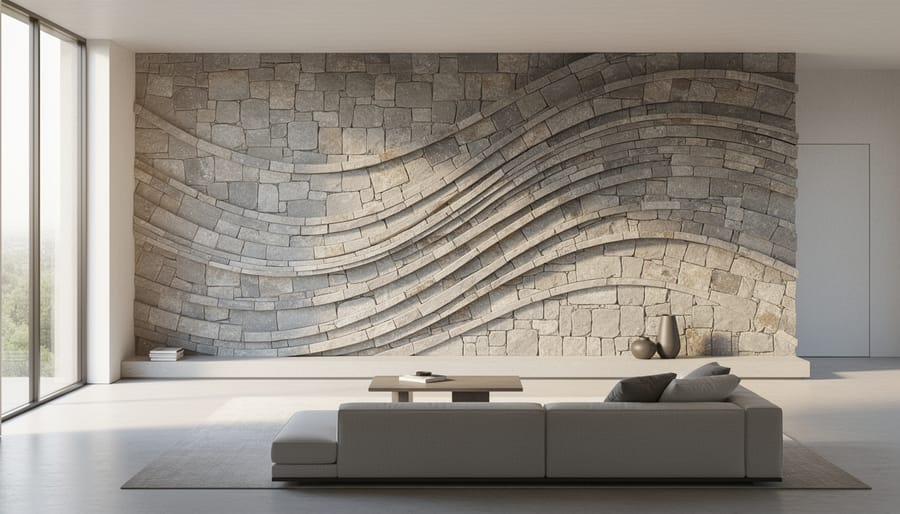
Curved stone veneer transforms ordinary walls into captivating architectural statements that command attention and define spaces. In lobbies, these undulating installations greet visitors with flowing movement that softens hard architectural lines while maintaining the timeless elegance of natural stone. The wavelike patterns create visual interest from multiple viewing angles, with light and shadow playing across the three-dimensional surfaces throughout the day.
Living rooms benefit from curved feature walls that serve as dramatic backdrops for seating areas or entertainment centers. The organic flow adds warmth and sophistication without overwhelming the space. In public venues like hotel atriums, museums, and corporate headquarters, these sculptural installations become memorable landmarks that reinforce brand identity and architectural vision.
The key to successful feature walls lies in strategic placement and lighting design. Position curves to guide foot traffic naturally while ensuring adequate illumination to highlight the stone’s texture and movement. Consider the wall’s relationship to surrounding elements, allowing the undulating surface to complement rather than compete with furniture, artwork, and other design features.
Curved Columns and Pillars
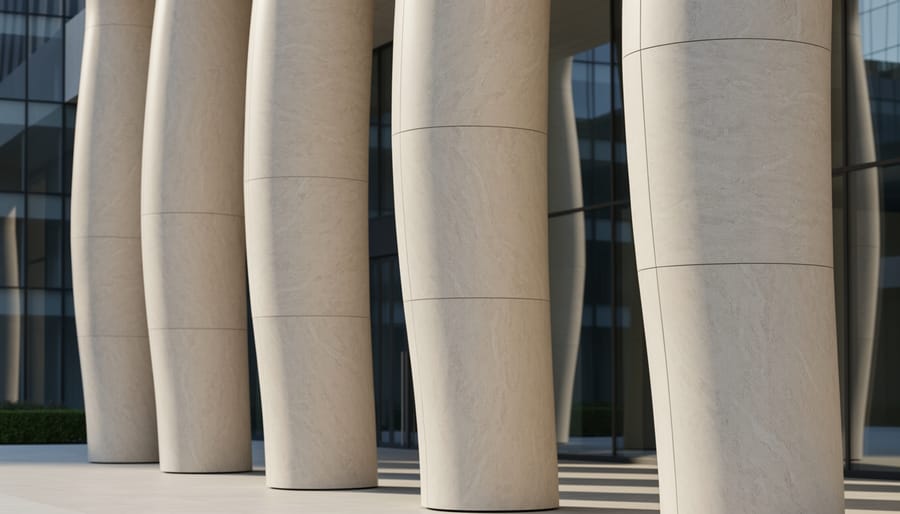
Columns and pillars present unique opportunities for curved stone veneer applications, transforming structural necessities into stunning architectural features. Whether wrapping a cylindrical column in an entryway or cladding an elliptical support in a commercial space, stone veneer adapts beautifully to vertical curved surfaces.
The installation process requires careful planning and specialized cutting techniques. Thin, flexible stone veneer pieces work best for tighter radius curves, while thicker materials suit gentler contours. Installers typically use a dry-stack method or precision-cut individual pieces that fit together seamlessly, creating the illusion of solid stone construction.
Column wrapping works exceptionally well with natural stone varieties that display directional patterns, such as travertine or ledgestone. The vertical orientation emphasizes the stone’s natural striations, drawing the eye upward and adding visual height to spaces. For best results, professional fabricators pre-cut veneer pieces to exact specifications, ensuring proper alignment and minimal grout lines. This attention to detail produces elegant, cohesive columns that serve as focal points in both residential and commercial settings.
Flowing Fireplace Surrounds
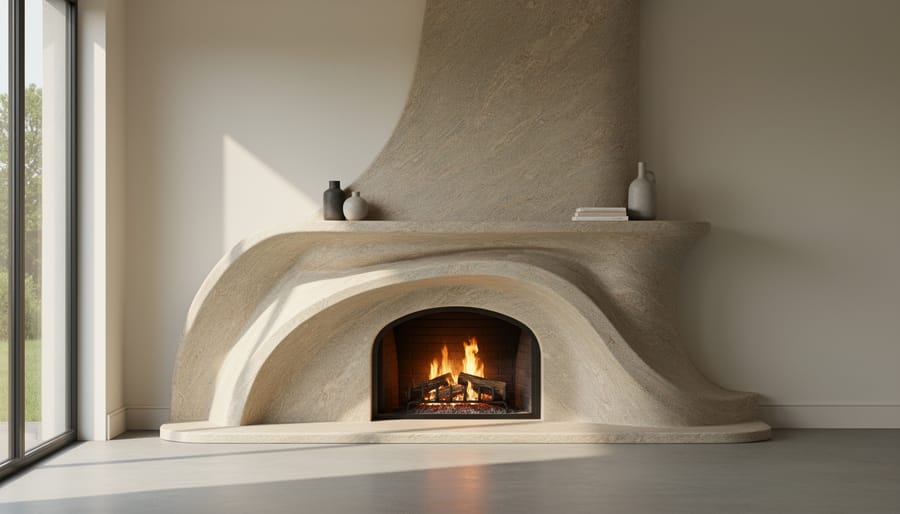
Fireplace surrounds represent one of the most visually striking applications for curved stone veneer. Rather than traditional rectangular frames, flowing designs follow the natural contours of organic forms, creating hearths that feel carved from living rock. These installations typically feature gentle arcs that embrace the firebox opening, sometimes extending upward in wavelike patterns or spiraling outward to blend seamlessly with adjacent walls.
The key to successful curved fireplace surrounds lies in selecting stone with natural layering that enhances the flowing aesthetic. Ledgestone and stacked stone profiles work particularly well, as their horizontal lines emphasize the sweeping motion while creating depth through shadow play. Installation begins at the firebox edge, with each course carefully shaped to maintain consistent curves while accommodating the irregular backs of natural stone pieces.
Modern curved surrounds often incorporate graduated color transitions, moving from darker tones near the hearth to lighter shades as the design flows upward, mimicking geological formations. This approach transforms the fireplace from a simple functional element into a sculptural focal point that anchors the entire room.
Spa and Wellness Spaces
Curved stone veneer transforms spa and wellness spaces into serene sanctuaries that evoke the tranquility of natural grottos and water-carved caves. In these moisture-rich environments, the organic flow of curved stone creates an immersive experience that enhances relaxation and connection to nature.
Bathrooms benefit from curved stone veneer in shower enclosures, where gentle arcs mimic the smooth surfaces sculpted by flowing water over millennia. The continuous, seamless appearance eliminates harsh corners and creates a cocoon-like atmosphere. Steam rooms and saunas particularly suit this application, as curved stone responds beautifully to humidity while providing excellent thermal properties.
The naturally porous texture of stone veneer helps regulate moisture in these spaces, while its curved installation softens acoustics, reducing echo for a more peaceful environment. Popular choices include travertine and limestone, which reference hot spring formations, or slate and quartzite for dramatic, layered effects reminiscent of canyon walls.
When designing spa environments, curved stone veneer on feature walls behind soaking tubs or along meditation alcoves creates focal points that ground the space in organic authenticity.
Installation Considerations for Curved Stone Projects
Substrate and Structural Requirements
Successfully installing curved stone veneer begins with creating a structurally sound curved substrate. The foundation must be rigid enough to support the stone’s weight while precisely maintaining the desired curve radius.
Flexible cement board offers the most versatile solution for gradual curves. These specialty boards can bend to accommodate radiuses as tight as 24 inches when scored properly on one side. They must be secured to a framework of curved metal studs or laminated plywood ribs spaced no more than 16 inches apart to prevent deflection under the stone’s weight.
For tighter curves or architectural features requiring extreme precision, metal lath over custom-built forms provides superior control. Contractors typically construct these forms using laminated layers of thin plywood or by kerfing thicker plywood sheets. The metal lath is then fastened securely and coated with a scratch coat of mortar to create the bonding surface.
Critical considerations include ensuring the substrate projects far enough from the wall to accommodate both the mortar bed and stone thickness, typically requiring 2 to 3 inches of clearance. The substrate must also be properly waterproofed with a moisture barrier before stone installation begins. Structural engineers should review plans for load-bearing applications or complex geometric designs to verify the framework can support the complete installation weight.
Working with Experienced Installers
Curved stone veneer installations demand a level of craftsmanship that goes well beyond standard flat wall applications. The three-dimensional nature of curves requires installers who understand how stone behaves under tension and compression, how to properly support convex and concave surfaces, and how to create seamless transitions that maintain structural integrity while achieving the desired aesthetic flow.
When selecting an installer for curved stone projects, prioritize experience with similar applications. Ask to see portfolios specifically featuring curved work, not just traditional installations. Qualified professionals should demonstrate knowledge of flexible backing systems, specialized adhesives rated for curved applications, and proper substrate preparation techniques. They should also understand how different stone types respond to curved installation—some materials are more forgiving than others when creating organic forms.
Look for installers who conduct thorough site assessments and provide detailed installation plans. They should discuss expansion joints, drainage considerations, and long-term maintenance requirements specific to your curved design. Membership in professional organizations and manufacturer certifications can indicate commitment to industry standards, but hands-on curved installation experience remains the most critical qualification. Don’t hesitate to request references from previous curved stone projects and contact those clients about the installer’s problem-solving abilities and attention to detail.
Cost Factors and Timeline Expectations
Curved stone veneer installations typically cost 25-40% more than flat applications due to increased complexity. Material waste runs higher as stones must be cut and fitted to follow irregular contours, with 15-20% additional material often required compared to 10% for straight walls. Labor costs represent the most significant premium—skilled masons need 30-50% more time to properly set each piece, ensuring curves flow naturally without visible breaks or awkward transitions.
Project timelines extend accordingly. A standard 100-square-foot flat wall might require 2-3 days for installation, while the same area on curved surfaces typically needs 3-5 days. Complex projects featuring multiple radius changes or tight curves demand even more time. However, the investment delivers substantial value: curved installations create architectural focal points that dramatically elevate space perception and property value. For budget-conscious projects, consider limiting curves to strategic accent areas rather than entire surfaces. Planning ahead also helps—detailed templates and precise measurements reduce field adjustments, controlling both costs and installation time while ensuring the organic flow that makes curved stone veneer so visually compelling.
Design Strategies for Maximum Impact
Lighting Curved Stone Surfaces
Proper lighting transforms curved stone veneer from a beautiful surface into a dynamic sculptural element. The three-dimensional nature of curved installations creates natural opportunities for play between light and shadow, emphasizing the organic flow that makes these designs so captivating.
Grazing light techniques work particularly well with curved stone surfaces. By positioning fixtures to skim across the stone at shallow angles, you accentuate texture variations and the gentle undulations of the curve itself. This approach creates dramatic shadow lines that shift throughout the day, bringing the installation to life with constantly changing visual interest.
Recessed uplighting placed at the base of curved stone walls produces a theatrical effect, highlighting the vertical sweep while creating depth through graduated shadows. Conversely, downlighting from above can emphasize the stone’s natural texture and color variations, particularly effective with stacked or ledger stone profiles.
For interior applications, adjustable track lighting or strategically placed spotlights allow you to fine-tune the interplay of highlights and shadows. Consider the stone’s finish when planning your lighting design—polished surfaces reflect light differently than honed or natural-cleft finishes, affecting the overall visual impact.
Layering multiple light sources at different angles and intensities creates the most sophisticated result, celebrating both the material’s inherent beauty and the architectural form it defines.
Combining Curves with Complementary Materials
Curved stone veneer achieves its full potential when paired thoughtfully with complementary materials that enhance both the organic forms and inherent beauty of natural stone. The key to successful material combinations lies in creating visual balance while maintaining the flowing aesthetic that makes curved installations so compelling.
Wood brings warmth and natural grain patterns that soften the mineral character of stone, making it an ideal pairing for curved installations. In residential settings, walnut or oak cabinetry alongside a curved stone feature wall creates depth and tonal variation. The grain direction of wood can either follow or contrast with the stone’s curvature, offering designers flexibility in directing visual flow.
Metal accents provide structural definition and contemporary contrast. Brushed bronze, blackened steel, or satin brass trim can outline curved edges, emphasizing the sculptural quality of the installation while adding refined detail. These metallic elements work particularly well in commercial spaces where a sophisticated, polished aesthetic is desired.
Glass serves multiple functions when combined with curved stone. Backlit glass shelving integrated into curved stone walls creates dramatic illumination effects, while glass railings or partitions allow curved stone features to remain visually prominent without obstruction. The transparency of glass ensures the stone’s organic form stays central to the design composition.
These material combinations transform spaces into multi-textured environments where each element enhances the others, creating layered visual interest that evolves with changing light and viewing angles throughout the day.
Maintenance and Longevity of Curved Installations
Curved stone veneer installations require thoughtful maintenance to preserve their beauty and structural integrity over time. The good news is that when properly cared for, these dramatic architectural features can maintain their appearance for decades with minimal intervention.
Regular cleaning forms the foundation of any maintenance program. For curved installations, use pH-neutral cleaners specifically formulated for natural stone, as harsh chemicals can damage the surface and compromise sealants. A soft brush or microfiber cloth works best for routine cleaning, allowing you to follow the contours without scratching. Pay special attention to concave curves where dirt and moisture may accumulate more readily than on flat surfaces.
Sealing curved stone veneer is essential for protection against staining and moisture penetration. Most stone types benefit from resealing every 1-3 years, depending on the stone’s porosity and environmental exposure. Interior applications typically require less frequent sealing than exterior installations. When applying sealant to curved surfaces, work in small sections to ensure even coverage across all angles and contours. The three-dimensional nature of curved installations means you’ll need to adjust your application technique to reach recessed areas effectively.
Inspect curved installations annually for signs of wear or damage. Look for efflorescence, cracks, or loose stones, particularly along the most pronounced curves where stress may concentrate. Address any issues promptly to prevent more extensive repairs down the line.
Environmental factors play a significant role in longevity. Exterior curved installations face weathering from rain, temperature fluctuations, and UV exposure. Consider the orientation of curved walls, as south-facing installations may experience more intense sunlight and temperature variations. Interior curved features generally require less intensive maintenance but still benefit from regular cleaning and periodic sealing to maintain their lustrous appearance and ensure they remain a stunning focal point for years to come.
Curved stone veneer represents more than a design trend—it’s a return to the organic patterns that surround us in nature. By incorporating flowing lines and dynamic surfaces into your spaces, you create environments that feel inherently welcoming and harmonious. Whether you’re envisioning a sweeping residential feature wall, an inviting commercial entrance, or an outdoor sanctuary that blurs the boundaries between architecture and landscape, the transformative potential of curved stone applications is limitless.
As you plan your next project, consider how organic fluidity can elevate both the aesthetic appeal and emotional resonance of your design. The interplay of natural stone with curved forms creates a timeless quality that transcends passing trends, offering lasting value and visual interest. From subtle undulations to dramatic sculptural statements, curved stone veneer adapts to diverse design visions while maintaining its connection to the natural world.
Ready to explore the possibilities? Consulting with experienced stone professionals is essential for successful custom curved applications. These experts can guide you through material selection, structural requirements, and installation techniques that ensure your vision becomes a stunning reality that endures for generations.