Showing 3 Result(s)
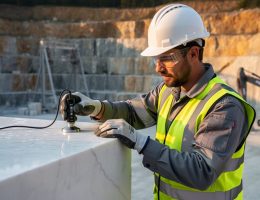
Quarry technician in safety gear inspects a large white marble block, hand tracing veining and checking for fissures, with stacked blocks, quarry face, and a wire saw visible under bright overcast daylight.
Origins and Extraction

Why Your Marble Supplier’s Block Grading System Matters More Than Price

Not all natural stone is created equal. A seemingly identical slab of granite or marble can vary dramatically in price—sometimes by hundreds of dollars per square foot—and the difference comes down to a systematic evaluation process that the stone industry calls block quality grading.
Block quality determines everything from the structural integrity of your countertop to whether that stunning white marble will develop unsightly cracks within a year. When quarry operators extract raw stone blocks, they immediately assess multiple factors: the uniformity of color and veining, the presence of natural fissures or weak planes, the …

Elevated view of a rehabilitated quarry with terraced vegetated slopes around a clear wetland pond and drainage channel at golden hour, with a distant rock face and forested ridgelines in the background.
Origins and Extraction

How Quarries Transform Scarred Land Back Into Thriving Ecosystems

Every quarry that extracts natural stone carries a responsibility that extends far beyond the final cut. When limestone, granite, or marble leaves a quarry site, the land bears visible scars—stripped topsoil, exposed rock faces, altered water drainage patterns, and disrupted ecosystems. Land rehabilitation transforms these extraction sites back into productive, ecologically viable spaces, addressing growing concerns about the environmental footprint of the natural stone industry.
Modern quarry rehabilitation employs systematic approaches that begin during active extraction, not after closure. Progressive companies implement phased…

Quarry technician wearing a high-visibility vest scans a tagged marble block with a handheld RFID reader in a stone yard, late-afternoon side light, with quarry terraces, stacked slabs, and a loader softly blurred in the background.
Origins and Extraction

How Quarry Trace Technology Proves Your Stone’s Authentic Journey

Quarry trace transforms natural stone from an anonymous building material into a documented product with verifiable origins, quality standards, and ethical credentials. When you specify quarry-traced stone for your next project, you gain access to geological reports, extraction methods, environmental certifications, and the complete chain of custody from mountainside to installation site.
The demand for traceable stone has surged as green building certifications, supply chain transparency regulations, and consumer awareness converge. Architects now face requirements to document material origins for LEED credits. Homeowners …