Showing 39 Result(s)
Wide view of Stone Mountain’s exposed granite dome with weathered quarried blocks and an old rail spur in the foreground under warm golden-hour light, with pine forest and a faint Atlanta skyline on the horizon.
Historical and Cultural Context

How Stone Mountain Shaped Atlanta and Changed American Cities Forever

Rising 825 feet above the Georgia Piedmont, Stone Mountain stands as North America’s largest exposed granite mass—a 300-million-year-old geological wonder that transformed from sacred Indigenous landmark into one of the nation’s most significant natural stone quarries. This monolithic dome shaped Atlanta’s architectural identity and influenced construction practices across the Southeast for over a century.
The mountain’s dense, fine-grained granite attracted quarry operators as early as the 1830s, who recognized its superior durability and workability. Within decades, Stone Mountain granite appeared in some…


Early 20th-century street scene with a granite and limestone skyscraper casting long shadows over brick tenements, a small stone civic building, and a factory smokestack, with pedestrians and a streetcar in the distance at golden hour.
Historical and Cultural Context

How Stone Buildings Shaped America’s First Zoning Laws

America’s cities didn’t always look the way they do today. Before 1916, nothing stopped a factory from operating next to a mansion, a slaughterhouse beside a school, or a towering skyscraper from casting entire neighborhoods into permanent shadow. The history of zoning in the United States began as a response to these chaotic conditions, fundamentally reshaping how Americans build, live, and interact with urban spaces.
New York City enacted the nation’s first comprehensive zoning ordinance in 1916, establishing a legal framework that would spread to virtually every American municipality within decades. This …

Low-angle view of the Arch of Constantine showing mismatched reused marble relief panels and columns in warm late-day light, with the Colosseum softly blurred behind.
Historical and Cultural Context

Why Ancient Romans Built Their Greatest Monuments from Stolen Stone

Spolia refers to the architectural practice of repurposing building materials, decorative elements, or stone components from earlier structures into new constructions. This centuries-old tradition transformed columns from Roman temples into medieval church pillars, incorporated ancient marble reliefs into Renaissance palaces, and created visual dialogues between past and present civilizations. The term derives from the Latin word for “spoils,” originally describing materials taken from conquered territories, but evolved to encompass any deliberate reuse of historic architectural elements.
Throughout history, builders …

Colonial-era stepped stone quarry with workers extracting large blocks, ox-drawn carts and a narrow-gauge rail running toward a hazy harbor with sailing ship masts at golden hour
Historical and Cultural Context

How Colonial Stone Quarries Built Empires (And Changed Architecture Forever)

For centuries, the extraction and trade of natural stone mapped the ambitions of empire across continents, leaving an indelible mark on both landscape and culture. From the marble quarries of Carrara supplying Roman conquests to the granite mines of colonial India shipping materials to British imperial projects, stone extraction became inseparable from the mechanics of colonial expansion. European powers systematically identified, claimed, and exploited mineral-rich territories, transforming indigenous quarrying traditions into industrial operations that prioritized metropolitan demand over local needs.
This colonial legacy …

Low-angle view of weathered white marble temple columns in warm evening light, with softly blurred silhouettes of distant standing stones and a rock-cut stupa in the background.
Historical and Cultural Context

Why Ancient Civilizations Chose These Stones for Their Most Sacred Spaces

Stone has anchored humanity’s most sacred spaces for millennia, serving as silent witnesses to prayers, rituals, and spiritual transformations across every major civilization. From the megalithic circles of Stonehenge to Jerusalem’s Western Wall, from Buddhist stupas carved into mountainsides to the marble altars of Renaissance cathedrals, rock endures as the fundamental building block of religious architecture and ceremony.
This enduring relationship between stone and spirituality transcends mere practicality. While durability and permanence make stone an obvious choice for structures meant to last generations, the …

Reused Roman marble columns with mismatched capitals in a later stone church colonnade, warmly side-lit, with softly blurred arches and masonry in the background.
Historical and Cultural Context

Why Ancient Builders Recycled Stone (And What It Reveals About Their World)

When examining ancient buildings, monuments, and archaeological sites, historical and cultural context explains why builders made specific choices about materials, design, and construction methods. These two interrelated concepts unlock the deeper meaning behind architectural decisions that might otherwise seem purely practical or aesthetic.
Historical context encompasses the timeline, events, and circumstances surrounding construction. It includes economic conditions, available technologies, political stability, military conflicts, and resource accessibility at specific moments in time. When Roman engineers incorporated Greek …

Low-angle wide photo of a weathered stone archway and cobblestone street leading toward glass skyscrapers at golden hour, with street trees and pedestrians softened by atmospheric haze.
Historical and Cultural Context

How Ancient Stone Structures Shaped the Cities We Live in Today

Stone shaped civilization itself. From the moment humans stacked the first quarried blocks, cities began their transformation from temporary settlements into permanent monuments of collective ambition. The Colosseum, Angkor Wat, and Machu Picchu stand not merely as tourist attractions but as evidence of stone’s unparalleled capacity to anchor urban life across millennia.
Understanding stone’s historical role in urban development reveals why ancient builders chose this material over wood, mud, or thatch. Stone provided fire resistance in densely populated quarters, load-bearing strength for multi-story construction, and …

Monolithic Que Sera Stone altar and feature wall in a contemporary meditation hall, showing a blue-gray matrix with pink and burgundy inclusions under soft natural daylight, with blurred cushions, candles, and wooden floor in the background.
Historical and Cultural Context

Why Ancient Shamans Trusted Que Sera Stone (And What Modern Sacred Spaces Can Learn)

Que Sera Stone—also known as Llanite or Llanoite—emerges as one of nature’s most enigmatic materials for sacred architecture, combining rare geological origins with distinctive visual properties that have captured the attention of spiritual communities and design professionals alike. This rhyolite-based stone, found exclusively in specific regions of Texas and Brazil, displays a remarkable composition of blue quartz, feldspar, and iron oxide that creates mesmerizing patterns reminiscent of celestial formations.
Specify Que Sera Stone for sacred spaces by requesting slabs that showcase its characteristic blue-gray matrix …

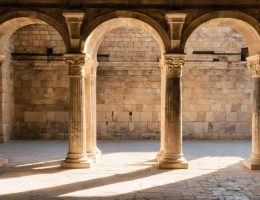
"Close-up of a medieval church's towering stone facade, showcasing intricate masonry and arches in soft natural light."
Historical and Cultural Context

Medieval Stone Churches: How Ancient Builders Created Sacred Masterpieces

Medieval stone churches stand as enduring monuments where architectural brilliance meets sacred religious traditions. These masterpieces of masonry, constructed between the 5th and 15th centuries, showcase humanity’s highest achievements in stone engineering and spiritual expression. Massive limestone walls, soaring Gothic arches, and intricately carved marble altars demonstrate how master craftsmen transformed raw stone into sanctuaries that have inspired worshippers for centuries….

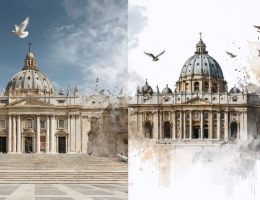
A conceptual illustration blending elements of the Church of the Holy Sepulchre and St. Peter's Basilica, featuring textures of limestone and marble, with subtle motifs of pilgrims and abstract doves symbolizing faith and devotion.
Historical and Cultural Context

Sacred Stone: How Jerusalem’s Temple Mount and Vatican City Shaped Christianity

Throughout history, stone has served as the eternal witness to humanity’s most profound spiritual connections, particularly in Christianity’s most revered sites. The intersection of faith and architecture reaches its zenith in two remarkable locations where sacred stone traditions in Christianity continue to inspire millions of pilgrims annually. The Church of the Holy Sepulchre in Jerusalem and St. Peter’s Basilica in Vatican City stand as testament to both divine devotion …