
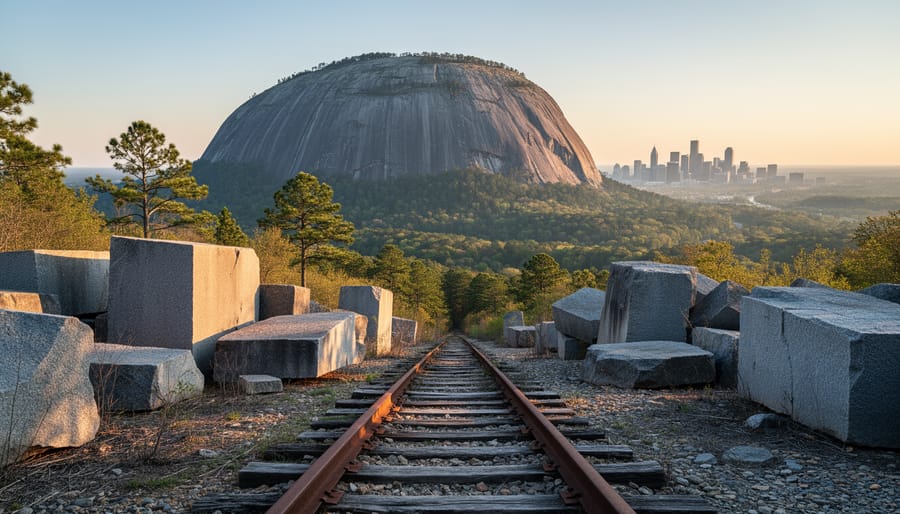
Rising 825 feet above the Georgia Piedmont, Stone Mountain stands as North America’s largest exposed granite mass—a 300-million-year-old geological wonder that transformed from sacred Indigenous landmark into one of the nation’s most significant natural stone quarries. This monolithic dome shaped Atlanta’s architectural identity and influenced construction practices across the Southeast for over a century.
The mountain’s dense, fine-grained granite attracted quarry operators as early as the 1830s, who recognized its superior durability and workability. Within decades, Stone Mountain granite appeared in some of America’s most enduring structures, from the U.S. Capitol’s east wing steps to bridges spanning major waterways throughout Georgia. The quarrying operations that peaked in the early 1900s employed hundreds of skilled stonecutters and helped establish Atlanta as a major metropolitan center, demonstrating natural stone’s historical impact on urban development.
Beyond its economic influence, Stone Mountain’s story encompasses complex cultural dimensions—from its spiritual significance to the Muscogee Creek and Cherokee peoples to its controversial role in 20th-century American history. Understanding this multifaceted legacy reveals how a single geological formation influenced construction techniques, shaped regional architecture, and provided the literal building blocks for Southern infrastructure. Today, the mountain serves as both a testament to natural stone’s enduring appeal and a case study in how quarrying operations fundamentally altered American landscapes and cities.

The Geological Foundation: Stone Mountain’s Unique Composition
Why This Granite Mattered for Construction
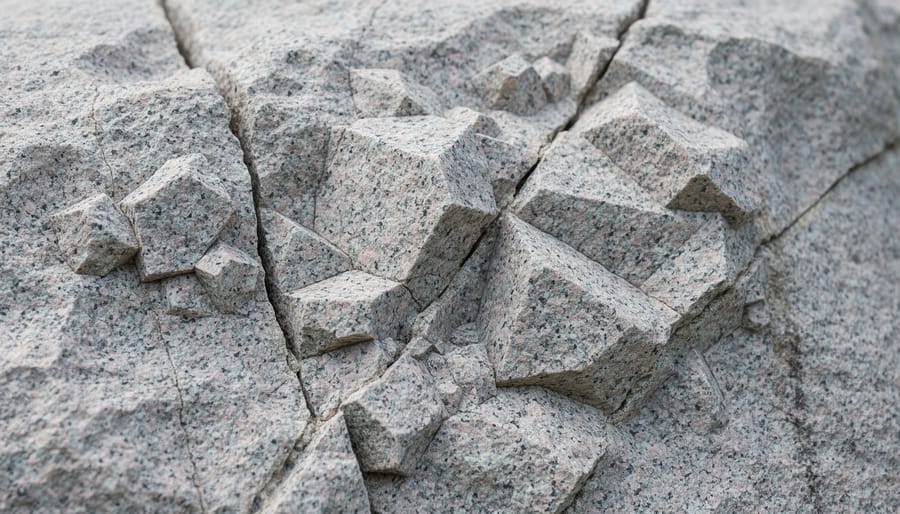
Stone Mountain granite earned its reputation as a premier building material through a unique combination of physical and aesthetic properties that set it apart from other granite sources. The stone’s exceptional durability stems from its dense crystalline structure, formed over 300 million years ago through slow cooling deep within the Earth’s crust. This geological process created a remarkably hard, weather-resistant material capable of withstanding decades of exposure to the elements with minimal degradation.
What made Stone Mountain granite particularly valuable was its workability despite its hardness. Quarriers and stonemasons discovered that the granite could be cut, shaped, and polished with relative efficiency compared to other igneous rocks of similar density. This balance between durability and workability translated directly into cost savings for construction projects, making it economically competitive in the building materials market.
The stone’s aesthetic appeal further enhanced its desirability. Stone Mountain granite features a distinctive light gray to pinkish-gray coloration with visible crystalline patterns that add visual interest to structures. This attractive appearance made it suitable for both structural applications and decorative architectural elements, from building foundations to ornamental columns and monuments.
Compared to granite sources in the northeastern United States, Stone Mountain offered geographic advantages for Southern construction projects, reducing transportation costs significantly. The quarry’s proximity to Atlanta and other growing Southern cities during the late 19th and early 20th centuries positioned it as a reliable, high-quality regional supplier. The combination of superior material properties, aesthetic versatility, and strategic location established Stone Mountain granite as a cornerstone of Southern architecture and infrastructure development.
Early Indigenous and Colonial Encounters
Long before European settlers recognized its commercial value, Stone Mountain held deep significance for the indigenous peoples of the region. Native American tribes, including the Creek and Cherokee nations, utilized the granite outcrop as a territorial landmark and gathering place. Archaeological evidence suggests these communities understood the mountain’s unique geological properties, using smaller granite pieces for tools and ceremonial objects. The mountain’s imposing presence made it a natural navigation point and boundary marker between tribal territories.
European exploration of the area began in earnest during the late 18th century. Early colonial surveyors and settlers quickly identified the massive granite dome as more than just a geographical curiosity. By the early 1800s, American pioneers recognized the mountain’s potential as an abundant source of high-quality building material. The granite’s exceptional durability and uniform composition made it particularly attractive for construction purposes, though extraction technology of the era limited initial quarrying efforts.
The transition from natural landmark to commercial resource accelerated as Georgia developed throughout the antebellum period. Small-scale quarrying operations emerged in the 1830s and 1840s, primarily serving local construction needs. These early ventures laid the groundwork for what would become one of the most significant granite quarrying operations in the southeastern United States, fundamentally transforming both the mountain and the surrounding region’s economic landscape.
The Quarrying Era: Building Atlanta with Stone Mountain Granite
Industrial Operations and Extraction Methods
Stone Mountain’s transformation into a major granite supplier began in earnest during the late 1860s, following the Civil War. The mountain’s exceptional light-gray granite, prized for its durability and attractive appearance, attracted commercial quarrying operations that would shape the region’s economy for decades.
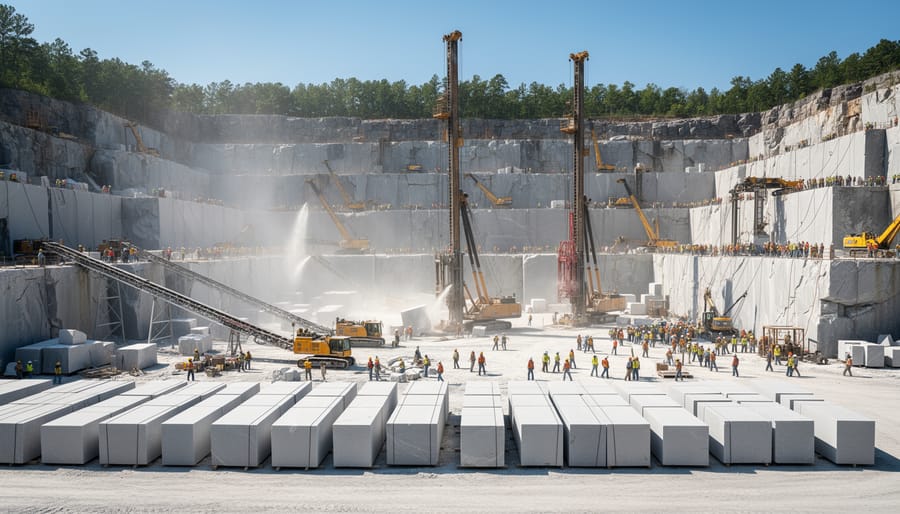
Early extraction methods relied heavily on manual labor and simple tools. Quarrymen used hand drills to create a series of holes along natural fracture lines in the granite face. Wedges and feathers—paired metal pieces—were then hammered into these holes to split massive blocks from the mountain. This labor-intensive process required skilled workers who understood the granite’s grain patterns and natural weaknesses.
As operations expanded through the 1880s and 1890s, quarries introduced steam-powered machinery that revolutionized extraction efficiency. Steam drills could penetrate the dense granite faster than hand tools, while derricks and hoists moved enormous blocks weighing several tons. The workforce grew to include hundreds of laborers, many of whom were recently freed African Americans and European immigrants seeking stable employment.
Processing the raw granite involved multiple steps. After extraction, skilled stonecutters used pneumatic tools and eventually electric-powered saws to shape blocks according to specifications. Finishing techniques included polishing, flaming, and bush-hammering to create various surface textures suitable for different architectural applications. Much like how stone quarries shaped development throughout American history, Stone Mountain’s operations directly influenced Atlanta’s rapid urban expansion.
By the early 1900s, the quarries employed sophisticated cable systems and narrow-gauge railways to transport finished stone to waiting freight cars, distributing Georgia granite across the growing nation.
Iconic Structures Built from Stone Mountain Granite
Stone Mountain granite became the foundation of Atlanta’s architectural identity during the late 19th and early 20th centuries, leaving an enduring legacy across the urban landscape. The distinctive grey granite, prized for its durability and aesthetic appeal, was incorporated into numerous structures that continue to define the city’s character today.
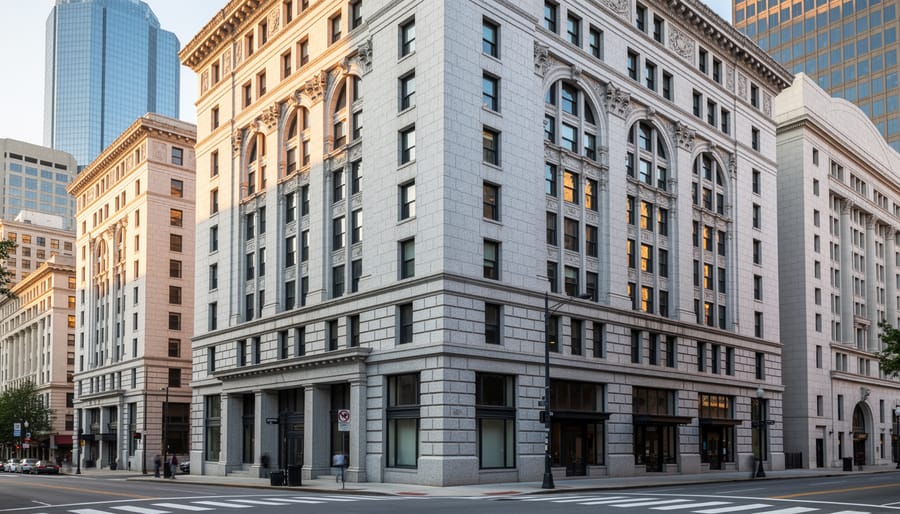
The Georgia State Capitol, completed in 1889, stands as perhaps the most prominent example of Stone Mountain granite’s architectural significance. The building’s foundation and exterior components feature the locally sourced material, representing both economic practicality and regional pride. Similarly, the Fulton County Courthouse, constructed in 1914, showcases the granite’s versatility in government architecture, with its impressive columns and facade demonstrating the stone’s capacity for both structural and decorative applications.
Beyond government buildings, Stone Mountain granite played a crucial role in Atlanta’s commercial development. The Candler Building, erected in 1906 as headquarters for Coca-Cola founder Asa Candler, utilized the granite extensively in its base and architectural details. The Flatiron Building, completed in 1897, incorporated the material into its distinctive triangular structure, creating one of Atlanta’s earliest architectural landmarks.
Infrastructure projects also relied heavily on this resource. The stone was used in numerous bridge constructions throughout the Atlanta metropolitan area during the early 1900s, including railroad overpasses and pedestrian bridges that served the expanding city. These structures demonstrated the granite’s exceptional load-bearing properties and resistance to weathering.
The material’s reach extended beyond Atlanta’s borders as well. Stone Mountain granite was shipped by rail to construct buildings throughout the Southeast, including courthouses in neighboring Georgia counties and commercial structures in cities like Birmingham and Charlotte. This distribution network established the quarry as a regional supplier of premium building stone, contributing to architectural consistency across the developing South while supporting local economic growth through the mid-20th century.
Economic Impact on Regional Development
Stone Mountain’s quarrying operations became a cornerstone of regional economic development throughout the late 19th and early 20th centuries. The granite extracted from the mountain provided essential building materials for Atlanta’s rapidly expanding infrastructure, supplying stone for roads, foundations, and municipal buildings. This created hundreds of jobs in quarrying, cutting, and transportation, establishing a skilled workforce that would serve the region for generations.
The demand for Stone Mountain granite directly influenced transportation development. Railroad lines were constructed specifically to transport the heavy stone blocks to Atlanta and beyond, connecting rural quarrying sites to urban markets. These rail connections facilitated not only stone transport but also passenger travel and general commerce, accelerating regional connectivity.
As Atlanta emerged as a major Southern urban center, Stone Mountain granite became synonymous with durability and quality in construction. The relationship between quarry and city exemplifies how stone shaped urban growth across America. Local suppliers gained competitive advantages through proximity, while Atlanta’s builders benefited from reliable access to premium building materials. This symbiotic relationship transformed both the mountain community and the metropolitan area, demonstrating how natural resources can catalyze comprehensive economic development beyond immediate extraction activities.
From Quarry to Monument: The Confederate Carving Era
The End of Commercial Quarrying
Commercial quarrying operations at Stone Mountain gradually declined through the early 20th century as construction demands shifted and more accessible granite sources became available. By the 1920s, large-scale extraction had substantially decreased, though small-scale quarrying continued sporadically into the 1960s. The mountain’s transformation from industrial site to public attraction began in earnest when the State of Georgia acquired the property in 1958, establishing Stone Mountain Memorial Park.
This transition marked a pivotal shift in how Americans valued natural landmarks. Growing environmental awareness and historic preservation movements recognized that Stone Mountain’s significance extended beyond its utility as a building material source. The granite that had constructed Atlanta’s infrastructure now represented geological heritage worth protecting. Preservation efforts focused on maintaining the mountain’s natural features while acknowledging its industrial past through interpretive programs.
Today, the quarry scars and abandoned derricks serve as tangible reminders of the mountain’s contribution to regional development. These remnants help visitors understand how natural stone resources shaped urban growth, bridging the gap between Stone Mountain’s working history and its current role as a protected landmark that continues educating the public about Georgia’s geological and construction heritage.
Stone Mountain’s Legacy in Modern Atlanta Architecture
Preservation and Restoration of Historic Stone Structures
Maintaining the architectural legacy of Stone Mountain granite presents unique challenges for today’s preservation specialists and restoration professionals. Historic buildings constructed with this distinctive gray granite during the late 19th and early 20th centuries require careful attention to ensure their longevity while respecting their original character.
The preservation of historic stone structures involves addressing weathering, pollution damage, and structural deterioration that occurs naturally over time. Stone Mountain granite, while exceptionally durable, can experience surface erosion, staining, and microscopic cracking after decades of exposure to the elements. Conservation teams must carefully clean these surfaces using methods that remove contaminants without damaging the stone’s integrity.
One of the most significant challenges facing restoration projects is sourcing matching replacement stone. While Stone Mountain quarries still operate, the specific coloration and grain patterns of granite extracted today may differ from historical quarried material due to variations in the geological formation. Skilled stonemasons and architects must carefully select replacement pieces that blend seamlessly with original stonework, sometimes requiring custom cutting to match historic dimensions and finishes.
Modern restoration efforts also incorporate advanced techniques such as laser cleaning, consolidation treatments, and water-repellent coatings that protect the stone while maintaining its natural appearance. These approaches ensure that Stone Mountain granite structures continue serving their communities while honoring the craftsmanship of their original builders, preserving an important chapter in American architectural history for future generations.
Broader Lessons: Stone Quarries and Urban Growth Patterns
Stone Mountain’s development offers valuable insights into fundamental patterns that governed urban growth throughout history. When examined closely, this Georgia landmark exemplifies how natural stone deposits functioned as gravitational centers for settlement and economic expansion.
The presence of abundant, high-quality granite created a ripple effect that extended far beyond the immediate quarrying operations. First, it attracted skilled stoneworkers and their families, establishing a specialized labor force. This workforce required supporting infrastructure—housing, schools, markets, and civic buildings—which themselves were often constructed from the very stone being quarried. The economic activity generated by stone extraction created wealth that funded further development, creating a self-reinforcing cycle of growth.
Transportation networks invariably evolved to serve quarrying operations. Roads, rail lines, and eventually highways were routed to facilitate stone transport, inadvertently shaping regional connectivity for generations. These same routes later served other industries and residential development, demonstrating how resource extraction permanently influenced regional geography.
The architectural character of communities near stone sources reflects material availability. Buildings constructed from local granite possess distinctive aesthetic qualities that define regional identity. This pattern repeats globally—limestone cities look fundamentally different from granite ones, and these differences stem from geological happenstance rather than purely cultural choices.
Stone Mountain exemplifies how stone structures shaped cities through material availability, economic opportunity, and transportation logistics. Understanding these principles helps modern architects and designers appreciate why certain building traditions developed in specific locations and how natural resources continue influencing construction choices today. The lessons extend beyond historical interest, informing sustainable building practices that emphasize local materials and reduced transportation costs.
Stone Mountain’s history reveals the profound influence that natural stone resources have exerted on American urban development. From its geological formation millions of years ago to its role as a vital quarrying site in the 19th and 20th centuries, this granite monolith demonstrates how proximity to quality stone shaped the physical character of Atlanta and surrounding communities. The buildings, monuments, and infrastructure constructed from Stone Mountain granite stand as enduring testaments to both the material’s exceptional durability and the skilled craftsmanship of those who worked it.
For contemporary architects and designers, Stone Mountain’s legacy offers valuable lessons about material selection and longevity. The granite structures built over a century ago continue to serve their purposes with minimal deterioration, highlighting natural stone’s sustainability credentials and lifecycle value. This historical perspective becomes increasingly relevant as today’s professionals seek materials that balance aesthetic appeal with environmental responsibility and long-term performance.
Understanding this history also enriches appreciation for regional building traditions and the connection between local geology and architectural character. Stone Mountain exemplifies how natural resources influenced not just individual buildings but entire urban landscapes, creating a distinctive architectural identity that persists today. As the industry continues evolving, these historical insights remind us that working with natural stone connects contemporary projects to centuries of building tradition while providing proven solutions for modern design challenges. The mountain’s story ultimately underscores stone’s timeless role in shaping our built environment.