Showing 68 Result(s)
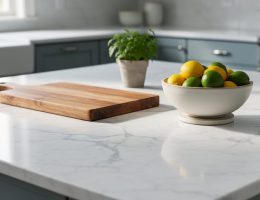
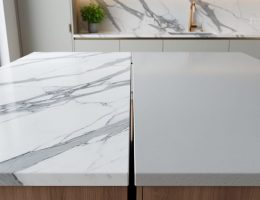
Polished white marble kitchen island with gray veining and slight patina, styled with a wooden cutting board and a citrus bowl on a coaster, soft natural light, blurred modern cabinets and a small potted herb in the background.
General Comparison and Selection

Why Marble Countertops Last Longer Than You Think (With Proper Care)

Marble countertops have graced prestigious buildings, palaces, and homes for thousands of years, yet homeowners today hesitate, wondering if this classic stone can survive modern kitchens. The answer requires distinguishing between two often-confused concepts: structural durability and surface sensitivity. Structurally, marble ranks among the most enduring countertop materials available, with properly installed slabs easily lasting 50 to 100 years or more without cracking, chipping, or deteriorating. The Pantheon in Rome still showcases marble floors after nearly 2,000 years, demonstrating the stone’s fundamental longevity.

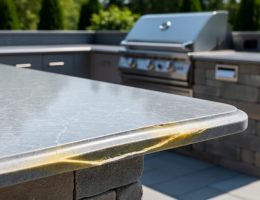
Close-up of an outdoor quartz countertop under harsh midday sun showing yellowed edges, faint warping, and micro-cracks, with a stainless-steel grill and stone island blurred in the background.
Quartz Countertops

Why Most Outdoor Quartz Countertops Fail (And What Works Instead)

Reconsider quartz for your outdoor kitchen before making a costly mistake. While quartz countertops dominate indoor spaces with their durability and low maintenance, they fundamentally fail in outdoor environments due to UV sensitivity. Direct sunlight causes quartz resin binders to break down, leading to discoloration, warping, and structural weakness within months—damage that manufacturers explicitly exclude from warranties.
The problem lies in quartz’s engineered composition. Approximately 90-95% ground quartz combines with 5-10% polymer resins and pigments, creating a non-porous surface ideal for interior applications. …

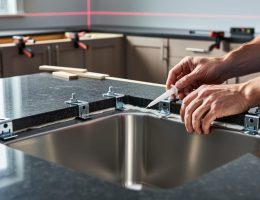
Hands of a professional installer attaching an undermount stainless steel sink to the underside of a polished granite countertop with epoxy and metal brackets; shims, clamps, and a faint laser line visible in a blurred modern kitchen background.
Granite Countertops

How to Install Granite Countertops with an Undermount Sink Without Costly Mistakes

Installing granite countertops with undermount sinks demands precision at the planning stage: measure your cabinet layout three times, accounting for the sink’s precise dimensions plus the required lip overhang of typically 1.5 to 2 inches. Order your granite slab with cutouts templated by a professional, as DIY sink hole cutting risks catastrophic cracking in this brittle material that can exceed thousands of dollars in replacement costs.
Secure the undermount sink to the granite underside using a two-part epoxy specifically formulated for stone, applying support brackets every 6 to 8 inches around the sink perimeter to …

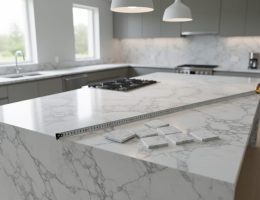
Modern kitchen with white and gray veined quartz island and perimeter countertops, visible edge profile, tape measure and quartz sample chips on the surface, soft natural daylight, matte cabinetry and stainless appliances subtly blurred in the background.
General Comparison and Selection

What You’ll Really Pay for Quartz Countertops (And Whether They’re Worth It)

Quartz countertops cost between $50 and $150 per square foot installed, with most homeowners paying $75 to $100 per square foot for mid-range options. This pricing positions quartz as a premium countertop material, typically costing 10-30% more than granite but offering distinct advantages that justify the investment for many buyers.
The total cost depends on four primary factors: material quality and brand selection, where entry-level options like basic patterns start at $50 per square foot while luxury collections featuring realistic veining can exceed $150; edge profile complexity, with standard edges included in base pricing but…

Two large slabs of Calacatta marble and light gray quartz displayed side by side on a modern kitchen island, with soft daylight and a blurred background of cabinetry, a brass faucet, and a small potted herb.
Countertop Materials and Selection

Why Marble Countertops Cost More Than Quartz (And When They’re Worth It)

Yes, marble typically costs more than quartz—expect to pay $50-$200 per square foot installed for marble versus $50-$150 for quartz. However, this conventional wisdom oversimplifies a nuanced purchasing decision that depends on the specific grade, origin, and rarity of each material.
The price gap exists because marble is a natural stone requiring extensive quarrying, transportation, and skilled fabrication, while quartz is an engineered product with more predictable manufacturing costs. Premium Calacatta or Statuario marble can reach $300+ per square foot, far exceeding most quartz options. Yet basic marble varieties sometimes …

Close-up of a Calacatta marble kitchen island corner with pronounced gray-gold veining, an installer’s hands positioning edge profile samples and a tape measure, with a bright modern kitchen of white cabinets and backsplash softly blurred in the background.
Countertop Materials and Selection

What You’ll Really Pay for Marble Countertops (Before You Commit)

Expect to invest between $40 and $200 per square foot installed for marble countertops, with most homeowners spending $75 to $150 per square foot depending on marble grade, slab thickness, and installation complexity. Budget an additional 15-30% beyond the base material cost for edge profiling, backsplash fabrication, seam placement, sink cutouts, and reinforcement requirements that contractors often quote separately. Compare three or more fabricators using identical measurements and specifications, since labor charges vary significantly by region and can account for 30-50% of your total project expense.
Factor in long-term …

Contemporary kitchen with a large warm neutral granite island slab showing an eased edge, matte charcoal cabinets, stainless range, and a subtle engineered tile backsplash under soft natural daylight.
Granite Countertops

Granite Countertops That Actually Work in 2024 Kitchens

Granite countertops remain a cornerstone of kitchen design, evolving beyond traditional aesthetics to meet contemporary demands for both visual impact and functionality. Today’s homeowners face a sophisticated marketplace where selecting the right granite involves understanding current color movements toward warm neutrals and dramatic veining, recognizing how different finishes complement modern cabinetry styles, and integrating edge profiles that balance timeless appeal with current sensibilities.
The strategic advantage of granite lies in its unique ability to anchor multiple design directions—from minimalist Scandinavian …

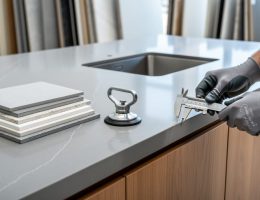
Close-up of a quartz countertop seam near an undermount sink in a modern kitchen, showing a tight, flush joint with color-matched adhesive under soft natural light; blurred faucet, cabinets, and backsplash in the background.
Quartz Countertops

Why Your Quartz Countertop Seams Show (And How to Make Them Disappear)

Quartz countertop seams are unavoidable in most installations, but their visibility depends entirely on three controllable factors: strategic placement, pattern selection, and fabricator skill. Every quartz slab measures approximately 120 by 56 inches, making seams necessary for kitchens with longer runs, L-shapes, or islands. The difference between a nearly invisible seam and an obvious eyesore lies in understanding how light, pattern, and color interact at the joint.
Position seams away from primary work zones and sightlines. Place them near sinks or cooktops where cutouts naturally draw the eye elsewhere, and avoid centering them…

Assorted countertop samples—granite, quartz, marble, quartzite, concrete, laminate, and solid surface—arranged on a modern kitchen island beside a butcher-block section, lit by soft natural daylight, with stainless appliances and potted herbs softly blurred in the background.
Countertop Materials and Selection

Which Kitchen Countertop Material Actually Deserves Your Money?

Your kitchen countertop choice will impact your daily life for decades, influencing everything from meal preparation efficiency to home resale value. With costs ranging from $15 to $300+ per square foot installed, understanding the differences between granite, quartz, marble, quartzite, butcher block, laminate, concrete, and solid surface materials prevents costly mistakes and buyer’s remorse.
Each material brings distinct advantages and limitations. Natural stones like granite and marble offer timeless beauty with unique patterns that synthetic materials cannot replicate, while engineered quartz provides consistency and low …

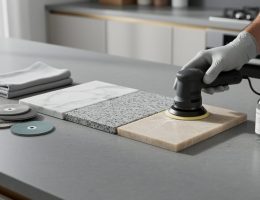
Gloved hand holding a foam applicator above a natural marble counter beside a glossy cultured marble surface with a polishing pad, in soft daylight with a blurred bathroom faucet in the background.
Marble Countertops

Why Cultured Marble Needs Different Sealant Than Natural Stone

Stop before applying any sealant to cultured marble—this engineered material fundamentally differs from natural marble and requires a completely different approach to protection. Cultured marble consists of crushed limestone mixed with resin and covered with a protective gel coat that manufacturers apply during production. This gel coat serves as the primary barrier against stains and moisture, meaning traditional marble sealants are not only unnecessary but potentially harmful to the surface.
Verify your countertop material before purchasing any product. Natural marble features unique veining patterns that penetrate throughout …