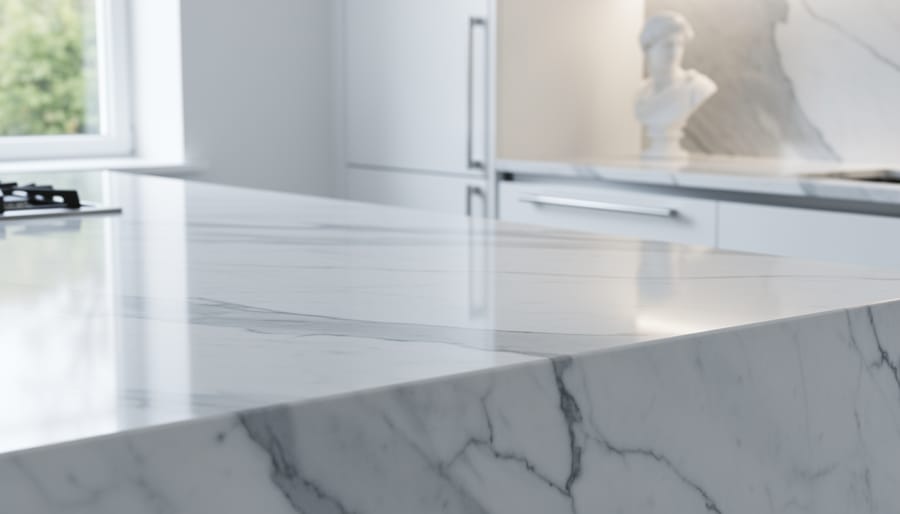
Marble has commanded prestige for over 5,000 years, from the Parthenon’s gleaming columns to the Taj Mahal’s luminous walls, and this metamorphic limestone continues defining luxury in modern homes for measurable reasons. Ancient civilizations chose marble not merely for aesthetics but for its unique crystalline structure that allows light penetration up to 40mm deep, creating an unmatched translucent glow that synthetic materials cannot replicate. Roman architects documented marble’s durability in 27 BC, and their installations remain intact today, proving this natural stone withstands centuries of use when properly maintained.
The geological transformation of limestone under extreme pressure creates marble’s distinctive veining patterns, ensuring no two slabs are identical—a characteristic that elevates countertops from functional surfaces to architectural statements. Michelangelo specifically selected Carrara marble for David because its fine grain structure prevents fragmentation during detailed work, the same density that makes marble countertops resistant to chipping in kitchen environments. Modern petrographic analysis reveals marble’s calcium carbonate composition scores 3-4 on the Mohs hardness scale, softer than granite but dense enough for daily meal preparation when sealed appropriately.
Historical applications validate contemporary choices: if marble satisfied the demanding standards of Renaissance sculptors and Mughal emperors, its proven performance record directly addresses whether this investment suits modern kitchens. The following facts demonstrate why marble remains architecture’s premium choice across millennia.
The Ancient Origins of Marble as a Surface Material
Marble in Ancient Greece and Rome
The ancient Greeks and Romans transformed marble from a sculptural material into a functional element of domestic architecture, establishing practices that directly influenced modern countertop applications. Beginning in the 5th century BCE, wealthy Greek households incorporated marble into their kitchens and work areas, using thick slabs as preparation surfaces in their cooking spaces. These early installations demonstrated marble’s practical advantages: its naturally cool surface proved ideal for working with dough and preparing food in warm Mediterranean climates.
Roman engineers advanced marble’s domestic applications even further during the Imperial period. Archaeological excavations at Pompeii and Herculaneum reveal sophisticated marble installations in both private villas and public facilities. Romans used marble extensively in their thermopolia, ancient equivalents of restaurants, where marble counters served food directly to customers. The famous House of the Vettii in Pompeii features marble work surfaces in its culinary area, showcasing how premium materials signified wealth and status.
Public bathhouses throughout the Roman Empire incorporated massive marble surfaces for various functions, from changing areas to massage tables. The Romans understood marble’s resistance to moisture and its ease of cleaning, making it practical for high-traffic spaces. They also developed techniques for cutting and polishing marble that remained largely unchanged until the Industrial Revolution.
This ancient precedent established marble as both a luxury material and a practical choice for surfaces requiring durability and hygiene, a reputation that continues to drive its popularity in contemporary kitchen and bathroom design.
The Geological Facts Behind Marble’s Formation
Marble begins its journey as limestone, a sedimentary rock formed from ancient marine organisms and calcium carbonate deposits on ocean floors. Through a natural process called metamorphism, limestone transforms into marble when subjected to intense heat (approximately 1,400-1,600°F) and pressure deep within the Earth’s crust. This transformation typically occurs over millions of years, often during mountain-building events when tectonic plates collide and force rock layers downward.
During metamorphism, the calcite crystals in limestone recrystallize and interlock, creating marble’s characteristic dense structure and distinctive veining patterns. The presence of various mineral impurities during this process determines marble’s final coloration—iron oxides produce warm reds and yellows, while clay minerals and graphite create gray and black veining.
This geological process explains why marble deposits exist in specific regions worldwide, particularly in areas with ancient mountain ranges like the Mediterranean, parts of Asia, and North America. The millions of years required for formation also contribute to marble’s status as a premium natural material. Understanding these geological origins helps explain why marble has been consistently available in certain civilizations throughout history, enabling its widespread use in ancient architecture and continuing through to modern applications in homes and buildings today.
Physical Properties That Made Marble Invaluable Throughout History
Natural Cooling Properties for Food Preparation
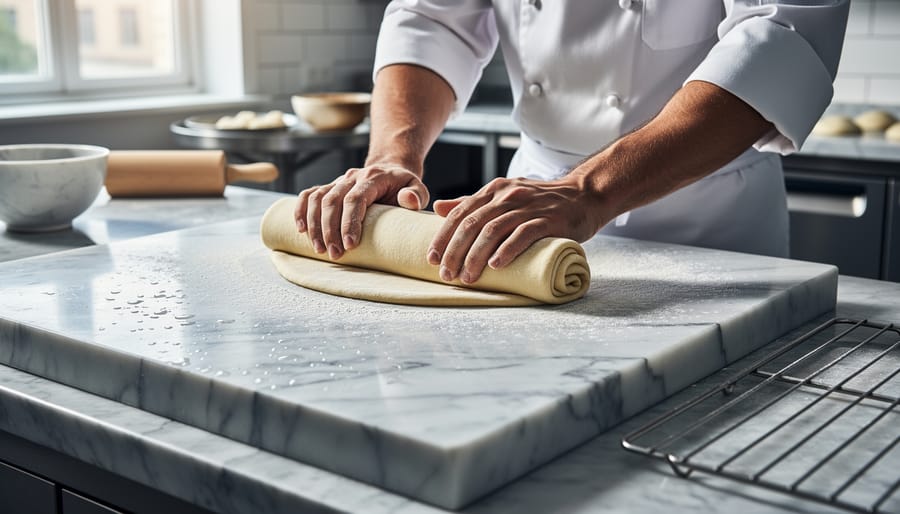
Marble’s exceptional cooling properties have made it indispensable in kitchens for centuries, particularly among pastry chefs and chocolatiers. The stone naturally maintains a temperature several degrees cooler than room temperature, typically staying between 65-68°F even in warm environments. This thermal conductivity stems from marble’s crystalline structure, which efficiently draws heat away from surfaces placed upon it.
Professional bakers discovered these properties as early as the 17th century, when French pastry chefs began using marble slabs for working butter into delicate dough. The cool surface prevents butter from melting during lamination, essential for creating flaky croissants and puff pastries. Chocolate makers similarly rely on marble’s consistent coolness for tempering chocolate, a process requiring precise temperature control between 88-91°F.
The science behind marble’s cooling effect relates to its high thermal mass and low thermal resistance. Unlike wood or laminate surfaces that retain ambient heat, marble absorbs warmth rapidly and disperses it throughout its dense structure. This explains why marble countertops feel noticeably cool to the touch and why they remain the gold standard in professional bakeries and confectioneries worldwide. Modern thermal imaging confirms marble surfaces stay 8-12 degrees cooler than surrounding countertop materials.
Durability Facts: Why Ancient Marble Surfaces Still Exist
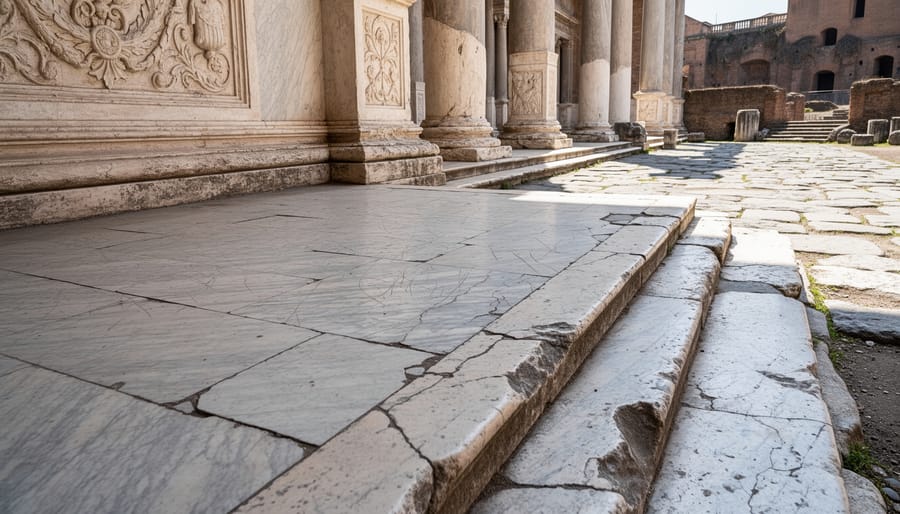
The remarkable longevity of marble is evidenced throughout history, from the Pantheon’s floors in Rome to the intricate surfaces of the Taj Mahal. These structures have endured for centuries, demonstrating marble’s exceptional durability when properly maintained.
Marble registers between 3 and 5 on the Mohs hardness scale, making it softer than granite but sufficiently durable for both interior and exterior applications. This moderate hardness contributed to its workability in ancient times while providing lasting strength. The ancient Greek Parthenon, constructed in 447 BCE, still showcases stunning marble surfaces over 2,400 years later, proving the stone’s resistance to weathering and time.
Temperature stability represents another durability advantage. Marble withstands significant temperature fluctuations without cracking, which explains why ancient Roman baths featured extensive marble surfaces. The material’s density also provides natural resistance to moisture penetration when sealed, protecting against water damage.
Modern scientific analysis of ancient marble reveals minimal structural degradation in protected environments. Archaeological sites demonstrate that interior marble surfaces maintain their integrity indefinitely with basic care, supporting marble’s reputation as a lifetime investment. This historical evidence validates why marble remains a premium choice for contemporary countertops and surfaces, offering proven performance spanning millennia rather than mere decades.
The Unique Veining That Defines Each Piece
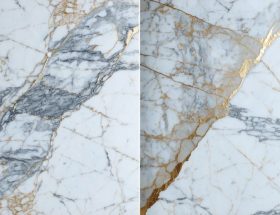
Marble’s distinctive veining forms through a fascinating geological process that makes each piece genuinely one-of-a-kind. These characteristic patterns develop when mineral impurities, primarily iron oxides, clay, and silica, infiltrate the crystalline structure during metamorphism. As limestone transforms under heat and pressure deep within the earth’s crust, these impurities concentrate along stress lines and fracture planes, creating the swirling ribbons and dramatic streaks we recognize today. The color variations range from subtle gray wisps in Carrara marble to bold gold and rust veining in Calacatta varieties, depending on which minerals were present during formation. This natural variability meant that ancient architects like those who designed the Pantheon carefully selected and positioned marble slabs to create symmetrical patterns or dramatic focal points. Historical records show that Roman builders paid premium prices for blocks with particularly striking veining, recognizing that no two slabs would ever match exactly. This geological authenticity continues to make marble installations valuable today, as each countertop or floor becomes an unrepeatable work of natural art shaped over millions of years.
Marble Countertops Through the Centuries
Renaissance and Baroque Periods: Marble in European Estates
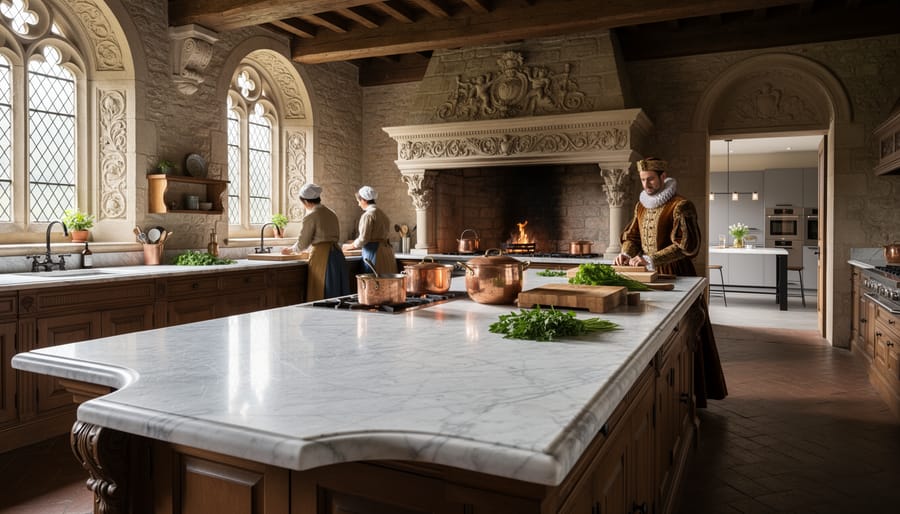
During the Renaissance and Baroque periods, European nobility elevated marble from architectural ornament to functional luxury in their estates. While full marble countertops remained rare due to cost and installation complexity, wealthy families incorporated marble work surfaces in preparation areas, pastry rooms, and specialized kitchen zones. The Palace of Versailles featured Carrara marble surfaces in confectionery preparation areas where cool stone proved essential for working with chocolate and sugar. Italian villas, such as Villa d’Este near Rome, showcased local travertine and marble in food storage and preparation spaces, taking advantage of the material’s naturally cool temperature.
Sourcing involved direct quarry contracts, with nobility commissioning specific slabs transported via river barges and ox-drawn carts. Installation required master stonecutters who shaped pieces on-site, as the weight made pre-fabrication impractical. These craftsmen used iron pins and lime mortar to secure slabs, techniques remarkably similar to modern methods. English country estates like Chatsworth House preserved marble scullery surfaces from the 1690s, demonstrating the stone’s durability across centuries. The Baroque period saw increased marble use in wet preparation areas, as owners recognized its resistance to moisture and staining from acidic ingredients, establishing patterns that inform luxury kitchen design today.
Victorian Era: The Rise of Marble in Middle-Class Homes
The Victorian Era marked a pivotal transformation in marble’s accessibility, shifting it from an exclusively aristocratic material to one attainable by the growing middle class. Between 1837 and 1901, technological innovations revolutionized marble extraction and distribution across Europe and America.
Steam-powered quarrying equipment introduced in the 1840s dramatically increased extraction efficiency, reducing both labor costs and production time. Previously, workers relied on hand tools and basic machinery, limiting output and keeping prices prohibitively high. The new steam-powered wire saws could cut through marble blocks twenty times faster than traditional methods.
Railway expansion proved equally transformative. By the 1860s, extensive rail networks connected remote quarrying regions like Carrara, Italy, and Vermont’s marble belt directly to urban centers. This infrastructure reduced transportation costs by approximately 60 percent, making marble financially viable for middle-class homeowners aspiring to emulate upper-class aesthetics.
Victorian homes increasingly featured marble fireplace surrounds, entryway floors, and washstand tops—precursors to modern bathroom and kitchen applications. While full marble countertops remained rare due to kitchen design norms of the era, decorative marble accents became status symbols for upwardly mobile families. Understanding these historical pricing dynamics provides context for today’s marble countertop costs, which continue reflecting quarrying technology and transportation logistics established during this transformative period.
20th Century: From Traditional to Modern Applications
The 20th century witnessed marble’s remarkable evolution from opulent Art Deco statement pieces to versatile modern applications. During the 1920s and 1930s, Art Deco designers embraced marble’s geometric veining patterns, incorporating bold slabs into luxury hotels, banks, and residential interiors. The streamlined aesthetic celebrated marble’s natural drama alongside polished chrome and exotic woods.
Post-World War II, mid-century modern design temporarily shifted focus toward synthetic materials, yet marble maintained prestige in high-end applications. Architects like Mies van der Rohe and Philip Johnson continued specifying marble for signature projects, proving its compatibility with minimalist principles.
The late 20th century brought transformative fabrication advances. Diamond-blade cutting technology, introduced in the 1970s, enabled precise cuts and complex edge profiles previously unattainable. Computer-guided waterjet cutting emerged in the 1980s, allowing intricate inlays and custom shapes. These innovations made marble countertops more accessible to average homeowners while expanding design possibilities.
By the 1990s, improved sealing technologies addressed historical staining concerns, enhancing marble’s practicality for kitchens and bathrooms. Contemporary fabrication combines traditional hand-finishing with digital templating systems, ensuring millimeter-perfect installations. This technological progression transformed marble from an exclusively artisanal material into one offering both handcrafted beauty and modern precision, cementing its continued relevance in 21st-century design.
Famous Historical Marble Varieties and Their Quarries
Carrara Marble: The Renaissance Standard
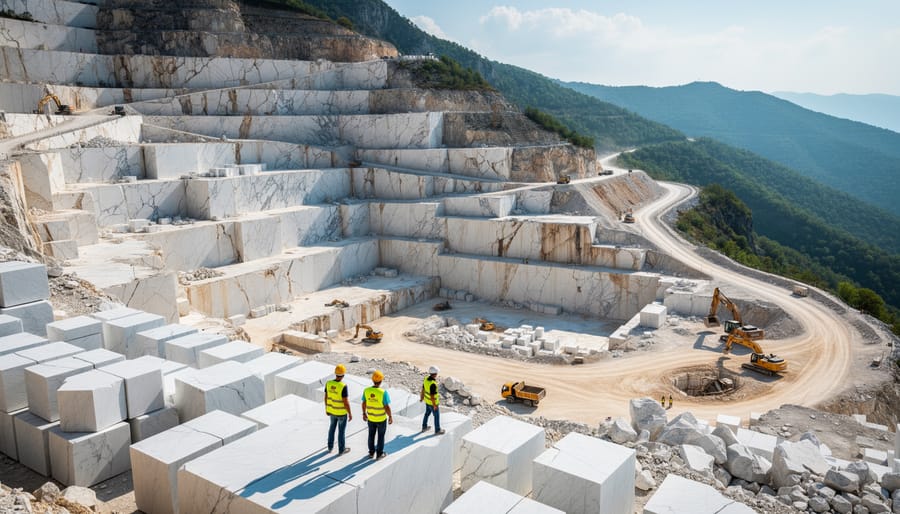
Nestled in the Apuan Alps of Tuscany, Italy, the Carrara quarries have supplied the world’s most coveted marble for over 2,000 years. Ancient Romans extracted this luminous white stone from the same mountains that provided material for Michelangelo’s David and the Pantheon’s interior columns. Carrara marble’s distinctive blue-gray veining and fine-grain structure made it the Renaissance standard for both monumental sculpture and architectural elements.
What sets Carrara apart is its remarkable purity and consistent coloring, resulting from metamorphosed limestone deposits formed millions of years ago. The stone’s relatively soft composition allowed Renaissance masters to achieve unprecedented detail in their work, while its subtle elegance made it equally desirable for palace floors and functional surfaces. Today, Carrara remains highly sought after for countertops and architectural applications, though proper Carrara marble maintenance ensures its beauty endures. The quarries continue operating using modern extraction methods while preserving centuries-old traditions, producing approximately one million tons annually for worldwide distribution.
Calacatta and Other Prestigious Varieties
Calacatta marble represents the pinnacle of luxury stone, historically commanding prices up to ten times higher than standard white marbles. Quarried exclusively in the Carrara region of Italy, genuine Calacatta remains exceptionally rare, comprising less than 5% of the region’s total marble output. Its distinctive bold, dramatic veining in gold or gray against a bright white background sets it apart from the more common Carrara marble, which features softer, feathered veining patterns.
Throughout history, Calacatta adorned only the most prestigious spaces, from Vatican palaces to royal estates across Europe. The marble’s scarcity stems from limited extraction sites and the geological conditions required for its formation. Other elite varieties include Statuario, prized for its pure white background and linear gray veining, and Arabescato, recognized for intricate, flowing patterns. These premium marbles continue commanding substantial price premiums today, with genuine Calacatta slabs often exceeding $250 per square foot. Authentication remains crucial, as the market includes numerous imitations attempting to replicate these prestigious varieties’ distinctive characteristics.
Regional Varieties That Defined Local Architecture
Regional geology shaped architectural identities for centuries, as cultures naturally gravitated toward locally-quarried marble varieties. Ancient Greeks prized Pentelic marble from Mount Pentelicus near Athens, using its fine-grained white stone with subtle golden undertones for the Parthenon and other classical monuments. The Turkish region of Marmara gave marble its name, supplying distinctive white stone with gray veining throughout the Byzantine and Ottoman empires. Spain’s Macael quarries in Andalusia have produced brilliant white marble since Roman times, featuring prominently in Moorish palaces like the Alhambra. American architectural heritage includes Vermont’s Danby marble, used in the Supreme Court building, and Georgia’s Creole marble, which adorned numerous Southern mansions. These regional preferences weren’t merely aesthetic choices but practical decisions based on transportation limitations and local availability, creating distinct architectural signatures that still influence design preferences today.
The Craftsmanship Behind Historical Marble Countertops
Traditional Quarrying and Fabrication Methods
Before the advent of modern machinery, quarrying marble was an extraordinarily labor-intensive process that required exceptional skill and patience. Ancient craftsmen identified suitable marble deposits by examining natural outcrops and studying the stone’s veining patterns and color consistency.
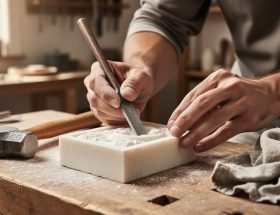
Workers used simple hand tools including chisels, hammers, and wedges to extract large blocks from quarry faces. The wedge-and-feather method involved driving wooden or metal wedges into natural fissures, sometimes soaking wooden wedges with water to create expansion that gradually split the stone along desired lines. A single block could take weeks or even months to extract without damaging the valuable material.
Once removed, marble blocks were transported using wooden rollers, sledges, and later wheeled carts pulled by oxen. Fabrication into slabs required skilled stonecutters who used hand saws with abrasive sand and water to slowly cut through the dense stone. Polishing involved progressively finer abrasives applied through manual rubbing, a process that could take days to achieve the characteristic glossy finish.
Shaping marble for architectural features and early countertop applications demanded precision hand-carving and grinding. This painstaking craftsmanship explains why marble installations were historically reserved for palaces, temples, and wealthy estates. These traditional methods, while time-consuming, produced remarkably precise results that contrast sharply with today’s modern installation techniques.
The Evolution of Edge Profiles and Finishes
Marble finishing techniques have evolved significantly throughout history, reflecting both technological advances and changing aesthetic preferences. The polished finish, achieved through progressive grinding and buffing with finer abrasives, became the standard for luxury applications during the Renaissance period when artisans developed more sophisticated polishing wheels and compounds. This glossy surface reveals marble’s full depth of color and veining patterns, making it the preferred choice for palatial interiors and religious monuments.
Honed finishes gained popularity in the mid-20th century as modernist architects sought subtler, matte surfaces that reduced glare and offered a more contemporary aesthetic. This technique stops the polishing process at an earlier stage, creating a smooth but non-reflective surface that better conceals etching and scratches in high-traffic areas.
Tumbled and antiqued finishes emerged in the late 1990s as homeowners embraced Old World aesthetics. These treatments artificially age marble through mechanical tumbling or acid washing, replicating the weathered appearance of ancient stone.
Edge profiles evolved from simple squared edges in ancient construction to elaborate decorative treatments. The ogee edge became fashionable during the Victorian era, while beveled and bullnose profiles gained prominence in the 1960s. Today’s CNC technology enables precise replication of classical profiles alongside entirely custom designs, offering unprecedented versatility for both traditional and contemporary applications.
Why Historical Marble Installations Remain Functional Today
Maintenance Practices from the Past
Before modern sealants and specialized cleaners emerged in the 20th century, marble owners relied on time-tested methods passed down through generations. Ancient Romans cleaned their marble surfaces with mixtures of crushed pumice stone and water, gently buffing away stains without damaging the stone. During the Renaissance, household staff maintained marble countertops and floors using soft cloths dampened with milk or diluted vinegar for light cleaning, though acidic solutions were eventually recognized as harmful to the calcium-based stone.
In the 18th and 19th centuries, a paste made from chalk dust, whiting powder, and water served as a popular polishing agent, helping restore shine to dulled surfaces. Beeswax applications provided a protective barrier against moisture and staining, though this required frequent reapplication. While these historical methods demonstrated varying effectiveness, they established fundamental principles still relevant today: gentle cleaning agents, soft materials, and regular attention. Modern proper marble care builds upon these traditional practices with advanced formulations that better protect this timeless material.
Lessons from Centuries-Old Installations
Ancient marble installations offer valuable insights for today’s homeowners. Surviving examples from Roman villas and European palaces reveal that proper installation and quality material selection are paramount to longevity. Historic installations consistently demonstrate three key factors: adequate substrate support, minimal joint lines through larger slabs when possible, and positioning away from extreme temperature fluctuations.
Archaeological evidence shows that ancient builders selected marble from specific quarries known for density and low porosity, similar to how modern consumers should prioritize material grade over price alone. Well-preserved centuries-old countertops typically feature thicker slabs, often 2-3 inches compared to today’s standard 1.25 inches, providing greater durability and crack resistance.
These time-tested installations also highlight the importance of proper sealing and maintenance routines. Historic records indicate regular applications of natural oils and waxes, which protected surfaces from staining while maintaining the stone’s breathability. Modern homeowners can apply these same principles, understanding that marble’s longevity depends less on the material itself and more on thoughtful installation and consistent care practices proven effective across centuries.
Marble’s Influence on Modern Countertop Standards
Marble’s centuries-long dominance in architecture and interior design fundamentally shaped the standards we apply to all countertop materials today. When modern engineered surfaces emerged in the mid-20th century, manufacturers didn’t create arbitrary specifications—they reverse-engineered their products to meet benchmarks already established by marble’s performance in real-world applications.
The standard countertop thickness of 3 centimeters (approximately 1.25 inches) traces directly to traditional marble slab specifications used in European palazzos and American estates. This dimension proved optimal for balancing structural integrity with material efficiency, a fact validated by marble countertops that have performed flawlessly for over a century. Even 2-centimeter marble slabs, common in historical installations, continue functioning perfectly in preserved homes, demonstrating that thickness requirements often exceed actual structural needs.
Standard countertop dimensions also originated from marble quarrying and fabrication practices. The common 25.5-inch depth for kitchen counters corresponds to efficient cutting patterns from marble blocks, minimizing waste while providing adequate workspace. Similarly, the 36-inch standard height for counter installation was established during eras when marble countertops defined luxury kitchens.
Performance expectations for modern surfaces likewise derive from marble’s track record. Heat resistance standards reference marble’s ability to withstand hot cookware without damage. Scratch resistance ratings compare materials against marble’s Mohs hardness of 3-4. Even maintenance protocols for engineered quartz acknowledge that if properly sealed marble can last generations, synthetic alternatives should require less upkeep to justify their existence.
Today’s countertop industry essentially asks: “Can this material match what marble has delivered for centuries?” That question itself reveals marble’s profound influence—it established the baseline that all subsequent materials must meet or exceed, making it the original gold standard in countertop performance.
Marble’s journey from the temples of ancient Greece to marble in modern kitchens tells a compelling story of enduring quality and timeless appeal. For over 4,000 years, this metamorphic stone has proven its worth through countless applications, from Michelangelo’s David to the Lincoln Memorial. The facts speak clearly: marble’s natural beauty, formed over millions of years through geological pressure and heat, creates unique veining patterns that cannot be replicated by manufactured materials.
Today’s homeowners and designers continue choosing marble for the same reasons ancient architects did—its luminous surface, cool touch, and dignified presence. While modern technology has introduced numerous countertop alternatives, marble remains the gold standard for those seeking authentic luxury backed by millennia of proven performance. Its calcium carbonate composition provides natural antibacterial properties, and proper sealing techniques now make maintenance more manageable than ever before.
When selecting countertop materials for your next project, consider marble’s remarkable track record. Few materials can claim such longevity or demonstrate such consistent value across civilizations. The same qualities that made marble precious to Roman emperors make it a sound investment today—natural durability, distinctive beauty, and an ability to elevate any space it inhabits. This stone has literally stood the test of time, and that historical validation offers reassurance that your marble surfaces will serve generations to come.