Showing 17 Result(s)
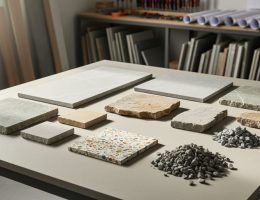
Architect’s drafting table with natural stone slabs, reclaimed offcuts, crushed aggregate, and a terrazzo tile arranged under soft daylight, with blurred shelves of tools and stacked stone in the background.
Retail and Sourcing Networks

How Circular Economy Graphics Transform Natural Stone Sourcing (And Why You Should Care)

Examine lifecycle flow diagrams that track natural stone from quarry extraction through fabrication, installation, and eventual reclamation to identify waste reduction opportunities at each stage. These visual tools reveal where materials can be recovered, repurposed, or returned to production cycles rather than ending up in landfills.
Request material passport graphics from your stone supplier that document the complete journey of specific slabs, including quarry location, processing methods, transportation routes, and carbon footprint calculations. This transparency allows you to compare the environmental performance of different …

Architect’s hands holding marble and granite samples over architectural blueprints on a studio desk, with travertine swatches, scale ruler, and blurred rolled plans and building model in the background, lit by soft daylight.
Blog Economic Aspects Guides

Why Natural Stone Businesses Are Winning with Specialized Guest Posting

Recognize that generic blogger outreach fails natural stone businesses because lifestyle bloggers and general home improvement sites don’t reach architects specifying marble lobbies or contractors sourcing granite countertops. Natural stone guest posting services target industry-specific publications where your actual buyers spend time—architectural digest platforms, interior design forums, construction trade journals, and luxury home magazines. These specialized placements build authority with decision-makers who control six-figure stone projects, not homeowners browsing Pinterest….

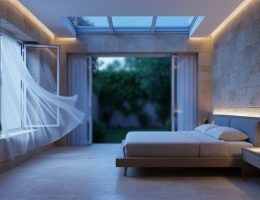
Modern bedroom with limestone wall and travertine floor, open windows and flowing sheer curtains in cool pre-dawn light, suggesting natural cross-ventilation with a leafy courtyard visible outside.
Technical Properties

How Natural Stone Transforms Your Indoor Air While You Sleep

Natural air ventilation systems harness wind patterns, temperature differentials, and strategic building design to circulate fresh air without mechanical equipment—reducing energy costs by up to 40% while improving indoor air quality. The performance of these systems depends critically on material selection, with natural stone playing a surprisingly dynamic role in thermal mass, moisture regulation, and airflow optimization.
Stone’s high thermal capacity stabilizes indoor temperatures by absorbing heat during day and releasing it at night, creating pressure differentials that drive natural air circulation. A limestone facade…

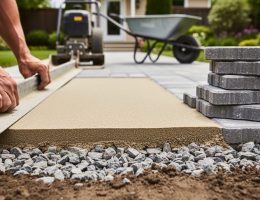
Hands using a screed board to level coarse sand over a compacted crushed gravel base for a garden stone pathway, with stacked pavers and a blurred plate compactor and wheelbarrow in the background.
Home Improvement and DIY

Why Your DIY Pathway Stones Keep Failing (And How to Fix the Foundation)

Excavate your pathway bed to a depth of 8-10 inches, ensuring consistent depth across the entire route to prevent settling and drainage issues that plague amateur installations. Remove all organic material, roots, and debris—even small amounts of decomposing matter will compromise your foundation over time. Compact the exposed soil firmly using a plate compactor or hand tamper, making multiple passes until the surface shows no visible movement under pressure.
Install landscape fabric directly on the compacted soil to create a barrier against weed penetration while allowing water drainage. Overlap fabric edges by at least six …

Gloved hands use a natural bristle brush and low-pressure sprayer to clean lichen from a marble gravestone, with blurred cemetery headstones and trees in the background under soft daylight.
Stone Restoration and Preservation

Why Professional Gravestone Cleaners Are Switching to These New Solutions

Choose pH-neutral cleaners specifically formulated for stone to prevent irreversible etching and discoloration on granite, marble, or limestone monuments. Test any solution on an inconspicuous area first, waiting 24-48 hours to observe potential adverse reactions before proceeding with full application.
Apply biological growth removers containing quaternary ammonium compounds or hydrogen peroxide for algae, lichen, and moss removal, allowing 15-20 minutes of dwell time before gentle agitation with natural bristle brushes. Avoid pressure washers exceeding 500 PSI, which can erode softer stones and drive contaminants deeper into …

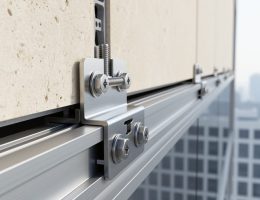
Stainless steel bracket and undercut anchor fastening a limestone cladding panel to an aluminum rail with a visible ventilated cavity gap, shot from a low angle with a blurred high-rise facade and skyline in the background.
Installation and Manufacturing

Why Stone Falls Off Buildings (And How Mechanical Fixing Prevents It)

Mechanical installation systems anchor natural stone permanently to building structures through engineered metal brackets, clips, and pins—eliminating traditional mortar bonding for superior performance in high-stress applications. These precision-engineered fixing methods distribute weight loads across structural frameworks, enabling stone facades on high-rise buildings, exterior cladding that withstands seismic activity, and interior features requiring exact alignment without adhesive degradation risks.
Understanding mechanical systems proves essential before committing to stone projects, as installation methods directly impact …

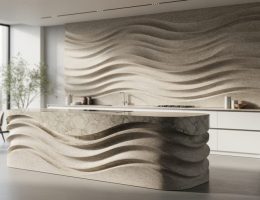
Eye-level view of a sinuous marble kitchen island and wave-inspired stone wall in a minimalist modern room, softly side-lit, with blurred large windows, indoor plants, and minimal furnishings in the background.
Aesthetic and Style Trends

How Curved Stone Designs Bring Natural Flow into Modern Spaces

Organic shapes in three-dimensional stone design transform rigid architectural elements into flowing, natural forms that echo landscapes, water movement, and biological structures. These curved, asymmetrical designs—ranging from sinuous countertops to wave-inspired wall cladding—require mastering fundamental drawing techniques before fabrication begins.
Start by sketching flowing contours using continuous line exercises, allowing your hand to trace smooth, uninterrupted curves that mimic natural erosion patterns and biological growth. Study reference materials like river rocks, shells, and wind-carved formations to understand …

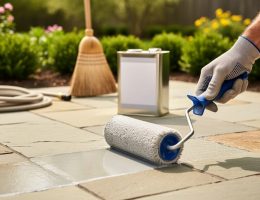
Gloved hand using a pole-mounted roller to apply clear sealer to a flagstone patio, with a blurred background of garden beds, coiled hose, broom, and an unlabeled sealer can in soft spring daylight
Maintenance and Care

Your Natural Stone Landscape Needs Care All Year (Here’s When and How)

Divide your natural stone maintenance into quarterly intervals, scheduling deep cleaning and sealing in spring before weather extremes hit, monthly inspections during summer’s peak heat and traffic, preventive treatments in fall before freeze-thaw cycles begin, and protective measures throughout winter when ice and salt pose the greatest threats. This systematic approach prevents the costly mistake of reactive maintenance—addressing damage only after it occurs—which typically costs three to five times more than preventive care.
Mark your calendar for spring resealing between March and May, when temperatures stabilize above…

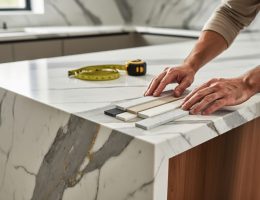
Close-up of a Calacatta marble kitchen island corner with pronounced gray-gold veining, an installer’s hands positioning edge profile samples and a tape measure, with a bright modern kitchen of white cabinets and backsplash softly blurred in the background.
Countertop Materials and Selection

What You’ll Really Pay for Marble Countertops (Before You Commit)

Expect to invest between $40 and $200 per square foot installed for marble countertops, with most homeowners spending $75 to $150 per square foot depending on marble grade, slab thickness, and installation complexity. Budget an additional 15-30% beyond the base material cost for edge profiling, backsplash fabrication, seam placement, sink cutouts, and reinforcement requirements that contractors often quote separately. Compare three or more fabricators using identical measurements and specifications, since labor charges vary significantly by region and can account for 30-50% of your total project expense.
Factor in long-term …

Eye-level wide photo of a partially built stone house with thick mortared walls as a mason sets an ashlar block at a corner; fieldstone pallets, a mortar mixer, and wooded hills appear in the background under warm evening light.
Design Applications

Building Your Dream Stone House: What You Need to Know Before Breaking Ground

Building with natural stone creates structures that can last centuries while offering unmatched thermal mass, fire resistance, and timeless aesthetic appeal. Before breaking ground, understand that stone construction requires 30-50% more time than conventional building methods and typically costs $200-400 per square foot depending on stone type, wall thickness, and regional labor rates.
Start by selecting your stone based on local availability and structural requirements. Fieldstone costs $50-150 per ton and works well for walls 18-24 inches thick, while quarried ashlar stone provides uniform dimensions at $8-25 per square foot but …