Showing 17 Result(s)
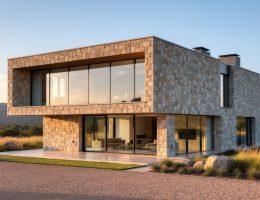
Contemporary stone home with dry-stacked limestone walls, floor-to-ceiling glass, and a cantilevered upper level at sunset, with native grasses and distant hills; interior polished stone floor visible through the glazing.
Stone Art and Design

Stone Houses That Redefine Contemporary Living

Stone houses today merge ancient durability with cutting-edge architectural vision, creating residences that stand as testaments to timeless elegance and environmental responsibility. Where medieval castles once dominated hillsides, contemporary stone homes now showcase transparent walls, cantilevered volumes, and minimalist geometries—all anchored by the raw, textured beauty of natural rock.
The resurgence of stone in residential architecture reflects a fundamental shift in how we approach sustainable living. Modern architects harness limestone, granite, sandstone, and slate not merely as structural elements but as design …

Low-angle view of a steel A-frame racking system holding large granite and marble slabs, with visible base plates and expansion bolts securing the rack to a reinforced concrete floor; softly lit workshop cranes and saws appear blurred in the background.
Safety and Risk Management

Why Stone Slabs Fall Over (And How Racking Structures Prevent Catastrophic Accidents)

Assess your current racking system by measuring the width-to-height ratio—any structure taller than four times its base width enters high-risk territory for tip-over incidents. Stone fabrication facilities face unique stability challenges because natural stone slabs create massive concentrated loads that shift during access, making proper racking design a life-or-death consideration rather than a simple storage solution.
Install anti-tip anchoring systems that secure racking structures to reinforced concrete floors using expansion bolts rated for seismic zones, even in non-earthquake regions. The lateral forces from accessing a …

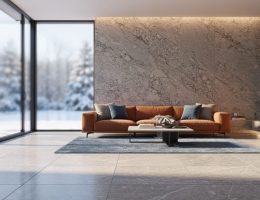
Modern living room with thick limestone floor and granite accent wall illuminated by low winter sunlight through south-facing windows, with a snowy garden softly blurred outside.
Technical Properties

How Natural Stone Keeps Your Home Warmer in Winter (And Cooler in Summer)

Walk through any centuries-old stone cathedral on a summer afternoon and you’ll experience thermal mass in action—cool interior air despite blazing outdoor temperatures, without any modern HVAC system. This natural phenomenon occurs because dense materials like stone, concrete, and brick absorb heat slowly during the day and release it gradually at night, creating stable indoor temperatures that can reduce heating and cooling costs by 25-30% in well-designed spaces.
Thermal mass isn’t just an ancient building technique—it’s a practical solution for modern homes and commercial buildings facing rising energy …

Contemporary limestone-clad house with large floor-to-ceiling windows and weathered steel accents, photographed at eye level from a three-quarter angle at golden hour, surrounded by native grasses and mature trees.
Stone-Inspired Architectural Legacies

Why Contemporary Stone Houses Outlast Modern Trends (And Save You Money)

Contemporary stone houses represent architecture’s most compelling intersection of timeless durability and forward-thinking sustainability. While glass, steel, and concrete dominate modern construction conversations, natural stone delivers superior thermal mass, zero off-gassing, and a carbon footprint that decreases over the building’s 100-plus year lifespan. Recent studies show stone-clad homes reduce heating and cooling costs by 25-30% compared to conventional construction, with materials that require minimal processing and generate virtually no construction waste.
The contemporary application differs dramatically …

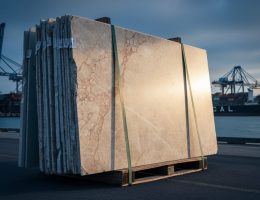
Pallet of strapped marble and granite slabs at a seaport with blurred cranes and containers under moody skies, conveying supply chain disruption
Retail and Sourcing Networks

Why Your Stone Project Just Got More Expensive (And What You Can Do About It)

Global stone supply chains face unprecedented disruption as trade tensions, sanctions, and territorial disputes ripple through quarries from Turkey to India. The marble countertop delayed by three months, the travertine project quote that doubled overnight, or the sudden unavailability of a specific granite—these aren’t isolated incidents but symptoms of geopolitical shifts fundamentally reshaping how natural stone moves across borders.
Transportation routes that have carried stone for decades now face blockades, tariffs, and rerouting through costlier corridors. Quarries in conflict zones shut down without warning. …

Overhead 45-degree view of an extra-large artisanal stoneware bowl embedded with marble and granite fragments, filled with fresh salad on an oak table, with translucent glaze visible and a softly blurred linen runner, wooden spoons, and plates in the background.
Culinary Stone Applications

Why Artisanal Stone-Embedded Bowls Transform Your Table (And How to Choose Yours)

Examine the vessel’s weight-to-size ratio when evaluating an extra large stoneware bowl, as authentic pieces with natural stone elements should feel substantially heavier than standard ceramic alternatives. Quality stone-embedded serving dishes combine the durability of fired clay with the thermal properties of natural minerals like marble, granite, or soapstone fragments integrated during the forming process.
Test the bowl’s thermal retention by placing it in a refrigerator for 30 minutes …

Low-angle photo of a modern high-rise with natural stone cladding at the corner, sharp panel joints and texture visible, with fast-moving clouds and a distant skyline in the background.
Codes, Standards & Compliance

Why Stone Cladding Fails Without Proper Wind Load Engineering

Understanding ASCE 7 wind load requirements is essential for any stone cladding project’s structural integrity and longevity. The American Society of Civil Engineers standard ASCE 7 provides the framework for calculating wind pressures that stone facades must withstand, with requirements varying significantly based on building height, geographical location, exposure conditions, and terrain characteristics.
Stone cladding systems face unique challenges under wind loads. Unlike lighter facade materials, natural stone’s mass creates different stress patterns on anchoring systems, while its rigidity means less deflection …