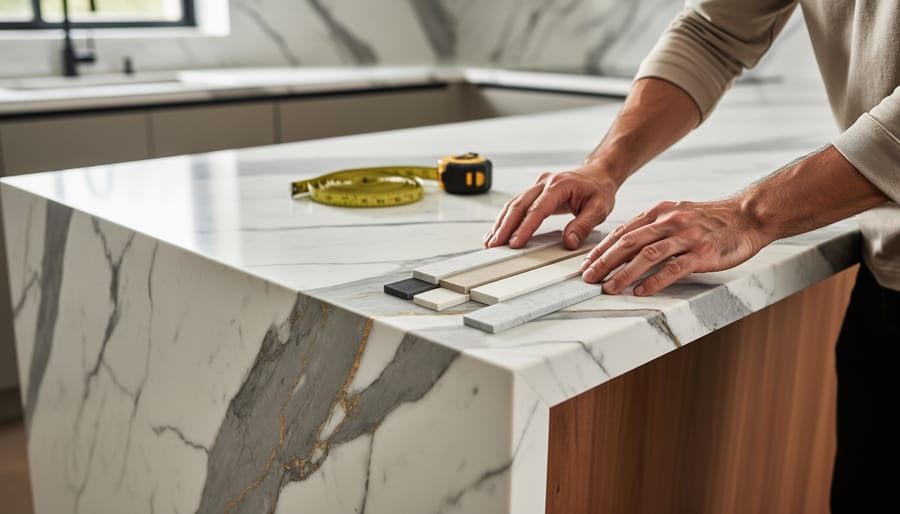
Expect to invest between $40 and $200 per square foot installed for marble countertops, with most homeowners spending $75 to $150 per square foot depending on marble grade, slab thickness, and installation complexity. Budget an additional 15-30% beyond the base material cost for edge profiling, backsplash fabrication, seam placement, sink cutouts, and reinforcement requirements that contractors often quote separately. Compare three or more fabricators using identical measurements and specifications, since labor charges vary significantly by region and can account for 30-50% of your total project expense.
Factor in long-term maintenance expenses that reach $100-300 annually for professional sealing, specialized pH-neutral cleaners, and periodic polishing to preserve marble’s distinctive veining and prevent etching from acidic substances. Lower-grade commercial marble starts around $40 per square foot but shows more variation in pattern consistency, while premium Calacatta and Statuario varieties command $150-200 per square foot for their dramatic white backgrounds and bold gray-gold veining. Request remnant pieces from fabricators for smaller projects like bathroom vanities, potentially saving 30-50% compared to full slab pricing while still achieving the luxurious aesthetic marble provides.
Base Cost Breakdown: Material and Installation
Material Costs by Marble Type
Marble countertop prices vary significantly based on the specific variety you select, with costs ranging from $40 to $200+ per square foot for materials alone. Understanding these price differences helps you budget appropriately when choosing marble types for your project.
Carrara marble represents the most budget-friendly option at $40-65 per square foot. Quarried abundantly in Italy, this white-gray marble features soft veining and remains widely available, making it accessible for cost-conscious homeowners seeking classic marble aesthetics.
Statuary marble commands a mid-range price of $50-80 per square foot. This Italian marble offers brighter white backgrounds with bold, dramatic veining patterns that provide more visual impact than Carrara while remaining relatively affordable.
Calacatta marble sits in the premium category at $80-120 per square foot. Rarer than Carrara, Calacatta displays distinctive thick veining against bright white backgrounds. Its limited availability and striking appearance justify the higher price point.
Calacatta Gold represents the luxury tier at $150-200+ per square foot. This exceptional marble features warm gold and gray veining that creates stunning visual depth. Extreme rarity, quarrying difficulty, and high demand from luxury markets drive these premium prices.
Several factors explain these price variations. Rarity significantly impacts cost—marbles from limited quarry sections command premium prices. Veining complexity matters too, as dramatic patterns require careful selection and matching during fabrication. Transportation costs from international quarries, especially for heavy stone slabs, add to final pricing. Block quality also influences price, with flawless sections free from structural weaknesses costing considerably more than standard grades.

Fabrication and Installation Fees
Fabrication and installation represent significant portions of your total marble countertop investment, typically ranging from $40 to $100 per square foot on top of material costs. The fabrication process includes precise cutting, seam matching, polishing, and edge profiling—all requiring specialized equipment and skilled craftspeople.
Basic cutting and polishing generally cost $30 to $50 per square foot. Edge profiles add $10 to $30 per linear foot depending on complexity. Simple edges like eased or pencil profiles cost less, while ornate options such as ogee or dupont profiles command premium prices due to increased labor and expertise required.
Installation labor typically adds $25 to $45 per square foot. This includes template creation, careful transportation, precise placement, seam joining with color-matched epoxy, and sink cutouts. Complex installations with multiple seams, curves, or undermount sinks increase costs by 15 to 30 percent.
Regional variations significantly impact pricing. Metropolitan areas like New York, San Francisco, and Boston see fabrication and installation fees 25 to 40 percent higher than national averages. Rural areas or regions with multiple competing fabricators often offer more competitive rates.
Additional charges include sink cutouts at $100 to $200 each, cooktop cutouts at $150 to $300, and backsplash installation at $40 to $60 per square foot. Many fabricators require 50 percent deposits before beginning work, with final payment due upon completion. Always request itemized quotes from multiple fabricators to understand exactly what services are included and compare value accurately.
Hidden Costs That Catch Homeowners Off Guard
Edge Profiles and Customization
The edge profile you select for your marble countertop significantly impacts the final cost. Standard edges like straight or eased profiles typically come included in the base fabrication price, usually $40 to $60 per square foot. These simple cuts require minimal labor and create clean, contemporary lines suitable for modern kitchens.
Mid-range edge profiles such as bullnose, bevel, or ogee add $10 to $30 per linear foot to your project cost. These profiles involve more complex cutting and polishing techniques, requiring skilled fabricators to achieve smooth, consistent results. A standard kitchen with 25 linear feet of countertop edges would add $250 to $750 to your total investment.
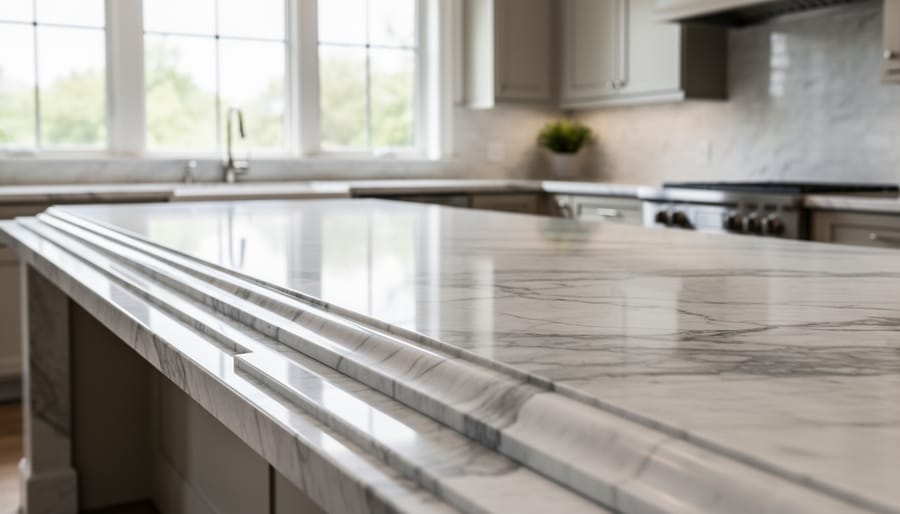
Premium and custom edge treatments like waterfall, dupont, or hand-carved details can cost $35 to $100+ per linear foot. These ornate profiles demand extensive labor, specialized equipment, and experienced craftspeople. Double or stacked edges, where two pieces of marble are laminated together for added thickness and visual impact, also fall into this premium category.
Custom fabrication requests beyond edge profiles—such as integrated drainboards, decorative inlays, or unique cutouts—are typically quoted separately based on complexity and labor hours required. These bespoke elements can add several hundred to thousands of dollars depending on the intricacy of your design vision.
Sink Cutouts, Plumbing, and Modifications
Beyond the base price of marble, countertop modifications represent significant additional expenses that often catch homeowners off guard. Understanding these costs upfront helps you budget accurately and avoid surprises during installation.
Sink cutouts typically range from $100 to $200 for standard undermount installations, with farmhouse sinks costing $200 to $400 due to the front apron exposure requiring precise fabrication. Each additional cutout for soap dispensers or hot water taps adds $50 to $75. Cooktop cutouts for ranges command premium pricing at $200 to $500, as fabricators must ensure perfect measurements and reinforced edges to handle heat exposure.
Faucet hole drilling costs $40 to $75 per hole, though many modern installations use deck-mounted faucets that eliminate this expense. Edge profiling around cutouts may incur additional charges of $10 to $20 per linear foot beyond standard edges.
Complex layouts dramatically increase costs. L-shaped configurations with seams require precise alignment and color matching, adding $200 to $500 in fabrication fees. Island installations with overhangs exceeding 10 inches need structural support brackets or corbels, costing $100 to $300 per support. Cutouts for electrical outlets in backsplashes run $75 to $150 each.
Angled cuts, radius corners, and custom shapes increase fabrication time substantially, potentially adding 20 to 40 percent to your base installation cost. Discuss all layout requirements during the initial quote to ensure accurate pricing and avoid change orders that carry premium rates.
How Kitchen Size and Layout Affect Your Total Investment
Your kitchen’s dimensions and configuration significantly influence your total marble countertop investment, often more than homeowners initially anticipate. Understanding these spatial factors helps you develop realistic budget expectations and avoid surprises during the installation process.
Square footage represents the most obvious cost driver. Fabricators calculate pricing per square foot, but the relationship between size and cost isn’t always linear. Small kitchens typically range from 25-40 square feet of countertop space, resulting in material costs between $1,875 and $6,000 for mid-range marble at $75-150 per square foot installed. Medium kitchens with 50-75 square feet might cost $3,750-11,250, while large kitchens exceeding 100 square feet can easily surpass $15,000 for premium varieties.
Kitchen layout introduces complexity beyond simple measurements. L-shaped and galley kitchens often require fewer seams than U-shaped or island configurations. Each seam adds $150-300 to your project, as fabricators must precisely align veining patterns and polish edges. Complex layouts with angled corners, curved edges, or custom cutouts for sinks and cooktops increase fabrication time and material waste, driving up costs proportionally.
The waste factor deserves careful consideration in your budget planning. Fabricators must cut marble slabs to accommodate your specific dimensions, and this process typically generates 15-35 percent waste depending on layout complexity. Irregular shapes, multiple cutouts, and diagonal installations produce more waste. You’re essentially paying for this unused material, as fabricators purchase full slabs. A kitchen requiring 50 square feet of finished countertop might actually need 60-65 square feet of raw material.
Islands present additional considerations since they’re visible from multiple sides and may require waterfall edges or decorative treatments. These features can add $500-2,000 depending on design complexity. When planning your investment, request detailed measurements from your fabricator and discuss how your specific layout impacts the final square footage calculation, including waste allowances and seam placement strategies.
Long-Term Ownership Costs: Maintenance and Care
Annual Sealing and Routine Maintenance
Marble’s porous nature means ongoing maintenance is essential to preserve its beauty and represents a real cost factor in ownership. Professional resealing typically ranges from $200 to $500, recommended every 6 to 12 months depending on usage intensity. For those handling marble maintenance requirements themselves, quality penetrating sealers cost $15 to $60 per bottle, with each bottle covering approximately 150 square feet.
Daily care products add another layer of expense. pH-neutral stone cleaners run $10 to $25 per bottle, while specialized marble polishing compounds cost $20 to $40. Budget approximately $100 to $200 annually for routine cleaning supplies. Some homeowners invest in poultice kits for stain removal, priced at $25 to $50 each.
Over a 10-year period, maintenance costs can total $2,000 to $4,000 when combining professional resealing, cleaning products, and occasional stain treatment. While this represents an ongoing investment, proper maintenance significantly extends your countertop’s lifespan and preserves its value, making it a necessary consideration in your total cost of ownership calculation.

Repair and Restoration Expenses
Marble repair costs vary significantly depending on the type and severity of damage. Surface etching from acidic substances, one of the most common issues, typically costs $200 to $400 for professional buffing and polishing to restore the finish. Minor chips and edge repairs range from $150 to $300 per location, while larger chips may cost $300 to $600 depending on complexity and matching requirements.
Crack repairs present more substantial expenses, starting at $300 for simple hairline cracks and reaching $800 to $1,500 for extensive damage requiring epoxy filling, color matching, and refinishing. Deep scratches that penetrate beyond the surface layer cost approximately $250 to $500 to repair professionally.
Full countertop restoration, including deep cleaning, honing, and resealing, runs between $5 and $15 per square foot. For a standard 30-square-foot countertop, expect to pay $150 to $450 for complete restoration services. Keep in mind that severe staining, especially from rust or dyes, may require specialized poultice treatments adding $200 to $600 to restoration costs. Professional assessment is recommended for damage exceeding simple surface issues, as improper DIY repairs can further compromise the stone’s integrity and appearance.
Marble vs. Alternative Materials: The Cost Comparison
When evaluating countertop materials, marble typically falls in the premium price range at $75-$250 per square foot installed, but how does this compare to alternatives?
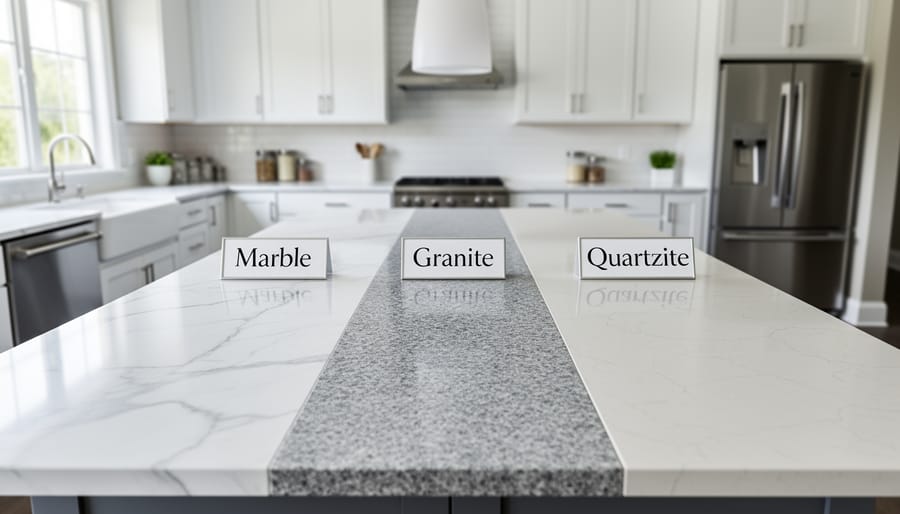
Granite countertops present the closest competitor, ranging from $50-200 per square foot installed. While high-end exotic granites can match marble’s price point, standard granite options often cost 15-25% less. Granite offers superior durability and scratch resistance, making it more forgiving for busy kitchens. However, marble’s distinctive veining and luxurious aesthetic remain unmatched.
Quartzite, increasingly popular among homeowners, costs $70-200 per square foot installed—comparable to marble. This natural stone combines marble-like aesthetics with granite-level durability. Though harder and more resistant to etching than marble, quartzite shares similar maintenance requirements and carries a premium price for exotic varieties.
Engineered quartz countertops range from $60-150 per square foot installed, positioning them slightly below marble on average. While comparing quartz and granite reveals different characteristics, quartz offers notable advantages over marble: zero porosity, no sealing requirements, and superior stain resistance. However, quartz cannot replicate marble’s natural depth and uniqueness, and heat resistance remains inferior to natural stone.
Beyond upfront costs, long-term value considerations shift the comparison. Marble requires annual sealing ($150-300) and more careful maintenance, potentially adding $2,000-3,000 over a decade. Granite and quartzite need similar sealing but tolerate daily use better. Quartz eliminates sealing costs entirely but may require professional repairs if damaged, which can be costly.
Resale value also factors into the equation. Marble countertops consistently appeal to luxury home buyers and can increase property value by 5-10% in appropriate markets. While granite offers similar returns, quartz may not command the same premium despite its practical advantages.
For kitchen applications prioritizing durability, granite or quartz often provides better value. However, for bathroom vanities, powder rooms, or spaces where marble’s elegance takes center stage, the investment frequently justifies itself through aesthetic impact and timeless appeal. The best choice depends on your specific space, usage patterns, and whether you value natural beauty over maintenance convenience.
Smart Ways to Reduce Costs Without Sacrificing Quality
Smart marble countertop investments start with choosing the right variety. While Calacatta and Statuario command premium prices, equally beautiful options like Carrara, Crema Marfil, or Emperador offer timeless elegance at 30-50% lower costs. These classic varieties provide the luxurious marble aesthetic without stretching your budget to its limits.
Timing your purchase strategically can yield significant savings. Many fabricators offer reduced rates during slower seasons, typically late fall and winter months. Additionally, attending stone yard clearance sales or end-of-year inventory reductions can uncover substantial discounts on quality slabs. Building relationships with local fabricators often leads to insider information about upcoming promotions.
Edge profile selection dramatically impacts your final cost. While ogee, dupont, and other decorative edges add visual interest, they require additional labor and material. Standard eased or bullnose edges provide clean, attractive finishes at considerably lower prices—sometimes saving $10-20 per linear foot. For modern kitchens, these simpler profiles often better complement contemporary design aesthetics anyway.
For smaller projects like bathroom vanities, islands, or backsplashes, using remnants presents an excellent cost-saving opportunity. Remnants are leftover pieces from larger projects, typically sold at 25-40% discounts. Many fabricators maintain extensive remnant inventories in various marble varieties, providing access to premium stones at budget-friendly prices.
Selecting the right fabricator requires research beyond price comparison. Request multiple detailed quotes, verify licensing and insurance, check references, and review completed projects. Experienced fabricators with strong reputations often provide better value through superior craftsmanship, accurate measurements, and fewer costly mistakes. Lower initial quotes from inexperienced contractors frequently result in higher long-term expenses due to poor installation quality or damage requiring repairs. Investing time in finding reputable professionals protects both your budget and your investment’s longevity.
Regional Price Variations and When to Buy
Your location significantly impacts marble countertop costs, with price variations of 20-40% between regions. Urban markets in major metropolitan areas like New York, San Francisco, and Los Angeles typically command premium prices due to higher labor costs, often $70-$100 per hour compared to $40-$60 in rural areas. However, these cities also benefit from greater fabricator competition and established stone distribution networks, which can offset some expenses.
Shipping costs represent a substantial factor, especially for exotic marble varieties. Coastal cities with major ports often access imported marble at lower freight costs than inland locations. A Calacatta marble slab shipped to Miami might cost $200-$300 less than the same material delivered to a landlocked state requiring additional trucking. Regional stone availability also matters—areas near quarries naturally offer better pricing on locally sourced marble.
Seasonal timing affects both material availability and labor rates. Late fall and winter represent optimal buying periods when fabricators experience slower demand and may offer 10-15% discounts to maintain steady workflow. Avoid peak renovation seasons in spring and early summer when contractors operate at capacity and have less negotiating flexibility.
Successful negotiation starts with obtaining three to five competitive quotes. Fabricators are more willing to negotiate during project planning phases rather than during rushed timelines. Consider bundling multiple stone projects together or being flexible with remnant pieces for smaller applications like bathroom vanities. Ask about package deals that include fabrication, installation, and sealing services.
Local market research proves invaluable—join community forums or consult with designers familiar with regional pricing patterns. Some areas have stone wholesalers open to public sales, potentially saving 15-25% compared to retail fabricators while requiring you to arrange separate installation services.
Investing in marble countertops requires careful consideration of the complete cost picture beyond the initial purchase price. While you might budget $40 to $200 per square foot for materials and installation, remember that marble demands ongoing maintenance expenses including regular sealing, specialized cleaning products, and potential repairs over time. These long-term costs can significantly impact your total investment.
Before committing to marble, honestly assess whether its maintenance requirements align with your lifestyle. Families with young children, frequent entertainers, or those seeking low-maintenance surfaces may find marble’s susceptibility to etching and staining challenging. However, if you appreciate natural stone’s unique beauty and are prepared for attentive care, marble offers timeless elegance that can enhance your home’s value.
Get at least three detailed quotes from reputable fabricators and installers, ensuring each includes material costs, installation, edge profiles, cutouts, and sealing. Compare not just pricing but also warranties, experience with marble specifically, and customer reviews. Factor in annual maintenance costs when calculating your budget. By thoroughly researching and planning, you’ll make an informed decision that balances aesthetic preferences with practical considerations and financial realities.