
Showing 6 Result(s)
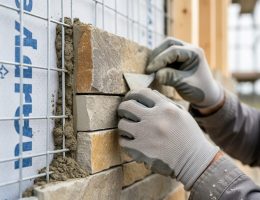
Mason’s gloved hands fastening a natural stone veneer piece onto galvanized metal lath with stainless steel ties on a partially finished exterior wall, shot at eye level under soft overcast light with blurred scaffolding and weather barrier behind
Codes, Standards & Compliance

How Anchored Stone Veneer Meets Modern Building Codes (Without the Headaches)

Anchored stone veneer transforms building exteriors with authentic natural stone beauty while meeting stringent structural requirements that protect both property and occupants. Unlike thin adhesive-applied veneers, this system mechanically fastens each stone unit to the building structure using corrosion-resistant ties and metal lath, creating a durable exterior cladding capable of withstanding wind loads, seismic forces, and decades of weather exposure.
Building codes governing anchored stone veneer installations have evolved significantly, particularly following updates to the International Building Code and International …
Low-angle photo of a modern high-rise with natural stone cladding at the corner, sharp panel joints and texture visible, with fast-moving clouds and a distant skyline in the background.
Codes, Standards & Compliance

Why Stone Cladding Fails Without Proper Wind Load Engineering

Understanding ASCE 7 wind load requirements is essential for any stone cladding project’s structural integrity and longevity. The American Society of Civil Engineers standard ASCE 7 provides the framework for calculating wind pressures that stone facades must withstand, with requirements varying significantly based on building height, geographical location, exposure conditions, and terrain characteristics.
Stone cladding systems face unique challenges under wind loads. Unlike lighter facade materials, natural stone’s mass creates different stress patterns on anchoring systems, while its rigidity means less deflection …

Stone veneer exterior wall assembly in a test lab during a fire test, flames venting from a window opening toward the upper facade, with blurred scaffolding and safety equipment in the background.
Codes, Standards & Compliance

Why Stone Veneer Facades Must Pass NFPA 285 (And What Happens If They Don’t)

NFPA 285 determines whether your stone veneer façade project can legally proceed on buildings with combustible wall assemblies—and misunderstanding this fire safety standard costs the construction industry millions in project delays, redesigns, and compliance failures every year.
This fire test standard, officially titled “Standard Fire Test Method for Evaluation of Fire Propagation Characteristics of Exterior Wall Assemblies Containing Combustible Components,” evaluates how quickly flames can spread vertically and horizontally across a building’s exterior when combustible materials like foam insulation exist …

Low-angle close-up of textured granite floor with water droplets as a rubber-soled shoe and white mobility cane tip step securely in a modern lobby, with blurred glass doors and plants in the background.
Codes, Standards & Compliance

Why Most Stone Floors Fail ADA Slip Resistance Standards (And How to Fix Yours)

Understanding ADA slip resistance requirements protects building occupants from falls while ensuring your project meets federal accessibility standards. The Americans with Disabilities Act (ADA) mandates a minimum Dynamic Coefficient of Friction (DCOF) of 0.42 for level surfaces and walkways, measured using the DCOF AcuTest according to ANSI A137.1 standards. This threshold applies to both wet and dry conditions, making surface selection particularly critical for natural stone installations in entrances, bathrooms, commercial kitchens, and other areas exposed to moisture.
Specify the appropriate stone finish from the outset based on…

Gloved engineer tightens a stainless steel anchor bracket securing a stone cladding panel to concrete, low-angle view with a blurred high-rise facade and crane in the background under soft overcast light
Codes, Standards & Compliance

How IBC Seismic Certification Keeps Your Stone Cladding From Falling Off Buildings

Understanding IBC seismic certification requirements separates compliant stone cladding installations from potential structural liabilities. When stone veneer exceeds four stories or 40 feet in height in seismic design categories D, E, or F, the International Building Code mandates specific anchoring systems, detailed structural calculations, and often third-party testing to verify the installation can withstand lateral forces without failure.
Verify your project’s seismic design category through local building departments, as this single classification determines whether you need standard attachment methods or enhanced …

Cutaway view of a natural stone facade showing concealed clips, ventilated rainscreen cavity, continuous rigid insulation, and air/water barrier on a modern building, with a softly blurred construction site and skyline in the background.
Codes, Standards & Compliance

How Stone Facades Pass Modern Energy Codes (And Save You Money)

Natural stone facades can absolutely meet today’s stringent building energy codes—when designed and installed as part of a properly engineered wall assembly. The key is understanding that energy efficiency doesn’t depend on the stone itself, but rather on the insulation, air barriers, and moisture management layers working behind it.
Building energy codes like the International Energy Conservation Code (IECC) and ASHRAE 90.1 establish minimum thermal performance standards for exterior walls, typically requiring R-values between R-13 and R-25 depending on climate zone. Stone cladding functions as the aesthetic and …