
Showing 8 Result(s)
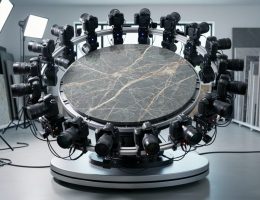
Circular array of DSLR cameras forming a photogrammetry rig around a veined natural stone slab on a motorized turntable in a studio, side-lit to highlight texture, with workshop equipment softly blurred in the background.
Digital Design and Modeling

How a Photogrammetry Rig Captures Every Detail of Natural Stone

Photogrammetry rigs are transforming how the natural stone industry captures, preserves, and shares the intricate beauty of stone materials through precise digital documentation. These specialized camera setups use multiple synchronized photographs taken from different angles to create highly accurate 3D digital models of stone slabs, entire quarry faces, and architectural installations.
The technology works by positioning cameras in a circular or spherical array around the subject, …
Architect wearing a VR headset evaluates a life-size virtual marble wall with vein-matched panels and a quartzite island in a modern studio, with stone samples and blurred monitors in the background.
Digital Design and Modeling

See Your Stone Before You Buy: How VR Prototyping Transforms Natural Stone Projects

Visualize your natural stone installation before a single slab is cut. Virtual reality prototyping transforms how architects, designers, and fabricators approach stone projects by creating immersive 3D environments where materials, patterns, and spatial relationships come alive at full scale. Walk through a marble-clad lobby, examine vein matching across multiple slabs, or test different edge profiles on a quartzite countertop—all before committing to fabrication costs or irreversible cuts.
This technology addresses the fundamental challenge in natural stone design: each piece is unique, and traditional 2D drawings or physical …

Architect holding a tablet with a 3D BIM model of a limestone cladding system at a construction site, with stacked stone panels and stainless anchors in the foreground and a partially installed facade with scaffolding in the background.
Digital Design and Modeling

How BIM Software Is Transforming Natural Stone Installation (And Saving Thousands)

Building Information Modeling (BIM) software has transformed how natural stone projects move from concept to installation, enabling architects and fabricators to visualize complex assemblies, detect clashes before construction begins, and coordinate multi-trade installations with millimeter precision. This digital approach replaces traditional 2D drawings with intelligent 3D models that contain detailed information about each stone element—from material specifications and finish types to installation sequences and structural connections.
The stone industry faces unique challenges that make BIM particularly valuable: heavy …

Close-up angled photo of granite, marble, and limestone samples on a workbench, an analog caliper touching a slab edge, and water droplets beading on polished granite, with blurred stoneworking tools and a thin stone strip resting across two supports in the background.
Digital Design and Modeling

Why Natural Stone Behaves the Way It Does (And What That Means for Your Project)

Physical material properties determine whether natural stone will thrive or fail in your specific application. Density dictates weight loads and structural requirements—a low-density limestone at 135 pounds per cubic foot demands different installation approaches than a dense granite exceeding 180 pounds per cubic foot. Water absorption rates reveal vulnerability to staining, freeze-thaw damage, and weathering, with rates below 0.5% indicating superior resistance for exterior applications while porous stones above 3% require rigorous sealing protocols in moisture-prone environments. Compressive strength measurements, typically ranging …

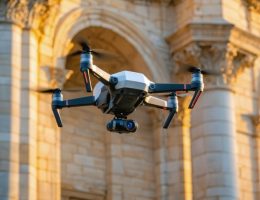
Quadcopter drone hovering near an ornate limestone building facade at golden hour, capturing detailed images for 3D photogrammetry with carved stone textures clearly visible and a softly blurred city street behind
Digital Design and Modeling

How Drones Are Transforming Stone Measurement and Installation Accuracy

Drones equipped with high-resolution cameras are revolutionizing how stone contractors, architects, and designers capture and model building facades, quarry sites, and historical stone structures. UAV photogrammetry transforms hundreds of aerial photographs into precise 3D models and measurements, eliminating the need for scaffolding, manual measurements, and dangerous climbing while delivering millimeter-level accuracy that traditional surveying methods cannot match at comparable costs.
This technology solves critical challenges in natural stone projects: documenting existing conditions for restoration work, measuring complex …

A quarry worker with natural stone tools on one side and a high-tech 3D digital twin of a stone project on a screen with holographic data on the other side, symbolizing the integration of traditional craftsmanship and digital innovation.
Digital Design and Modeling

3D Digital Twins Transform Natural Stone Projects: From Quarry to Installation

In the rapidly evolving landscape of digital construction and design, 3D digital twins are revolutionizing how we interact with natural stone projects. These exact virtual replicas capture every detail, texture, and characteristic of physical stone installations, enabling unprecedented levels of analysis, planning, and optimization.
Imagine walking through a detailed virtual representation of your stone project before a single slab is cut. From quarry to final installation, 3D digital twins are transforming how architects, designers, and stone professionals visualize, plan, and execute their projects. This technology creates a …

A conceptual image comparing traditional and AI-driven stone texture mapping, showing a transition from manual design tools to advanced digital visualization technologies.
Digital Design and Modeling

AI-Powered Stone Mapping: Transform Your Natural Stone Design Process

Texture mapping revolutionizes how we visualize and design natural stone surfaces, bridging the gap between digital conception and physical reality. By precisely mapping high-resolution images onto 3D models, this groundbreaking technology enables designers to accurately preview how stone patterns, veining, and surface variations will appear in finished installations. Working alongside parametric design in stone architecture, texture mapping has transformed the way architects and designers approach …

A futuristic building facade featuring an intricate pattern of stone elements created through parametric design, illustrating the seamless blend of traditional and modern architectural techniques.
Digital Design and Modeling

How Advanced Parametric Design Is Revolutionizing Stone Architecture

At the intersection of ancient craftsmanship and cutting-edge technology, advanced architectural stone is revolutionizing how we design and construct our most ambitious buildings. Through parametric design fundamentals, modern architects are pushing the boundaries of what’s possible with natural stone, creating structures that were unimaginable just decades ago.
Today’s architectural stone applications combine computational design, robotic fabrication, and sophisticated material science to transform solid rock into fluid, organic forms. From ultra-thin stone veneers reinforced with…