
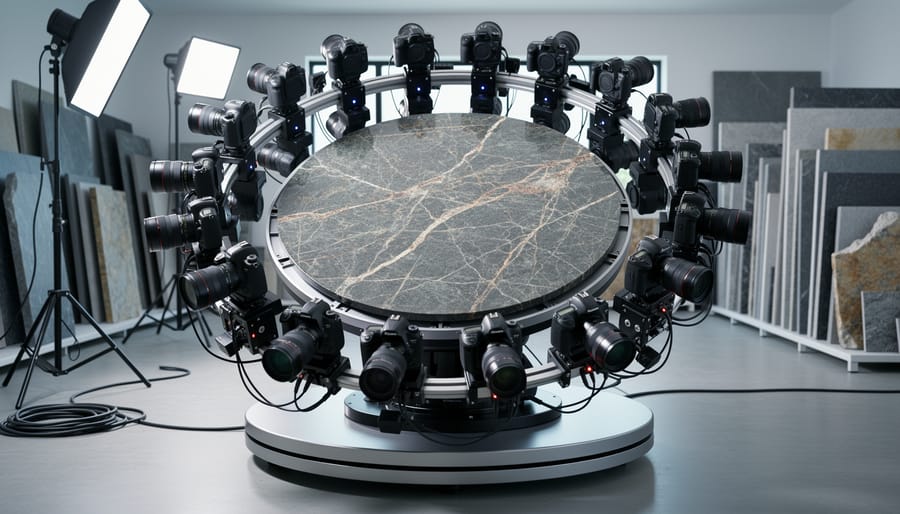
Photogrammetry rigs are transforming how the natural stone industry captures, preserves, and shares the intricate beauty of stone materials through precise digital documentation. These specialized camera setups use multiple synchronized photographs taken from different angles to create highly accurate 3D digital models of stone slabs, entire quarry faces, and architectural installations.
The technology works by positioning cameras in a circular or spherical array around the subject, capturing hundreds of overlapping images that software processes into detailed three-dimensional representations. Unlike traditional photography, photogrammetry rigs measure actual dimensions, surface textures, and color variations with millimeter-level precision, making them invaluable for architects selecting stone materials remotely, fabricators planning complex installations, and quarry operators documenting inventory.
Modern photogrammetry rigs range from simple DIY turntable setups with a single DSLR camera to sophisticated automated systems featuring dozens of industrial cameras, controlled lighting, and integrated software workflows. The investment varies accordingly, from a few hundred dollars for basic configurations to tens of thousands for professional-grade installations.
For stone industry applications, these rigs solve critical challenges: enabling remote material selection, preserving historical documentation of unique slabs, facilitating accurate fabrication planning, and creating immersive digital showrooms. The resulting models can be manipulated, measured, and shared instantly across global teams, fundamentally changing how natural stone is specified, sold, and installed in contemporary projects.
What Is a Photogrammetry Rig?
A photogrammetry rig is a specialized system designed to capture multiple high-resolution photographs of an object from various angles simultaneously or in rapid succession. In the context of natural stone documentation, these rigs have revolutionized how the industry creates accurate digital representations of stone slabs, samples, and installations.
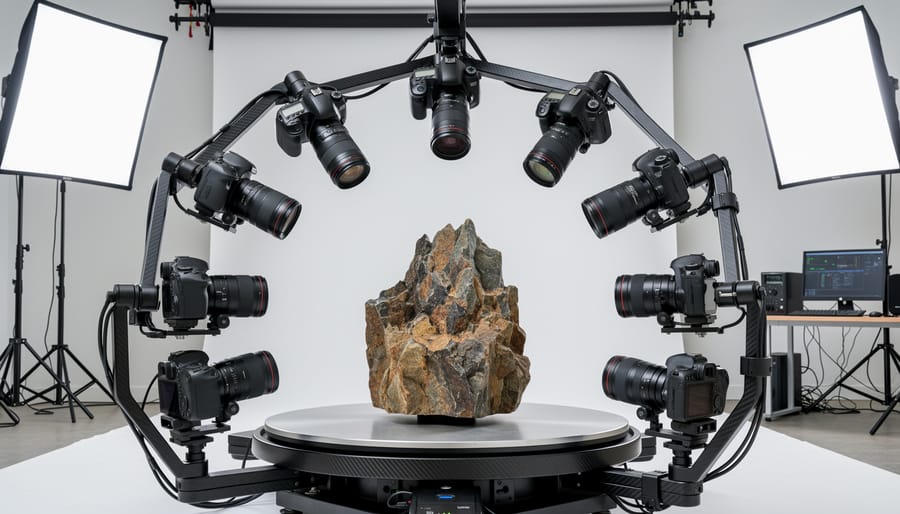
At its core, a photogrammetry rig consists of several essential components working in harmony. The primary element is a camera array, typically featuring multiple DSLR or mirrorless cameras positioned at strategic angles around the subject. These cameras can range from a modest setup of 24 cameras to elaborate systems incorporating 100 or more cameras, depending on the required detail level and coverage area.
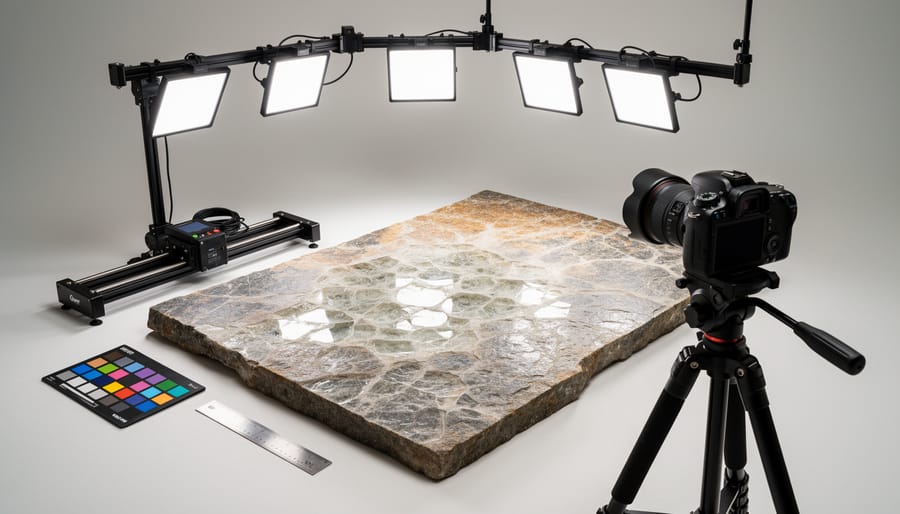
Lighting systems form another critical component, ensuring consistent, shadow-free illumination across the stone surface. Professional rigs employ calibrated LED panels or strobe lights positioned to eliminate glare and accurately capture the stone’s natural colors, veining patterns, and texture variations. This controlled lighting environment is essential for documenting the subtle characteristics that make each stone slab unique.
Many photogrammetry rigs also incorporate motorized turntables or robotic arms that rotate the stone sample or move cameras around stationary slabs. This automated movement ensures complete coverage while maintaining precise positioning data crucial for the reconstruction process.
The final component is sophisticated software integration that synchronizes camera triggers, manages image capture sequences, and processes the resulting photographs into detailed 3D models. This software translates hundreds or thousands of overlapping images into accurate digital representations.
The advantage of photogrammetry rigs over single-camera methods is substantial. While traditional photography requires manual repositioning between each shot, creating inconsistencies and extending capture time, rig systems photograph an entire stone slab in seconds. This speed reduces labor costs, minimizes human error, and enables stone suppliers to digitize their entire inventory efficiently, providing architects and designers with comprehensive digital catalogs for project planning and material selection.
Why Natural Stone Needs Specialized Capture Technology
Natural stone presents extraordinary challenges for digital capture that standard photography simply cannot overcome. Unlike solid-colored materials, stone features intricate veining patterns, complex surface textures, subtle color gradations, and varying degrees of translucency that change dramatically under different lighting conditions. Materials like marble and onyx can allow light to penetrate several millimeters beneath the surface, creating an internal glow that flat photography misses entirely.
Traditional photography captures only a single perspective under fixed lighting, which fails to record the dimensional depth of stone’s surface texture or the way light interacts with crystalline structures within the material. A polished granite countertop might appear uniformly dark in a standard photo, completely obscuring the sparkling mineral deposits and color variations visible to the human eye. Similarly, the reflective properties of honed or polished finishes create hotspots and glare that distort the stone’s true appearance in conventional images.
Photogrammetry rigs solve these problems through a systematic approach that captures stone from multiple angles under controlled, consistent lighting. By photographing a stone slab from dozens or even hundreds of positions, the rig’s software can triangulate exact surface topography, creating a three-dimensional model that preserves every texture detail. The controlled lighting environment eliminates inconsistent shadows and reflections while specialized polarizing filters manage glare from polished surfaces.
This comprehensive capture method records not just what stone looks like from one viewpoint, but how its appearance transforms as perspective and light change. The resulting digital model accurately represents the stone’s depth, texture, veining complexity, and光泽 characteristics, giving designers and customers a truly realistic preview of how the material will appear in their projects.
Types of Photogrammetry Rigs for Stone Applications
Turntable-Based Rigs
Turntable-based rigs represent the most accessible entry point into photogrammetry for stone suppliers and showrooms. These systems feature a motorized rotating platform that spins stone samples while one or more fixed cameras capture images at precise intervals. The setup is straightforward: position your stone slab or sample on the turntable, set your desired rotation increments, and let the system automatically photograph the specimen from every angle.
This configuration excels at digitizing smaller stone samples, decorative pieces, and cut slabs typically under 100 pounds. The automated rotation ensures consistent spacing between shots, which translates to more reliable 3D models. Many stone suppliers have adopted turntable rigs for their showrooms, allowing customers to virtually examine samples before committing to full slabs.
The primary advantage lies in repeatability and efficiency. Once calibrated, a turntable rig can digitize dozens of samples daily with minimal operator intervention. This makes it particularly valuable for suppliers maintaining extensive digital catalogs or offering online selection tools. While turntable systems cannot accommodate full-sized slabs due to weight and dimension constraints, they provide an economical solution for creating comprehensive libraries of stone varieties, enabling remote customer consultations and reducing the need for physical sample shipments.
Fixed-Object Camera Array Rigs
For capturing larger stone installations like countertops, backsplashes, or architectural features already in place, fixed-object camera array rigs provide an efficient solution. These systems position multiple cameras in a circular or dome-shaped configuration around the stationary stone piece, with all cameras triggered simultaneously to capture the subject from numerous angles at once.
This approach offers significant advantages when digitizing installed stonework that cannot be easily moved or rotated. A typical fixed array might include anywhere from 24 to over 100 cameras, depending on the size and complexity of the stone installation being captured. The synchronized capture ensures consistent lighting conditions across all images and dramatically reduces total scanning time compared to single-camera methods.
Fixed-object rigs excel at documenting completed stone projects for portfolio purposes, creating digital archives of custom installations, or generating accurate 3D models for renovation planning. The technology proves particularly valuable for architects and designers who need precise measurements of existing stone features without physical access or invasive measuring techniques. While these systems require more substantial initial investment and dedicated space, they deliver professional-grade results with minimal processing time, making them ideal for high-volume commercial applications in the stone industry.
Hybrid and Portable Systems
For professionals who need flexibility across multiple environments, hybrid photogrammetry rigs offer the best of both worlds. These systems combine automated components with portable features, making them ideal for documenting stone at quarries, fabrication facilities, and construction sites where conditions vary.
A typical hybrid setup might include a collapsible rotating platform paired with removable camera mounts and portable LED lighting panels. The modular design allows users to configure the rig based on available space and power sources. At a quarry, you might deploy the full automated rotation system for detailed block documentation. On a construction site, the same components can be reconfigured for manual operation, capturing installed stone elements like façades or countertops.
These rigs typically feature wheeled bases for easy transport and quick-release camera brackets that accommodate different equipment needs. Battery-powered options eliminate dependence on electrical outlets, crucial when working in remote quarry locations or active construction zones. Some systems include weather-resistant components, protecting sensitive electronics from dust and moisture common in stone-working environments.
The investment in hybrid systems pays dividends for businesses that serve diverse clients. Stone suppliers use them to create digital libraries of quarry blocks, while fabricators document custom installations for archive purposes. The flexibility means one rig serves multiple documentation needs, from creating detailed 3D models for client presentations to generating accurate measurements for restoration projects. This versatility makes hybrid rigs particularly valuable for mid-sized operations seeking professional results without maintaining separate equipment for different scenarios.
Real-World Applications in the Stone Industry
Virtual Stone Selection and Visualization
Once photogrammetry captures precise slab details, the real magic happens when clients experience virtual stone visualization in their actual spaces. Digital models created from photogrammetry rigs enable designers and homeowners to view exact slabs—complete with unique veining patterns, color variations, and natural characteristics—within their kitchen, bathroom, or commercial project before making a purchase commitment.
This technology significantly reduces buyer’s remorse and costly returns. Instead of relying on small samples that don’t represent the full slab’s appearance, clients can see how their specific stone selection will look under different lighting conditions and alongside existing finishes. AR visualization technology takes this further by overlaying digital stone models directly into physical spaces through smartphones or tablets.
The precision of photogrammetry-based models ensures what clients preview matches what gets installed, eliminating surprises about vein placement or color intensity. This transparency builds confidence in purchasing decisions, particularly for high-value materials like rare marble or exotic granite, where every slab represents a significant investment.

Archiving Rare and Historic Stone Specimens
Photogrammetry rigs serve a vital preservation role in documenting stone materials that are no longer accessible. When quarries close due to depletion or economic factors, the unique characteristics of their stone are lost forever unless properly archived. Digital scanning creates permanent 3D records of these materials, preserving their distinctive veining patterns, color variations, and textural qualities for future reference.
Heritage conservation projects particularly benefit from this technology. When restoring historic buildings, architects need to match original stone materials that may have been quarried centuries ago. A comprehensive digital archive allows professionals to search for the closest available alternatives or even recreate the appearance through advanced manufacturing techniques.
Museums and geological institutions now maintain growing libraries of scanned stone specimens, documenting everything from rare marbles to region-specific granites. These archives serve multiple purposes: they help designers specify appropriate materials for restoration work, assist geologists in research, and preserve cultural heritage. The high-resolution captures can reveal microscopic details invisible to the naked eye, creating reference materials far more detailed than traditional photography or physical samples alone. This democratizes access to rare specimens, allowing professionals worldwide to study materials they might never encounter in person.
Quality Control and Fabrication Planning
Once photogrammetry captures a stone slab’s precise geometry, the resulting 3D model becomes an invaluable quality control tool. Fabricators can digitally inspect slabs for structural weaknesses, fissures, or inclusions that might compromise the final installation. This virtual examination allows teams to identify potential issues before cutting begins, preventing costly material waste and project delays.
The detailed digital twin enables fabricators to plan cuts with millimeter-level precision. By overlaying template patterns onto the 3D model, teams can position design elements to showcase the stone’s best features while avoiding problem areas. This optimization ensures premium vein patterns appear exactly where designers intend them.
Integration with fabrication planning software takes this process further, automatically calculating the most efficient cutting layouts to maximize yield from each slab. The software accounts for the stone’s unique characteristics captured by photogrammetry, including thickness variations and surface irregularities. This digital-first approach has helped leading fabricators reduce material waste by up to 15% while improving project turnaround times and ensuring the finished installation matches the original design vision precisely.
Key Components of an Effective Stone Photogrammetry Setup
Lighting Requirements
Proper lighting is essential for photogrammetry rigs to accurately capture stone’s intricate surface details, color variations, and dimensional characteristics. The ideal setup employs diffused, multi-directional lighting that eliminates harsh shadows and reflective hotspots that can obscure natural texture. LED panels with adjustable color temperatures, typically positioned around the stone sample at multiple angles, ensure even illumination across all surfaces. Softboxes or diffusion materials help scatter light uniformly, preventing the glare that polished stone surfaces can produce under direct lighting. Many professional rigs incorporate cross-polarized lighting techniques to further reduce unwanted reflections while preserving authentic color rendition. The lighting arrangement should maintain consistent intensity throughout the capture session, as variations can create stitching errors in the final 3D model. When photographing highly reflective materials like polished granite or marble, graduated lighting setups may be necessary to balance exposure across different surface finishes, ensuring the resulting digital model accurately represents the stone’s true appearance.
Camera Specifications and Settings
Capturing stone’s intricate textures, veining patterns, and color variations requires careful attention to camera specifications. Full-frame sensors with at least 24 megapixels provide the resolution necessary to document fine surface details that distinguish one stone variety from another. Larger sensors also deliver superior dynamic range, essential for accurately rendering both the deep shadows in stone crevices and the subtle highlights on polished surfaces.
Prime lenses in the 35-50mm range offer excellent sharpness with minimal distortion, making them ideal for photogrammetry work. Select lenses with apertures between f/8 and f/11 to maximize depth of field while maintaining crisp detail across the entire stone surface. This ensures consistent focus from foreground to background in each capture.
Color accuracy demands proper white balance calibration using a gray card reference. Shoot in RAW format to preserve maximum color information, allowing post-processing adjustments that faithfully represent the stone’s natural appearance. Consistent lighting pairs with these camera settings to produce photogrammetry models that accurately showcase material characteristics for selection and specification purposes.
Software Processing Considerations
Capturing stone’s unique characteristics requires specialized photogrammetry software capable of addressing material-specific challenges. Natural stone surfaces present difficulties including reflectivity from polished finishes, complex color variations, and intricate texture patterns that can confuse standard processing algorithms.
Leading software solutions like Agisoft Metashape, RealityCapture, and 3DF Zephyr offer advanced features specifically beneficial for stone processing. These programs employ sophisticated algorithms that compensate for specular highlights on polished surfaces and accurately reconstruct fine details like veining patterns and crystalline structures.
When processing stone captures, software settings require careful adjustment. Increasing the number of tie points improves accuracy for complex textures, while advanced filtering options help eliminate artifacts caused by reflective surfaces. Modern programs also support high dynamic range processing, essential for capturing both deep shadows in textured stones and bright highlights on polished areas.
Cloud-based processing options are increasingly available, allowing professionals to handle large datasets from multi-camera rigs without investing in expensive local hardware. Most professional packages also integrate directly with CAD and 3D design software, streamlining workflows for architects and designers working with stone applications.
Benefits for Different Stakeholders
Photogrammetry rigs deliver distinct advantages across the entire stone industry supply chain, transforming how professionals work and how consumers make purchasing decisions.
For stone suppliers and quarry operators, these systems dramatically reduce the time required to create digital inventories. What once took days of manual measurement now happens in hours, allowing companies to showcase their entire stone selection online with precise 3D models. This digital catalog approach reduces the need for physical samples and showroom space, cutting overhead costs while expanding market reach to clients anywhere in the world.
Architects and designers gain unprecedented confidence in material selection. High-resolution digital models allow them to virtually place exact stone slabs into projects during the planning phase, eliminating guesswork about veining patterns, color distribution, and how multiple pieces will fit together. This visualization capability integrates seamlessly with digital stone design workflows, streamlining the creative process and reducing costly specification errors.
Fabricators benefit from improved precision in cutting and installation planning. Digital models generated by photogrammetry rigs enable exact measurements and automated cutting paths, minimizing material waste and reducing labor hours. The technology also facilitates better communication with clients, as fabricators can show customers exactly what their finished project will look like before cutting begins.
End consumers experience fewer surprises and greater satisfaction. Rather than selecting stone from small samples that may not represent the full slab’s character, buyers can examine complete digital replicas, making informed decisions that align with their aesthetic vision. This transparency builds trust and reduces returns or dissatisfaction after installation, benefiting everyone involved in the transaction.
Photogrammetry rigs are transforming how we interact with natural stone, bridging the gap between physical material and digital design. By creating highly accurate 3D models, this technology makes stone selection more accessible, efficient, and confident for everyone from homeowners planning renovations to architects designing large-scale projects. The ability to visualize exact color variations, veining patterns, and surface textures before making purchasing decisions eliminates much of the uncertainty traditionally associated with natural stone selection.
As this technology continues to evolve and become more widespread, we can expect even greater integration with design software, virtual reality experiences, and online visualization tools. The future of stone selection lies in these digital representations that maintain the authenticity and beauty of the physical material while offering unprecedented convenience and precision.
When choosing a natural stone supplier, consider those who have invested in photogrammetry technology. This commitment to innovation demonstrates a dedication to customer service and transparency that extends beyond the scanning equipment itself. The stone industry is entering an exciting era where ancient materials meet cutting-edge technology, making premium stone more accessible and easier to work with than ever before.