Showing 34 Result(s)
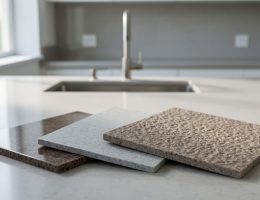
Three granite sample tiles—polished glossy, honed matte, and leathered textured—fanned out on a countertop under soft natural light, with a contemporary kitchen sink and faucet blurred in the background.
Granite Countertops

The Texture That Makes or Breaks Your Granite Countertop

Granite countertop texture determines far more than visual appeal—it directly impacts maintenance requirements, stain resistance, and daily functionality in your kitchen or bathroom. The surface finish you select influences everything from how easily spills wipe clean to whether bacteria can harbor in microscopic pores, making this decision critical for both aesthetics and practicality.
Three primary texture categories dominate the granite countertop market: polished finishes deliver mirror-like shine and maximum stain resistance through tightly sealed pores; honed surfaces offer a smooth, matte appearance that conceals …
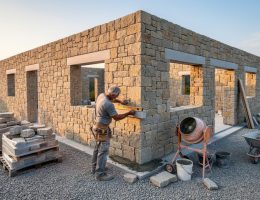
Eye-level wide photo of a partially built stone house with thick mortared walls as a mason sets an ashlar block at a corner; fieldstone pallets, a mortar mixer, and wooded hills appear in the background under warm evening light.
Design Applications

Building Your Dream Stone House: What You Need to Know Before Breaking Ground

Building with natural stone creates structures that can last centuries while offering unmatched thermal mass, fire resistance, and timeless aesthetic appeal. Before breaking ground, understand that stone construction requires 30-50% more time than conventional building methods and typically costs $200-400 per square foot depending on stone type, wall thickness, and regional labor rates.
Start by selecting your stone based on local availability and structural requirements. Fieldstone costs $50-150 per ton and works well for walls 18-24 inches thick, while quarried ashlar stone provides uniform dimensions at $8-25 per square foot but …

Contemporary stone home with dry-stacked limestone walls, floor-to-ceiling glass, and a cantilevered upper level at sunset, with native grasses and distant hills; interior polished stone floor visible through the glazing.
Stone Art and Design

Stone Houses That Redefine Contemporary Living

Stone houses today merge ancient durability with cutting-edge architectural vision, creating residences that stand as testaments to timeless elegance and environmental responsibility. Where medieval castles once dominated hillsides, contemporary stone homes now showcase transparent walls, cantilevered volumes, and minimalist geometries—all anchored by the raw, textured beauty of natural rock.
The resurgence of stone in residential architecture reflects a fundamental shift in how we approach sustainable living. Modern architects harness limestone, granite, sandstone, and slate not merely as structural elements but as design …

Architect holding a tablet with a 3D BIM model of a limestone cladding system at a construction site, with stacked stone panels and stainless anchors in the foreground and a partially installed facade with scaffolding in the background.
Digital Design and Modeling

How BIM Software Is Transforming Natural Stone Installation (And Saving Thousands)

Building Information Modeling (BIM) software has transformed how natural stone projects move from concept to installation, enabling architects and fabricators to visualize complex assemblies, detect clashes before construction begins, and coordinate multi-trade installations with millimeter precision. This digital approach replaces traditional 2D drawings with intelligent 3D models that contain detailed information about each stone element—from material specifications and finish types to installation sequences and structural connections.
The stone industry faces unique challenges that make BIM particularly valuable: heavy …

Low-angle view of a steel A-frame racking system holding large granite and marble slabs, with visible base plates and expansion bolts securing the rack to a reinforced concrete floor; softly lit workshop cranes and saws appear blurred in the background.
Safety and Risk Management

Why Stone Slabs Fall Over (And How Racking Structures Prevent Catastrophic Accidents)

Assess your current racking system by measuring the width-to-height ratio—any structure taller than four times its base width enters high-risk territory for tip-over incidents. Stone fabrication facilities face unique stability challenges because natural stone slabs create massive concentrated loads that shift during access, making proper racking design a life-or-death consideration rather than a simple storage solution.
Install anti-tip anchoring systems that secure racking structures to reinforced concrete floors using expansion bolts rated for seismic zones, even in non-earthquake regions. The lateral forces from accessing a …

Modern living room with thick limestone floor and granite accent wall illuminated by low winter sunlight through south-facing windows, with a snowy garden softly blurred outside.
Technical Properties

How Natural Stone Keeps Your Home Warmer in Winter (And Cooler in Summer)

Walk through any centuries-old stone cathedral on a summer afternoon and you’ll experience thermal mass in action—cool interior air despite blazing outdoor temperatures, without any modern HVAC system. This natural phenomenon occurs because dense materials like stone, concrete, and brick absorb heat slowly during the day and release it gradually at night, creating stable indoor temperatures that can reduce heating and cooling costs by 25-30% in well-designed spaces.
Thermal mass isn’t just an ancient building technique—it’s a practical solution for modern homes and commercial buildings facing rising energy …

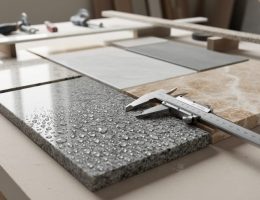
Close-up angled photo of granite, marble, and limestone samples on a workbench, an analog caliper touching a slab edge, and water droplets beading on polished granite, with blurred stoneworking tools and a thin stone strip resting across two supports in the background.
Digital Design and Modeling

Why Natural Stone Behaves the Way It Does (And What That Means for Your Project)

Physical material properties determine whether natural stone will thrive or fail in your specific application. Density dictates weight loads and structural requirements—a low-density limestone at 135 pounds per cubic foot demands different installation approaches than a dense granite exceeding 180 pounds per cubic foot. Water absorption rates reveal vulnerability to staining, freeze-thaw damage, and weathering, with rates below 0.5% indicating superior resistance for exterior applications while porous stones above 3% require rigorous sealing protocols in moisture-prone environments. Compressive strength measurements, typically ranging …

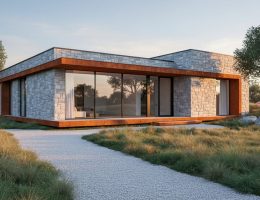
Contemporary limestone-clad house with large floor-to-ceiling windows and weathered steel accents, photographed at eye level from a three-quarter angle at golden hour, surrounded by native grasses and mature trees.
Stone-Inspired Architectural Legacies

Why Contemporary Stone Houses Outlast Modern Trends (And Save You Money)

Contemporary stone houses represent architecture’s most compelling intersection of timeless durability and forward-thinking sustainability. While glass, steel, and concrete dominate modern construction conversations, natural stone delivers superior thermal mass, zero off-gassing, and a carbon footprint that decreases over the building’s 100-plus year lifespan. Recent studies show stone-clad homes reduce heating and cooling costs by 25-30% compared to conventional construction, with materials that require minimal processing and generate virtually no construction waste.
The contemporary application differs dramatically …

Gloved hand smoothing clear epoxy into a small chip on a light gray quartz countertop with a razor blade, with a minimalist kitchen softly blurred in the background.
Quartz Countertops

Your Quartz Countertop Just Cracked — Here’s How to Fix It Without Replacing

Assess damage severity before attempting repairs by examining whether chips are surface-level or penetrate through multiple layers, as this determines whether DIY methods will suffice or professional intervention is necessary. Surface chips smaller than a quarter inch typically respond well to epoxy-based repair kits, while deeper cracks or extensive damage require professional resin injection to prevent moisture infiltration and structural compromise.
Clean the damaged area thoroughly with isopropyl alcohol and allow complete drying before applying any repair materials, as residual oils, cleaning products, or moisture create …

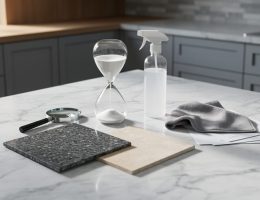
Polished marble kitchen island photographed from above with an hourglass, magnifying glass, granite and limestone sample tiles, and an unlabeled cleaning spray with microfiber cloth on a stack of papers; blurred cabinets and stone backsplash in the background.
General Comparison and Selection

Why Your Stone Installation’s 1-Year Warranty Might Not Be Enough

Evaluate your natural stone purchase through the lens of warranty duration versus material longevity. A 1-year warranty typically covers manufacturing defects, installation errors, and premature deterioration—but granite, marble, and quartzite naturally endure for decades when properly maintained. This mismatch between coverage period and material lifespan requires you to assess what protection you actually need.
Compare warranty terms against the stone’s inherent vulnerability. Polished granite requires minimal intervention and rarely develops issues within the first year, making extended warranties less critical. …