Showing 9 Result(s)
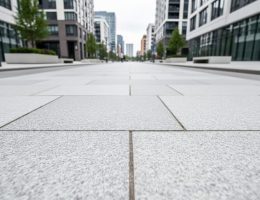
Low-angle view of an urban plaza pathway paved with large quartz stone slabs, showing uniform color and detailed textured surface.
Stone Lifestyle Integration

Quartz Natural Stone: Why It’s Reshaping Urban Landscape Design in 2026

Quartz natural stone brings exceptional hardness, visual consistency, and weather resistance to landscape projects, making it a practical choice for urban plazas, high-traffic pathways, and exposed site conditions where durability matters most. Unlike softer sedimentary materials that weather unpredictably or granite that shows wide color variation within a single shipment, quartz delivers reliable performance and tighter aesthetic control across large installations.
For landscape architects and project specifiers working in 2026, understanding quartz’s material properties helps answer critical questions about longevity, …
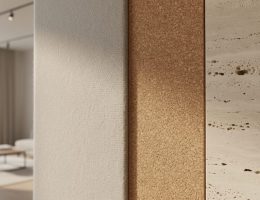
Natural acoustic materials in a modern interior, showing textured wool, cork or wood-fiber panels, and porous limestone/travertine stone surfaces for sound absorption.
Stone Lifestyle Integration

What Are Natural Sound Absorbing Materials (and How Do They Work in Acoustic Design)?

Natural sound absorbing materials are porous or fibrous substances derived from renewable biological sources or geological formations that reduce noise levels by converting sound energy into minimal heat through friction within their structure. These materials include wool, cork, wood fiber, recycled cotton, hemp, and certain stone varieties like porous limestone and travertine.
The growing demand for these materials reflects a broader shift in architectural design. Building professionals and homeowners increasingly reject synthetic foam panels and fiberglass treatments in favor of solutions that deliver acoustic performance without…

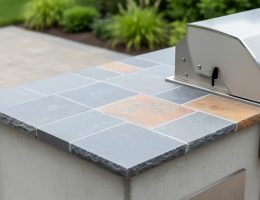
Close-up of an outdoor countertop with ceramic tile over a concrete backer and bluestone accents in a patio kitchen near a built-in grill.
Countertop Materials and Selection

How to Choose Inexpensive Outdoor Countertops: A Buying Guide

Inexpensive outdoor countertops range from $15 to $110 per square foot installed, with materials like pressure-treated tile, concrete, and select natural stones offering the best balance of affordability and weather resistance. The key is distinguishing between genuinely outdoor-rated budget options and cheap indoor materials that will crack, fade, or delaminate within a season.
Most homeowners approach this search backwards. They find an attractive laminate or faux-granite surface at a big-box retailer, see the low price tag, and assume it will work for their patio kitchen. It won’t. Indoor countertop materials are engineered…

Close-up of a natural stone slab with a hand holding an iPhone above it, suggesting iOS photogrammetry capture for creating a digital 3D model.
Digital Design and Modeling

How to Use Photogrammetry on iOS for Digital Stone Modeling

You can capture a complete 3D model of natural stone using nothing more than an iPhone or iPad and the built-in Object Capture API introduced in iOS 15. This photogrammetry technique transforms a series of overlapping photographs into detailed digital models suitable for architectural visualization, fabrication planning, and design mockups, typically requiring 20-40 minutes of shooting time and basic familiarity with camera positioning.
The technology democratizes what once demanded expensive equipment and specialized software. While a professional …

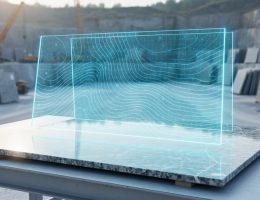
Polished marble stone slab in a quarry with a translucent holographic 3D digital twin overlay matching the slab’s veining and shape.
Emerging Stone Technologies

Twin Stones: Digital Twins Are Revolutionizing Stone Quarry and Asset Management

Digital twins for stone assets create precise virtual replicas of physical slabs, capturing every vein pattern, color variation, and dimensional detail through high-resolution scanning and 3D modeling. This technology allows architects, designers, and stone professionals to visualize, specify, and work with exact representations of natural stone materials throughout the design and fabrication process without physically handling the slabs until installation.
The concept borrows from aerospace and manufacturing industries, where digital twins have revolutionized how complex assets are designed, monitored, and maintained. In the …

Close-up of zeolite thermal storage equipment with mineral granules near a natural stone wall inside a modern building.
Health and Wellness Benefits

What Is Zeolite Thermal Storage (and How Does It Work)?

Zeolite thermal storage uses natural or synthetic microporous minerals to absorb, hold, and release heat through reversible chemical reactions, offering one of the highest energy densities of any solid-state thermal storage material available in 2026. Unlike conventional thermal mass that relies solely on temperature differences, zeolites store heat through adsorption and desorption cycles, a process that can retain energy for months without loss and release it on demand when moisture is introduced.
For architects, designers, and homeowners exploring sustainable climate control, zeolite systems represent a proven technology that …

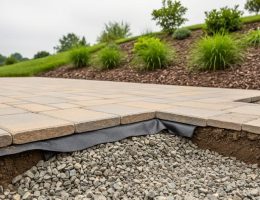
Close view of a stone patio and paver edge on a landscaped slope, showing a prepared gravel base and erosion-control fabric beneath stones with green vegetation in the background.
Stone in Cultural Heritage

4 Techniques That Keep Soil in Place Around Your Stone Features

Soil erosion threatens stone installations by undermining foundations, creating voids beneath pavers, and washing away the supportive base that keeps your investment stable. Four proven techniques stop this damage: vegetative cover, terracing and grading, erosion control fabrics, and proper drainage systems. Each method addresses different erosion triggers, from sheet erosion on gentle slopes to concentrated runoff that carves channels through your landscape.
The financial argument for soil stabilization is straightforward. Replacing a compromised stone patio or retaining wall costs thousands, while preventive measures typically run…

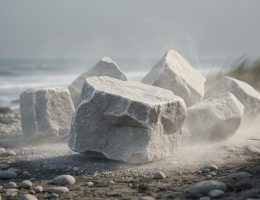
Low-angle view of rough-cut limestone blocks arranged on a misty shoreline, suggesting an ephemeral stone artwork exposed to wind and erosion.
Artistic Craftsmanship Insights

What Is Ephemeral Artwork (and How Does It Apply to Stone)?

Ephemeral artwork refers to art intentionally created to be temporary, existing for a brief period before disappearing through natural decay, environmental forces, or deliberate removal. When stone becomes the medium for ephemeral work, a fascinating paradox emerges: one of humanity’s most enduring materials is deliberately deployed in pieces designed not to last. This practice challenges the ancient stone carving legacy that prizes permanence, instead emphasizing process, transformation, and the moment of…

Close-up of water beading on a polished granite surface and a glossy car hood, illustrating shared surface protection properties of stone sealants and automotive ceramic coatings.
Finishes & Surface Treatments Maintenance and Care Technical Properties

What Natural Stone Sealants and Automotive Ceramic Coatings Have in Common: Surface Protection Beyond Shine

Surface protection technology works by creating a microscopic barrier that shields porous materials from water, stains, UV damage, and chemical intrusion. Whether applied to a granite countertop or a vehicle’s paint, these protective coatings share fundamental chemistry: they bond at the molecular level to fill microscopic surface irregularities and form a hydrophobic or oleophobic shield that repels contaminants before they penetrate.
This article examines the parallel technologies behind natural stone sealants and automotive ceramic coatings, two product categories that solve the same core challenge in different contexts. …