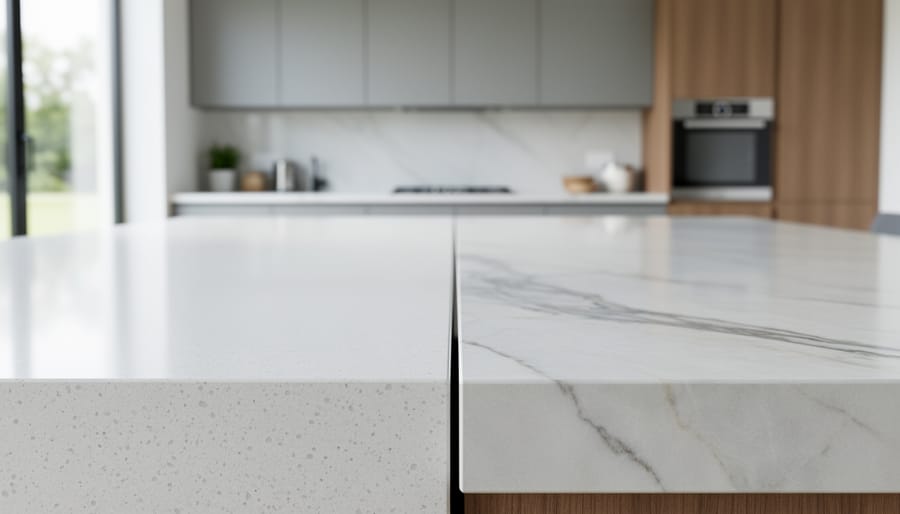
Quartz stone is a hard, dense surface material made from quartz, one of the most abundant minerals in the earth’s crust. The term covers two different products: natural quartzite, a metamorphic rock formed when sandstone is fused under heat and pressure, and engineered quartz, a manufactured slab that binds crushed quartz (typically around 90 percent of the mix) with polymer resins and pigments. They look similar on a showroom floor but behave differently once installed.
Quartz ranks 7 on the Mohs hardness scale, which is why it resists scratching better than marble or limestone. Engineered slabs are essentially non-porous, so they shrug off most stains, while natural quartzite varies in porosity and often benefits from sealing. Heat is the weak spot for resin-based slabs, which can discolor or crack under a hot pan.
Understanding these properties matters because the right choice depends on where the stone will live and how it will be used. It also shapes how you protect it. Good maintenance habits and long-term stone protection strategies start with knowing what a material can and can’t tolerate. This guide breaks down hardness, porosity, heat and stain response, the key differences between quartzite and engineered quartz, common applications, and practical care.
What Quartz Stone Means: Natural Mineral vs. Engineered Surface
Quartz is one of the most common minerals on the planet. Quartz is about 12% of the Earth’s crust by volume, which helps explain why it shows up in so many stones and building materials. Chemically it is silicon dioxide, a hard, stable crystal that resists wear better than most minerals.
The confusion starts with the label. “Quartz stone” can mean two quite different things, and the difference matters when you compare products.
- Quartz
- A naturally occurring mineral made of silicon dioxide, found in many rocks worldwide.
- Quartzite
- A metamorphic rock formed when quartz-rich sandstone is fused by heat and pressure deep underground.
- Engineered quartz
- A manufactured slab made from crushed natural quartz mixed with resin and pigments.
- Resin binder
- The polymer that holds crushed quartz together in engineered slabs and shapes how they react to heat and sunlight.
- Mohs hardness
- A 1-to-10 scale that ranks a mineral’s resistance to scratching, with quartz sitting at about 7.
On the natural side, you will find quartzite, along with granite and sandstone that contain quartz as one of several minerals. These stones are quarried, cut, and polished, so every slab carries its own veining and variation.
Engineered quartz is a different product. It is made in a factory, which gives manufacturers control over color and pattern but also means the resin plays a real role in how the surface behaves.
The word that trips people up most is “quartzite.” Quartz is a mineral, while quartzite is a rock made largely of that mineral. When you read a spec sheet, check whether it describes a quarried stone or a manufactured slab. That one detail tells you how to expect the material to handle heat, sealing, and long-term wear.
How Quartz Stone Works: The Properties Behind Its Performance
Hardness, Density, and Porosity
Hardness, density, and porosity work together, and each one answers a different everyday question. Hardness tells you how well a surface resists scratching. Quartz hardness is 7 on the Mohs scale, which sits above most kitchen knives, keys, and household grit. Marble, by comparison, usually falls around 3 to 4, so it dulls and scuffs far more readily. Granite typically lands in the 6 to 7 range, close to quartz.
Density and porosity decide how a stone handles liquids. A dense stone with tiny, sparsely connected pores resists absorbing wine, oil, or coffee. Marble is relatively porous and soft, which is why spilled lemon juice or red wine can leave marks if you don’t wipe them up fast. Granite varies by type but is usually denser and less absorbent than marble.
Engineered quartz is made with resin filling the gaps between crushed particles, so it is essentially non-porous and generally doesn’t need sealing. Natural quartzite is dense but can still have small pores, so many installers recommend a periodic sealer, especially on lighter colors.
The practical takeaway: harder means fewer scratches, denser means fewer stains, and lower porosity means less sealing upkeep.
Heat, Light, and Chemical Response
Engineered quartz handles most kitchen life well, but heat is its weak spot. The crushed quartz itself is stable, yet the resin that binds it is not. Many manufacturers advise against placing hot pans straight from the stove or oven on the surface, because localized heat can scorch the resin, leave a pale or discolored mark, or cause cracking from thermal shock. A trivet takes two seconds and avoids the problem entirely. Natural quartzite is different. It is a metamorphic stone formed under intense heat and pressure, so it shrugs off hot cookware far better, though a sudden temperature swing is still a good thing to avoid.
Light matters too. Prolonged exposure to direct sunlight can cause some engineered surfaces to yellow or fade over time, because UV radiation slowly breaks down the resin and certain pigments. Light-colored slabs in sun-drenched rooms or outdoor settings tend to show it first. Many engineered products are rated for indoor use only, so check the manufacturer’s guidance before specifying one near large south-facing windows or on a patio. Natural quartzite has no resin to degrade, so it generally holds its color under strong sun.
Chemicals are the third consideration. Harsh products can dull or damage resin and the polished finish. Keep these away from the surface:
– Oven cleaners and drain cleaners
– Paint strippers and solvents
– Bleach and other strongly alkaline or acidic products
– Abrasive scouring powders
Mild soap and warm water handle nearly everyday messes. If a spill of something aggressive does occur, wipe it up promptly and rinse thoroughly, then follow your manufacturer’s care instructions for anything stubborn.
Types of Quartz Stone: Natural Quartzite, Engineered Quartz, and Quartz-Rich Stones
Three families of stone get called “quartz,” and they behave quite differently. Knowing which one you’re looking at is half the battle when you read a spec sheet.
Natural quartzite is a metamorphic rock. It begins as quartz-rich sandstone, then heat and pressure deep in the Earth fuse the sand grains into a dense, interlocking mass. The result is very hard, with low porosity and strong resistance to heat and acids. Its veining and color come from trace minerals present during formation, so no two slabs match. Quartzite generally benefits from sealing, since a slab’s porosity varies by source.
Engineered quartz is manufactured. Producers combine crushed natural quartz, which general industry descriptions put at roughly 90 percent of the slab, with polymer resins and pigments, then compress and cure the mix into uniform sheets. The resin makes the surface essentially non-porous, so it usually needs no sealer, and the pigments give a consistent look from slab to slab. The trade-off is that resin is less tolerant of high heat and prolonged sun than solid stone.
Quartz-bearing natural stones are the third group. Granite contains quartz alongside feldspar and mica, typically somewhere around 20 to 60 percent depending on the stone. Sandstone is made of quartz grains cemented together, which gives it a softer, more porous character. Because quartz is only one ingredient in these stones, their overall hardness and stain resistance depend on the whole mineral mix, not on quartz alone.
Here is how the three compare at a glance:
– Quartzite: Very hard, dense, natural variation, usually sealed.
– Engineered quartz: Uniform, non-porous, resin-bound, heat-sensitive.
– Granite and sandstone: Quartz plus other minerals, with porosity ranging from low to high.
Natural stone stands out where authenticity matters. Veining and grain are unique to each slab, and a quarried stone is a single-ingredient material with a long service life that can be refinished rather than replaced. For many designers and homeowners, that character and longevity make the case for natural stone, even though engineered options offer easier upkeep.
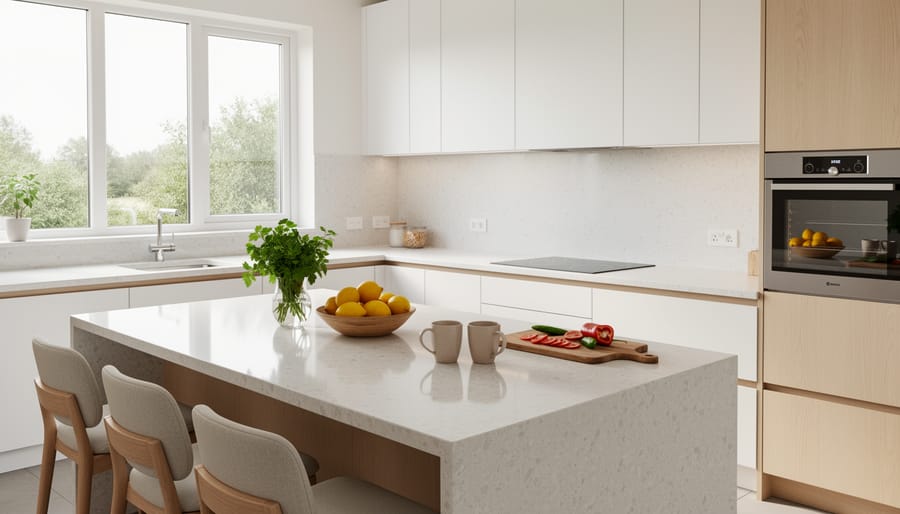
How Quartz Stone Is Used in Homes and Commercial Spaces
Quartz shows up in more rooms than most people expect, and the reason is usually a single property doing the heavy lifting. Here’s where it tends to earn its place:
- Kitchen and bath countertops: scratch and stain resistance from a hard, dense surface.
- Flooring: abrasion resistance that holds up to daily foot traffic.
- Wall cladding: stable, uniform slabs that install cleanly over large areas.
- Backsplashes: easy wipe-down surfaces that shrug off splashes and grease.
- Fireplace surrounds: natural quartzite handles ambient warmth well, though direct, intense heat is a different story.
- Exteriors and facades: natural quartzite and quartz-rich stone resist weathering, while resin-bound engineered slabs are generally better kept indoors because of UV exposure.
That last distinction matters in commercial work too. Hotels, restaurants, and retail spaces lean on quartz because it tolerates constant cleaning and heavy use without much fuss.
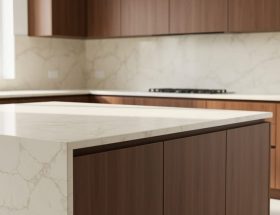
Consider a hospitality-style kitchen renovation where the owners wanted the look of marble without its etching problems. They chose a natural quartzite for the island and perimeter counters, drawn by its soft veining and real-stone character. Performance was solid: after a year of daily cooking and entertaining, the surface showed no scratching from knives or cookware and no etching from lemon juice or wine. Maintenance was modest. The installer recommended sealing at the start, then resealing roughly once a year, and the owners found that routine wipe-downs with a pH-neutral cleaner were enough. The one lesson they passed along was to use trivets, since sudden heat is hard on any stone surface, even a tough one.
For visuals, aim for high-quality photos that show scale and finish. Good candidates include a wide shot of a quartzite island with visible veining (caption: “Natural quartzite kitchen island, honed finish”), a close-up of a polished countertop edge (caption: “Quartzite countertop detail showing mineral grain”), and an exterior or feature-wall image (caption: “Quartz-rich sandstone cladding on a residential facade”). Naming the stone type in each caption helps readers connect what they see to the properties described above.
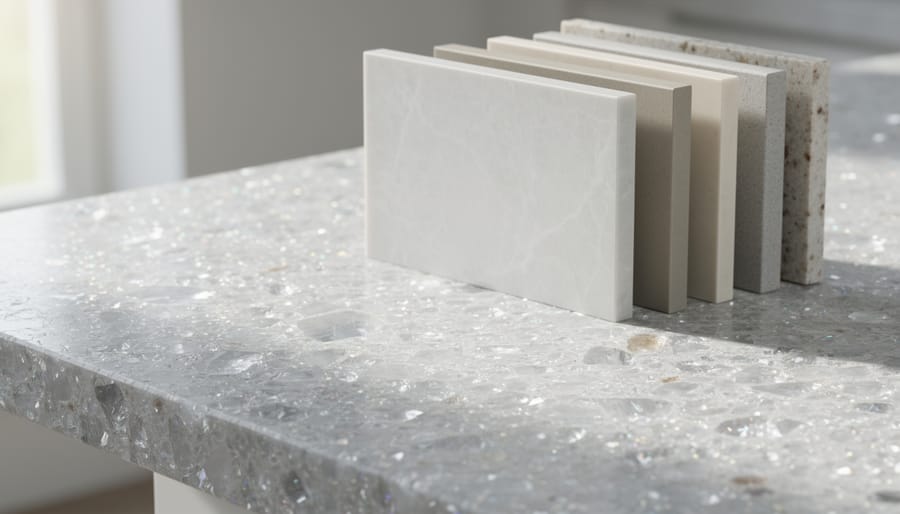
Preserving Quartz Stone: Care Techniques and Common Challenges
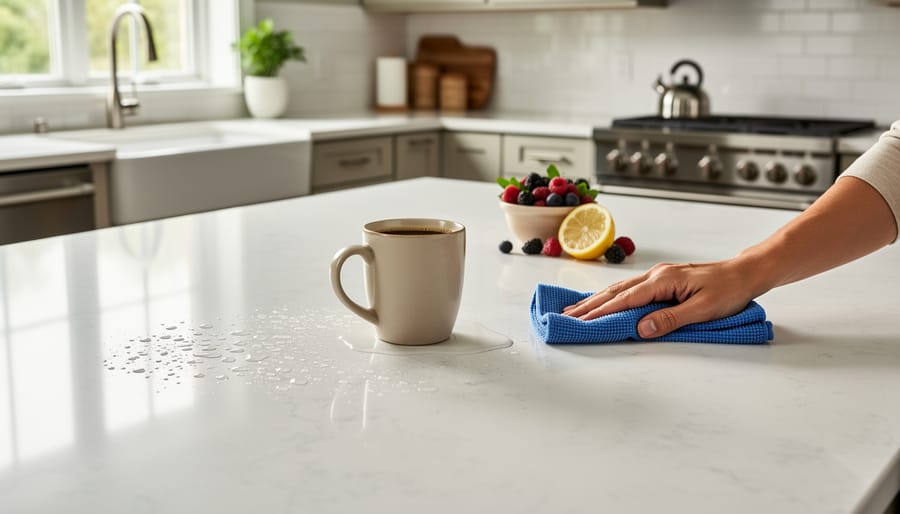
Good care starts with what the stone is made of. Engineered quartz is mostly crushed quartz held together by resin, so it’s dense and low in porosity, but the resin is its weak point. Natural quartzite is harder and more heat tolerant, but it’s a natural stone with its own quirks. Matching your routine to the material is the heart of sound stone preservation methods.
For day-to-day cleaning, warm water, a soft cloth and a few drops of pH-neutral soap do nearly everything. Wipe spills promptly, rinse, and dry. Skip abrasive pads and scouring powders, which dull the finish, and avoid strongly acidic or alkaline products like bleach, oven cleaner, drain cleaner and many bathroom descalers. On engineered quartz these can attack the resin; on quartzite, acids can etch the surface if the stone has any calcite content or a weak sealer.
Sealing is where the two materials part ways. Engineered quartz is typically sealer-free because the resin leaves little open pore space. Natural quartzite is often dense too, but porosity varies from slab to slab, so a simple water-drop test helps. If water darkens the surface within a few minutes, a penetrating sealer is worth applying. Specific products differ, so manufacturer care instructions are the final word on cleaners, sealers and warranty terms.
A few realistic challenges come up again and again:
– Thermal shock: Engineered quartz can crack or scorch when a hot pot goes straight onto it. Use trivets, even though quartzite shrugs off heat far better.
– Sunlit discoloration: Prolonged UV exposure can yellow or fade some resin-bound surfaces, so they’re a poor fit for sun-baked outdoor spaces.
– Seams and edges: These take the most punishment. Chips often start at corners and sink cutouts, and good fabrication and sensible handling go a long way to protect stone edges.
For stains, act quickly. Lift most food and drink marks with mild soap and water, then try a gentle non-abrasive cleaner for stubborn spots. Etching, a dull patch rather than a stain, is mostly a concern for acid-sensitive natural stones and may need professional honing.
None of this demands heroic effort. A few consistent care techniques beat occasional deep cleaning, and the same mindset applies elsewhere, as in guidance on how to protect stone from damage over decades. No surface is indestructible, but with sensible habits quartz will stay attractive for years.
Quartz Stone FAQs
Readers tend to ask the same handful of questions before choosing or caring for quartz surfaces, so here are straight answers to the most common ones.
Is quartz the same as quartzite?
No. Quartzite is a natural metamorphic stone formed from sandstone, while engineered quartz is a manufactured slab made from crushed quartz bound with resin and pigments. Check the product label or spec sheet to see which one you’re getting.
Does quartz stone need sealing?
Engineered quartz generally doesn’t, because the resin leaves it very low in porosity. Natural quartzite often benefits from a sealer, so follow the supplier’s guidance for your specific slab.
Can it handle hot pans?
Natural quartzite tolerates heat well, but resin-bound engineered quartz can scorch or crack from thermal shock. Use trivets for either type, since that’s the safer habit regardless of material.
Will it stain or scratch?
Both are hard, rating around 7 on the Mohs scale, so everyday scratching is unlikely. Staining risk is low for engineered quartz and depends on sealing for natural quartzite, though prompt wipe-ups help in both cases.
Two questions remain: outdoor use and long-term comparison with other stones. Natural quartzite is a reasonable outdoor choice in many climates, since it stands up to weather and UV. Engineered quartz is usually better kept indoors, because prolonged sunlight can yellow or fade the resin. Against marble and granite, quartz-based surfaces typically resist etching and staining better than marble, while granite remains a tough, heat-tolerant natural option. Which one lasts longest ultimately depends on where it’s installed and how it’s maintained, so match the stone to the space and defer to the manufacturer’s care instructions.
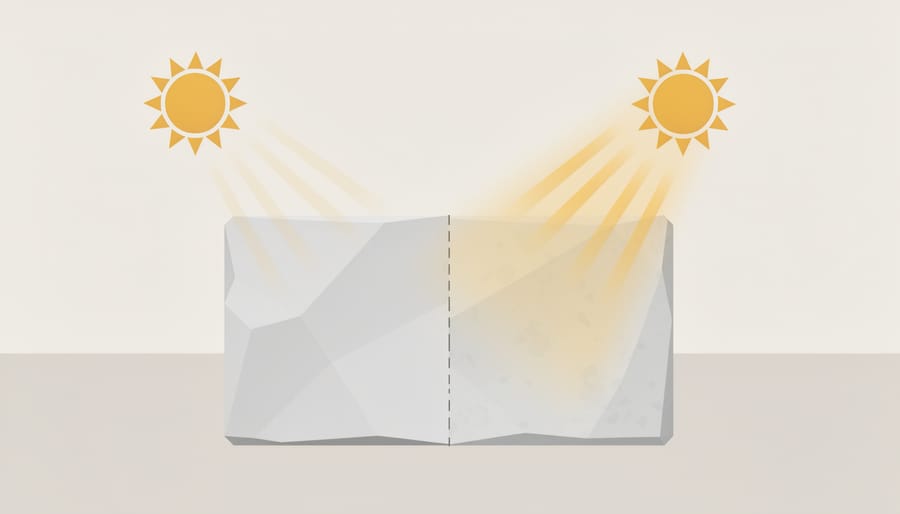
Choosing quartz comes down to knowing what you’re actually buying. Natural quartzite and engineered quartz share a mineral, but they behave differently under heat, light, and daily use. Quartzite brings real hardness and one-of-a-kind veining, and it benefits from sealing. Engineered quartz offers consistency and low porosity, but its resin binder asks for more caution around hot cookware and prolonged sun.
The care principles stay simple: clean with gentle, pH-neutral products, use trivets and cutting boards, keep harsh chemicals away, and wipe spills before they settle. Follow the manufacturer’s instructions for your specific slab, since formulations vary.
Before you commit, match the stone to the space. A sunlit patio, a busy family kitchen, and a quiet powder room each call for something different. A qualified stone professional can confirm the material, advise on installation, and set realistic expectations, which is the surest way to keep your surface looking right for years.