
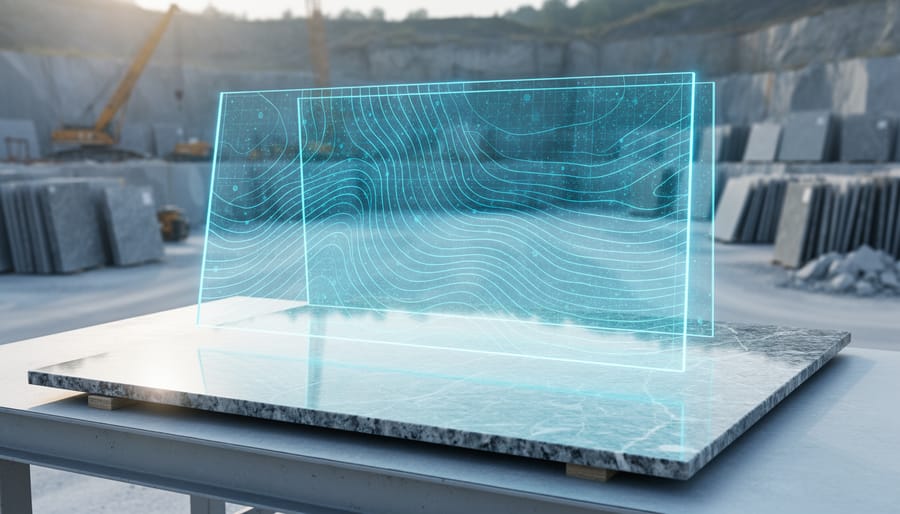
Digital twins for stone assets create precise virtual replicas of physical slabs, capturing every vein pattern, color variation, and dimensional detail through high-resolution scanning and 3D modeling. This technology allows architects, designers, and stone professionals to visualize, specify, and work with exact representations of natural stone materials throughout the design and fabrication process without physically handling the slabs until installation.
The concept borrows from aerospace and manufacturing industries, where digital twins have revolutionized how complex assets are designed, monitored, and maintained. In the natural stone sector, this means transforming how we select, price, and apply materials that are inherently unique. Unlike manufactured products with consistent specifications, each slab of marble, granite, or quartzite tells its own geological story. Digital twin technology captures that uniqueness in a format that travels instantly across continents, fits into building information modeling systems, and enables real-time collaboration between quarries, fabricators, and design teams.
For end-users, the practical benefits are substantial. You can compare actual slabs from multiple suppliers without visiting warehouses, preview how specific veining patterns will look in your space using augmented reality, and eliminate costly surprises when material arrives on-site. Fabricators gain precision in yield calculations and can optimize cuts digitally before touching the physical stone. Architects integrate exact material data into their digital models, ensuring design intent carries through to installation.
The technology has matured significantly since its experimental phase in the early 2020s. Several major stone suppliers and technology providers now offer digital twin platforms, though implementation approaches vary. Understanding what this technology delivers, where it adds genuine value, and what limitations still exist helps you make informed decisions about adopting or specifying digital twin solutions for your stone projects.
What Digital Twins Mean for Natural Stone
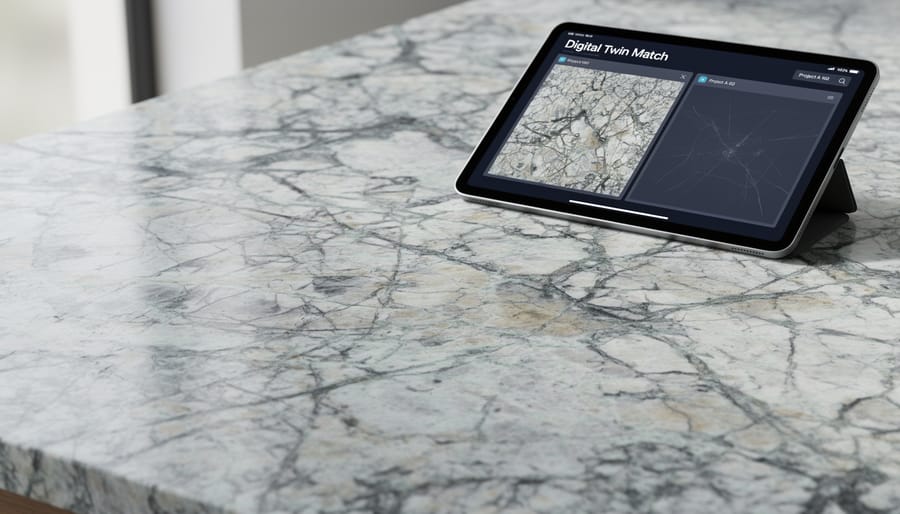
A digital twin is a virtual replica of a physical object that updates continuously to reflect real-world conditions. In the natural stone industry, this means creating precise digital models of stone assets, from entire quarries down to individual slabs, that track their status, location, and characteristics throughout their lifecycle.
The technology works by combining several data sources. High-resolution 3D scanners capture the exact dimensions, surface patterns, and color variations of stone blocks and slabs. Sensors embedded in processing equipment monitor temperature, vibration, and humidity during cutting and polishing. GPS trackers follow materials as they move from quarry to fabricator to installation site. This continuous stream of information feeds into software platforms that maintain up-to-date digital records of each stone asset.
What makes digital twins different from simple photographs or measurements is their dynamic nature. When a marble block gets cut into slabs, the digital twin updates to show the new pieces, their exact veining patterns, and their current location. If environmental sensors detect moisture affecting a quarry face, the twin reflects that condition immediately. This real-time synchronization between physical and digital versions creates a living record rather than a static snapshot.
Nearly every stage of stone production can be twinned. Quarry operators create digital models of entire extraction sites, mapping geological features and predicting where quality stone lies beneath the surface. Individual blocks receive digital identities the moment they’re extracted, documenting their source coordinates and initial condition assessments. Slabs get scanned after cutting to capture their unique appearance, making it possible to preview exact pieces before specifying them for a project. Some luxury developments even maintain digital twins of installed stonework, tracking wear patterns and scheduling maintenance.
The core components, 3D scanning technology, IoT sensors, and cloud-based data platforms, have existed separately for years. What’s new is integrating them specifically for stone assets, creating a complete digital thread from bedrock to building. This integration turns traditional stone sourcing, which relied heavily on physical samples and educated guessing about quarry inventory, into a data-driven process with unprecedented visibility and precision.
How Twin Stone Technology Works in Quarries
Quarry Mapping and Geological Modeling
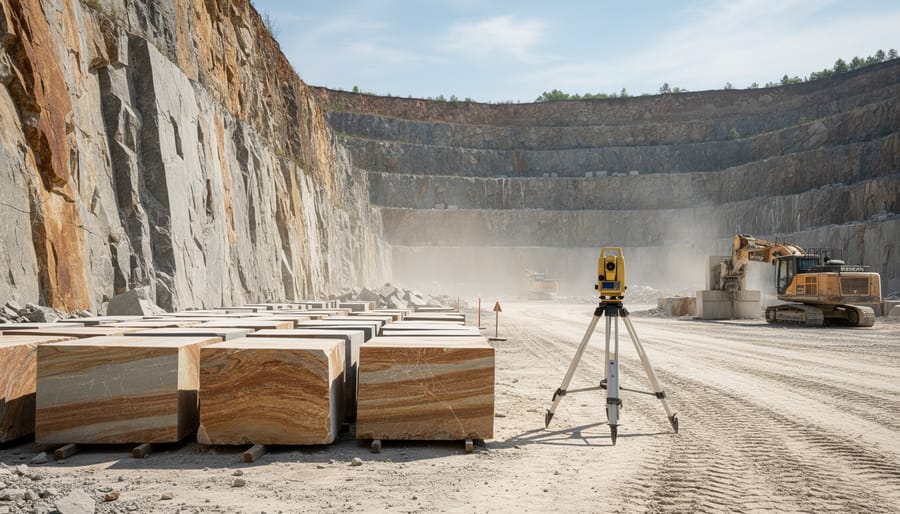
Quarry operators now deploy drones equipped with high-resolution cameras and LiDAR sensors to systematically scan quarry faces and surrounding terrain, capturing millions of data points that form comprehensive three-dimensional models. These aerial surveys, often combined with ground-based geological investigations, reveal stone quality variations, vein patterns, structural fractures, and deposit depths across the entire site, details impossible to assess accurately through visual inspection alone. The resulting 3D geological models integrate with technologies like laser imaging to help extraction teams identify the most valuable stone deposits, plan optimal cutting sequences that maximize yield from premium material, and estimate remaining resources with precision that improves both profitability and sustainability. Quarry managers can virtually slice through the digital model at any angle, simulate different extraction scenarios, and calculate waste ratios before a single cut occurs, dramatically reducing the guesswork that has historically plagued stone extraction. This upfront geological intelligence means fewer surprises during excavation, better matching of stone characteristics to specific project requirements, and significantly reduced environmental impact through more efficient land use.
Individual Block and Slab Tracking
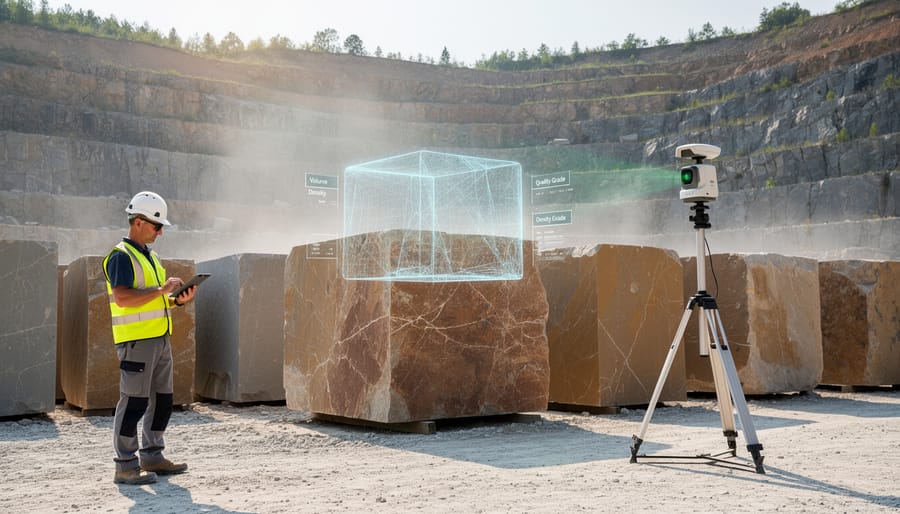
Once a block leaves the quarry face, it receives a unique digital identity, essentially a passport that follows it through every subsequent stage. High-resolution scanners capture the block’s exact dimensions, veining patterns, color variations, and any natural fissures or structural characteristics. This digital record becomes the block’s permanent profile, accessible to anyone in the supply chain.
As fabricators cut the block into slabs, whether through traditional diamond wire sawing or precision methods like water jet cutting each slab inherits the parent block’s data while adding its own specifications: thickness, surface finish, and exact position within the original block. This genealogy matters because slabs from the same block share visual continuity, making them ideal for book-matching or coordinating large installations.
The tracking continues through polishing, treatment, warehousing, and shipping. At any moment, distributors can pull up a slab’s complete history: where it was quarried, when it was cut, its current location, and who has viewed or reserved it. This eliminates the common frustration of selecting stone samples only to discover the actual slab looks different or is no longer available.
Real-Time Monitoring and Predictive Maintenance
Sensors embedded throughout modern quarry operations track far more than basic production metrics. Temperature fluctuations in cutting equipment, vibration patterns in diamond wire saws, and humidity levels in processing areas feed continuous data into the digital twin system. This constant monitoring reveals subtle shifts in machinery performance, a bearing running slightly hot, a wire showing irregular tension, before catastrophic failures occur.
The real value emerges when predictive maintenance sensors analyze patterns over time. Rather than following fixed maintenance schedules or reacting to breakdowns, operators service equipment based on actual wear indicators. A wire saw might run 300 hours beyond its typical replacement interval because sensor data confirms optimal performance, saving thousands in premature replacements.
Stone quality monitoring proves equally critical. Sensors detect micro-fractures during extraction, moisture content changes during seasoning, and structural variations within individual blocks. When the system flags a block with unexpected internal stress patterns, fabricators adjust cutting parameters or redirect it to applications where the characteristic won’t compromise performance. This proactive approach catches defects early, preventing costly rework after slabs reach job sites.
Benefits for Architects, Designers, and Consumers
Virtual Stone Selection and Visualization
Digital twins eliminate the guesswork that plagued natural stone projects for decades. Instead of selecting from generic photos or small samples, designers now access photorealistic 3D scans of the exact slabs they’re considering, complete with every vein, color variation, and natural fissure. The technology captures slab surfaces at sub-millimeter resolution, letting architects rotate digital models, examine pattern flow, and test how adjacent pieces will align before committing to purchase.
This precision dovetails with broader advances in AI stone selection tools that suggest optimal matches based on project requirements. Some platforms integrate VR for stone visualization, allowing clients to walk through virtual spaces with their chosen materials rendered at true scale. Returns drop significantly when buyers see precisely what they’re getting, and installers spend less time problem-solving mismatched veining on site. The result: fewer change orders, tighter budgets, and stone installations that match the designer’s vision.
Transparency in Sourcing and Sustainability
Digital twins create an unbroken chain of custody documentation from quarry face to final installation. Each stone asset carries a complete digital record: extraction coordinates, geological origin, processing methods, and transportation routes. This transparency matters because consumers and architects increasingly demand proof that their materials meet ethical standards.
The technology automatically logs carbon emissions at each supply chain stage, from diesel consumption during extraction to energy use in cutting and polishing facilities. Many digital twin platforms now integrate third-party sustainability certifications directly into stone records, allowing designers to verify compliance with LEED requirements or specific environmental benchmarks without chasing paper certificates.
For projects requiring documented traceability, digital twins eliminate guesswork. You’ll know whether your marble came from a certified responsible quarry, how much water was used during processing, and the exact journey your slabs traveled. This level of documentation protects against misrepresentation and supports genuine sustainability commitments rather than vague marketing claims.
Precision Matching and Waste Reduction
Digital twin technology transforms how fabricators approach material yield, particularly for projects requiring consistent veining patterns across multiple slabs. Traditional inventory management relies on physical warehouse visits and visual memory, an inefficient process that often results in purchasing excess material “just in case” adequate matches can’t be found.
With digital twins, fabricators access precise 3D models showing every slab’s unique characteristics. Advanced software can automatically suggest optimal slab pairings for book-matching or sequence-matching based on vein structure, color intensity, and pattern flow. This eliminates guesswork and reduces the safety margin fabricators typically build into material orders.
The waste reduction extends beyond initial selection. Digital models allow fabricators to virtually nest cut patterns before touching physical material, optimizing how countertops, wall panels, or flooring pieces fit within each slab’s usable area. Some systems calculate that this precision reduces offcuts by 15-25% compared to conventional layout methods.
For large commercial projects, this capability proves especially valuable. A hotel lobby requiring fifty matching marble panels can be precisely mapped to specific slabs before fabrication begins, ensuring visual continuity while minimizing material purchases and the environmental impact of quarrying excess stone.
Industry Applications and Real-World Implementation
Marble and Granite Quarry Operations
Premium marble and granite quarries are implementing digital twins to transform century-old extraction practices. At Italian Carrara marble quarries, operators now deploy drone-mounted LiDAR scanners to create detailed 3D geological models before extraction begins. These models reveal veining patterns and structural weaknesses meters below the surface, allowing quarry managers to plan optimal cutting angles that maximize yield while preserving premium blocks.
Brazilian granite quarries use digital twins to monitor extraction equipment performance in real time. Sensors on wire saws and drilling rigs track blade wear, cutting speed, and stone density variations. When the system detects anomalies suggesting equipment failure or encountering unexpected geological features, it alerts operators immediately, preventing damage to valuable stone blocks and reducing costly equipment downtime.
Quality assurance has improved significantly through digital documentation. Each extracted block receives a digital profile including precise dimensions, color classification, and structural integrity ratings. Portuguese limestone quarries maintain digital inventories showing exact location and characteristics of every block in their yards, enabling them to match customer specifications within minutes rather than days of physical searching.

Large-Scale Architectural Projects
The Dubai Opera House renovation exemplifies how digital twin technology transforms complex stone installations. Project managers created detailed digital replicas of 3,500 Carrara marble panels, each scanned to capture unique veining patterns. This allowed architects to pre-arrange panels virtually, ensuring visual continuity across curved surfaces before fabrication began. The digital model reduced installation errors by 40% and cut on-site adjustment time by three weeks.
London’s Crossrail stations deployed similar technology for their limestone cladding. Engineers tracked 12,000 individual stones through digital twins, coordinating delivery schedules with construction phases to minimize storage needs. The system flagged potential color mismatches before installation, preventing costly replacements. Maintenance teams now use these digital records to identify specific panels requiring cleaning or repair, eliminating guesswork.
At Singapore’s Marina Bay development, digital twins enabled architects to simulate how natural stone facades would age under tropical conditions. This predictive modeling influenced sealing schedules and maintenance protocols, extending the building’s aesthetic lifespan. The digital archive serves as a permanent reference for future restoration work, documenting exact stone origins and characteristics.
Fabrication and Distribution Networks
Stone fabricators and distributors face constant challenges tracking hundreds of slabs across multiple warehouses and keeping customers informed about availability. Digital twins solve this by creating searchable databases where each slab’s exact location, dimensions, and visual characteristics are instantly accessible. When a client requests Calacatta marble with specific veining, fabricators can pull up precise images of every matching slab in inventory rather than walking acres of yard space.
This technology also enables virtual showrooms where customers browse actual inventory remotely, seeing the exact slab they’ll receive instead of generic samples. Distributors use predictive analytics from digital twin data to forecast demand, optimize stock levels, and reduce carrying costs. The system tracks fabrication progress in real-time, automatically updating delivery schedules and sending clients progress photos of their specific material being cut and finished.
Implementation Considerations and Current Limitations
While digital twin technology offers compelling benefits for natural stone management, implementing it requires realistic planning and an understanding of current industry constraints.
Investment and Infrastructure Requirements
Deploying digital twin systems demands substantial upfront investment. Quarry operators need specialized scanning equipment, LiDAR units, drones, and high-resolution cameras, plus robust data infrastructure to store and process terabytes of geological and inventory information. Most quarries also require external consultants to establish initial systems, adding to implementation costs. Smaller operations may find the investment prohibitive, while larger quarries can justify expenses through operational efficiencies and premium positioning.
Technical expertise presents another barrier. Digital twin platforms require staff trained in 3D modeling software, sensor networks, and data analytics. Many stone industry professionals lack this background, necessitating new hires or extensive training programs. The learning curve can extend 12-18 months before teams operate these systems effectively.
Current Adoption and Standardization Challenges
Industry adoption remains uneven in 2026. Premium marble and granite quarries supplying high-end architectural projects have embraced digital twins, but the majority of global stone operations still rely on traditional management methods. This creates supply chain gaps where digitally-tracked stone enters non-digital fabrication facilities, breaking the data continuity.
Standardization poses ongoing challenges. No universal data format exists for stone digital twins, meaning different quarries and platforms use incompatible systems. This fragmentation complicates multi-source projects and prevents seamless data sharing between stakeholders. Industry groups are developing standards, but consensus remains years away.
The technology continues evolving rapidly, what advanced systems do today may become baseline capabilities within three years. Some quarries hesitate to invest heavily while capabilities and 3D stone printing integration paths remain fluid.
Questions to Ask Suppliers
When evaluating stone suppliers, inquire whether they maintain digital twins of their inventory, what scanning resolution they use for slabs, if they provide digital certificates of authenticity, and how long they retain digital records post-installation. Ask if their system integrates with your architect’s BIM software and whether they offer virtual selection tools for reviewing exact slabs remotely.
Common Questions About Digital Twins in Natural Stone
The transition to digital twin technology naturally raises practical questions from architects, fabricators, and consumers weighing its value for their projects. Here’s what you need to know about implementing and working with twin stone systems.
Does digital twin technology increase stone costs?
Initial implementation costs for quarries are significant, but the technology typically adds minimal markup to consumer prices, often 2-5% for documented premium stones. The transparency and waste reduction frequently offset this marginal increase through better material utilization and fewer errors.
How accurate are digital representations compared to physical samples?
High-resolution 3D scans capture color, veining, and texture with 95-98% visual accuracy under controlled lighting conditions. However, natural stone viewing conditions vary significantly, so digital twins work best alongside physical samples for final color approval rather than as complete replacements.
Can homeowners access this technology for residential projects?
Access depends on your supplier’s capabilities and project scale. Premium stone suppliers increasingly offer virtual slab selection for residential clients, though smaller fabricators may not yet have adopted the technology. Large-format installations and high-value projects have better access than standard countertop work.
What happens to digital twin data after installation?
Leading suppliers maintain digital records indefinitely, creating permanent documentation of your stone’s characteristics, origin, and installation specifications. This data proves valuable for future renovations, repairs, or when matching additional stone work years later.
How does this affect stone warranties and maintenance?
Digital documentation strengthens warranty claims by providing clear baseline conditions and proper installation verification. Maintenance becomes more predictable since the digital twin tracks stone characteristics that affect long-term performance, such as porosity and structural composition.
Is the technology standardized across the industry?
Not yet, different quarries and suppliers use varying platforms and data formats, which can complicate cross-supplier coordination. Industry groups are working toward common standards, but expect some inconsistency in implementation quality and data accessibility for now.
The accuracy question deserves additional context beyond visual matching. Digital twins excel at documenting measurable physical properties, dimensions, density, mineral composition, with laboratory precision. Where they fall short is capturing the subjective experience of standing beside a slab under specific lighting, feeling its texture, and observing subtle color shifts that photographs struggle to convey. Smart buyers use digital twins for initial selection and logistics but confirm aesthetic decisions with physical viewing when the project budget allows.
Cost transparency matters here. While quarries invest heavily in scanning equipment, drones, and data infrastructure, economies of scale distribute these expenses across their entire output. A quarry producing 10,000 square meters monthly might spend $200,000 on digital twin infrastructure, adding roughly $20 per square meter, a fraction of premium stone pricing. The return comes through reduced waste, better inventory turnover, and fewer customer disputes over material discrepancies.
For residential clients wondering whether to request digital twin capabilities, consider your project’s complexity and value. A straightforward kitchen countertop may not justify seeking out digitally-documented stone, but whole-home installations with book-matched feature walls absolutely benefit from precise virtual planning. Ask potential suppliers directly what digital documentation they provide and whether you’ll retain access to that data after purchase.
Twin stones, the convergence of digital twin technology with natural stone assets, marks a genuine shift in how the industry approaches transparency, sustainability, and quality. This isn’t just a buzzword or passing trend. It’s a practical tool that gives architects, designers, and consumers unprecedented visibility into the stone they specify and purchase, from the quarry face to the final installation.
Yes, adoption remains uneven across the industry. Not every quarry has invested in scanning equipment, and not every supplier maintains digital inventories. But the trajectory is clear. As clients increasingly demand documentation of sourcing practices, carbon footprints, and material traceability, digital twins provide the evidence that vague sustainability claims cannot match. They deliver measurable waste reduction, better project coordination, and long-term maintenance advantages that translate directly to cost savings and performance.
If you’re specifying natural stone for a project or making a significant purchase, start asking questions. Does your supplier use digital tracking? Can they provide 3D scans of the exact slabs you’re considering? What data accompanies the stone from extraction through delivery? Quarries and fabricators embracing these capabilities signal their commitment to modern standards and accountability.
The technology exists. The benefits are real. As twin stone systems become more accessible and widespread, they’ll reshape industry expectations. Those leading this change deserve your business, and those resisting it deserve scrutiny.