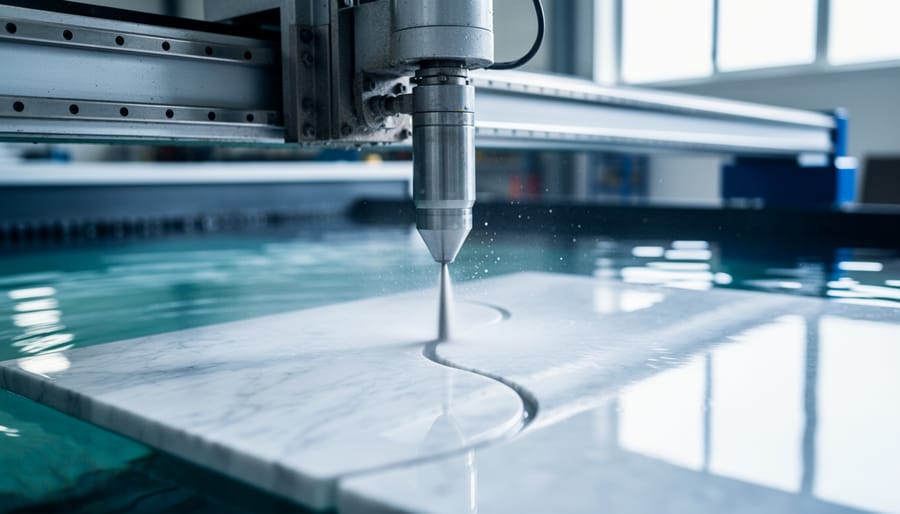
Water jet stone cutting transforms raw slabs into intricate architectural elements using pressurized water streams reaching 60,000 PSI, mixed with fine abrasive particles that slice through marble, granite, and quartzite with tolerances as tight as 0.005 inches. This technology eliminates the heat, vibration, and structural stress associated with traditional saw cutting, preserving the stone’s natural integrity while enabling complex curves, inlays, and three-dimensional shapes previously achievable only through hand-carving. Modern fabrication shops deploy computerized waterjet systems to produce everything from kitchen countertops with seamless mitered edges to decorative wall panels featuring geometric patterns, medallions, and custom logos. The process accommodates stone thicknesses from delicate 3/8-inch tiles to substantial 6-inch architectural slabs, making it equally valuable for residential renovations and commercial installations. Understanding waterjet capabilities helps homeowners specify realistic design elements, enables architects to push creative boundaries within budget constraints, and allows fabricators to quote projects accurately based on cutting time, material waste, and finishing requirements.
What Makes Hydro Jet Cutting Different From Traditional Stone Cutting Methods
The Physics Behind Water Pressure Stone Cutting
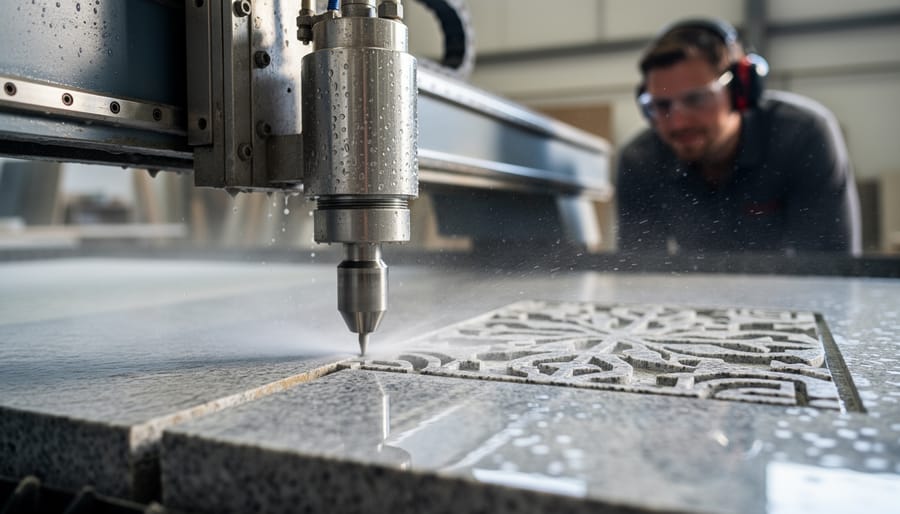
Water jet stone cutting harnesses extreme hydraulic pressure to slice through even the densest natural stone with remarkable precision. The process operates at pressures ranging from 30,000 to 90,000 PSI—approximately 200 to 600 times the pressure of a typical car tire. At these intensities, water accelerates through a specialized nozzle to speeds exceeding 2,500 feet per second, nearly three times the speed of sound.
The pure water stream alone can cut softer materials, but stone requires an abrasive component. Fine garnet particles, typically 50 to 120 mesh in size, are introduced into the pressurized water stream through a mixing chamber. These garnets act as microscopic cutting tools, eroding the stone at the molecular level. The combination creates a focused cutting stream approximately 0.030 to 0.040 inches in diameter, enabling intricate cuts that would be impossible with traditional diamond blade saws.
The physics principle at work is erosion acceleration. As the abrasive-laden water impacts the stone surface, it transfers kinetic energy that fractures and removes material particles. The continuous stream maintains consistent pressure, creating clean cuts without generating heat that could crack or discolor sensitive stones like marble. Unlike laser cutting methods, waterjet technology produces no thermal stress zones, preserving the stone’s structural integrity and aesthetic qualities throughout the cutting process.
Why Cold Cutting Protects Your Stone’s Natural Properties
Traditional stone cutting methods that rely on blades or saws generate significant friction and heat, which can fundamentally alter the material you’re working with. Water jet cutting eliminates this thermal stress entirely, operating at ambient temperatures to preserve your stone’s inherent characteristics.
When conventional cutting tools heat stone surfaces, they create invisible microfractures that weaken structural integrity. These tiny cracks may not appear immediately but can lead to premature deterioration, especially in exterior applications exposed to freeze-thaw cycles. The cold cutting process of water jet technology prevents this internal damage, maintaining the stone’s original strength and durability.
Heat-related discoloration poses another challenge with traditional methods. Many natural stones contain minerals that change color when exposed to high temperatures. Marble can develop unsightly burn marks, while granite may experience subtle but permanent shade variations along cut edges. Water jet cutting preserves the stone’s natural coloration throughout the entire piece, ensuring consistent appearance from edge to center.
The absence of heat also means no chemical alterations to the stone’s composition. This is particularly important for sensitive materials like limestone or onyx, where thermal exposure can trigger crystalline changes that affect both aesthetics and performance. By maintaining the stone’s original molecular structure, water jet cutting delivers results that truly represent the material’s natural beauty and functional properties.
Precision Capabilities That Matter for Your Stone Project
Tolerances You Can Actually Achieve
Modern waterjet cutting systems deliver remarkable precision, typically achieving tolerances between ±0.003 inches and ±0.005 inches (roughly the thickness of a human hair to two sheets of paper). This level of accuracy translates into tangible benefits across various stone applications.
For kitchen countertops, this precision means seams between slabs become virtually invisible when professionally installed. The tight tolerances allow fabricators to create perfect cutouts for undermount sinks and cooktops without requiring additional grinding or adjustment on-site. Edge profiles remain consistent along the entire perimeter, and corner miters meet with minimal visible gaps.
In flooring applications, waterjet precision enables intricate medallions and border patterns where individual pieces fit together seamlessly. Designers can specify complex geometric patterns knowing that marble, granite, or limestone pieces will align perfectly during installation. This eliminates the common issue of grout lines appearing uneven due to inconsistent cuts.
Decorative elements benefit most dramatically from these tight tolerances. Waterjet technology makes possible delicate filigree patterns, custom wall art, and architectural features with fine details as small as one-eighth inch. Fabricators can reproduce logos, replicate historical patterns, or create original designs with curves and angles that would be impossible using traditional blade cutting.
The practical implication is straightforward: what you approve in the design phase is what you receive in the final installation. This predictability reduces waste, minimizes installation time, and ensures professional results that meet exacting architectural specifications.
Complex Shapes and Intricate Designs Made Possible
Water jet cutting technology has revolutionized what’s achievable in stone fabrication, enabling designs that were once impossible or prohibitively expensive with traditional methods. The precision of abrasive water jets allows fabricators to cut tight radii as small as 0.010 inches, creating delicate curves and intricate patterns in marble, granite, and other natural stones.
Detailed medallions and floor inlays showcase the technology’s artistic potential. Complex geometric patterns, floral motifs, and custom logos can be executed with multiple stone types fitted together seamlessly. Edge profiles extend beyond standard bevels and bullnose finishes—fabricators now create ornate ogee edges, rope designs, and completely custom profiles tailored to specific architectural visions.
Three-dimensional contouring capabilities open additional possibilities for sculptural elements, curved backsplashes, and relief designs. Modern water jet systems work alongside 3D visualization tools to translate digital concepts directly into physical reality. Real-world applications include museum installations with historically accurate stone reproductions, luxury hotel lobbies featuring branded stone artwork, and residential kitchens with intricately detailed island countertops. This precision makes water jet cutting the preferred method when design complexity matters most.
Stone Types That Benefit Most From Water Jet Cutting
Delicate Stones: Marble, Limestone, and Travertine
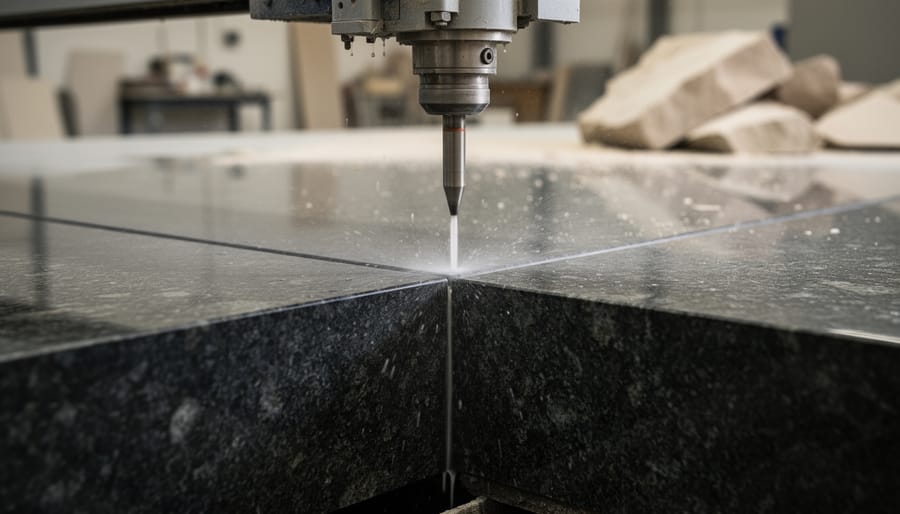
Softer sedimentary stones like marble, limestone, and travertine present unique challenges during fabrication. These delicate materials are particularly vulnerable to chipping, cracking, and edge damage when cut with traditional blade saws or other mechanical methods. The heat generated by spinning blades can cause thermal stress, while physical contact creates micro-fractures that compromise structural integrity and aesthetic appeal.
Water jet cutting eliminates these risks entirely through its non-contact, cold-cutting process. The high-pressure water stream slices through stone without applying mechanical force to the material’s surface, preserving the natural crystalline structure and preventing stress fractures. This gentle approach is especially beneficial for veined marble, where traditional cutting can cause existing fissures to expand or create new ones along the stone’s natural grain patterns.
For limestone and travertine, which often contain porous areas and natural voids, water jet technology navigates these variations without causing edge breakage or surface spalling. The adjustable pressure settings allow operators to fine-tune the cutting force based on each stone’s specific density and composition, ensuring clean cuts even in materials with inconsistent hardness levels. This precision proves invaluable when working with premium or rare stone varieties where material waste must be minimized and every slab needs maximum yield.
Dense Materials: Granite, Quartzite, and Engineered Stone
Water jet cutting delivers exceptional results when working with dense materials like granite, quartzite, and engineered stone. These hard surfaces, which can quickly dull traditional cutting tools, pose no challenge to the abrasive water jet stream. The technology virtually eliminates tool wear concerns since there’s no physical blade making contact with the stone, translating to consistent cut quality from start to finish and lower long-term operational costs for fabricators.
The cold-cutting nature of water jet technology offers a critical advantage when processing thick slabs. Unlike saw blades that generate significant heat and can cause thermal stress, micro-cracking, or discoloration in dense materials, water jets maintain the stone’s structural integrity throughout the cutting process. This makes the method ideal for creating thick countertop edges, structural elements, or custom architectural features from materials like quartzite, which can be particularly sensitive to heat-induced damage.
Edge quality remains remarkably uniform across cuts, even when processing slabs up to 6 inches thick. The precision of the water jet stream produces clean edges that require minimal finishing work, reducing fabrication time and labor costs. For designers and architects specifying intricate patterns or tight tolerances in granite or engineered stone projects, this consistency ensures that complex designs translate flawlessly from concept to installation.
Real-World Applications in Residential and Commercial Spaces
Custom Countertops and Kitchen Islands
Water jet cutting has revolutionized custom countertop fabrication by enabling precision work that traditional methods simply cannot match. For homeowners planning kitchen renovations, this technology unlocks design possibilities that were once impossible or prohibitively expensive.
The most significant advantage appears in seamless sink cutouts. Water jet cutting creates perfectly smooth edges that eliminate the need for visible metal rim sinks, allowing for elegant undermount installations. The process produces such precise measurements that sinks fit flush without gaps, creating a continuous surface that’s both beautiful and hygienic.
Complex kitchen islands benefit tremendously from this technology. Designers can now specify curved edges, geometric patterns, and asymmetrical shapes without worrying about structural compromises. Water jet cutting excels at creating perfect mitered edges for waterfall countertops, where the stone wraps from the horizontal surface down the sides. These 45-degree joints align so precisely that the veining patterns flow continuously, making seams virtually invisible.
Integrated drain boards carved directly into countertops showcase another practical application. The water jet can cut subtle grooves at exact depths and angles, allowing water to drain efficiently while maintaining the stone’s integrity. This level of customization means your countertop can include functional features tailored specifically to your cooking habits and kitchen workflow, transforming standard surfaces into personalized workspaces.
Architectural Features and Decorative Elements
Water jet cutting has revolutionized architectural stone applications by enabling designs that were once impossible or prohibitively expensive with traditional methods. In facade cladding, the technology creates perfectly fitted panels with intricate edge profiles, ventilated rainscreen systems, and dimensional relief patterns that add visual depth to building exteriors. The precision allows architects to specify complex geometric patterns without compromising structural integrity or installation efficiency.
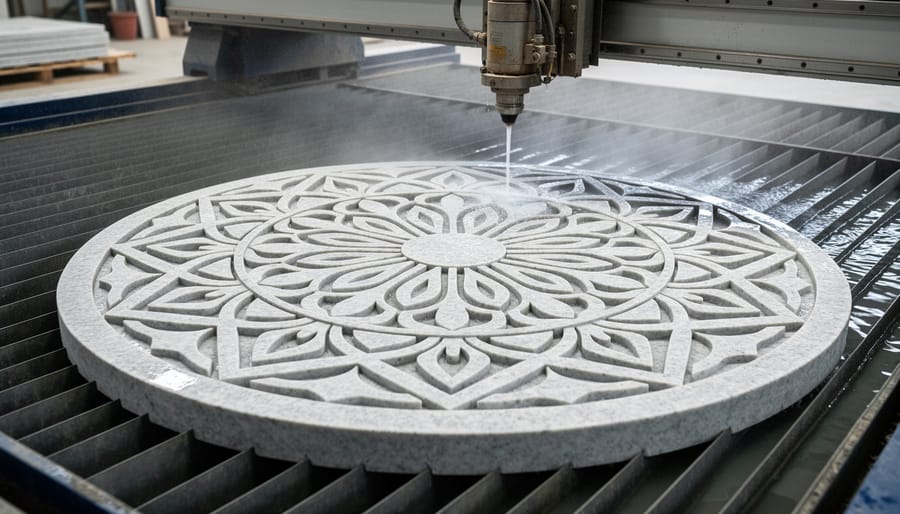
Floor medallions showcase water jet cutting’s artistic capabilities, producing elaborate designs from multiple stone types with tolerances as tight as 0.1mm. These custom inlays incorporate everything from classical rosette patterns to contemporary abstract motifs, seamlessly integrating contrasting materials like marble, granite, and limestone into unified compositions.
Custom fireplace surrounds benefit enormously from this technology, as fabricators can create detailed corbels, ornamental borders, and three-dimensional carved effects that elevate these focal points beyond standard offerings. The non-contact cutting process preserves delicate edge work and fine details that would chip or fracture with saw blades.
Artistic installations represent perhaps the most impressive application, where designers collaborate with fabricators to realize sculptural elements, decorative screens with pierced patterns, and site-specific commissions. Museums, corporate lobbies, and public spaces increasingly feature water jet-cut stone art that demonstrates both technical mastery and creative vision, proving that functional architectural elements can also serve as compelling visual statements.
Commercial and High-Traffic Installations
High-traffic commercial environments demonstrate waterjet cutting’s transformative impact on project timelines and installation quality. At the Grand Meridian Hotel’s marble-clad lobby, waterjet-cut floor medallions arrived ready for immediate installation, with each interlocking piece fitting precisely without field modifications. This eliminated three days of anticipated on-site cutting and adjustment, allowing the hotel to open on schedule.
Similarly, a restaurant chain’s signature granite bar tops, featuring intricate edge profiles and integrated drainage channels, showcased waterjet precision across multiple locations. Fabricators produced identical pieces for fifteen restaurants, ensuring brand consistency while reducing installation time from two days to six hours per location.
Retail environments benefit particularly from waterjet’s ability to create complex inlays and logos. A flagship store’s entrance featured a limestone floor with an eight-foot corporate emblem composed of 127 individual pieces. The precision fitting meant installers completed the entire floor in one weekend, minimizing business disruption and eliminating costly grinding or shimming that traditional cutting methods would require.
Cost Considerations: When Water Jet Cutting Makes Financial Sense
Material Waste Reduction and ROI
Water jet cutting delivers significant material savings through its remarkably narrow kerf width of just 0.03″ to 0.04″, compared to traditional saw blades that can waste 0.125″ or more per cut. This precision becomes critically important when working with expensive exotic stones like Calacatta marble, Blue Bahia granite, or rare quartzites that can cost $200-$500 per square foot. On a typical kitchen countertop project requiring multiple cutouts and edge profiles, water jet technology can preserve 5-15% more usable material compared to conventional methods.
The financial impact multiplies with project scale. For a luxury residential project using premium stone, this efficiency translates to thousands of dollars in saved material costs. The technology excels at nesting complex shapes efficiently on slabs, extracting maximum value from each piece while minimizing material waste. Fabricators can often complete intricate inlay work or mosaic patterns from remnants that would otherwise be discarded, further improving return on investment. This efficiency not only reduces project costs but also supports sustainable practices by maximizing the use of natural resources.
Project Complexity as the Deciding Factor
Project complexity should be your primary consideration when choosing between water jet and traditional cutting methods. For intricate designs featuring curves, tight radii, or custom inlay work, water jet cutting delivers unmatched precision that traditional saws simply cannot replicate. Consider water jet technology essential when working with high-value materials like rare marbles or exotic granites, where a single cutting error could mean substantial financial loss.
Traditional methods remain practical and cost-effective for straightforward cuts, standard tiles, or projects with simple geometric shapes. However, when your design includes medallions, complex borders, or architectural details requiring tolerances within 0.005 inches, water jet cutting becomes the clear choice.
Installation requirements also factor into your decision. Projects demanding pre-fabricated pieces that fit together seamlessly benefit from water jet precision, reducing on-site adjustments and installation time. For one-off custom pieces or projects where material preservation is paramount, the cold-cutting process prevents thermal damage and maintains stone integrity throughout fabrication.
What to Expect When Working With a Water Jet Cutting Fabricator
Design File Preparation and Technical Requirements
Successful waterjet stone cutting begins with properly prepared design files. Most waterjet systems accept CAD files in DXF (Drawing Exchange Format) or DWG formats, with DXF being the industry standard due to its universal compatibility across software platforms. Vector-based files are essential—these contain mathematical path definitions rather than pixel-based images, ensuring the cutting machine follows precise edge trajectories.
When preparing files, designers should convert all shapes to closed polylines or paths, eliminating overlapping lines that could cause redundant cuts. Line weights and colors often communicate cutting parameters to operators, with different colors indicating varying cutting depths or speeds. Files should include clear dimensional references and be scaled accurately to avoid sizing errors during fabrication.
Complex patterns benefit from collaboration between designers and fabricators early in the process. Many fabrication shops offer file review services to identify potential issues before cutting begins. For intricate inlays or custom patterns, designers can visualize complex designs digitally before committing to production, reducing costly mistakes and ensuring the final product matches expectations perfectly.
Questions to Ask Your Stone Fabricator
Before committing to a stone fabricator, ask about their water jet equipment specifications and what tolerance levels they can achieve—precision within 0.005 inches indicates high-quality machinery. Inquire about their experience with your specific stone type, as different materials like marble, granite, or quartzite require adjusted cutting parameters for optimal results.
Request details about edge finishing capabilities, since water jet cutting produces raw edges that need refinement. Ask whether they handle finishing in-house or outsource it, as this affects project timelines and quality control. Understanding their post-cutting processes ensures you’ll receive a polished, installation-ready product.
Question their quality assurance procedures and what warranties they offer on precision cuts and overall workmanship. Request examples of similar projects they’ve completed, including photos or case studies that demonstrate their ability to handle intricate designs.
Finally, ask about their turnaround times and whether rush services are available. Clarify their pricing structure—whether they charge by linear foot, square footage, or project complexity—and request a detailed written estimate before work begins. These questions help you evaluate whether the fabricator can deliver the precision and quality your project demands.
Water jet stone cutting has fundamentally transformed the stone fabrication industry, offering unprecedented precision, versatility, and design freedom. This technology eliminates the limitations of traditional cutting methods, enabling intricate patterns, tight tolerances under 0.005 inches, and virtually waste-free fabrication. Whether you’re a homeowner planning a kitchen renovation, an architect designing a signature installation, or a designer seeking distinctive stone elements, hydro jet cutting opens new creative possibilities while reducing material costs and environmental impact.
The benefits are clear: no heat damage, minimal material waste, compatibility with all stone types, and the ability to execute complex designs that were once impossible or prohibitively expensive. As you plan your next stone project, consider consulting with experienced fabricators who specialize in water jet technology. They can provide samples, discuss design feasibility, and demonstrate how precision cutting can bring your vision to life while optimizing your budget. Embrace this innovative approach to unlock the full potential of natural stone in your space.