Expect to invest between $60 to $200 per square foot installed for sintered stone countertops, with most homeowners spending $8,000 to $15,000 for an average kitchen project. This engineered surface commands premium pricing due to its manufacturing process, which subjects natural minerals to extreme heat and pressure, creating a material that outperforms natural stone in durability and stain resistance.
Budget realistically by calculating both material costs ($40-$120 per square foot) and professional installation ($20-$80 per square foot), which requires specialized tools and expertise. Premium brands like Dekton and Neolith sit at the higher end, while emerging manufacturers offer comparable quality at 20-30% lower prices. Thickness significantly impacts cost—12mm slabs run approximately 40% less than 20mm options, though thinner materials limit edge profile choices.
Compare sintered stone against quartz ($50-$150 per square foot) and granite ($40-$100 per square foot) not just on initial investment, but lifecycle value. While sintered stone costs 15-25% more upfront than quartz, it withstands heat up to 1,200°F without damage, eliminates sealing requirements, and resists UV fading for outdoor applications—advantages that translate to lower maintenance costs over 20-plus years.
Request itemized quotes that separate material, fabrication, edge treatments, cutouts, and installation to identify negotiation opportunities. Purchase directly from fabricators rather than big-box retailers to eliminate markup, and consider remnant pieces for smaller projects like bathroom vanities or islands to achieve 40-60% savings on premium materials.
Understanding Sintered Stone vs. Porcelain Countertops
The relationship between sintered stone and porcelain often confuses consumers, and understanding this connection is essential when evaluating pricing. While sintered stone shares similarities with porcelain—both undergo high-temperature manufacturing processes—they represent distinct material categories with different production methods and performance characteristics.
Sintered stone is technically an ultra-compact surface created through an advanced sintering process that mimics the natural formation of stone over thousands of years, but compressed into a matter of hours. During this process, manufacturers subject natural minerals, quartz, porcelain, and glass particles to extreme heat (exceeding 2,000 degrees Fahrenheit) and intense pressure (approximately 400 bars). This combination fuses the particles at a molecular level without melting them, creating an extraordinarily dense, non-porous surface.
Porcelain countertops, while also fired at high temperatures, typically involve clay-based compositions and different manufacturing techniques. The key distinction lies in density and composition. Sintered stone contains no resins or binding agents, making it completely inert and more resistant to heat, UV rays, scratches, and staining than traditional porcelain surfaces.
This manufacturing complexity directly impacts pricing. The specialized equipment required for sintering, the extended production time, and the precise control needed throughout the process all contribute to higher costs compared to standard porcelain. Additionally, sintered stone slabs are typically larger and thicker than porcelain alternatives, requiring more raw materials and energy.
Understanding these technical differences helps explain why sintered stone commands premium pricing in the marketplace. You’re not simply paying for an aesthetic surface—you’re investing in advanced materials science that delivers superior performance characteristics. This knowledge becomes crucial when comparing quotes and evaluating whether the additional investment aligns with your project requirements and long-term durability expectations.
The Real Numbers: Sintered Stone Price Breakdown
Material Costs Per Square Foot
Sintered stone material costs typically range from $60 to $200 per square foot, though prices vary significantly based on quality tier and specific characteristics.
Entry-level sintered stone starts at approximately $60 to $80 per square foot. These options feature simpler patterns, limited color selections, and standard thickness. While they deliver the fundamental benefits of sintered stone—durability, heat resistance, and non-porosity—they may lack the visual complexity and premium finishes available in higher-end products.
Mid-range sintered stone falls between $80 and $120 per square foot. This tier offers more sophisticated patterns, including realistic marble and natural stone veining, wider color palettes, and better consistency in manufacturing. Most residential projects gravitate toward this range, as it balances aesthetic appeal with reasonable pricing.
Premium sintered stone commands $120 to $200+ per square foot. These top-tier slabs feature exceptional detail, large-format options, specialty finishes, and patterns that closely mimic rare natural stones. Premium products often include unique textures and advanced manufacturing techniques that create extraordinary visual depth.
When comparing sintered stone to other countertop materials, the pricing sits at the upper end of the spectrum. Granite typically costs $40 to $100 per square foot, while quartz ranges from $50 to $150. Natural marble varies from $50 to $200 depending on rarity. Laminate represents the budget option at $20 to $50 per square foot.
While sintered stone’s upfront cost exceeds many alternatives, its superior durability, stain resistance, and minimal maintenance requirements can offset the initial investment over time. The material’s resistance to scratches, heat, and UV damage means fewer repairs and replacements throughout its lifespan.
Installation Costs and Labor
Installation costs significantly impact your total sintered stone investment, typically adding $40 to $100 per square foot beyond material expenses. Unlike conventional countertop materials, sintered stone demands specialized fabrication techniques and experienced professionals, making labor a substantial portion of your overall budget.
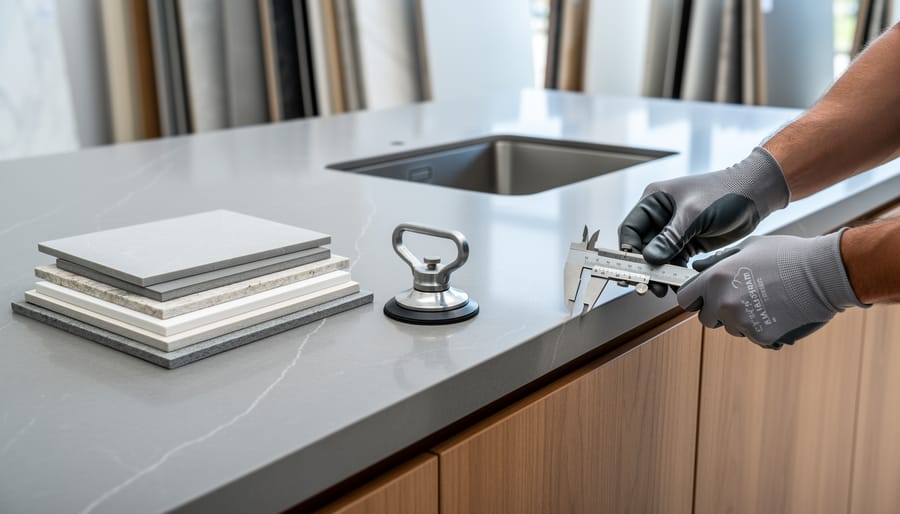
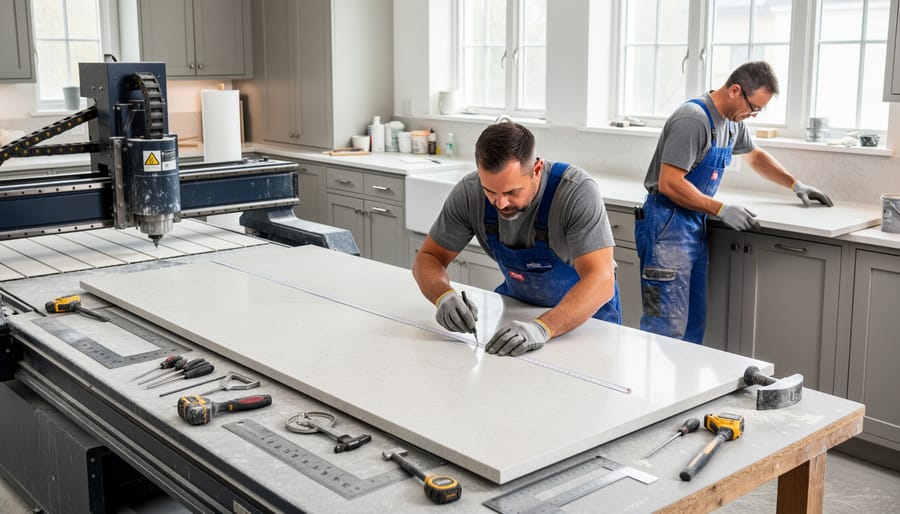
The unique density and hardness that make sintered stone exceptionally durable also create installation challenges. Standard cutting tools often prove inadequate—fabricators require diamond-tipped blades and specialized equipment to cut, shape, and polish these surfaces properly. This specialized machinery represents a significant investment for installers, costs that inevitably transfer to consumers.
Professional installation is non-negotiable with sintered stone. The material’s weight and brittleness during handling mean improper installation can result in cracking or breakage, voiding warranties and requiring expensive replacement. Experienced fabricators understand proper support requirements, seam placement strategies, and temperature considerations during installation.
Several factors influence your final labor costs. Complex edge profiles, cutouts for sinks and cooktops, and integrated backsplashes increase fabrication time and difficulty. Kitchen islands with waterfall edges or book-matched slabs require additional expertise and precision. Geographic location also matters—metropolitan areas with higher living costs typically charge premium rates for skilled fabricators.
Template costs add another consideration. Most installers create physical templates of your space before fabrication begins, ensuring precise measurements. This service typically costs $100 to $300 but prevents costly mistakes.
When budgeting, request itemized quotes from multiple certified installers. Verify their experience specifically with sintered stone, not just general countertop installation. Quality installation protects your investment and ensures your surfaces perform as intended for decades.
Total Project Investment
Understanding the complete investment for a sintered stone project helps you budget accurately. Here’s what typical kitchen countertop installations cost across different sizes.
For a small kitchen (25 square feet), expect to invest $2,500-$5,000 total. This includes material costs at $60-$100 per square foot, fabrication fees of $300-$500, basic edge treatment (eased or beveled) adding $150-$300, and professional installation running $400-$750. The lower end reflects domestic brands with standard finishes, while premium Italian sintered stone pushes costs higher.
Medium-sized kitchens (50 square feet) typically range from $5,000-$10,000. Material comprises the largest portion at $3,000-$5,000, with fabrication doubling to $600-$1,000 due to increased complexity. Edge treatments for longer runs cost $300-$600, and installation scales to $800-$1,500. Adding features like integrated sinks or decorative edges increases the total by 15-25 percent.
Large kitchen projects (75+ square feet) start at $7,500 and commonly reach $15,000-$20,000 for high-end installations. These projects often include island countertops, backsplashes, and premium edge profiles like waterfall or ogee treatments, which add $50-$100 per linear foot. Complex layouts with multiple seams require expert fabrication, justifying higher labor costs that ensure long-term durability and aesthetic consistency.
What Drives Sintered Stone Pricing
Brand and Manufacturer Differences
Brand selection significantly impacts your sintered stone investment, with premium manufacturers typically commanding 20-40% higher prices than generic alternatives. The three dominant brands—Dekton, Neolith, and Lapitec—each occupy distinct price tiers while offering different value propositions.
Dekton, manufactured by Cosentino, generally sits at the premium end, ranging from $70-$120 per square foot installed. Their proprietary TSP (Technology of Sinterized Particle) process and extensive color range justify the premium, along with a robust warranty and widespread fabricator network. Neolith follows closely at $60-$100 per square foot, emphasizing design innovation with ultra-thin options and architectural applications. Lapitec typically prices between $55-$95 per square foot, positioning itself with a focus on antibacterial properties and technical performance.
Generic or lesser-known brands can cost 30-50% less, sometimes as low as $40-$60 per square foot installed. However, these savings come with considerations. Premium brands invest heavily in quality control, ensuring consistent color batches and dimensional accuracy. They also maintain extensive fabricator training programs, reducing installation errors that could cost thousands to remedy. Warranty coverage differs substantially—premium brands often provide 25-year transferable warranties, while generic options may offer limited protection.
The value question depends on your project scope. For high-visibility residential applications where longevity and resale value matter, premium brands typically justify their cost. For commercial projects or budget-conscious renovations, reputable mid-tier or generic options can deliver satisfactory performance. Always request samples, verify fabricator experience with your chosen brand, and compare total project costs rather than material prices alone.
Thickness and Slab Size
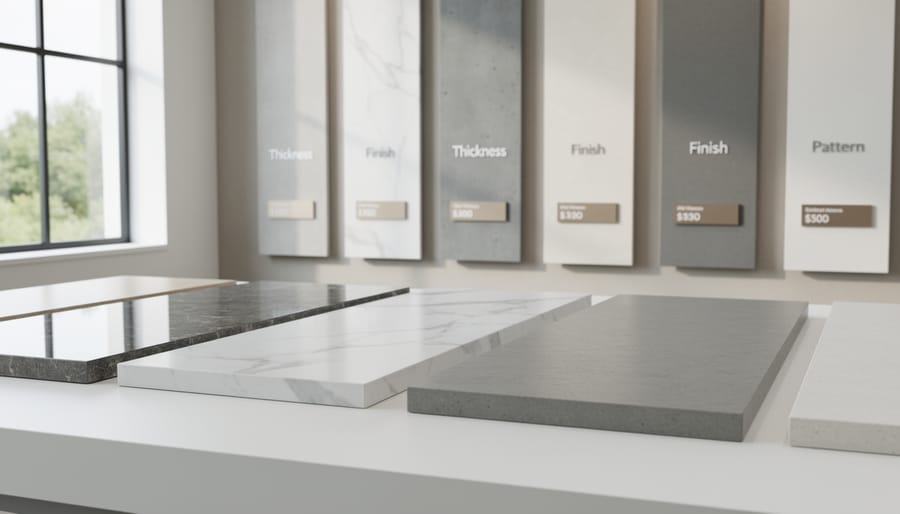
Sintered stone typically comes in three standard thickness options, each with distinct pricing and applications. The 12mm thickness is the most economical choice, generally adding $40-60 per square foot to your total cost. This thinner option works well for wall cladding, backsplashes, and light-duty surfaces where structural support isn’t a primary concern.
The 20mm thickness represents the mid-range option at approximately $60-80 per square foot and serves as the standard for most countertop installations. This thickness provides adequate durability for kitchen countertops and bathroom vanities while maintaining a reasonable price point. Most residential projects default to this specification unless specific structural requirements dictate otherwise.
For applications requiring maximum strength, such as outdoor kitchens, waterfall edges, or unsupported overhangs, the 30mm thickness becomes necessary. Expect to pay $80-110 per square foot for this premium option. The additional material and weight increase fabrication complexity and transportation costs significantly.
Large-format slabs, which can reach 10 feet by 5 feet, offer aesthetic advantages by minimizing seams but command premium pricing. These oversized slabs require specialized equipment for handling and installation, potentially adding 15-25 percent to fabrication costs. However, for spacious kitchens or commercial applications, the seamless appearance often justifies the investment. Consider your project’s structural requirements and visual goals when selecting thickness and slab dimensions to optimize both performance and budget.
Color, Pattern, and Finish Selection
Aesthetic choices significantly impact sintered stone pricing, with solid colors typically representing the entry point at $50-$75 per square foot installed. These uniform hues—whites, grays, blacks, and contemporary concrete tones—require simpler manufacturing processes, making them more budget-friendly options for cost-conscious projects.
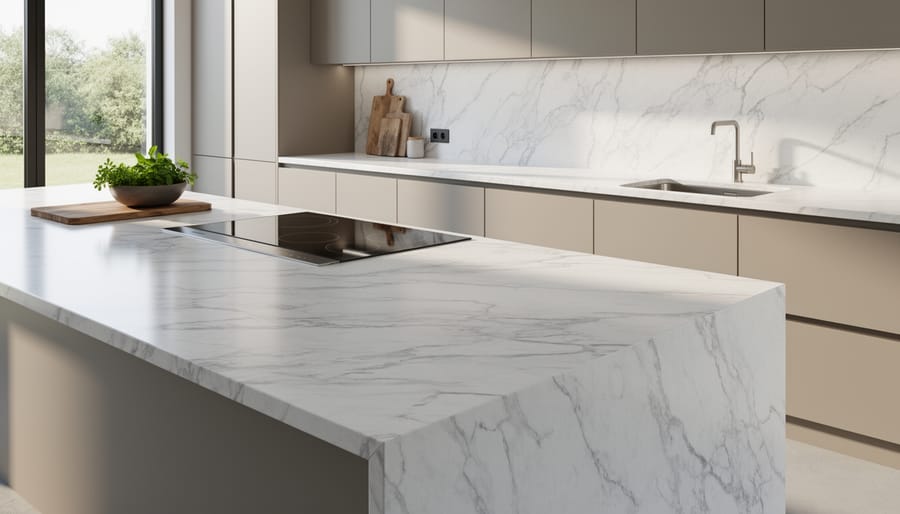
In contrast, marble and granite lookalikes command premium pricing, ranging from $75-$150 per square foot installed. These sophisticated reproductions involve advanced digital imaging technology and multi-layered coloration processes to replicate natural veining, movement, and depth. Popular patterns like Calacatta marble imitations or dramatic book-matched designs often reach the upper end of this spectrum due to their complexity and desirability among designers.
Finish selection also influences cost. Matte finishes generally align with standard pricing, while polished surfaces may add $5-$15 per square foot due to additional processing steps. Textured finishes that replicate honed natural stone or leather-like surfaces can increase costs by 10-20 percent.
Certain patterns command premiums for specific reasons: book-matched slabs require precise manufacturing alignment, rare color combinations demand specialized pigments, and large-format veining patterns need advanced production capabilities. Limited-edition collections from premium manufacturers can exceed $150 per square foot, positioning them alongside luxury natural stone options while maintaining sintered stone’s superior performance characteristics.
Geographic Location and Availability
Geographic location significantly influences sintered stone pricing, with costs varying considerably across regions and countries. Urban markets typically see higher prices due to increased overhead costs, while rural areas may have limited access to suppliers and fabricators, potentially offsetting any savings with higher transportation fees.
Since most sintered stone is manufactured in Europe and Asia, particularly Spain and Italy, imported materials incur substantial shipping costs that directly impact the final price. Freight charges, import duties, and customs fees can add 15-30% to the base material cost, depending on your distance from major distribution centers. Coastal regions with established port infrastructure generally enjoy lower shipping expenses compared to landlocked areas.
The availability of local fabricators and installers also affects your total investment. Areas with established stone fabrication industries offer competitive pricing due to market competition, while regions with fewer skilled professionals may charge premium rates for their services. Metropolitan areas typically have more fabricators familiar with sintered stone, reducing installation costs through efficiency and experience.
Additionally, some manufacturers maintain regional distribution networks or warehouses that can reduce lead times and shipping expenses. Before committing to a purchase, research local suppliers and compare prices from multiple sources, including both local distributors and direct importers, to identify the most cost-effective option for your specific location.
Hidden Costs and Budget Considerations
Fabrication and Edge Treatments
Fabrication and edge treatments significantly impact your final sintered stone investment. Professional cutting and finishing typically add $30 to $75 per linear foot for custom edge profiles. Simple edges like eased or straight cost less, while beveled, ogee, or waterfall edges command premium pricing due to the specialized equipment and expertise required.
Sintered stone’s extreme hardness demands diamond-blade cutting tools and experienced fabricators, making it more challenging to work with than granite or quartz. Cutouts for undermount sinks range from $150 to $400 each, while cooktop openings cost $200 to $500 depending on size and complexity. Corner cuts, electrical outlets, and faucet holes add $50 to $150 per opening.
Specialty fabrication like mitered edges for waterfall islands or book-matched patterns increases labor costs by 25 to 50 percent. The material’s density also means longer cutting times and faster tool wear, expenses fabricators pass to consumers. Some installers charge travel fees if bringing portable cutting equipment to your site for dust control.
Always verify your fabricator has specific sintered stone experience, as improper handling can cause chips or cracks. Request itemized quotes that separate material costs from fabrication charges to understand exactly where your money goes and compare estimates effectively.
Removal and Disposal of Existing Countertops
Removing existing countertops typically costs between $100 and $300, depending on the material and complexity. Standard laminate removal runs on the lower end, while granite or tile with extensive backsplashes can reach the upper range. Labor accounts for most of this expense, as professionals must carefully disconnect plumbing fixtures, detach countertops from cabinetry, and avoid damaging surrounding areas.
Disposal fees add another $50 to $150 to your total, varying by location and material type. Some materials like granite can be recycled, potentially reducing costs, while others require special handling. Surface preparation for sintered stone installation includes leveling cabinets, repairing any damage, and ensuring proper support structures, which may add $100 to $400 depending on existing conditions.
When budgeting for sintered stone, factor in these preliminary costs as part of your total investment. Many installers include removal in their quotes, so request itemized estimates to understand exactly what you’re paying for and identify potential savings opportunities.
Additional Materials and Supplies
Beyond the sintered stone slabs themselves, several supplementary materials impact your total project cost. Unlike natural stone, sintered stone typically doesn’t require sealing due to its non-porous nature, potentially saving $50-$150 in initial treatment costs. However, you’ll need specialized adhesives formulated for large-format tiles, running $100-$300 per project depending on square footage.
Underlayment or substrate preparation materials add $2-$5 per square foot, ensuring proper support for heavy slabs. If your project includes backsplashes, matching sintered stone typically costs the same per square foot as countertops, though smaller quantities may increase waste. Edge treatments and corner pieces require specialized cutting, adding $10-$30 per linear foot for finished edges.
Installation supplies like diamond blades for cutting (approximately $150-$400 each) and specialty grout for minimal seams ($30-$80) round out ancillary expenses. Factor in roughly 10-15% of your material costs for these additional supplies when budgeting your sintered stone project. Professional installers typically include basic supplies in their quotes, but confirm what’s covered to avoid surprises.
How Sintered Stone Compares to Other Countertop Materials
Understanding how sintered stone stacks up against traditional countertop materials helps you make an informed investment decision. While sintered stone typically ranges from $60 to $150 per square foot installed, let’s examine how it compares in both price and performance.
Granite remains one of the most popular choices, with prices ranging from $40 to $100 per square foot installed. While initially less expensive, granite requires periodic sealing and offers less resistance to staining and heat shock compared to sintered stone. Over a 20-year lifespan, maintenance costs can narrow the price gap considerably.
Marble countertop costs run between $50 and $200 per square foot installed, placing it in a similar range to sintered stone. However, marble’s porous nature demands regular sealing and careful maintenance to prevent etching and staining. Sintered stone delivers marble’s elegant appearance without these ongoing concerns.
Quartz countertops typically cost $50 to $120 per square foot installed, making them closely competitive with sintered stone. Both materials offer excellent durability and low maintenance. The key difference lies in heat resistance—sintered stone withstands direct heat from hot pans, while quartz can suffer damage.
Laminate and solid surface materials cost significantly less at $20 to $60 per square foot, but they cannot match sintered stone’s durability, heat resistance, or scratch resistance. These budget-friendly options may require replacement within 10 to 15 years, while sintered stone can last several decades with minimal maintenance.
When evaluating total cost of ownership, consider that sintered stone’s superior durability, zero maintenance requirements, and extended lifespan often justify the initial premium, delivering better long-term value than many alternatives.
Is Sintered Stone Worth the Investment?
Determining whether sintered stone justifies its premium price requires examining its long-term value beyond the initial investment. While the upfront cost typically ranges higher than many alternatives, the material’s performance characteristics and longevity often deliver substantial returns over time.
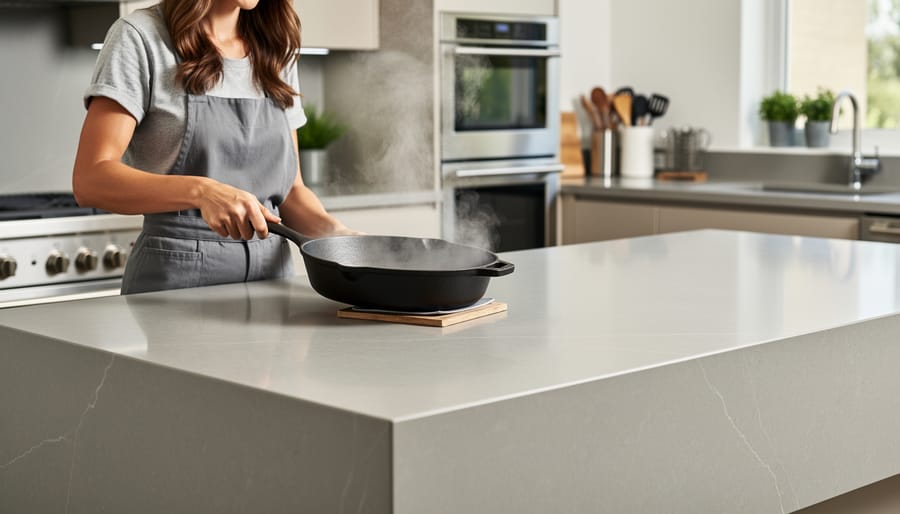
Durability stands as sintered stone’s most compelling advantage. This engineered material resists scratching, staining, and etching far better than natural stone options like marble or granite. Unlike quartz, sintered stone withstands direct heat from pots and pans without scorching or discoloring, eliminating the need for trivets and reducing the risk of costly damage. This resilience translates directly to lower maintenance costs over the material’s lifespan, which can extend decades without requiring sealing, special cleaners, or professional restoration.
The maintenance equation significantly impacts overall value. Natural stone requires periodic sealing and careful cleaning with pH-neutral products, while sintered stone needs only soap and water. Over a 20-year period, homeowners can save hundreds of dollars on maintenance products and professional services. For commercial applications in restaurants or hotels, where surfaces endure heavy use, these savings multiply substantially.
From a resale perspective, sintered stone installations increasingly attract buyers seeking modern, low-maintenance homes. Real estate professionals report that premium countertop materials contribute to faster sales and higher offers, though exact ROI varies by market. In luxury segments, sintered stone’s contemporary aesthetic and performance reputation can distinguish a property from competitors.
The investment makes strongest sense for specific applications. High-traffic kitchens where cooking intensity demands heat resistance benefit enormously. Outdoor kitchens represent ideal candidates, as sintered stone withstands UV exposure and temperature fluctuations that degrade other materials. Commercial spaces requiring sanitary, durable surfaces find exceptional value in sintered stone’s non-porous composition.
However, not every project requires sintered stone’s premium capabilities. Guest bathrooms with minimal use or decorative backsplashes might achieve adequate results with less expensive materials. When evaluating which countertop material deserves your budget, consider usage intensity, aesthetic priorities, and your timeline for home ownership.
For homeowners planning to stay long-term in high-use environments, sintered stone’s combination of durability, minimal maintenance, and timeless appearance typically validates the initial premium through reduced lifetime costs and sustained performance.
How to Get the Best Price on Sintered Stone Countertops
Getting the best price on sintered stone countertops requires strategic planning and informed decision-making. Start by timing your purchase carefully—many fabricators offer discounts during slower seasons, typically late fall and winter when renovation activity decreases. You may also find promotional pricing during major holidays or industry trade shows when suppliers introduce new collections.
Working directly with fabricators rather than going through multiple intermediaries can reduce costs significantly. Request itemized quotes from at least three different fabricators to understand the pricing landscape in your area. These quotes should break down material costs, fabrication fees, edge treatments, cutouts, and installation charges separately. This transparency helps you identify where you have negotiation flexibility and which services you might handle independently if you have the skills.
Consider where to splurge versus save strategically. Invest in quality fabrication and installation, as poor workmanship can void warranties and create costly problems down the road. However, you might save by choosing simpler edge profiles instead of elaborate custom designs, which can add hundreds of dollars to your total cost. Standard thickness options (12mm or 20mm) are generally more affordable than specialty thicknesses that require custom ordering.
Be flexible with your color and pattern choices. Newly released designs command premium prices, while established collections often see price reductions. Remnant pieces from larger jobs can work perfectly for smaller projects like bathroom vanities or kitchen islands at substantial savings—sometimes 30-50% off regular pricing.
Bundle multiple stone surfaces in your home into a single project when possible. Fabricators often provide better per-square-foot pricing for larger orders. Finally, negotiate payment terms and ask about cash discounts, as some fabricators offer 3-5% reductions for upfront payment. Always verify that quoted prices include templating, delivery, and basic installation to avoid surprise charges that inflate your final cost.
Sintered stone represents a significant investment for any countertop project, with prices typically ranging from $60 to $200 per square foot installed, depending on brand, color complexity, thickness, and edge detailing. When compared to natural stone alternatives like granite or marble, sintered stone often falls in the mid-to-upper price range, but this premium reflects its superior performance characteristics, including unmatched stain resistance, heat tolerance, and virtually zero porosity.
For consumers and designers evaluating this material, the key is understanding total project value rather than focusing solely on upfront costs. While sintered stone may cost 20-40% more than basic granite, it requires no sealing, demonstrates exceptional durability in high-traffic applications, and maintains its appearance for decades with minimal maintenance. This translates to lower lifetime costs and greater peace of mind.
When budgeting for your project, remember to account for fabrication complexity, edge profiles, cutouts, and installation labor, which can add 30-50% to material costs alone. Obtain detailed quotes from multiple fabricators, ask about remnant availability for smaller projects, and consider purchasing directly from distributors when possible to reduce markups.
Ultimately, sintered stone delivers exceptional value for those prioritizing durability, hygiene, and low maintenance in kitchens, bathrooms, and commercial spaces. By understanding the pricing structure and carefully selecting features that align with your functional needs rather than purely aesthetic upgrades, you can maximize your investment while enjoying one of the most technologically advanced surfacing materials available today.