

America’s cities didn’t always look the way they do today. Before 1916, nothing stopped a factory from operating next to a mansion, a slaughterhouse beside a school, or a towering skyscraper from casting entire neighborhoods into permanent shadow. The history of zoning in the United States began as a response to these chaotic conditions, fundamentally reshaping how Americans build, live, and interact with urban spaces.
New York City enacted the nation’s first comprehensive zoning ordinance in 1916, establishing a legal framework that would spread to virtually every American municipality within decades. This landmark legislation didn’t emerge from abstract planning theories but from concrete urban crises: devastating fires that consumed wooden structures, public health emergencies in overcrowded tenements, and conflicts between incompatible land uses. Material choices played a surprisingly central role in these early regulations, as cities mandated fire-resistant construction using brick, granite, and limestone in dense commercial districts.
The evolution of American zoning reflects deeper tensions between property rights and collective welfare, economic development and neighborhood preservation, individual freedom and public safety. From early fire codes requiring masonry construction to mid-century suburban expansion and contemporary debates over affordable housing, zoning has continuously adapted to address emerging challenges. Understanding this history reveals not just how we got our current urban landscape, but why changing these deeply embedded systems remains so contentious today. The story of zoning is ultimately the story of who gets to decide how American communities grow and transform.
The Pre-Zoning Era: When Stone Buildings Defined City Growth (1600s-1860s)
Stone as a Status Symbol in Colonial Cities
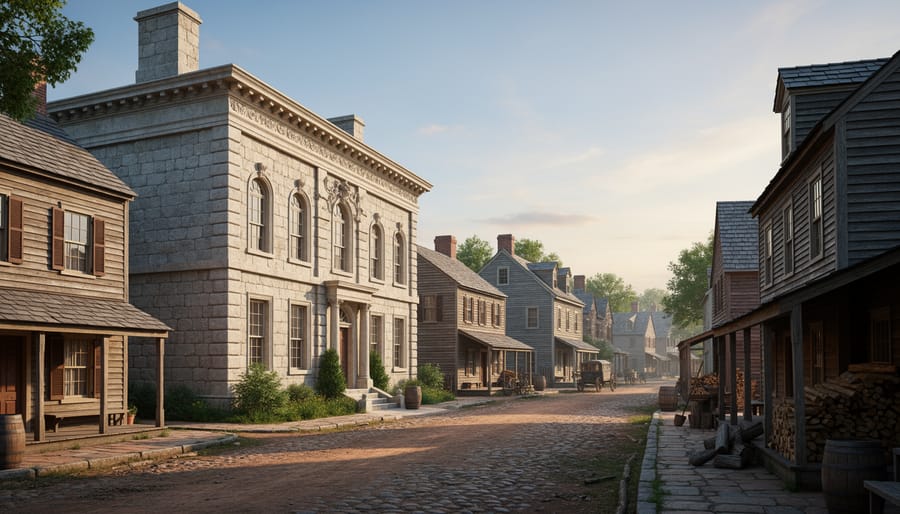
In colonial American cities, building materials created visible boundaries between social classes long before any official zoning ordinances existed. Wealthy merchants, professionals, and landowners constructed their homes and businesses using durable stone or brick, while working-class neighborhoods consisted primarily of wooden structures. This material divide established informal zones that would later influence formal zoning practices.
Stone construction demanded significant capital investment. Quarrying, transporting, and expertly laying stone required specialized labor and resources beyond the reach of most colonists. Consequently, stone buildings became concentrated in prestigious areas near waterfronts, central squares, and main thoroughfares where affluent families lived and conducted business. These granite, limestone, and marble facades announced financial success and social standing to all who passed by.
The architectural segregation extended beyond aesthetics. Stone structures offered superior fire resistance, weather protection, and longevity—practical advantages that enhanced property values and attracted similar high-investment development nearby. As stone structures shaped cities throughout history, they created precedents for land use patterns in colonial America.
Meanwhile, wooden buildings dominated areas housing laborers, craftsmen, and recent immigrants. These neighborhoods faced higher fire risks and lower property values, reinforcing economic stratification through construction materials. City officials began recognizing these material-based divisions when drafting early building codes, ultimately using construction standards as proto-zoning tools to control urban development patterns and maintain class distinctions within growing colonial cities.
The Fireproof City Movement
The devastating urban fires of the 19th century fundamentally transformed American cities and sparked the nation’s first building regulations based on construction materials. The Great Chicago Fire of 1871, which destroyed over 17,000 structures and left 100,000 residents homeless, stands as perhaps the most influential catalyst for fire-safety legislation. Within months, Chicago became one of the first American cities to mandate stone, brick, and other non-combustible materials for all construction within designated fire limits in the downtown core.
Boston had experienced similar devastation in its 1872 fire, which consumed 776 buildings across 65 acres of the commercial district. These catastrophes prompted cities nationwide to establish “fire districts” where wooden construction was prohibited or severely restricted. Baltimore, San Francisco, and New York quickly followed suit, creating what historians recognize as America’s earliest form of material-based zoning.
These fire limits represented a significant departure from previous laissez-faire building practices. Property owners within designated zones faced strict requirements to use stone, brick, or other fireproof materials for exterior walls and structural elements. The regulations often specified minimum wall thickness and mandated stone foundations even when upper stories used brick.
This movement had profound economic implications. The demand for granite, limestone, and marble surged as cities rebuilt their cores with permanent, fire-resistant materials. Quarries expanded operations, and the stone industry became integral to urban development. These early regulations established a precedent that building codes could dictate construction methods for public safety, laying groundwork for the comprehensive zoning systems that would emerge in the 20th century.
Industrial Revolution: Stone Factories and the Birth of Land Use Separation (1860s-1900)
Granite Mills and Limestone Factories
The permanence of stone industrial structures presented unique challenges for early zoning reformers that wood-frame buildings never posed. When granite mills and limestone factories were built in the late 19th and early 20th centuries, they were constructed to last centuries—massive load-bearing walls, foundations that reached deep into bedrock, and architectural footprints that dominated entire city blocks. Unlike wooden structures that could be demolished relatively inexpensively, these stone edifices represented enormous capital investments that couldn’t simply be torn down when neighborhoods changed character.
This durability made zoning decisions particularly consequential. A poorly placed stone factory would remain an industrial presence for generations, regardless of residential development around it. Cities like Lowell, Massachusetts, and Quincy, Massachusetts, home to massive granite quarrying operations, faced this reality directly. Their limestone processing facilities and granite cutting mills created permanent industrial zones that influenced how stone shaped modern cities for decades to come.
Zoning boards began recognizing that stone construction demanded more careful initial planning than temporary wooden structures. Early zoning maps often designated areas with existing stone industrial buildings as permanent manufacturing districts, essentially acknowledging that these zones couldn’t be easily transformed. This reality pushed reformers to be more proactive rather than reactive, establishing clear industrial boundaries before permanent stone structures locked in land uses that might later prove incompatible with surrounding development.

Tenement Laws and Stone Construction Standards
Before formal zoning laws emerged in the early 20th century, American cities employed building codes as a practical tool to control urban development. Following devastating fires in cities like Boston (1872) and Chicago (1871), municipalities enacted ordinances mandating stone, brick, or other fireproof materials in densely populated districts. New York’s Tenement House Act of 1867 established minimum construction standards requiring masonry walls in multi-family dwellings, effectively determining where different building types could exist.
These material requirements created de facto zoning by making construction costs prohibitive in certain areas. Wooden structures became relegated to less dense neighborhoods, while stone and brick buildings dominated commercial districts and crowded residential zones. The economic implications were significant—only developers with substantial capital could build in prime urban locations, indirectly shaping land use patterns before comprehensive zoning existed.
San Francisco’s 1906 post-earthquake rebuild further demonstrated how material mandates functioned as spatial controls. The city designated fire limits requiring masonry construction in rebuilt areas, essentially creating zones of permanence versus temporary construction. This approach influenced the development of formal zoning laws, proving that building material standards could effectively organize urban space, protect public safety, and establish neighborhood character long before Euclid v. Ambler legitimized comprehensive zoning in 1926.
The 1916 New York Zoning Resolution: Stone Skyscrapers Force the Issue

The Equitable Building Crisis
In 1915, the Equitable Life Assurance Society completed what would become one of the most consequential buildings in American urban planning history. Rising 538 feet above lower Manhattan’s Financial District, the Equitable Building consumed an entire city block and exemplified stone’s journey through early 20th-century construction technology. The structure featured a granite base with limestone cladding across its massive 1.2 million square feet of floor space—approximately 30 times the area of its building lot.
The building’s sheer stone walls rose straight from the property line without setbacks, creating a towering cliff that cast a seven-acre shadow across neighboring properties during much of the day. This dramatic loss of natural light and air circulation sparked immediate outrage from adjacent property owners who saw their real estate values plummet. The limestone-clad giant became a physical manifestation of unchecked development rights.
Architects and city planners recognized the crisis the Equitable Building represented. Its granite-and-limestone construction, while impressive in scale and fireproof qualities, demonstrated how modern building materials enabled structures that could fundamentally alter urban environments. The public outcry over its oppressive presence provided the political momentum needed for comprehensive zoning reform.
By 1916, just one year after the Equitable Building’s completion, New York City enacted America’s first comprehensive zoning resolution. The law established height and setback requirements specifically designed to prevent another Equitable-style monolith from monopolizing light and air. This stone-clad skyscraper thus became the catalyst that transformed American cities forever.
Euclidean Zoning and the Stone Suburban Landscape (1920s-1950s)
Stone Veneer Regulations and Aesthetic Zoning
As American suburbs expanded rapidly in the mid-20th century, municipalities developed increasingly detailed aesthetic zoning ordinances that regulated exterior building materials, including stone veneer requirements. These regulations emerged from concerns about property values and neighborhood cohesion, with many communities establishing architectural review boards to enforce material standards.
By the 1960s and 1970s, numerous affluent suburbs mandated natural stone, brick, or high-quality manufactured stone for residential facades, particularly for homes facing primary streets. These provisions aimed to prevent the monotony of vinyl siding and maintain an upscale character that justified higher property taxes. Commercial districts followed suit, with many downtown revitalization efforts requiring stone or masonry elements to evoke historical authenticity and permanence.
The legal foundation for aesthetic zoning was solidified through landmark cases like Berman v. Parker (1954), which affirmed that aesthetic considerations alone could justify regulatory restrictions. This precedent enabled communities to specify percentages of natural materials required on building exteriors. Today, stone veneer regulations remain common in planned developments, historic districts, and areas with homeowners’ associations, reflecting the material’s enduring association with quality construction and architectural distinction.
Historic Preservation Zoning: Protecting Stone Heritage (1960s-Present)
Stone Buildings as Community Anchors
Stone buildings represent a fascinating paradox in American zoning history: they are simultaneously remnants of the past and powerful shapers of the present. When cities establish historic districts and preservation ordinances, stone structures receive protection at rates far exceeding their wooden or brick counterparts. This preferential treatment stems from multiple factors rooted in both material properties and cultural perceptions.
The durability of stone means these buildings simply outlast other construction types, creating a survivor bias in the historic record. A limestone bank from 1890 stands pristine while contemporaneous wood-frame buildings have long since deteriorated or been demolished. Historic preservation committees naturally gravitate toward these impressive survivors when designating landmarks. Additionally, stone’s association with institutional importance—courthouses, banks, churches, and civic buildings—means these structures often occupy prominent downtown locations, making them central to preservation efforts.
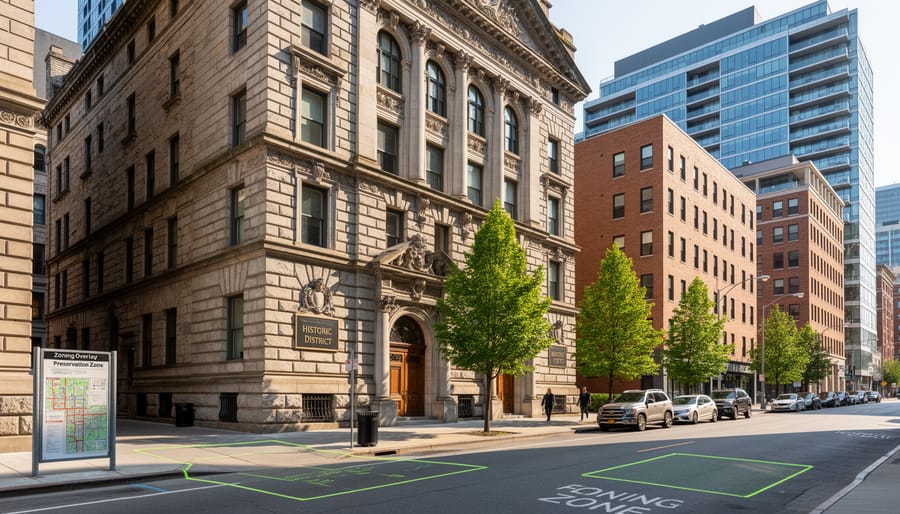
These stone building practices have profound implications for modern development. Historic district boundaries frequently form around clusters of masonry buildings, creating zones where new construction faces stringent design reviews and height restrictions. Developers must navigate complex approval processes, often requiring new buildings to complement existing stone architecture through compatible materials, scale, and design elements.
This dynamic creates interesting tensions in growing cities. While preservation protects architectural heritage and neighborhood character, it can also limit housing supply and increase costs. Communities must balance honoring their stone-built past with accommodating future growth, a challenge that continues shaping zoning debates nationwide.
Modern Zoning and Natural Stone Applications
LEED, Green Building Codes, and Natural Stone
Modern zoning increasingly incorporates sustainability standards that directly benefit natural stone construction. LEED (Leadership in Energy and Environmental Design) certification programs and green building codes now offer density bonuses, expedited permitting, and tax incentives for projects meeting environmental benchmarks—advantages that natural stone readily delivers.
Natural stone’s durability means buildings last centuries rather than decades, reducing demolition waste and embodied carbon over time. Unlike manufactured materials requiring energy-intensive production cycles, stone quarrying involves minimal processing. Many jurisdictions now recognize these qualities in sustainability assessments, allowing stone-clad buildings to earn points toward LEED credits for recycled content, regional materials, and low-emitting products.
Contemporary zoning ordinances in cities like Seattle and San Francisco explicitly reward developers who incorporate durable, locally-sourced materials. Stone’s thermal mass properties also contribute to energy efficiency credits, as the material naturally regulates interior temperatures. These modern incentive-based regulations represent a full-circle return to stone’s enduring value in urban planning—though now framed through environmental stewardship rather than fire prevention. As climate-conscious zoning expands, natural stone’s environmental profile positions it advantageously within evolving regulatory frameworks that prioritize longevity and resource conservation.
The enduring relationship between stone construction and American zoning reveals a fundamental truth: permanence demands foresight. From the earliest fire district regulations requiring masonry buildings in colonial cities to modern preservation ordinances protecting historic stone facades, the durability of natural stone has consistently elevated the stakes of urban planning decisions. Unlike temporary wooden structures that could be rebuilt after fires or demolition, stone buildings represented substantial investments that shaped neighborhoods for generations, making thoughtful regulation essential.
This historical pattern offers valuable lessons for today’s architects, designers, and developers. When selecting materials for contemporary projects, the permanence principle remains relevant. Natural stone installations—whether granite storefronts, limestone cladding, or marble interiors—create lasting visual and functional impacts on urban environments. These choices influence not just individual properties but entire streetscapes and community character for decades to come.
The evolution of zoning demonstrates that durable materials like natural stone warrant careful consideration within broader urban contexts. Historic districts nationwide now protect stone buildings precisely because their permanence allowed them to survive as tangible connections to our architectural heritage. Modern projects incorporating natural stone continue this legacy, contributing to the built environment in ways that transcend temporary trends.
As cities confront questions about sustainability, resilience, and identity, the lessons from zoning history remind us that material choices matter profoundly. Natural stone’s proven longevity—evidenced by centuries-old buildings still standing throughout American cities—positions it as both a link to our regulatory past and a strategic choice for thoughtful urban development moving forward.