Showing 100 Result(s)
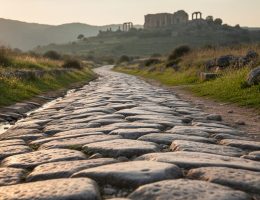
Low-angle view of a Roman stone road with tightly fitted paving stones and side drainage, extending through rolling countryside at golden hour.
Stone-Inspired Architectural Legacies

How Ancient Stone Roads Built the Foundation of Modern Engineering

The roads beneath our feet tell a 5,000-year story of human ingenuity, where ancient engineers solved problems that modern civil engineering still grapples with today. Long before asphalt and concrete dominated transportation infrastructure, civilizations built stone roads that have outlasted empires, withstood millions of footsteps, and continue teaching contemporary engineers valuable lessons about durability and design.
Roman engineers perfected techniques for stone road construction that remain foundational to modern civil engineering principles. Their layered approach—combining large foundation stones, smaller aggregate …
Floor-to-ceiling stacked slate fireplace wrapping a corner with a floating hearth and defined stone frame, illuminated by soft daylight in a high-ceiling living room with neutral sofa, wood beams, and built-in shelves.
Design Applications

Transform Your Living Space with These Natural Stone Fireplace Designs

Select stone varieties based on your fireplace’s functional demands and aesthetic goals—marble and limestone deliver refined elegance for low-use decorative fireplaces, while granite and slate withstand high temperatures and frequent fires in active hearths. Match stone texture and color to your room’s existing palette by bringing home large samples that reveal authentic variations in natural light, avoiding costly mismatches between showroom selections and installed results.
Design your fireplace proportions to anchor the room without overwhelming it—floor-to-ceiling installations create dramatic focal points in …

Modern interior with light limestone floors and accent wall illuminated by low winter sun through south-facing floor-to-ceiling windows, long shadows on the stone surface, snowy courtyard and native plants visible outside.
Stone Project Planning

How Natural Stone Projects Can Slash Energy Costs While Building Greener

Maximize thermal mass by selecting dense stone materials like granite, limestone, or marble that absorb heat during warm periods and release it gradually when temperatures drop, reducing HVAC demands by up to 30% in well-designed applications. Position stone flooring, accent walls, or interior cladding on south-facing exposures to capture passive solar gains during winter months while providing natural cooling effects in summer through their inherent temperature-regulating properties.
Specify locally quarried stone to slash embodied energy from transportation—a often-overlooked factor that can account for 40% of a material’s…

Graded quarry stone sizes arranged from a large cut block to riprap, gravel, and fine dust on a concrete pad, photographed from a 45-degree angle with warm golden light; blurred conveyors, stockpiles, and a wheel loader in the background.
Origins and Extraction

Turn Your Quarry Waste Into Profit: The Stone Size Chart That Changes Everything

Understanding quarry stone size classifications transforms how you specify, purchase, and maximize the value of natural stone materials. Every piece extracted from a quarry—from monumental blocks weighing hundreds of tons to fine dust particles—serves a purpose in the circular economy of stone production.
Stone size charts categorize quarried material into distinct grades based on dimensional measurements, typically ranging from large architectural blocks (36+ inches) down to stone dust (passing through a #200 sieve). These classifications determine applications, from premium building facades and countertops to landscaping …

Close-up angled view of granite, marble, slate, and quartzite samples on a dark workbench with a metal scratch pick and hand lens, side-lit to emphasize texture and luster, with a blurred architecture studio and rolled plans in the background.
Natural Stone Fundamentals

Why These 5 Mineral Properties Determine If Your Stone Will Last

Understanding mineral properties forms the foundation of effective natural stone selection for any architectural or design project. Every natural stone—from granite countertops to marble flooring—derives its performance characteristics from five fundamental mineral properties: hardness, cleavage, luster, color, and specific gravity. These properties determine whether a stone can withstand heavy foot traffic, resist scratching, maintain its appearance over decades, and suit specific structural requirements.
Hardness measures a mineral’s resistance to scratching and abrasion, directly impacting durability in high-use areas. …

Restoration engineer in hard hat on scaffolding examining an ornate limestone facade while referencing a tablet, with a subtle translucent 3D wireframe aligned to the stone; bright overcast light and softly blurred city buildings in the background.
Stone Restoration and Preservation

How 5D Cost Estimation Transforms Stone Restoration Projects Before Work Begins

Stone restoration projects fail most often not from poor craftsmanship, but from cost estimation blind spots that emerge weeks into the work. Traditional 2D blueprints and spreadsheet budgets cannot account for the stone-specific variables that separate accurate bids from budget disasters—hidden deterioration beneath surfaces, volumetric calculations for specialty materials, and the timeline dependencies that cascade through multi-phase heritage projects.
5D cost estimation transforms this landscape by integrating three spatial dimensions with schedule and cost data into a single, dynamic model. When applied to stone restoration, …

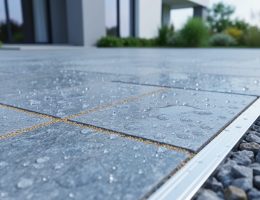
Low-angle view of a wet bluestone or granite patio with water beading, polymeric sand joints, and an aluminum edge restraint beside a gravel border, sloping away from a modern house with blurred garden beds in the background.
Stone Lifestyle Integration

Why Patio Natural Stones Outlast Every Other Outdoor Surface Material

Choose natural stone for your patio based on durability ratings and slip resistance coefficients, not aesthetics alone. Bluestone and granite offer DCOF ratings above 0.60 for wet surface safety, while travertine requires additional finishing to meet the same standards. Request test samples from suppliers and expose them to water, freezing cycles, and staining agents for 48 hours before committing to full orders.
Calculate total project costs using the $15-45 per square foot installed range as your baseline, factoring in substrate preparation ($3-8 per square foot), polymeric sand jointing ($1-2 per square foot), and sealing ($2-4 …

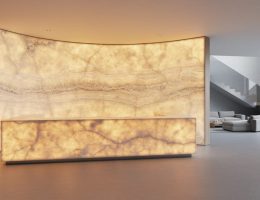
Curved backlit onyx feature wall with matching countertop glowing amber, veining clearly visible, photographed at eye level in a modern interior with minimal seating and a staircase in the background.
Artistic Craftsmanship Insights

How Translucent Stone Transforms Ordinary Spaces Into Living Art

Light becomes architecture when natural stone transforms from solid barrier to luminous canvas. Translucent stone applications—onyx, alabaster, quartzite, and select marbles—reveal nature’s hidden artistry through strategic backlighting, creating spaces where mineral veining, crystalline structures, and color gradations become three-dimensional installations. This convergence of geological formation and human craftsmanship produces surfaces that simultaneously conceal and reveal, offering designers a medium that performs as both functional material and sculptural element.
The phenomenon relies on stone’s …

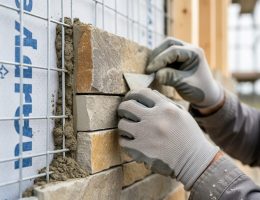
Mason’s gloved hands fastening a natural stone veneer piece onto galvanized metal lath with stainless steel ties on a partially finished exterior wall, shot at eye level under soft overcast light with blurred scaffolding and weather barrier behind
Codes, Standards & Compliance

How Anchored Stone Veneer Meets Modern Building Codes (Without the Headaches)

Anchored stone veneer transforms building exteriors with authentic natural stone beauty while meeting stringent structural requirements that protect both property and occupants. Unlike thin adhesive-applied veneers, this system mechanically fastens each stone unit to the building structure using corrosion-resistant ties and metal lath, creating a durable exterior cladding capable of withstanding wind loads, seismic forces, and decades of weather exposure.
Building codes governing anchored stone veneer installations have evolved significantly, particularly following updates to the International Building Code and International …

Low-angle photo of an athlete lifting a large rounded granite stone in a historic courtyard, with warm side lighting and blurred stone arches and stacked blocks in the background.
Cultural and Regional Stone Usage

Why Ancient Stone Lifting Reveals What Really Makes Stone Strong

Stone strength isn’t measured by compression tests alone—it’s proven through centuries of athletes hoisting rounded boulders overhead and masons building cathedrals that still stand today. When Highland Games competitors lift 300-pound stones or modern architects specify marble for high-traffic lobbies, they’re both relying on the same fundamental material properties: compressive strength, tensile resistance, and structural integrity under real-world stress.
The stones used in traditional lifting sports reveal critical insights about natural stone performance. Atlas stones, husafell stones, and lifting rocks …