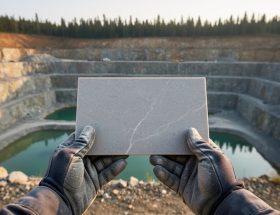

Quartzite’s piezoelectric properties and silicon dioxide composition position this natural stone as an unexpected candidate for quantum computing substrate materials. While marble graces countertops and granite anchors building facades, researchers now examine quartzite’s crystalline structure for its potential to support quantum bit stability at cryogenic temperatures. The same metamorphic processes that create quartzite’s durability and heat resistance also produce uniform atomic arrangements that may facilitate quantum coherence.
This intersection of geology and quantum physics represents a paradigm shift in how the stone industry views material applications. Quartzite’s high purity levels, particularly specimens with 95-99% silicon dioxide content, align with semiconductor industry requirements for substrate materials. Recent university studies explore whether specific quartzite varieties can provide stable platforms for quantum processors while offering cost advantages over synthetically manufactured alternatives.
The exploration of natural stone in computing extends beyond theoretical research. Material scientists collaborate with quarry operators to identify formations with optimal crystalline structures, potentially opening new revenue streams for the natural stone industry. Processing requirements differ significantly from traditional dimensional stone extraction, demanding precision cutting and contamination-free handling protocols typically reserved for semiconductor manufacturing.
Understanding quartzite’s role in quantum computing applications requires examining its geological formation, material properties, current research initiatives, and implications for both technology sectors and stone industry professionals seeking to diversify beyond conventional markets.
What Makes Quartzite Special for Advanced Technology

The Silicon Connection: From Stone to Semiconductor
At the heart of quartzite’s emerging technological relevance lies silicon dioxide (SiO₂), the same compound that forms the foundation of modern electronics. Natural quartzite can contain up to 99% pure silica, making it one of the most silicon-rich natural materials available. This exceptional purity creates an unexpected bridge between ancient geology and cutting-edge technology.
Silicon extracted from high-purity quartz becomes the raw material for semiconductor wafers used in computer chips, solar panels, and increasingly, quantum computing components. While quartzite itself isn’t directly used in semiconductor manufacturing, the ultra-pure quartz crystals within premium quartzite deposits represent valuable sources of silicon for the tech industry. These crystals, formed under intense metamorphic conditions over millions of years, possess a crystalline structure that can be processed into semiconductor-grade silicon.
The quantum computing connection stems from silicon’s unique properties at the atomic level. Researchers are exploring silicon-based quantum bits (qubits) because silicon atoms can host electron spins that maintain quantum states. High-purity natural quartz sources, including select quartzite formations, provide starting materials with fewer impurities than synthetic alternatives, potentially improving qubit stability.
This technological application adds unexpected value to certain quartzite deposits. While most quartzite continues serving architectural and decorative purposes, formations with exceptional purity may command premium prices from technology sectors. Understanding this dual nature helps industry professionals appreciate quartzite’s expanding role beyond traditional building materials, positioning natural stone within the broader materials science landscape that powers modern innovation.
Stability Under Extreme Conditions
Quantum computing systems operate under some of the most demanding conditions imaginable, requiring materials that can withstand extreme temperatures approaching absolute zero and maintain structural integrity under significant pressure variations. Natural quartzite demonstrates remarkable stability in these challenging environments, making it an increasingly valuable material for quantum computing infrastructure.
The stone’s exceptional durability stems from its metamorphic formation process, where sandstone undergoes intense heat and pressure deep within the Earth’s crust. This transformation creates an interlocking crystalline structure that remains dimensionally stable across dramatic temperature fluctuations, from cryogenic conditions below -270°C to standard operating temperatures. Unlike many synthetic materials that can experience thermal expansion issues or structural degradation, quartzite maintains its properties with minimal dimensional change.
In quantum computing facilities, where precision is measured in nanometers and even slight material shifts can compromise delicate qubit arrays, quartzite’s stability becomes critical. The stone exhibits low thermal conductivity, helping to isolate quantum processors from ambient temperature variations while providing robust mechanical support. Additionally, its resistance to chemical degradation ensures long-term performance in controlled laboratory environments where various cooling agents and gases are present. These characteristics position natural quartzite as a reliable foundation material for next-generation computing infrastructure.
Quartzite in Quantum Computing: Current Research and Applications
Qubit Substrates and Resonators
In quantum computing applications, quartzite-derived materials play a crucial role as both substrates and resonators, leveraging the stone’s exceptional purity and crystalline structure. When processed into high-purity silicon dioxide, quartzite provides the foundation for superconducting qubit circuits, where maintaining quantum coherence is essential for computational accuracy.
As a substrate material, processed quartzite offers several advantages in quantum systems. Its low dielectric loss at cryogenic temperatures minimizes energy dissipation, which is critical when qubits operate near absolute zero. The material’s thermal stability ensures dimensional consistency across extreme temperature fluctuations during cooling and operation cycles. Research laboratories have found that substrates derived from high-grade quartzite deposits can achieve purity levels exceeding 99.9%, reducing unwanted electromagnetic interference that could disrupt delicate quantum states.
Quartzite materials also function as resonators in quantum circuits, acting as frequency-selective components that help control and measure qubit behavior. The crystalline uniformity of quartzite-sourced silica enables precise fabrication of resonator structures with predictable electromagnetic properties. These resonators must maintain incredibly stable frequencies, and quartzite’s natural resistance to material degradation supports long-term operational reliability.
The transition from raw quartzite to quantum-grade material requires extensive processing, including chemical purification, crystal growth, and precision machining. While not all quartzite deposits possess the necessary purity for quantum applications, premium sources from specific geological formations have shown promise. This emerging use case represents a significant value addition for the natural stone industry, though commercial-scale quantum computing remains in developmental stages.
Thermal Management Solutions
Quantum computers operate at temperatures near absolute zero, requiring exceptional materials to manage extreme thermal conditions. Quartzite’s unique crystalline structure and thermal properties position it as a promising candidate for these demanding environments.
The material’s ultra-low thermal expansion coefficient makes it dimensionally stable across dramatic temperature fluctuations, a critical requirement in quantum computing chambers that cycle between room temperature and near-zero Kelvin. This stability prevents microscopic shifts that could disrupt delicate quantum operations. Additionally, quartzite’s high thermal conductivity enables efficient heat dissipation from quantum processors, while its natural resistance to thermal shock ensures reliability during rapid cooling cycles.
Research facilities are exploring quartzite-based substrates and mounting platforms for quantum chips, where traditional materials often fail under extreme conditions. The stone’s natural composition, primarily silicon dioxide, offers low electromagnetic interference—essential for maintaining quantum coherence. As quantum computing advances, quartzite joins other thermal management solutions derived from natural stone, demonstrating how ancient geological materials continue finding applications in cutting-edge technology. Material scientists are particularly interested in quartzite varieties with minimal impurities, which maximize thermal performance in cryogenic environments.

Shielding and Infrastructure
Quartzite’s exceptional electromagnetic shielding properties and thermal stability make it increasingly valuable for protecting quantum computing infrastructure. The material’s dense crystalline structure effectively blocks electromagnetic interference that can disrupt delicate quantum states, while its minimal magnetic signature prevents unwanted field interactions. Research facilities and quantum computing companies are exploring quartzite cladding systems for housing quantum processors, which require ultra-stable environments operating near absolute zero. The stone’s natural vibration damping characteristics provide additional isolation from external disturbances that could cause decoherence in quantum systems. As an architectural element, quartzite panels offer both functional shielding and aesthetic appeal in specialized laboratory settings. Unlike synthetic shielding materials that may outgas or degrade, quartzite remains chemically inert and dimensionally stable across extreme temperature ranges. This emerging application represents a significant evolution in natural stone functionality, positioning quartzite as a high-performance material for next-generation computing infrastructure beyond its traditional decorative and structural roles.
From Quarry to Laboratory: How Quartzite Is Processed for Tech Applications

Purity Requirements and Selection
Selecting appropriate quartzite specimens requires understanding the distinct criteria for technological versus decorative applications. For quantum computing and advanced technological uses, purity requirements are exceptionally stringent. High-tech applications demand quartzite with minimal impurities, particularly iron oxides and other metallic inclusions that could interfere with quantum processes. Silicon dioxide content should exceed 95%, with uniform crystalline structure verified through spectroscopic analysis. These specimens typically appear white to translucent with minimal color variation.
In contrast, decorative quartzite selection prioritizes aesthetic qualities. Architects and designers seek specimens with attractive veining patterns, color variations, and unique mineral inclusions that create visual interest. Iron oxide traces that would disqualify technological specimens become desirable features, producing pink, red, or gold hues. Decorative applications value durability, hardness rating above 7 on the Mohs scale, and resistance to etching and staining.
Industry professionals must recognize these divergent selection criteria when sourcing quartzite. While a single quarry may produce both grades, proper classification ensures each specimen reaches its optimal application, maximizing value across technological and architectural markets.
Processing and Refinement
Transforming natural quartzite into ultra-pure silicon for quantum computing requires an intensive multi-stage process that begins at the quarry. Unlike quartzite extracted for countertops or architectural applications, quantum-grade material demands exceptional purity levels—typically 99.9999% or higher. Mining operations select deposits with minimal iron content and other trace elements that could interfere with quantum processes.
The refinement process starts with crushing and grinding the quartzite into fine particles. Thermal reduction then converts silicon dioxide into metallurgical-grade silicon through heating with carbon in electric arc furnaces at temperatures exceeding 2000°C. This silicon undergoes additional purification through chemical processes, including treatment with hydrochloric acid to remove metallic impurities.
The final stages involve converting silicon to volatile compounds like trichlorosilane, then using chemical vapor deposition to produce ultra-pure polycrystalline silicon. This material serves as the foundation for creating silicon-28 isotopes used in quantum computing qubits. While conventional quartzite applications focus on aesthetic properties, quantum applications prioritize molecular structure and isotopic purity, representing a remarkable evolution in how we utilize this ancient metamorphic stone.
The Sustainability Advantage: Natural Stone in High-Tech Manufacturing
As quantum computing advances, the environmental implications of material sourcing have become increasingly important. Natural quartzite presents a compelling sustainability advantage over synthetic alternatives currently used in high-tech manufacturing, offering a lower environmental footprint while maintaining the necessary material properties.
Unlike laboratory-grown crystals and engineered materials that require energy-intensive production processes, naturally-occurring quartzite forms through geological metamorphism over millions of years. This means no manufacturing emissions, no chemical synthesis, and no industrial waste streams associated with its formation. The extraction and processing of quartzite, while requiring energy, typically generates a significantly smaller carbon footprint compared to creating synthetic silicon dioxide or other engineered alternatives from raw materials.
The scalability of natural quartzite also supports long-term sustainability goals. Abundant quartzite deposits exist worldwide, reducing transportation distances and associated emissions when sourced locally. The stone’s durability means components can potentially be repurposed or recycled at the end of their technological lifecycle, unlike many composite materials that become hazardous waste.
Furthermore, quartzite processing generates minimal chemical waste. Traditional cutting and polishing methods use water-based systems without the toxic solvents or hazardous byproducts common in synthetic material production. This aligns with broader industry movements toward sustainable stone applications across various technological sectors.
As quantum computing scales from research laboratories to commercial production, material sourcing decisions will significantly impact the industry’s environmental credentials. Natural quartzite offers a path toward more sustainable high-tech manufacturing, demonstrating that naturally-occurring materials can meet cutting-edge technological demands while supporting environmental responsibility. This positions the natural stone industry as an unexpected but valuable partner in advancing green technology initiatives.
What This Means for the Stone Industry
The emergence of quartzite in quantum computing applications signals a fascinating convergence between traditional stone industries and cutting-edge technology sectors. For quarries and processors, this development opens potential new revenue streams beyond conventional architectural and design markets. While quantum computing remains a specialized niche, the research validates quartzite’s unique material properties and could elevate its market positioning.
Quarries producing high-purity quartzite may find opportunities to partner with technology companies or research institutions seeking specific geological characteristics. This could require investment in more sophisticated testing equipment to verify silica content, crystalline structure, and other technical specifications that matter for quantum applications. Processors might need to develop new extraction and finishing protocols that preserve the precise material properties required for technological uses.
The stone industry should view this development as part of a broader trend where natural materials are being reconsidered for advanced applications. Similar patterns have emerged with granite in precision engineering and marble in specialized filtration systems. For industry professionals, staying informed about these alternative applications enhances credibility and market awareness.
However, it’s important to maintain realistic expectations. Quantum computing applications will likely represent a tiny fraction of quartzite sales compared to traditional uses in countertops, flooring, and cladding. The primary value lies in demonstrating quartzite’s versatility and reinforcing its position as a premium natural material with exceptional inherent properties that extend far beyond aesthetic appeal.
The convergence of natural stone quartzite and quantum computing represents a fascinating evolution in how we perceive and utilize traditional materials. What began as decorative stone prized for millennia has emerged as a potential contributor to the most advanced computing technology of our time. This unexpected intersection demonstrates that even in an age of synthetic materials and engineered solutions, nature continues to provide resources with properties we’re only beginning to fully understand and harness.
For professionals in architecture, design, and the natural stone industry, this development offers valuable perspective. Quartzite’s journey from countertops to quantum laboratories underscores the importance of understanding material properties beyond aesthetic considerations. The same silicon dioxide composition that creates stunning visual patterns also exhibits piezoelectric and thermal characteristics that researchers find valuable for quantum applications.
While quantum computing applications remain largely in research phases, they highlight quartzite’s versatility and relevance in contemporary technology. This doesn’t diminish its primary role in construction and design but rather enriches our appreciation for this natural material’s complexity. As research progresses, the stone industry may find new markets and applications emerging alongside traditional uses.
The story of quartzite and quantum computing ultimately reminds us that innovation often builds upon ancient foundations. Traditional materials continue to surprise us with untapped potential, bridging the gap between geological history and technological future in ways that benefit multiple industries and applications.