
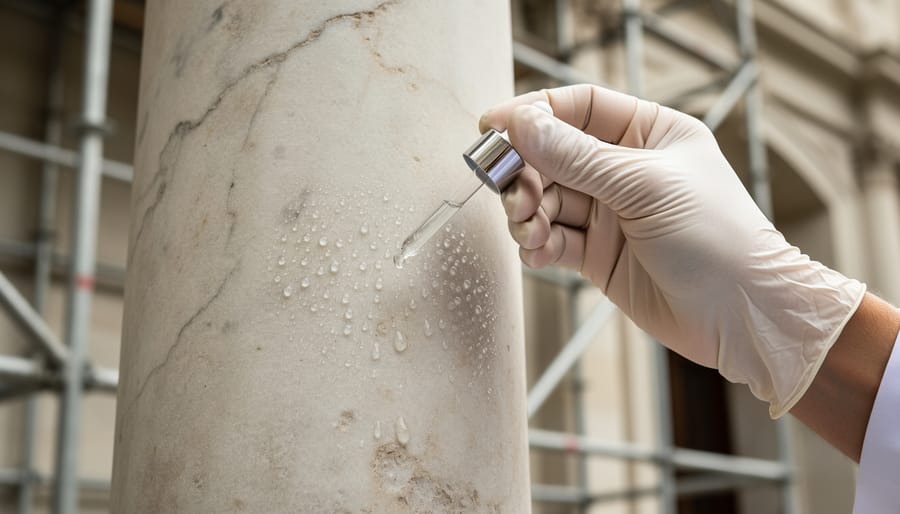
Nanotechnology now operates at the molecular level to protect historic marble and limestone where traditional sealers fail. These engineered particles—measuring one-billionth of a meter—penetrate deep into stone’s crystalline structure, creating protective barriers that preserve breathability while blocking water, pollutants, and biological growth that accelerate damage.
The technology addresses a fundamental weakness in conventional stone protection: most treatments either sit on the surface where they quickly degrade, or they trap moisture inside, causing more harm than good. Nano-scale formulations solve this by forming bonds with the stone’s mineral composition at depths unreachable by traditional products, establishing protection that can last decades rather than years.
Understanding how these molecular-level interventions work matters because stone restoration represents both significant financial investment and irreplaceable cultural heritage. The Parthenon, Venice’s waterfront palazzos, and countless cathedral facades now benefit from nano-engineered protection systems that weren’t available even fifteen years ago. These same breakthrough conservation techniques have become accessible for residential and commercial applications, from marble countertops to limestone building facades.
The science builds on detailed knowledge of stone deterioration processes. Each type of damage—salt crystallization, freeze-thaw cycles, acid rain exposure—requires specific molecular responses. Nano-engineered solutions target these mechanisms precisely, offering customized protection that adapts to environmental conditions and stone composition.
This introduction examines how nanotechnology transforms stone preservation from periodic maintenance into long-term protection, what these treatments actually do inside your stone, and when they represent the right choice for your restoration project.
What Engineering Nanotechnology Means for Stone Restoration
The Scale That Makes the Difference
To understand nanotechnology’s advantage in stone treatment, consider the scale. A nanometer is one-billionth of a meter. A human hair measures approximately 80,000 nanometers in diameter, while the natural pores in marble, limestone, and granite typically range from 100 to 10,000 nanometers.
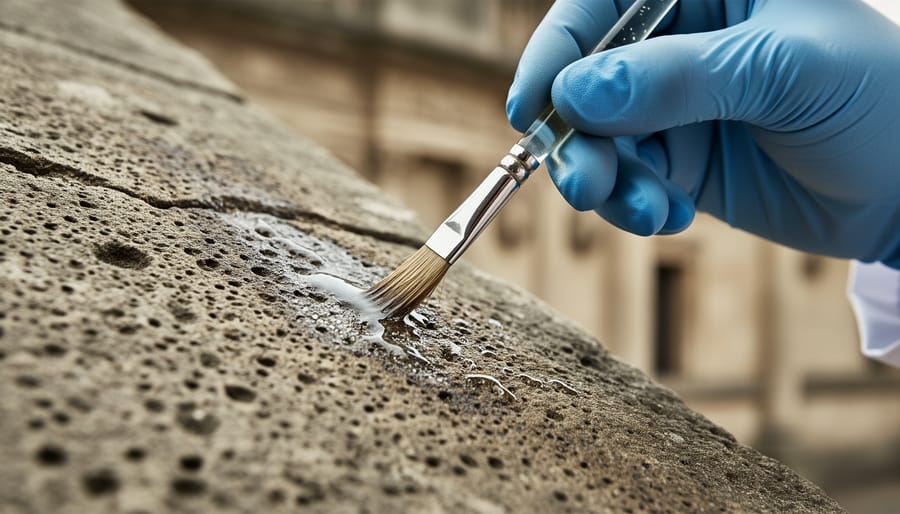
Traditional stone sealers use particles measuring 3,000 to 5,000 nanometers. These molecules can only penetrate the surface layer, creating a protective film that sits primarily on top of the stone. Nanotechnology treatments use particles sized between 5 and 100 nanometers, small enough to penetrate deep into the stone’s capillary structure.
This size difference is critical. Imagine trying to fill a network of tiny tunnels: larger particles block the entrance, while nano-sized particles flow deep inside. When protection molecules reach deeper into the stone matrix, they bond with more surface area internally, creating a three-dimensional protective network rather than just a surface coating. This deeper penetration means better protection against water infiltration, staining, and weathering while maintaining the stone’s natural breathability and appearance. The result is longer-lasting protection that works with the stone’s structure rather than simply covering it.
How Nano-Treatments Interact with Stone
Nano-treatments work by penetrating the porous structure of natural stone, where nanoparticles—typically measuring between 1 and 100 nanometers—integrate with the stone’s surface at the molecular level. These ultra-small particles are engineered to be hundreds of times smaller than traditional sealants, allowing them to reach deep into microscopic capillaries and bond directly with the stone’s mineral composition.
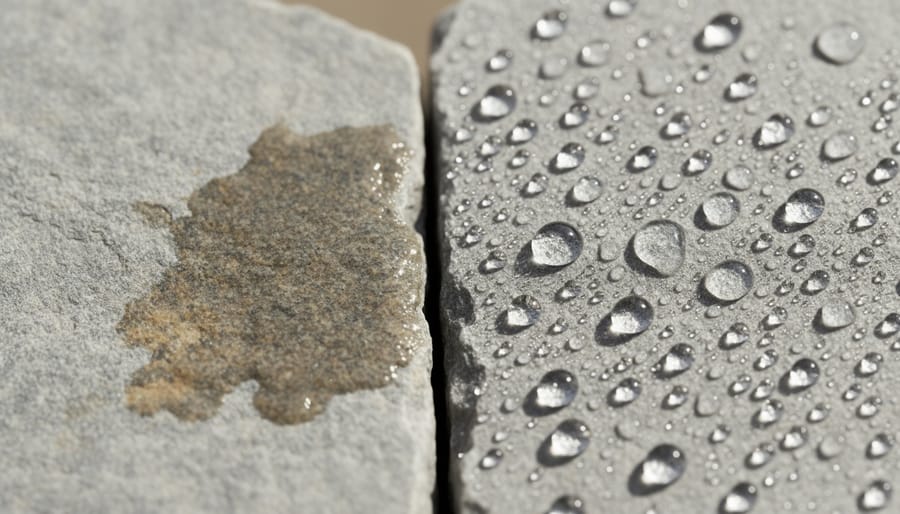
Once applied, nanoparticles form a chemical bond with the stone matrix rather than simply coating the surface. This molecular integration creates an invisible protective barrier that repels water, oils, and contaminants while allowing water vapor to pass through—a critical feature called breathability. Unlike film-forming sealers that can trap moisture and cause deterioration, nano-treatments maintain the stone’s natural ability to release internal moisture.
The protective layer modifies the stone’s surface tension without altering its texture or appearance. Water beads and rolls off treated surfaces rather than penetrating and causing staining or freeze-thaw damage. This hydrophobic effect occurs at the nanoscale level, meaning the stone retains its natural color, finish, and tactile qualities.
Because nanoparticles fill voids at the molecular level, they strengthen the stone’s surface structure while remaining flexible enough to accommodate natural expansion and contraction, preventing the cracking or peeling common with traditional coatings.
Common Types of Nano-Engineered Solutions for Stone
Nano-Lime and Consolidation
Nano-lime represents a breakthrough in consolidating deteriorated limestone and marble structures. These ultra-fine calcium hydroxide particles, typically measuring 50-300 nanometers, penetrate deeply into weathered stone through capillary action. Once inside the stone’s porous network, the nano-lime particles react with atmospheric carbon dioxide through carbonation, forming calcium carbonate crystals that bond with the original stone matrix. This process essentially recreates the stone’s natural composition at a molecular level.
Traditional lime treatments use larger particles that often remain on the surface, creating unsightly whitening or forming a weak superficial layer. Nano-lime’s microscopic size allows penetration up to several centimeters deep, providing structural reinforcement where it’s needed most. The particles disperse in alcohol-based solutions, which evaporate quickly without leaving water-soluble salts that could cause future damage.
Nano-lime works best on calcium-based stones like limestone, marble, and calcareous sandstone showing surface erosion, granular disintegration, or loss of cohesion. It’s particularly valuable for historic preservation where maintaining authenticity is paramount, as the treatment uses chemically compatible materials.
However, nano-lime isn’t suitable for all situations. Dense, non-porous stones won’t allow adequate penetration, and severely damaged stone may require additional interventions. Treatment typically requires multiple applications and several months for complete carbonation. Professional assessment remains essential to determine whether nano-lime consolidation is the appropriate solution for your specific stone restoration needs.

Nano-Silica for Protection
Nano-silica treatments represent one of the most widely adopted nanotechnology applications in stone protection. These formulations use silicon dioxide particles measuring between 5-20 nanometers to create an invisible protective barrier on stone surfaces. When applied, the nanoparticles penetrate deeply into the stone’s porous structure and form chemical bonds with the substrate.
The resulting treatment provides exceptional water repellency while maintaining breathability—a critical balance for stone preservation. Unlike traditional sealers that can trap moisture and cause deterioration from within, nano-silica allows water vapor to escape while preventing liquid water penetration. This characteristic makes it particularly valuable for exterior applications and historic restoration projects.
Nano-silica treatments work effectively across diverse stone types, including marble, limestone, granite, sandstone, and travertine. Each material benefits from the hydrophobic surface that resists staining, reduces biological growth, and minimizes freeze-thaw damage in cold climates. The treatment typically lasts 5-10 years depending on exposure conditions and stone porosity.
Field applications demonstrate remarkable performance improvements. Laboratory tests show treated surfaces repel water at contact angles exceeding 120 degrees, while maintaining vapor permeability rates above 85% of untreated stone. This dual functionality addresses the primary challenge in stone conservation: protecting against external moisture while preventing internal damage.
Nano-Titanium Dioxide for Self-Cleaning Surfaces
Nano-titanium dioxide represents one of nanotechnology’s most practical applications for stone surfaces. This naturally occurring compound, engineered at the nanoscale (typically 5-50 nanometers), delivers remarkable self-cleaning capabilities through a process called photocatalysis.
When sunlight strikes nano-titanium dioxide particles, it triggers a chemical reaction that breaks down organic pollutants, dirt, and biological growth on contact. The ultraviolet rays in natural light energize electrons in the titanium dioxide, creating highly reactive oxygen species that decompose organic matter into harmless carbon dioxide and water. This continuous cleaning cycle operates whenever the treated surface receives daylight, significantly reducing maintenance requirements.
The technology proves particularly valuable for exterior stone facades, monuments, and high-traffic areas where traditional cleaning methods risk damaging delicate surfaces. Unlike pressure washing or chemical treatments that can erode stone over time, photocatalytic coatings work passively without mechanical intervention.
Modern formulations incorporate these nanoparticles into transparent coatings that preserve the stone’s natural appearance while providing protection. The hydrophilic nature of activated titanium dioxide also enhances water sheeting, allowing rain to wash away decomposed pollutants more effectively.
Applications range from historic building preservation to contemporary architecture, with treatments typically lasting 3-5 years depending on exposure conditions. While initial costs exceed conventional sealers, the reduced maintenance frequency and gentle preservation approach make nano-titanium dioxide treatments increasingly popular among property managers and restoration professionals seeking sustainable stone care solutions.
Real-World Applications: Where Nanotechnology Shines
Historic Buildings and Monuments
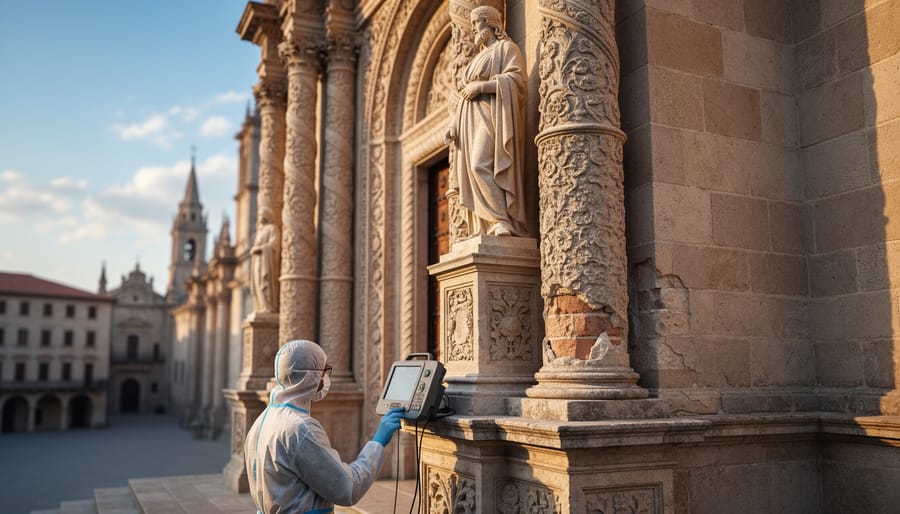
Nanotechnology is proving invaluable for preserving the world’s most treasured stone monuments. At the Colosseum in Rome, nano-silica treatments combat sulfate salt crystallization that causes marble and travertine to crumble from within. The treatment penetrates deeply, creating a protective network that allows moisture vapor to escape while blocking salt migration—a critical balance traditional sealers couldn’t achieve.
Venice’s St. Mark’s Basilica presents multiple challenges: saltwater infiltration from acqua alta flooding, biological growth in humid conditions, and atmospheric pollution. Nano-titanium dioxide coatings applied to the basilica’s marble columns provide photocatalytic self-cleaning properties, breaking down organic pollutants when exposed to light while inhibiting algae and lichen colonization.
Germany’s Cologne Cathedral utilized nano-calcium hydroxide treatments on weathered limestone surfaces. This approach differs from consolidants by actually re-mineralizing degraded stone at the molecular level, essentially reversing decades of acid rain damage. The treatment restored structural integrity to crumbling Gothic tracery without altering the stone’s appearance or breathability—requirements that eliminated conventional options. These applications demonstrate how nanotechnology addresses preservation challenges that were previously unsolvable, extending the life of irreplaceable cultural heritage.
Residential Stone Applications
Homeowners increasingly turn to nano-treatments to protect their stone investments, from travertine patios to marble kitchen countertops. These microscopic coatings penetrate stone surfaces at the molecular level, creating invisible barriers that repel water, oils, and staining agents without altering the stone’s natural appearance or breathability.
For exterior stone facades, nano-treatments dramatically reduce maintenance demands. The technology prevents water absorption that leads to freeze-thaw damage, efflorescence, and biological growth like algae or moss. Homeowners report cleaning their stone surfaces with simple water rinses rather than harsh chemical cleaners, preserving both the stone and surrounding landscaping.
Kitchen and bathroom countertops benefit significantly from nano-protection. The treatments create surfaces that resist wine, coffee, and cooking oil stains while maintaining the stone’s tactile qualities. Unlike topical sealers that wear away and require frequent reapplication, properly applied nano-coatings can last five to ten years, reducing long-term maintenance costs.
Stone flooring treated with nanotechnology shows enhanced durability in high-traffic areas. The microscopic protection reduces scratching and etching while making routine cleaning more effective. This modern stone care technology extends the lifespan of residential stone installations while preserving their natural beauty and value.
Commercial and Public Spaces
Commercial buildings and public spaces face unique challenges that make nanotechnology treatments particularly valuable. High foot traffic, exposure to environmental pollutants, and the need for consistent appearance create demanding maintenance requirements in these settings.
In corporate lobbies with marble floors and walls, nano-coatings provide invisible protection against daily wear while maintaining the stone’s natural appearance. The treatments create hydrophobic and oleophobic surfaces that resist staining from spilled coffee, tracked-in dirt, and handprints on walls. This translates to reduced cleaning frequency and lower maintenance costs over time.
Public plazas featuring granite or limestone paving benefit significantly from nano-treatments that prevent water absorption and subsequent freeze-thaw damage. The protective barrier extends the stone’s lifespan while resisting graffiti and facilitating easier removal when vandalism occurs.
Historic monuments in urban environments face accelerated deterioration from acid rain and pollution. Nanotechnology applications create breathable protective layers that allow moisture vapor to escape while blocking harmful pollutants. Case studies from European heritage sites demonstrate that properly applied nano-treatments can slow deterioration rates by 60-70% compared to untreated stone.
The durability of these treatments in commercial settings typically ranges from 5-10 years, depending on traffic levels and environmental exposure, making them cost-effective solutions for property managers seeking long-term protection strategies.
Advantages Over Traditional Stone Restoration Methods
Deeper Penetration Without Altering Appearance
Traditional stone sealers often create visible surface films or alter the natural appearance of stone through darkening or adding unwanted sheen. Nanotechnology solves this aesthetic challenge through particle size. With dimensions measuring between 1-100 nanometers—approximately 80,000 times smaller than a human hair—these engineered particles penetrate deeply into the stone’s microscopic pore structure rather than sitting on the surface.
This deep penetration offers dual benefits. The nanoparticles travel through capillary channels within the stone matrix, creating a protective barrier from within while leaving the surface completely unchanged. The result is invisible protection that maintains the stone’s original texture, color, and finish. Unlike acrylic or polyurethane sealers that can yellow over time or create a plastic-like appearance, nano-treatments preserve the authentic character of natural stone. This makes them particularly valuable for historic restoration projects and high-end installations where maintaining visual integrity is paramount while still achieving superior protection against moisture, staining, and environmental degradation.
Longer-Lasting Protection
Nanoparticle-based treatments demonstrate significantly extended protection periods compared to conventional stone sealers. Traditional surface treatments typically require reapplication every 3-5 years, while properly applied nanotechnology solutions can maintain effective protection for 10-15 years or more. This longevity stems from the molecular-level bonding between nanoparticles and the stone substrate, creating a stable protective matrix that resists degradation from UV exposure, weathering, and routine cleaning.
Field studies on treated historic facades show that nano-based hydrophobic coatings retain over 80% of their water-repellent effectiveness after a decade of exposure to urban pollution and seasonal temperature fluctuations. However, protection duration varies based on stone type, environmental conditions, and surface traffic. High-traffic marble flooring may require maintenance treatments at 7-10 year intervals, while sheltered exterior limestone can exceed 15 years between applications.
Property owners should understand that while nanotechnology extends treatment intervals substantially, no solution provides permanent protection. Regular monitoring and periodic professional assessment remain essential for maintaining optimal stone preservation, particularly on valuable or historically significant installations.
Breathability and Moisture Management
Unlike traditional sealers that create impermeable barriers on stone surfaces, nanotechnology-based treatments preserve the natural breathability essential to stone’s longevity. Stone is inherently porous, allowing water vapor to move through its structure—a characteristic that has enabled historic monuments to endure for centuries. When conventional sealers block this vapor transmission, moisture becomes trapped within the stone, leading to subsurface deterioration, efflorescence, and structural damage.
Nano-treatments function at the molecular level, bonding to stone pores without filling or blocking them. These microscopic particles create a protective matrix that repels liquid water while maintaining open pathways for vapor exchange. This selective permeability allows moisture naturally present in stone or migrating from underlying substrates to escape, preventing the hydrostatic pressure buildup that causes spalling and delamination in sealed stone.
The technology proves particularly valuable for exterior applications and historically significant structures where maintaining the stone’s original moisture dynamics is critical. By enabling natural drying cycles while protecting against water infiltration, nano-treatments address the fundamental weakness of traditional sealing methods—preservation without suffocation.
Limitations and Considerations
Cost and Accessibility
Nanotechnology-based stone treatments typically command premium pricing compared to traditional sealers, with professional applications ranging from $8 to $25 per square foot depending on surface type, condition, and product specifications. While traditional sealers might cost $2 to $6 per square foot, the enhanced durability and performance of nanotech solutions often justify the investment through extended protection intervals and reduced maintenance costs over time.
These advanced treatments are primarily available through specialized stone restoration professionals and select distributors rather than retail channels. Most manufacturers maintain networks of certified applicators who understand proper surface preparation and application protocols essential for optimal results. Some commercial-grade products have entered the consumer market, though professional application remains recommended for valuable installations.
The investment makes particular sense for high-traffic commercial environments, historic preservation projects, exterior applications exposed to harsh weather, and premium residential installations where appearance and longevity justify higher initial costs. For basic residential countertops or low-value applications, traditional treatments may provide adequate protection at lower cost. Property owners should request detailed cost-benefit analyses from restoration professionals, comparing total ownership costs including reapplication frequency rather than focusing solely on initial treatment expenses.
When Traditional Methods Still Win
While nanotechnology offers impressive capabilities, traditional restoration methods remain the better choice in many situations. For minor surface cleaning or basic maintenance work, conventional approaches typically provide sufficient results at a fraction of the cost. Simple repairs, such as filling small cracks or addressing isolated stains, often don’t require the advanced protective properties that nanotech treatments deliver.
Certain stone types also respond better to established techniques. Highly porous stones may absorb nano-particles unevenly, creating inconsistent protection. In these cases, traditional sealers with larger molecular structures can provide more predictable coverage. Similarly, when working with historically significant structures, conservation guidelines sometimes mandate traditional materials and methods to preserve authenticity and reversibility—a key principle in heritage preservation.
Budget constraints frequently make conventional methods more practical. For commercial properties requiring frequent cleaning or residential spaces with limited stone exposure to harsh conditions, standard restoration delivers adequate longevity without the premium investment. The expertise required to properly apply nanotechnology treatments also isn’t universally available, making traditional methods more accessible in regions where specialized technicians are scarce.
Understanding when conventional restoration suffices allows property owners and professionals to allocate resources effectively, reserving advanced nanotechnology solutions for applications where their unique benefits truly justify the investment.
Choosing the Right Approach for Your Stone
Questions to Ask Your Stone Restoration Professional
Before hiring a contractor for nanotechnology stone treatments, ask targeted questions to evaluate their expertise and ensure appropriate application. Start with: “What specific nanotechnology products do you use, and are they formulated for my stone type?” Understanding product compatibility prevents damage to sensitive materials like marble or limestone.
Ask about their training and certification: “Have you completed manufacturer training for these nanotech applications?” Professional contractors should demonstrate proper credentials and stay current with evolving technologies.
Inquire about assessment procedures: “How do you evaluate stone condition before recommending nanotechnology treatments?” Reputable professionals conduct thorough inspections, testing porosity and existing sealants before application.
Request case studies: “Can you provide examples of similar projects using these treatments, with before-and-after documentation?” This reveals their practical experience and expected outcomes.
Address longevity and maintenance: “How long will the treatment last, and what maintenance will be required?” Understanding performance expectations helps you plan for long-term care.
Discuss ethical considerations: “How do your treatments align with stone preservation ethics, particularly for historic installations?” This ensures treatments respect material integrity and reversibility standards, especially critical for heritage stone.
Finally, ask: “Do you offer warranties, and what do they cover?” Professional confidence in their nanotechnology applications should include performance guarantees.
Testing and Documentation
Before applying any nanotechnology treatment to valuable stone surfaces, always conduct thorough testing on inconspicuous areas. This step prevents potential adverse reactions like discoloration, haziness, or unwanted texture changes. Test patches should remain undisturbed for at least 48-72 hours to observe the full effect of the treatment.
Comprehensive documentation proves essential for long-term stone preservation. Record all treatments applied, including product names, application dates, environmental conditions during application, and the stone type treated. Photographs taken before, during, and after treatment provide valuable visual records for future reference and comparison.
Establish clear maintenance protocols following nanotechnology applications. While these treatments significantly reduce maintenance needs, periodic cleaning with pH-neutral products and annual inspections ensure continued protection. Document recommended cleaning methods and reapplication timelines, which typically range from 3-10 years depending on the product and environmental exposure. This systematic approach maximizes treatment effectiveness and protects your investment in both the stone and the nanotechnology solution.
Engineering nanotechnology represents a meaningful step forward in natural stone preservation when applied thoughtfully and in appropriate contexts. This technology offers measurable advantages in protection, particularly for high-value installations, historic structures, and environments where traditional methods fall short. The ability to create molecular-level barriers that preserve breathability while repelling contaminants addresses longstanding challenges in stone conservation.
However, innovation works best when balanced with proven traditional approaches. Not every stone surface requires nanotechnology treatment, and conventional sealers, proper maintenance protocols, and time-tested restoration techniques remain essential tools in the stone care arsenal. The key lies in understanding when advanced treatments offer genuine advantages over established methods and selecting solutions based on specific project requirements rather than novelty alone.
Looking forward, nanotechnology will likely play an expanding role in making natural stone more practical for contemporary applications while ensuring its preservation for future generations. As formulations improve and costs become more competitive, these treatments may transition from specialized solutions to standard practice for certain applications. The technology’s potential to extend the lifespan of stone installations, reduce maintenance demands, and protect against modern environmental challenges positions it as a valuable addition to stone care practices.
For professionals and property owners alike, the message remains clear: embrace innovation where it delivers demonstrable benefits, maintain respect for traditional methods that continue to perform effectively, and prioritize informed decision-making over trends. This balanced approach ensures natural stone remains both beautiful and functional across generations.