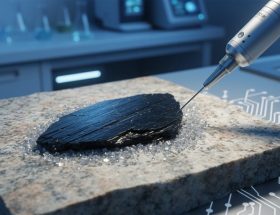
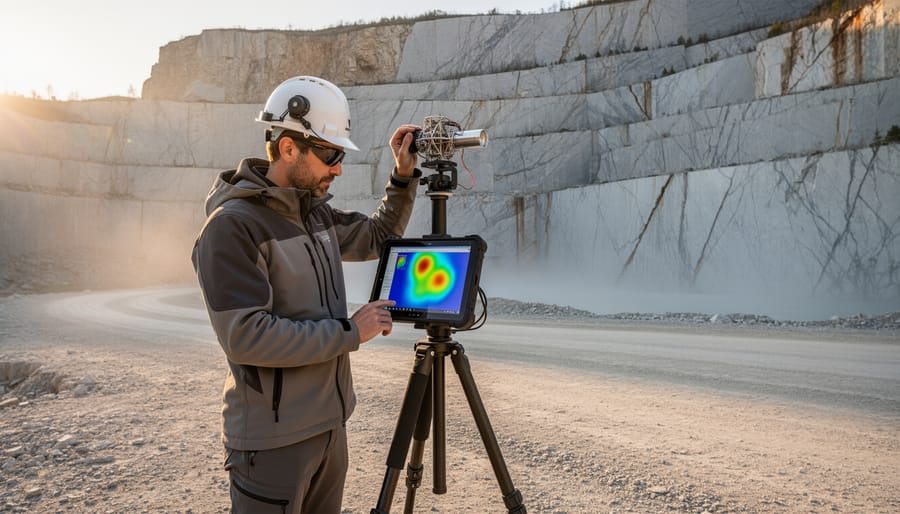
Quantum gravity sensors represent a revolutionary convergence of quantum physics and practical geology, transforming how we detect, analyze, and work with natural stone beneath the Earth’s surface. These sophisticated instruments measure minute variations in gravitational fields at the quantum level, revealing hidden stone deposits, geological formations, and structural characteristics with unprecedented precision—capabilities that extend far beyond traditional natural stone sensors used in construction monitoring.
Unlike conventional gravimeters that rely on mechanical components, quantum gravity sensors harness the wave-particle duality of ultracold atoms to detect gravitational changes as small as one part in a billion. When applied to the natural stone industry, this technology identifies premium marble, granite, and limestone deposits with remarkable accuracy, eliminating costly exploratory drilling and reducing environmental impact during quarry site selection.
The practical applications reshape every stage of stone extraction and utilization. Quarry operators now map subsurface formations in three dimensions before breaking ground, identifying optimal extraction points while avoiding fault lines and unstable zones. Architects and structural engineers deploy portable quantum sensors to assess foundation stability for monumental stone installations, detecting underground voids or density variations that could compromise building integrity. Historic preservation specialists use these devices to examine the internal structure of ancient stone monuments without invasive testing, revealing hidden fractures or deterioration invisible to conventional methods.
As quantum technology transitions from laboratory curiosity to field-ready equipment, the natural stone industry gains tools that dramatically improve efficiency, safety, and sustainability. Understanding how these sensors work and where they deliver maximum value positions professionals to leverage quantum innovation in an industry where precision and material quality remain paramount.
What Is a Quantum Gravity Sensor?
The Science Made Simple
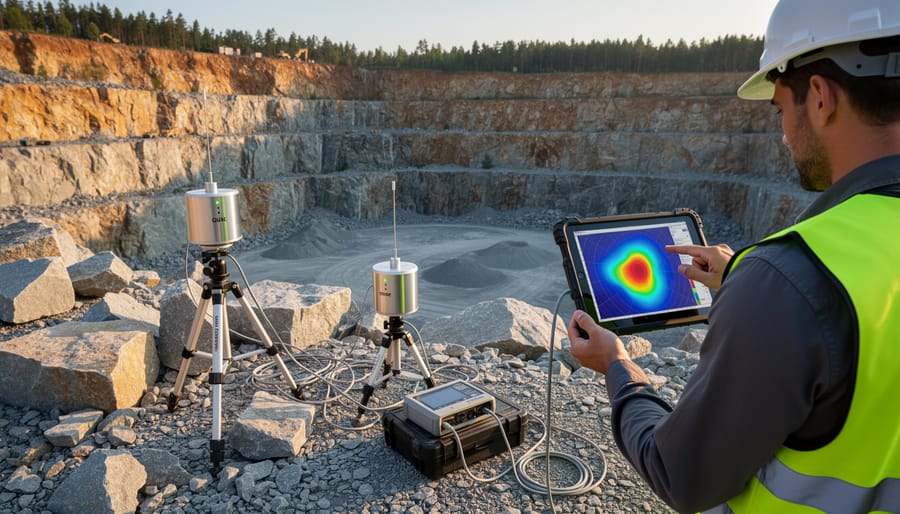
Quantum gravity sensors work on a surprisingly straightforward principle: atoms behave differently in varying gravitational fields. Think of these sensors as incredibly precise scales that measure the pull of Earth’s gravity at specific locations, detecting variations as subtle as finding a hollow space beneath solid ground.
Traditional gravity sensors use mechanical springs or pendulums, much like old-fashioned scales. Quantum sensors, however, employ clouds of ultra-cold atoms—typically rubidium or cesium—cooled to near absolute zero. At these extreme temperatures, atoms enter a quantum state where they act as both particles and waves simultaneously. When lasers pulse through these atom clouds, they create an interference pattern similar to ripples colliding in water. Changes in gravitational pull alter these patterns, revealing what lies beneath the surface.
For natural stone applications, this technology functions like an advanced X-ray vision for the earth. When surveyors scan a quarry site, the sensor detects density variations in subsurface rock formations. Dense granite creates stronger gravitational pulls than porous limestone or underground voids. The sensor processes these minute differences—measured in microgals, units so small they represent changes of one-billionth of Earth’s gravitational force—and produces detailed subsurface maps.
The practical advantage? Instead of exploratory drilling that damages sites and wastes resources, quantum gravity sensors provide non-invasive geological assessments. Construction teams can identify optimal stone deposits, detect structural weaknesses in existing installations, and assess foundation stability—all without disturbing a single stone. This technology transforms guesswork into precision, making stone sourcing and building projects more efficient and cost-effective.
Why Gravity Matters for Stone Detection
Natural stone varieties possess distinct mineral compositions and internal structures that create subtle variations in density. Granite, for example, typically weighs between 2.63 and 2.75 grams per cubic centimeter, while marble ranges from 2.5 to 2.7. These density differences, though seemingly minor, generate measurable gravitational field variations that quantum gravity sensors can detect with remarkable accuracy.
Traditional detection methods struggle to identify subsurface stone characteristics without invasive drilling or excavation. Quantum gravity sensors overcome this limitation by measuring minuscule changes in gravitational pull caused by density variations within stone deposits. The technology operates on principles of quantum mechanics, where ultra-cold atoms act as incredibly sensitive detectors of gravitational forces.
When positioned above a quarry site or building structure, these sensors can distinguish between different stone types, identify internal fissures or voids, and map subsurface formations with centimeter-level precision. This capability proves particularly valuable for quality assessment, as higher-density sections often indicate superior structural integrity and aesthetic appeal. The sensors detect gravitational variations as small as one part in a billion, enabling unprecedented accuracy in stone characterization without physical contact or damage to the material.
Transforming Natural Stone Exploration and Quarrying
Precision Mapping of Stone Deposits
Quantum gravity sensors revolutionize how quarry operators and geologists locate and evaluate underground stone deposits before committing to expensive extraction operations. Unlike traditional exploration methods that rely on test drilling at multiple sites, these advanced sensors measure minute variations in gravitational pull caused by different rock densities beneath the surface.
The technology works by detecting changes as small as one part in a billion in Earth’s gravitational field. Denser stone formations like granite or marble create slightly stronger gravitational signatures than surrounding materials, allowing the sensors to distinguish between valuable deposits and less desirable substrates. As operators move the sensors across a survey area, sophisticated software compiles these measurements into comprehensive 3D maps showing the size, depth, and boundaries of stone formations.
This precision mapping delivers substantial cost savings and operational advantages. Quarry planners can identify the most viable extraction zones, estimate deposit volumes with remarkable accuracy, and design access routes that minimize environmental disruption. The technology has proven particularly valuable for locating premium stone varieties where small pockets of high-quality material command premium prices.
Recent deployments in European marble quarries demonstrated how quantum sensors reduced exploratory drilling by up to 70 percent while improving deposit estimates by 40 percent compared to conventional methods. For architects and designers specifying particular stone types for projects, this enhanced geological intelligence means more reliable sourcing and better availability forecasts. The technology essentially provides x-ray vision into the earth, transforming stone extraction from an educated guessing game into a data-driven science.
Quality Assessment Before Extraction
Before the first excavator breaks ground, quantum gravity sensors provide quarry operators with an unprecedented view beneath the surface. These sophisticated instruments measure minute variations in gravitational fields caused by differences in rock density and composition, creating detailed underground maps without drilling a single exploratory hole.
This non-invasive assessment helps quarry managers identify premium stone deposits with optimal density and minimal fracturing. By detecting variations in gravitational pull—sometimes as small as one part per billion—these sensors distinguish between high-quality marble suitable for luxury applications and lower-grade material better suited for aggregate. The technology also reveals internal structural weaknesses, voids, and water-saturated zones that could compromise extraction efforts.
The practical benefits are substantial. Quarries can strategically plan their extraction sequences to maximize yield of premium-grade stone while avoiding problematic zones. This precision reduces the common industry problem of extracting unusable material, which traditionally accounts for significant waste. Similar to advanced sensor technologies used in quality control, quantum gravity sensors represent a shift toward data-driven decision-making in stone extraction. The result is improved operational efficiency, reduced environmental impact from unnecessary excavation, and better allocation of resources toward the most valuable deposits.
Real-World Case Study: Italian Marble Operations
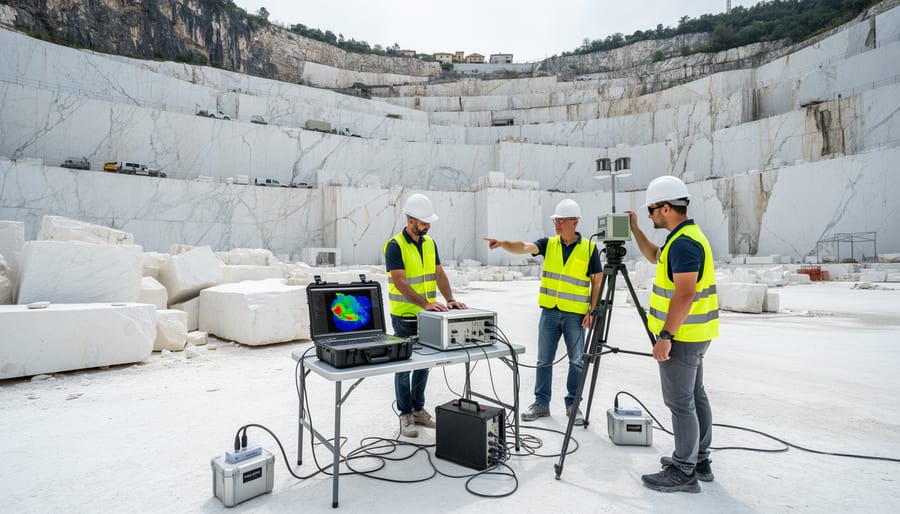
In the renowned Carrara quarries of Tuscany, Italy, researchers have begun field-testing quantum gravity sensors to map subsurface marble deposits with unprecedented precision. These trials, conducted in collaboration with the University of Birmingham and Italian geological institutes, demonstrate how quantum technology can identify high-quality marble veins buried up to 30 meters deep without invasive drilling. The sensors detect minute variations in gravitational pull caused by density differences between premium statuary marble and surrounding rock formations. Early results show the technology can distinguish between commercially valuable white Carrara marble and lower-grade material with 95% accuracy, potentially reducing exploratory waste by 40%. This application represents a significant advancement for premium stone operations, where traditional geological surveys often miss valuable deposits or require extensive test drilling that damages the landscape. The Carrara trials have attracted interest from quarry operators worldwide seeking sustainable methods to maximize resource extraction while minimizing environmental impact.
Applications in Construction and Building Integrity
Detecting Voids and Weaknesses in Stone Structures
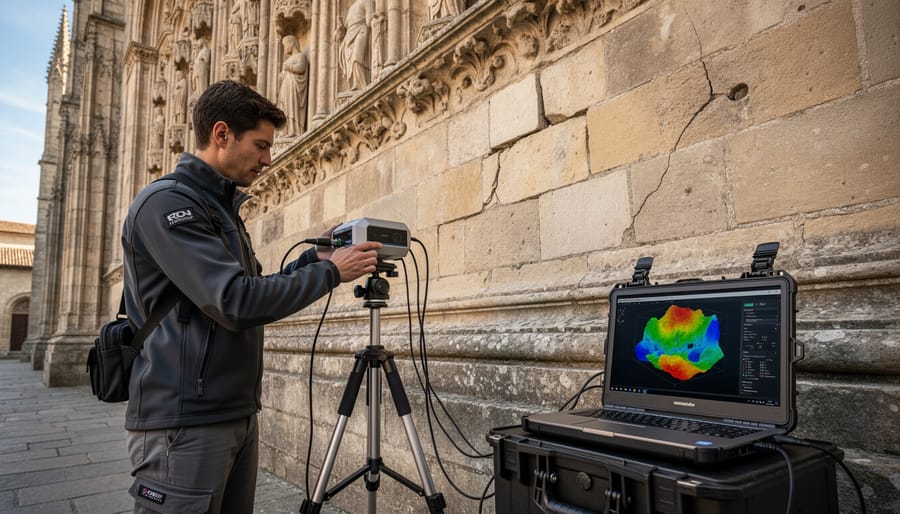
Quantum gravity sensors are transforming how engineers and preservationists assess the structural integrity of historic stone buildings and monuments. Unlike traditional inspection methods that often require invasive drilling or surface-level visual assessments, these advanced sensors detect minute variations in gravitational fields to reveal hidden voids, cracks, and areas of deterioration within stone structures without causing any damage.
The technology works by measuring incredibly small changes in gravity caused by density variations within stone walls and foundations. When deterioration occurs—whether through water damage, settling, or natural aging—it creates pockets of lower density that quantum gravity sensors can detect with remarkable precision. This capability is particularly valuable for heritage conservation, where preserving the original fabric of historic stone buildings is paramount.
Recent applications have demonstrated the sensors’ effectiveness in identifying hidden structural weaknesses in centuries-old marble cathedrals and limestone fortifications. In one notable case study, quantum gravity mapping revealed previously undetected voids behind the ornamental stone facades of a 17th-century courthouse, allowing engineers to address the issues before visible damage occurred.
The integration of quantum sensors with smart building applications creates new possibilities for continuous structural monitoring. This proactive approach enables building managers to track changes over time, schedule preventive maintenance, and ensure the longevity of valuable stone structures while minimizing repair costs and preserving architectural integrity for future generations.
Monitoring Historic Stone Architecture
Historic stone buildings represent irreplaceable cultural treasures, yet they face constant threats from structural settling, foundation shifts, and material degradation. Quantum gravity sensors are emerging as powerful tools for preservation specialists, offering unprecedented precision in monitoring these ancient structures.
Traditional monitoring methods often rely on visual inspections or mechanical sensors that can miss subtle changes occurring deep within stone walls or foundations. Quantum gravity sensors detect minute variations in gravitational fields caused by mass redistribution, whether from water infiltration, hidden voids, or gradual material loss. This non-invasive approach allows conservators to identify problems before visible damage appears.
At heritage sites worldwide, these sensors are being deployed to track foundation movement in cathedral walls, detect subsurface voids beneath castle courtyards, and monitor moisture accumulation within limestone facades. The technology proves particularly valuable for structures where drilling or installing traditional sensors would damage historic materials.
One notable application involves monitoring bell towers and spires, where imperceptible tilting over years can lead to catastrophic failure. Quantum sensors positioned at ground level can detect mass shifts in upper sections without requiring scaffolding or physical contact with delicate stonework.
The data collected helps preservation teams prioritize interventions, allocate restoration budgets effectively, and document structural health over time. As climate change accelerates weathering processes, this early-warning capability becomes increasingly critical for safeguarding architectural heritage. Conservation professionals can now make informed decisions based on precise measurements rather than educated guesses, ensuring these stone monuments endure for future generations.
The Broader Impact: Natural Stone in Advanced Sensor Technologies
Stone as Sensor Component
Natural stones play a surprisingly crucial role in quantum gravity sensor construction, serving as key components due to their exceptional stability and predictable physical properties. Granite, quartz, and marble are particularly valued for their low thermal expansion coefficients and resistance to vibration, making them ideal materials for the sensor’s foundational structures and test masses.
The atomic structure of crystalline stones like quartz provides remarkable consistency, essential for measurements that detect gravitational changes as minute as one part in a billion. These stones maintain dimensional stability across temperature variations, preventing false readings that could arise from material expansion or contraction. In quantum gravity sensors, precision-cut stone components serve as reference points and support structures, isolating sensitive quantum instruments from environmental interference.
Granite’s density and homogeneous composition make it especially suitable for vibration isolation platforms, while certain quartzites are being explored for quantum technology applications beyond gravity sensing. The natural piezoelectric properties found in specific stone crystals also contribute to sensor calibration systems. This practical application demonstrates how ancient geological materials continue to enable cutting-edge scientific advancement, bridging natural stone’s traditional uses with revolutionary measurement technology.
The Future of Smart Stone Selection
Quantum gravity sensors represent just the beginning of a technological revolution in stone selection and specification. As these instruments become more refined and accessible, architects and designers will gain unprecedented ability to evaluate stone materials before specifying them for projects. Rather than relying solely on visual inspection or basic physical tests, professionals will access detailed compositional maps showing density variations, mineral distributions, and structural integrity throughout entire stone slabs.
This data-driven approach to advanced stone selection will minimize project risks and optimize material performance. Designers will match specific stone characteristics to precise application requirements, selecting slabs with ideal density profiles for load-bearing applications or identifying materials with uniform composition for large-scale installations. The technology will also enable better prediction of long-term durability, helping specifiers choose stones that will maintain their appearance and structural properties throughout a building’s lifespan. As quantum sensing technology integrates with digital design tools, the stone industry will move toward a future where material selection becomes as precise and data-informed as any other aspect of architectural planning.
Current Limitations and Future Developments
While quantum gravity sensors represent a breakthrough in precision measurement, their application in the natural stone industry remains in early stages. Currently, these devices face several practical barriers that limit widespread adoption.
Cost stands as the primary obstacle. A single quantum gravity sensor system can exceed several hundred thousand dollars, placing it beyond reach for most small to mid-sized stone operations. The technology requires specialized cooling systems, often maintaining components at near-absolute-zero temperatures, which adds complexity and operational expenses. Additionally, trained technicians capable of operating and maintaining these sophisticated instruments remain scarce in the stone industry.
The equipment’s sensitivity, while advantageous for detection, also creates challenges. Environmental vibrations from nearby machinery or traffic can interfere with measurements, necessitating careful site preparation and sometimes limiting field deployment. Current systems also require relatively long measurement times compared to traditional methods, which can slow down surveying operations at active quarry sites.
Despite these limitations, the technology is advancing rapidly. Manufacturers are developing more compact, room-temperature quantum sensors that promise reduced costs and easier operation. Recent prototypes have demonstrated improved portability, with units small enough to mount on vehicles for mobile surveying applications.
Looking ahead, industry experts anticipate that within five to ten years, quantum gravity sensors will become more accessible for stone industry applications. Developments in miniaturization and simplified operation could bring costs down significantly. Pilot programs at several European quarries are already testing integration with existing geological survey workflows, gathering data that will inform best practices for broader implementation.
For now, the technology serves primarily as a specialized tool for large-scale operations and research institutions, but its trajectory suggests more democratic access is approaching.
Quantum gravity sensors represent a transformative frontier in natural stone technology, promising to revolutionize how we select, extract, and preserve these timeless materials. While this technology remains in its early stages of commercial application, its potential impact on the stone industry is substantial. By enabling unprecedented precision in detecting subsurface structures, density variations, and geological features, quantum sensors empower quarry operators to minimize waste, reduce environmental impact, and extract higher-quality stone more efficiently. For architects and designers, this technology translates to greater confidence in material selection and structural planning. Construction professionals benefit from enhanced site assessment capabilities that improve safety and project outcomes. As quantum gravity sensors become more accessible and affordable, they will likely become standard tools in sustainable stone sourcing and historic preservation efforts. The marriage of quantum physics with ancient materials demonstrates how innovation can honor tradition while advancing industry practices, making stone selection more precise, sustainable, and informed than ever before.