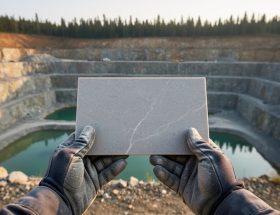
Choose natural stone for your patio based on durability ratings and slip resistance coefficients, not aesthetics alone. Bluestone and granite offer DCOF ratings above 0.60 for wet surface safety, while travertine requires additional finishing to meet the same standards. Request test samples from suppliers and expose them to water, freezing cycles, and staining agents for 48 hours before committing to full orders.
Calculate total project costs using the $15-45 per square foot installed range as your baseline, factoring in substrate preparation ($3-8 per square foot), polymeric sand jointing ($1-2 per square foot), and sealing ($2-4 per square foot initially, then $1-2 annually). Regional labor rates vary by 40-60%, making DIY installation viable for mechanically inclined homeowners working with modular flagstone patterns rather than precision-cut ashlar designs.
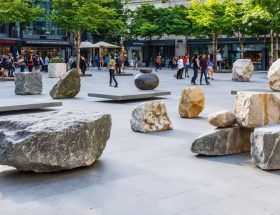
Prioritize stones with absorption rates below 0.5% for freeze-thaw climates. Dense granite and slate withstand thermal cycling without spalling, while sandstone and limestone require climate-appropriate selection based on porosity ratings. The same principles governing exterior natural stone applications in commercial projects apply to residential patios, though residential specifications typically allow slightly higher absorption thresholds.
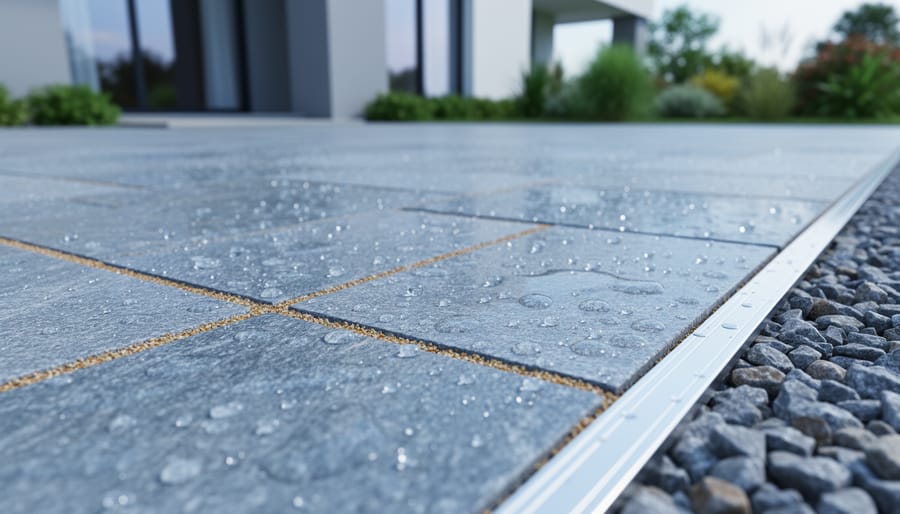
Install proper drainage with 2% minimum slope away from structures and 4-6 inch compacted gravel bases to prevent settling and water damage. Edge restraints using concrete haunching or aluminum edging systems prevent stone migration and maintain joint integrity for 15-20 years versus 5-7 years for unrestrained installations. These technical foundations determine whether your investment delivers decades of performance or requires premature replacement.
The Real Cost of Patio Natural Stones (And Why They’re Worth It)
Initial Investment Breakdown by Stone Type
Understanding the upfront costs for different patio stone options helps you budget accurately and select materials that align with your financial parameters. Here’s what you can expect to invest per square foot, including both materials and professional installation.
Flagstone represents one of the most popular choices, ranging from $15-30 per square foot installed. The irregular shapes create organic appeal, though complex patterns may push costs higher. Bluestone commands premium pricing at $20-35 per square foot installed due to its durability and consistent coloring, making it ideal for high-traffic areas.
Limestone offers mid-range pricing at $18-28 per square foot installed. Its neutral tones complement various architectural styles, though it requires sealing to prevent staining. Travertine typically costs $15-25 per square foot installed, offering distinctive pitted texture that adds character while remaining budget-friendly.
Slate provides excellent value at $15-28 per square foot installed, with natural cleft surfaces offering superior slip resistance. Color variations within individual pieces create visual interest without additional cost. Granite sits at the higher end, ranging from $25-40 per square foot installed, justified by exceptional hardness and minimal maintenance requirements over decades of use.
These prices reflect standard installation over prepared bases with polymeric sand or mortar joints. Complex patterns, remote locations, or challenging site conditions may increase labor costs by 20-30 percent. Geographic location significantly impacts pricing, with coastal and metropolitan areas typically commanding higher rates than rural regions.
The 30-Year Cost Comparison
When evaluating patio materials, the initial price tells only part of the story. A comprehensive 30-year analysis reveals natural stone’s true economic advantage.
Natural stone patios typically require minimal intervention over three decades. Beyond periodic sealing every 3-5 years at approximately $200-400 per application, maintenance costs remain negligible. The stone itself rarely needs replacement, with most repairs limited to occasional re-leveling of settled pavers or replacing individual stones damaged by extreme circumstances. Total 30-year maintenance costs average $2,500-4,000.
Compare this to concrete pavers, which often require complete replacement after 15-20 years due to fading, cracking, and surface degradation. A $8,000 concrete paver patio may need $9,000+ in replacement costs midway through the period, plus regular sealing and crack repairs totaling $3,000-5,000. Combined 30-year costs approach $20,000.
Pressure-treated wood decking fares worse, requiring replacement every 10-15 years, annual staining or sealing, and frequent board replacements. The lifecycle cost easily exceeds $25,000 for comparable square footage.
Natural stone’s durability means your initial investment of $12,000-18,000 remains largely your total cost, delivering superior long-term value while maintaining aesthetic appeal that actually improves with age rather than deteriorating.
Choosing the Right Natural Stone for Your Patio’s Climate and Use
Best Stones for High-Traffic Entertaining Areas
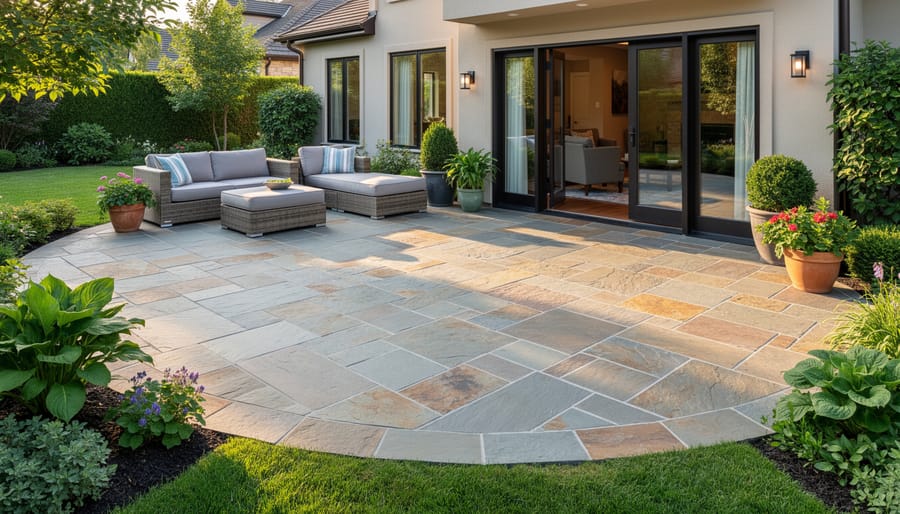
For high-traffic entertaining areas, selecting stone with exceptional durability is essential. Granite stands out as the most resilient option, boasting a Mohs hardness rating of 6-7, making it highly resistant to scratches, stains, and weather damage. Its dense composition handles constant foot traffic without showing wear, while thermal finishing provides slip-resistant texture ideal for poolside gatherings or outdoor kitchens.
Bluestone offers a compelling middle ground with a hardness rating of 5-6. This sedimentary stone develops a natural patina over time that many homeowners find appealing, and its naturally cleft surface provides excellent traction even when wet. Thermal or flamed finishes enhance slip resistance further, making bluestone particularly suitable for areas around outdoor bars or dining spaces.
Quartzite delivers premium performance with hardness ratings reaching 7 on the Mohs scale, rivaling granite’s durability while offering distinctive veining patterns. Its low porosity resists staining from spilled drinks and food, though professional sealing remains recommended for optimal protection.
All three stones perform admirably under heavy use, but texture selection matters significantly. Honed finishes create smooth surfaces that show wear more quickly, while thermal, flamed, or natural cleft textures disguise traffic patterns and provide superior slip resistance for safe entertaining environments.
Pool and Water Feature Selections
When selecting stone surfaces around water features, three properties become essential: slip resistance, heat management, and chemical durability.
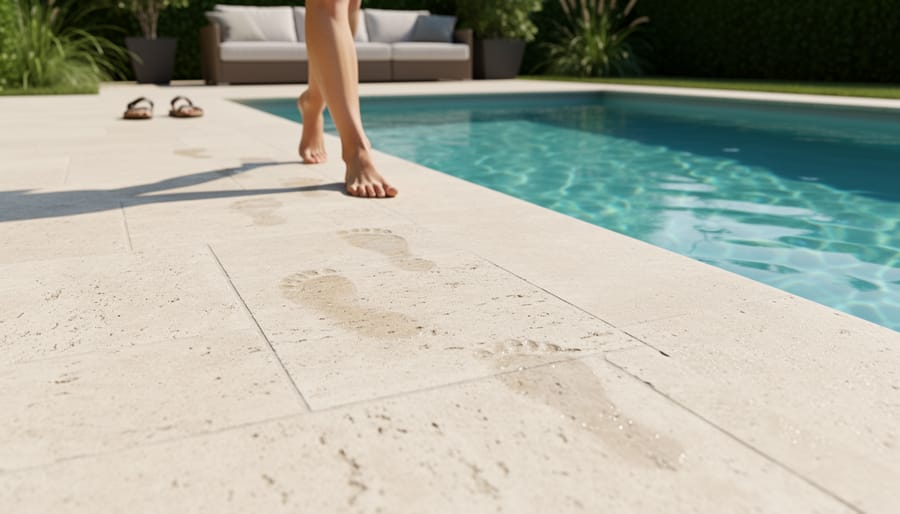
Travertine excels in poolside applications due to its naturally textured surface that provides excellent traction even when wet. The stone’s porous structure remains cool underfoot in direct sunlight, making it comfortable for bare feet on hot summer days. Its moderate resistance to chlorine and pool chemicals requires sealing every 1-2 years to maintain optimal performance.
Limestone offers a refined aesthetic with good slip resistance when finished with a honed or tumbled texture. While it stays relatively cool, darker varieties may absorb more heat than lighter tones. Regular sealing protects against chemical exposure from pool treatments and prevents water penetration that could cause staining or deterioration.
Sandstone provides superior non-slip characteristics thanks to its naturally gritty texture. The material reflects heat well, particularly in lighter shades, keeping surface temperatures manageable. However, its high porosity demands consistent sealing to withstand chemical exposure from pool maintenance products and prevent algae growth in textured areas.
All three stones require proper sealing protocols and periodic resealing to maintain their protective qualities in wet environments. Choose lighter colors to minimize heat absorption and select finishes that enhance natural slip resistance.
Cold Climate and Freeze-Thaw Considerations
Cold weather performance depends primarily on a stone’s porosity and water absorption rate. When water penetrates porous stone and freezes, it expands by approximately 9%, creating internal pressure that can cause cracking, spalling, and surface deterioration over repeated freeze-thaw cycles.
The American Society for Testing and Materials (ASTM) classifies natural stones by water absorption rates. Stones absorbing less than 0.4% by weight are considered dense and highly freeze-thaw resistant. Granite typically absorbs 0.2-0.4%, making it excellent for cold climates. Dense limestone varieties like Indiana limestone (0.3-7.5% depending on grade) perform well when lower-absorption grades are selected. Slate generally ranges from 0.1-0.3%, offering superior winter durability.
Sandstone presents more variability, with absorption rates between 1-8%. Higher-density sandstones work in cold climates, but always verify specifications. Bluestone, a dense sandstone variety, typically absorbs under 3% and has proven reliable in northeastern winters.
Travertine, despite its popularity, is naturally porous (2-5% absorption) and requires sealing in freeze-thaw environments. Unfilled travertine holes can trap water and fail rapidly.
For harsh winter regions, request absorption test results from suppliers and choose stones rated for severe weathering (SW) conditions. Proper installation with adequate drainage and regular sealing significantly extends stone life in challenging climates.
Installation Methods That Make or Break Your Stone Patio
The Foundation Layer That Prevents Cracking
The longevity of your natural stone patio depends less on the stone itself and more on what lies beneath it. A properly constructed foundation prevents the settling, shifting, and cracking that plague poorly installed patios within just a few seasons.
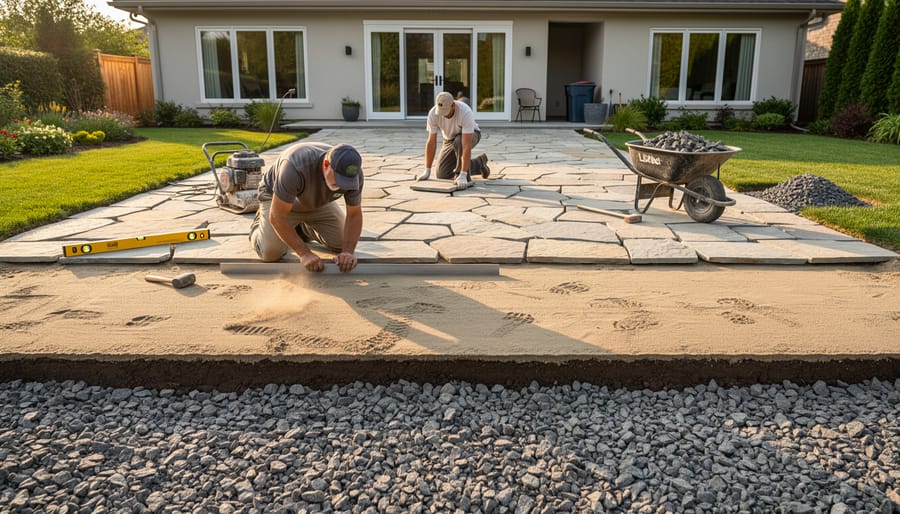
Start by excavating to a depth of 6-8 inches for pedestrian patios, or 10-12 inches for areas supporting heavier loads like outdoor kitchens. The excavation should extend 6 inches beyond the patio perimeter to accommodate edge restraints. Remove all organic material, roots, and debris that could decompose and create voids.
Soil type dictates your approach to outdoor natural stone installation. Clay soils require aggressive drainage solutions since they retain moisture and expand when frozen. Sandy soils drain naturally but need additional compaction. Consider a geotextile fabric barrier to prevent base material migration in unstable soils.
The base itself consists of two layers. First, install 4-6 inches of crushed angular stone (3/4-inch minus) as your sub-base. Compact in 2-inch lifts using a plate compactor, achieving 95% compaction density. This layer provides structural support and facilitates drainage.
Next, add 1-2 inches of coarse sand or stone dust as your setting bed. This layer accommodates minor irregularities in stone thickness and allows for precise leveling. Screed it flat but avoid over-compacting, which prevents proper stone seating.
Slope the entire foundation 2% away from structures—approximately 1/4 inch per foot—to ensure water runoff. Install perimeter drains in areas with poor natural drainage to prevent water accumulation that leads to frost heave and foundation failure.
Mortared vs. Dry-Laid Installation
Choosing between mortared and dry-laid installation significantly impacts your patio’s performance, longevity, and maintenance requirements. Each method offers distinct advantages suited to different circumstances.
Mortared installation involves setting stones on a concrete base with mortar joints, creating a permanent, stable surface. This method excels in high-traffic areas and prevents weed growth between stones. The rigid structure resists shifting and provides excellent stability on slopes or uneven terrain. Mortared patios also handle furniture placement better, as chair legs won’t catch on uneven edges. However, this approach requires professional installation in most cases, costs more upfront, and offers less flexibility for future modifications. Climate considerations are crucial—mortared installations in freeze-thaw regions need proper drainage systems to prevent cracking from ice expansion.
Dry-laid installation places stones on a compacted gravel and sand base without mortar. This permeable method allows water drainage, reducing runoff issues and supporting sustainable landscaping practices. The installation proves more DIY-friendly and costs less initially. Dry-laid patios adapt naturally to ground movement, making them ideal for areas with settling soil. Maintenance access remains simpler since individual stones lift out for repairs or utility work underneath. The drawbacks include potential weed growth between joints, gradual stone shifting over time, and less suitability for steep slopes.
For cold climates with significant freeze-thaw cycles, dry-laid installation often performs better by accommodating ground movement. In stable, warm climates or formal settings requiring crisp lines, mortared installation delivers superior results. Consider your budget, desired permanence, and local weather patterns when deciding which method suits your project best.
Surface Finishes and How They Transform Performance
Slip Resistance and Safety Ratings
Safety becomes paramount when selecting patio stones for wet environments, especially around pools, spas, and water features. The surface finish dramatically affects slip resistance, making this a critical consideration during material selection.
Thermal or flamed finishes provide the highest traction in wet conditions. This process uses intense heat to roughen the stone surface, creating a naturally textured profile that significantly reduces slipping hazards. Flamed granite and basalt are particularly popular for pool decks, offering excellent grip even when soaked. Similarly, brushed finishes deliver reliable traction while maintaining a slightly smoother feel underfoot compared to flamed surfaces.
Honed finishes present moderate slip resistance suitable for covered patios with limited water exposure. However, they become slippery when wet and should be avoided near pools or high-traffic wet areas. Polished surfaces, while visually striking, are extremely hazardous in wet conditions and inappropriate for outdoor applications.
Natural cleft stones like slate and quartzite inherently provide superior traction due to their split surface texture. These materials perform exceptionally well in wet environments without additional finishing treatments.
For ultimate safety, consider stones with higher porosity and rougher textures. Always request slip resistance ratings (measured by the Dynamic Coefficient of Friction) from suppliers, targeting values above 0.60 for wet areas. Real-world testing shows properly finished natural stones can exceed commercial safety standards while maintaining aesthetic appeal throughout years of use.
Heat Absorption and Barefoot Comfort
Surface temperature is a crucial consideration for barefoot comfort on your patio, particularly during peak summer months. Independent testing reveals significant variations among natural stone types when exposed to direct sunlight.
Limestone and travertine consistently record the coolest surface temperatures, typically measuring 15-20 degrees Fahrenheit lower than darker alternatives under identical conditions. Their light color and porous composition naturally reflect more solar radiation. Thermal imaging studies show limestone surfaces at approximately 105-110°F during midday summer sun, while darker granite can exceed 130°F under the same conditions.
Granite and basalt, especially in darker finishes, absorb considerably more heat due to their dense crystalline structure and color intensity. Sandstone falls in the moderate range, with surface temperatures varying based on its mineral composition and finish.
Finish selection also impacts heat retention. Honed and thermal finishes tend to run cooler than polished surfaces, which can intensify heat absorption. Testing indicates that textured finishes may register 5-10 degrees cooler than smooth alternatives of the same stone type.
For poolside applications and sun-exposed patios where barefoot traffic is common, choosing lighter-colored stones with textured finishes provides measurable comfort advantages while maintaining the durability and aesthetic appeal natural stone offers.
Maintenance That Takes Minutes, Not Hours
The Sealing Schedule by Stone Type
Different patio stones have varying porosity levels, which determines their sealing requirements. Highly porous materials like limestone, sandstone, and travertine absorb liquids readily and should be sealed immediately after installation, with resealing every 1-2 years depending on traffic and exposure. These stones benefit significantly from penetrating sealers that protect against oil, wine, and organic stains without altering their natural appearance.
Slate and bluestone fall into the moderate category, typically requiring sealing every 2-3 years. Their denser composition provides some natural resistance, but sealing enhances protection and simplifies maintenance, particularly in high-use areas or climates with freeze-thaw cycles.
Granite and quartzite are naturally dense and stain-resistant, often requiring minimal sealing or resealing only every 3-5 years. Some darker granites may not need sealing at all, though a light application can enhance color depth and simplify cleaning.
To test if your patio needs resealing, sprinkle water on the surface. If it darkens or absorbs within 5-10 minutes rather than beading up, resealing is recommended. Always use sealers specifically formulated for natural stone to avoid discoloration or surface damage.
Removing Common Stains Without Damage
Different stains require specific approaches to avoid damaging your natural stone patio. For oil-based stains like grease or cooking oil, absorb fresh spills immediately with baking soda or cornstarch, letting it sit for 20-30 minutes before sweeping away. Create a poultice by mixing the absorbent powder with mineral spirits for stubborn marks, applying it to the stain, covering with plastic wrap, and leaving for 24 hours before rinsing.
Wine and organic stains respond well to a solution of 12% hydrogen peroxide mixed with a few drops of ammonia. Apply directly to the stain, let it work for a few minutes, then rinse thoroughly. For biological growth like algae or mildew, use a mixture of one part bleach to four parts water, but test first on dense stones like granite. Avoid bleach entirely on iron-rich stones that may discolor.
Rust stains require commercial rust removers specifically formulated for natural stone, as home remedies can cause etching or discoloration. Follow manufacturer instructions carefully and always test in an inconspicuous area first.
Efflorescence, those white powdery salt deposits, typically brush away when dry. For persistent cases, use a specialized efflorescence cleaner designed for stone. Regular sweeping and proper drainage prevent most efflorescence issues.
Remember that acidic cleaners like vinegar or lemon juice will etch marble, limestone, and travertine surfaces. When in doubt, consult your stone supplier about appropriate cleaning products for your specific stone type.
Design Patterns and Layouts That Elevate Your Outdoor Space
The layout pattern you choose dramatically impacts your patio’s aesthetic appeal and perceived size. Running bond, where rectangular stones are offset by half their length like traditional brickwork, creates visual movement and works exceptionally well with bluestone and limestone rectangles. For a more traditional European aesthetic, consider ashlar patterns mixing multiple stone sizes in organized rows, particularly effective with travertine and sandstone. Random or irregular patterns suit flagstone beautifully, creating organic, cottage-style spaces that feel less formal.
Incorporating borders elevates any design from ordinary to exceptional. A contrasting stone type—such as dark granite framing lighter limestone—defines the space while adding sophistication. Border widths typically range from 12 to 24 inches, with soldier course arrangements (stones standing on edge) providing pronounced definition. Consider extending your border material into geometric inlays or medallions as focal points beneath seating areas or fire pits.
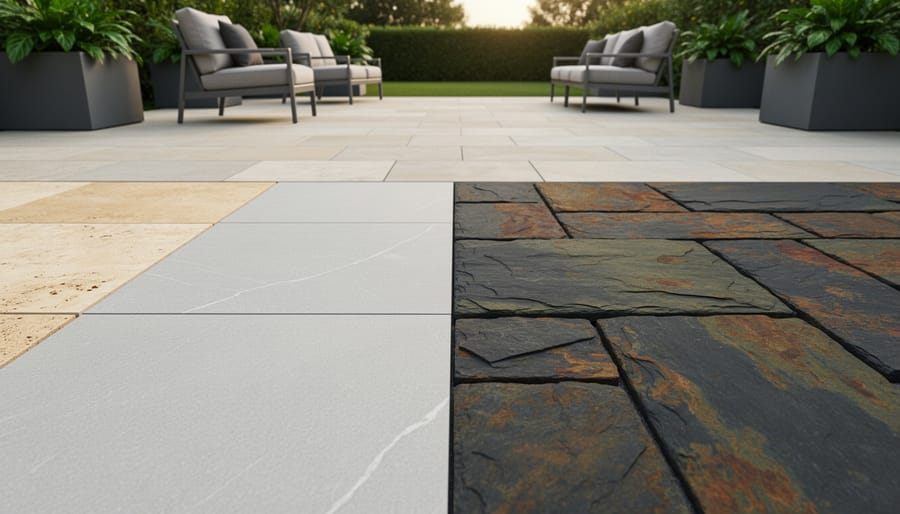
Mixing stone types within a single patio requires careful consideration of color harmony and thickness compatibility. Combining warm sandstone with cooler slate creates dynamic contrast, while pairing travertine with limestone maintains tonal consistency with textural variation. Ensure mixed materials have similar wear characteristics and thickness to prevent uneven surfaces and premature deterioration.
Scale matters significantly in pattern selection. Larger format stones (24 inches or greater) make small patios feel more expansive by reducing visual clutter from grout lines. Conversely, smaller modular units provide flexibility for curved edges and intricate patterns. The environmental benefits of natural stone extend through thoughtful design that maximizes material efficiency and longevity.
Always dry-lay your pattern before installation begins. This preview allows adjustments to color distribution, ensures proper drainage slopes, and confirms you’ve ordered sufficient material with appropriate color variation to achieve your desired aesthetic.
Sustainability and Environmental Impact
Natural stone patios offer significant environmental advantages that increasingly resonate with eco-conscious homeowners and designers. Unlike manufactured paving materials that require energy-intensive production processes, natural stone is quarried directly from the earth with minimal processing, resulting in a substantially lower carbon footprint. The extraction and fabrication of natural stone typically consumes less energy than concrete manufacturing, which requires high-temperature kilns and chemical additives.
Local sourcing amplifies these environmental benefits. Many regions have active quarries producing indigenous stone varieties, reducing transportation emissions and supporting local economies. Choosing locally-quarried stone can cut the environmental impact dramatically compared to imported alternatives or synthetic materials shipped long distances.
Natural stone’s exceptional durability translates to environmental savings over time. A properly installed stone patio can last 50 to 100 years or more with minimal maintenance, eliminating the need for replacement and reducing long-term material consumption. When eventual renovation occurs, natural stone is completely recyclable—removed pavers can be repurposed for other landscaping projects, used as fill material, or crushed for aggregate, keeping materials out of landfills.
Unlike composite decking or concrete pavers that may leach chemicals or microplastics into surrounding soil, natural stone is chemically inert and won’t contaminate your landscape. The material’s permeability, particularly when installed with permeable jointing, supports natural water infiltration and reduces stormwater runoff, contributing to healthier soil ecosystems and groundwater recharge. For environmentally responsible outdoor spaces, natural stone delivers authentic sustainability backed by geological durability.
Natural stone patios represent a substantial investment that delivers exceptional returns in durability, aesthetic appeal, and property value. Unlike manufactured alternatives that degrade or fade, natural stone matures beautifully over decades with minimal intervention. The inherent strength of granite, slate, bluestone, and limestone ensures your outdoor living space withstands weather extremes, heavy foot traffic, and daily use while maintaining its structural integrity and visual character.
As you move forward in your planning process, start by evaluating your climate conditions, budget parameters, and design preferences to narrow down suitable stone types. Request samples from suppliers to assess color variations and texture in your actual outdoor lighting conditions. Obtain multiple quotes from experienced installers who understand proper base preparation and drainage requirements, as professional installation significantly impacts long-term performance.
Consider your maintenance capacity honestly when selecting stone types. Some options require regular sealing while others need only occasional cleaning. Document your specific site conditions, including slope, soil type, and drainage patterns, before consulting with contractors.
The timeless elegance of natural stone transcends passing design trends, making your patio a lasting foundation for outdoor memories. Take the next step today by connecting with local stone suppliers and certified installers to transform your vision into reality.