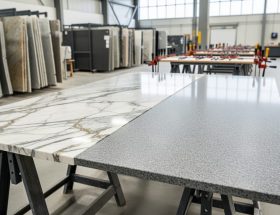
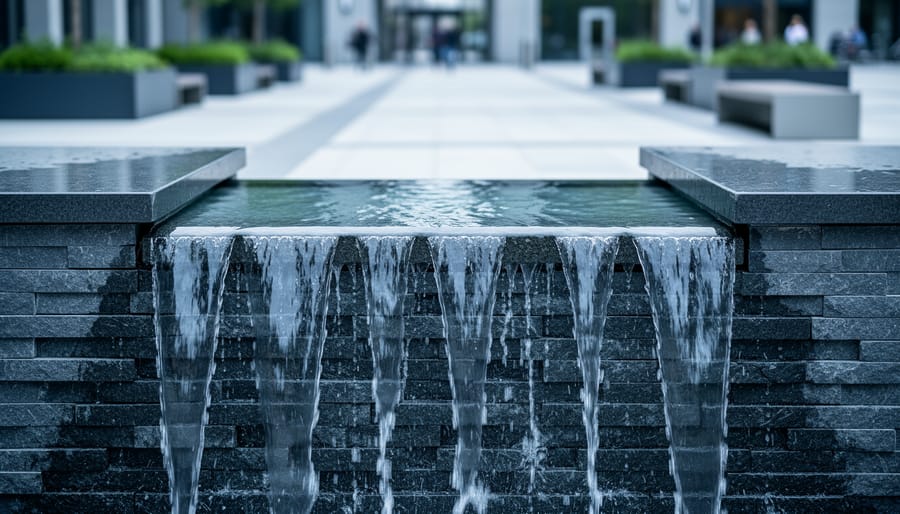
Evaluate your water feature project parameters before committing to any stone type—water chemistry, freeze-thaw cycles, and traffic patterns will eliminate unsuitable options faster than aesthetic preferences. Dense, low-porosity stones like granite and certain basalts consistently outperform porous alternatives in commercial fountain applications because they resist water absorption, minimize algae growth, and withstand chemical treatments without degradation.
Prioritize absorption rate testing over visual appeal when comparing stone samples. Request ASTM C97 data from suppliers showing water absorption percentages below 0.5% for submerged applications and below 3% for splash zones. This single metric predicts long-term performance more accurately than any other characteristic, preventing the costly failures that plague installations where natural stone selection prioritized appearance over engineering requirements.
Match stone hardness to anticipated wear patterns using the Mohs scale as your baseline. High-traffic commercial fountains demand stones rating 6 or higher—granite, quartzite, and dense limestone—while decorative wall features can accommodate softer materials like travertine or sandstone. Factor in maintenance accessibility during specification since harder stones require less frequent sealing and restoration, reducing lifecycle costs by 40-60% compared to softer alternatives.
Request regional performance data from stone suppliers showing how specific types weather in your climate zone. A limestone performing flawlessly in Arizona may fail catastrophically in Minnesota winters, while basalt thrives in both environments. This geographical intelligence transforms theoretical specifications into reliable, long-term installations.
What Makes Natural Stone Suitable for Water Features
Porosity and Water Absorption
Porosity directly determines how natural stone performs in water feature applications. This characteristic measures the volume of open space within the stone’s structure, dictating how much water it can absorb. Dense stones like granite typically have porosity rates below 0.5%, making them highly resistant to water penetration. Conversely, sedimentary stones like limestone and sandstone can exceed 10% porosity, absorbing significantly more moisture.
Higher absorption rates create several challenges in water features. Water-saturated stone becomes vulnerable to freeze-thaw damage in cold climates, as trapped moisture expands when frozen, causing cracks and spalling. Porous stones also readily absorb minerals, chemicals, and organic matter from water, leading to staining, discoloration, and biological growth like algae or moss. In chlorinated environments such as pool areas, high-porosity stones deteriorate faster as chemicals penetrate and weaken the stone’s matrix.
Testing absorption rates before selection is essential. The industry-standard water absorption test measures weight gain after 48-hour immersion. Stones with absorption rates below 0.4% are considered ideal for continuous water exposure, while those exceeding 3% require protective sealing and ongoing maintenance. Understanding these performance metrics helps prevent premature failure and ensures your water feature maintains its aesthetic appeal for decades.
Chemical Resistance and Mineral Stability
Different natural stones exhibit varying degrees of chemical resistance when subjected to continuous water exposure in commercial settings. Understanding these differences is essential for long-term performance and maintenance cost management.
Granite demonstrates exceptional resistance to chemical attack due to its dense crystalline structure and low porosity. It withstands chlorinated water, bromine treatments, and fluctuating pH levels without significant degradation, making it ideal for heavily treated commercial water features.
Marble and limestone, being calcium carbonate-based stones, are particularly vulnerable to acidic conditions. Even mildly acidic water (pH below 7) can gradually dissolve these materials through a process called etching. Chlorine and other oxidizing agents can accelerate surface deterioration, leading to loss of polish and structural weakening over time.
Slate offers moderate chemical resistance, though iron-rich varieties may experience oxidation staining when exposed to chlorinated water. The layered structure can be susceptible to delamination if chemical treatments penetrate along cleavage planes.
Quartzite ranks highly in chemical stability, rivaling granite in its ability to resist degradation from water treatment chemicals. Its high quartz content provides inherent resistance to both acidic and alkaline conditions, ensuring minimal maintenance requirements in commercial applications where consistent water chemistry may be challenging to maintain.
Granite: The Workhorse of Water Features
Performance Characteristics
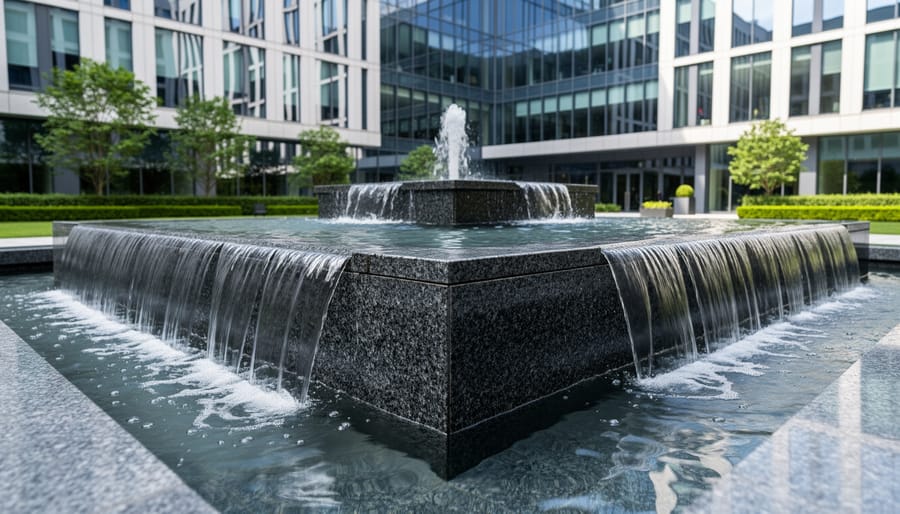
Granite stands out among natural stones for its exceptional performance in demanding commercial water feature applications. Its crystalline structure creates a remarkably low porosity rate, typically between 0.2% to 0.4%, making it highly resistant to water absorption and subsequent damage from freeze-thaw cycles. This dense composition translates to outstanding durability that can withstand decades of continuous water exposure without significant degradation.
The stone’s color stability is equally impressive. Granite maintains its appearance over extended periods because its coloring comes from mineral crystals formed deep within the earth under extreme heat and pressure. Unlike sedimentary stones, granite resists fading from UV exposure and won’t develop the water staining or discoloration common in more porous materials.
Chemical resistance is another critical advantage for commercial installations. Granite withstands exposure to chlorine, pH-balanced treatment chemicals, and typical cleaning agents without etching or surface deterioration. This makes it particularly suitable for treated water features where chemical contact is unavoidable.
The stone’s resistance to weathering ensures minimal maintenance requirements across all climate zones. From harsh northern winters to humid coastal environments, granite performs consistently, resisting cracking, spalling, and surface erosion that plague lesser materials in similar conditions.
Best Applications and Considerations
Granite consistently outperforms other stone types in demanding commercial water feature installations. For coping applications, granite’s impermeability and resistance to freeze-thaw cycles make it the preferred choice for pool edges, fountain rims, and spillway borders. The stone’s ability to be fabricated with precise edges and smooth finishes ensures both safety and aesthetic appeal in high-traffic areas. Basin liners benefit from granite’s minimal absorption rate, which prevents water migration and structural damage over time—a critical consideration for large-scale commercial applications where repairs are costly and disruptive.
Decorative elements such as carved water walls, sculptural fountains, and architectural accents showcase granite’s versatility while maintaining structural integrity. The material accepts various surface finishes from polished to thermal, allowing designers to achieve specific visual effects without compromising performance.
From a cost-benefit perspective, granite’s higher initial investment—typically 20-40 percent above limestone or sandstone—delivers substantial long-term value. Reduced maintenance requirements, exceptional longevity exceeding 50 years, and minimal replacement needs offset upfront costs. Projects requiring water features in climates with temperature extremes particularly benefit from this investment, as granite eliminates the deterioration cycle common with more porous alternatives.
Architects should specify granite with absorption rates below 0.4 percent for optimal performance. Dark-colored granites naturally resist algae growth and mineral staining, reducing ongoing maintenance expenses while preserving aesthetic quality throughout the installation’s lifespan.
Limestone: Beautiful but Demanding
Why Limestone Struggles in Water
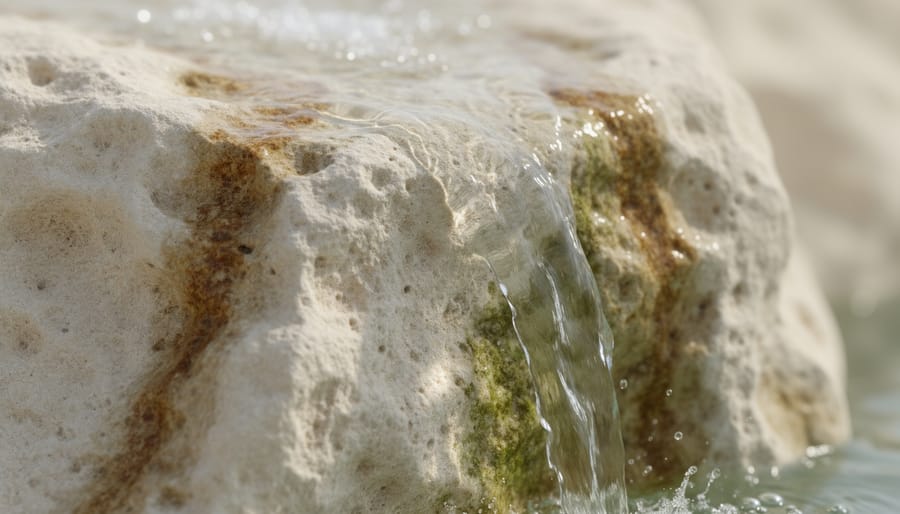
Limestone’s vulnerability in water features stems from its fundamental composition. Comprised primarily of calcium carbonate, this sedimentary stone reacts chemically with water, particularly when pH levels fluctuate or acidic conditions exist. This reaction gradually dissolves the stone’s surface, leading to erosion and loss of structural integrity over time.
The stone’s naturally high porosity presents another significant challenge. Limestone readily absorbs water, making it susceptible to staining from minerals, algae, and organic matter commonly found in commercial water features. This absorption also creates freeze-thaw concerns in colder climates, where trapped moisture expands and contracts, causing cracks and surface spalling.
Chemical sensitivity further compounds limestone’s water-related issues. Chlorine, commonly used in fountain maintenance, accelerates deterioration. Even seemingly neutral water can become problematic as calcium carbonate gradually leaches from the stone itself, creating a chalky residue and weakening the material.
While limestone offers aesthetic appeal and affordability, these inherent characteristics make it a risky choice for sustained water exposure. Understanding these limitations helps designers and facility managers avoid costly repairs and premature replacement in commercial installations where durability and longevity are paramount considerations.
When Limestone Can Work
Limestone can successfully serve in commercial water features when properly protected from harsh conditions. Interior applications with minimal water exposure—such as dry fountain surrounds, coping stones away from direct water flow, or decorative wall features—present ideal scenarios for this elegant stone.
For exterior applications, limestone requires rigorous protection protocols. Apply a high-quality penetrating sealer specifically formulated for limestone before installation, and reapply according to manufacturer recommendations, typically every 1-2 years. In water features, position limestone in areas with minimal direct water contact or where water chemistry can be carefully controlled to maintain neutral pH levels.
Climate considerations prove essential. Limestone performs best in temperate regions without extreme freeze-thaw cycles. In colder climates, use only dense, low-porosity limestone varieties and ensure proper drainage to prevent water infiltration that leads to spalling and cracking.
Establish a maintenance schedule including regular cleaning with pH-neutral stone cleaners, prompt stain removal, and periodic resealing. Monitor water chemistry monthly, maintaining pH between 7.0-8.0 to minimize acid etching. Document all treatments and inspections to track the stone’s condition over time and anticipate maintenance needs before problems escalate.
Marble: Luxury with Limitations
The Etching Problem
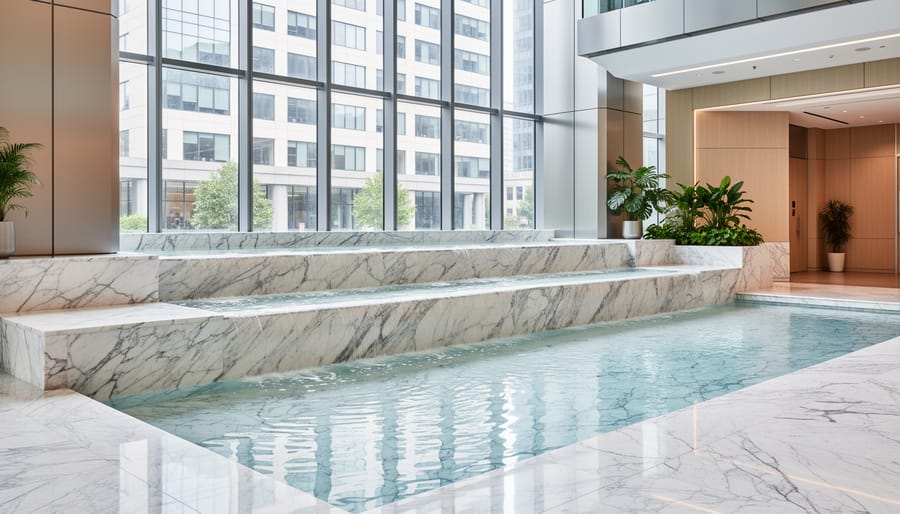
Marble’s elegant appearance comes with a significant vulnerability: etching. This occurs when acidic substances chemically react with the calcium carbonate that forms marble’s foundation. In water features, the problem intensifies as pH levels fluctuate. Water with a pH below 7 becomes increasingly acidic, dissolving the stone’s surface and creating dull, rough patches that compromise both aesthetics and structural integrity.
The etching process happens at the molecular level. Acidic water donates hydrogen ions that break down calcium carbonate, releasing carbon dioxide and leaving behind calcium ions in solution. This chemical weathering creates permanent surface damage that cannot be reversed through simple cleaning or polishing.
Mineral content compounds the issue. Hard water contains dissolved calcium and magnesium, which can deposit on surfaces, while chlorine and other sanitizing chemicals commonly used in commercial fountains accelerate deterioration. Even rainwater, with its typical pH of 5.5, poses a threat in outdoor installations.
The damage appears gradually—what begins as slight surface dulling progresses to visible pitting and roughness. In high-traffic commercial environments where water continuously flows over marble surfaces, this degradation can occur within months rather than years, making marble a problematic choice for most water feature applications.
Strategic Marble Applications
Marble’s elegant appearance makes it desirable for commercial water features, but success requires strategic planning. When incorporating marble in fountains or pools, location matters significantly. Place marble elements above the waterline or in areas with minimal direct water contact to reduce exposure. For submerged applications, select dense, light-colored marble varieties with lower porosity, as darker stones may show water staining more prominently.
Water chemistry management is essential for marble longevity. Maintain pH levels between 7.0 and 7.6, as acidic conditions will etch marble surfaces over time. Install proper filtration systems and avoid chlorine concentrations above 3 ppm. Regular water testing and adjustment prevent the chemical damage that frequently affects marble installations.
Protective measures extend marble’s service life considerably. Apply penetrating sealers specifically formulated for marble before installation, reapplying according to manufacturer recommendations. Create drainage slopes to prevent standing water, which accelerates deterioration. Working with experienced professional stone installers ensures proper substrate preparation, including waterproof membranes and appropriate setting materials that accommodate thermal expansion.
For high-profile commercial projects, consider hybrid approaches where marble serves decorative roles in protected zones while more durable stones handle direct water exposure. This strategy delivers marble’s aesthetic appeal without compromising performance.
Slate: The Textured Alternative
Durability and Maintenance Profile
Slate offers exceptional water resistance due to its naturally low porosity and dense composition, making it a superior choice for commercial water features where constant moisture exposure is inevitable. The stone’s layered structure effectively repels water infiltration when properly installed and sealed, though this same characteristic presents the primary maintenance challenge: delamination.
In commercial applications, delamination—the separation of slate’s natural layers—occurs when water penetrates between the stone’s planes, particularly during freeze-thaw cycles or with poor installation techniques. Selecting high-grade slate with tight lamination and ensuring proper sealing during installation significantly reduces this risk. Regular inspection of horizontal surfaces where water pools is essential for early detection.
Color variation represents another consideration for long-term planning. While slate maintains its appearance better than many alternatives, prolonged UV exposure can cause subtle fading, particularly in darker varieties. Wet environments actually help preserve color vibrancy by keeping the stone’s natural oils active.
Maintenance requirements remain modest: routine cleaning with pH-neutral cleaners, periodic resealing every 3-5 years depending on exposure, and prompt attention to any chipping or edge damage. When properly maintained, slate in commercial water features delivers decades of reliable performance with minimal aesthetic degradation, justifying its initial investment through longevity and reduced replacement costs.
Design Applications
Slate excels in commercial water features due to its natural cleavage planes and water-resistant properties. The stone’s layered structure creates dramatic visual effects when water flows across vertical surfaces, making it ideal for statement walls in hotel lobbies, corporate atriums, and public spaces. Slate’s low porosity prevents water absorption that can lead to deterioration, ensuring longevity in high-exposure applications.
For spillways and water walls, installers typically mount slate tiles in stacked or staggered patterns to maximize the cascading effect. The stone’s natural texture diffuses water flow, creating gentle sheets rather than concentrated streams. This characteristic makes slate particularly effective for indoor installations where splash control matters.
Accent walls benefit from slate’s color variation, ranging from charcoal and silver to green and purple tones. These hues intensify when wet, providing dynamic visual interest throughout the day. Commercial designers often specify cleft-finish slate for water features rather than honed surfaces, as the natural texture provides better water dispersion and reduces mineral deposit visibility during operation.
Basalt and Volcanic Stones: Modern Design Solutions
Performance Advantages
Volcanic stones like basalt and granite deliver exceptional performance in commercial water features due to their crystalline structure formed under extreme heat and pressure. This formation process creates an incredibly dense material with minimal porosity, typically below 1% water absorption, compared to limestone’s 5-10% range. The tight molecular structure prevents water infiltration that leads to cracking, staining, and deterioration over time.
These stones demonstrate superior weather resistance across all climate zones. Their low absorption rate means freeze-thaw cycles cause minimal damage, as there’s little trapped moisture to expand and crack the material. Surface integrity remains stable even after decades of exposure to UV radiation, temperature fluctuations, and chemical exposure from water treatment systems.
The dense composition also resists biological growth. Algae and bacteria struggle to colonize the non-porous surface, reducing maintenance requirements and preserving the stone’s appearance. In high-traffic commercial applications, this durability translates to lower lifecycle costs and extended replacement intervals. Installation teams appreciate the material’s consistent quality and predictable performance, making volcanic stones the preferred choice for projects where longevity and minimal maintenance are priorities.
Contemporary Design Integration
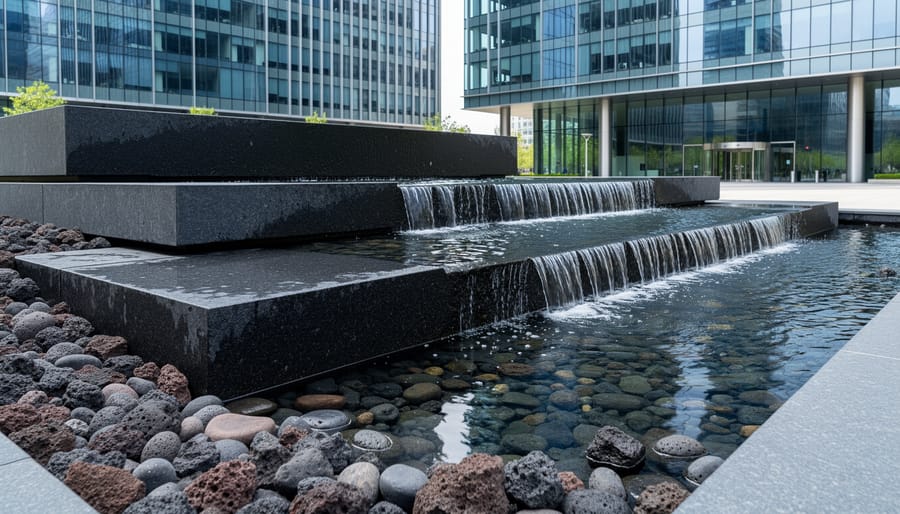
Basalt and volcanic stones have emerged as preferred materials for commercial water features that embrace modern architectural aesthetics. Their naturally dark hues—ranging from charcoal gray to deep black—create striking contrast against glass, steel, and concrete, forming visually compelling focal points in lobbies, plaza fountains, and outdoor installations. The fine-grained texture of basalt offers a contemporary minimalist appeal, while its ability to be precisely cut and shaped allows for clean geometric designs that align with modernist principles. Thermal finishing techniques can enhance basalt’s natural character, producing varied surface textures from polished sophistication to flame-textured depth. This versatility makes volcanic stones particularly effective in commercial settings where design impact must balance with durability requirements, seamlessly integrating with surrounding architectural elements while maintaining the material integrity essential for long-term water feature performance.
Quartzite: Premium Performance
Quartzite represents the pinnacle of natural stone performance, offering an exceptional combination of aesthetic appeal and structural resilience that makes it particularly well-suited for high-traffic commercial water features. This metamorphic rock forms when sandstone undergoes intense heat and pressure, transforming quartz grains into an interlocking crystalline structure that delivers remarkable durability.
The material’s density typically exceeds that of granite, resulting in superior resistance to scratching, etching, and water absorption. With absorption rates often below 0.4 percent, quartzite performs exceptionally well in continuous water exposure environments. Its hardness on the Mohs scale ranges from 7 to 8, making it highly resistant to wear even in demanding commercial applications. The stone maintains its appearance remarkably well over decades, requiring minimal maintenance beyond routine cleaning.
Aesthetically, quartzite offers diverse options from subtle whites and grays to dramatic veining patterns that rival marble’s beauty without the vulnerability. Popular varieties like Sea Pearl, Taj Mahal, and Macaubas White provide sophisticated looks for contemporary commercial installations.
Cost considerations place quartzite in the premium category, typically ranging from 70 to 150 dollars per square foot installed, depending on rarity and origin. While initial investment exceeds many alternatives, the long-term value proposition proves compelling when factoring in durability and minimal maintenance requirements. Availability can be limited for certain exotic varieties, requiring advance planning during project specification phases. However, mainstream colors generally maintain consistent supply through established stone distributors, making quartzite a reliable choice for architects and designers seeking premium performance.
Selecting the Right Stone for Your Project
Environmental and Usage Factors
Selecting the right natural stone for commercial water features requires careful consideration of environmental conditions that directly impact longevity and maintenance requirements. Climate plays a crucial role—regions with freeze-thaw cycles demand stones with low absorption rates like granite or dense basalt, as porous materials can crack when water expands during freezing. In contrast, tropical climates with high humidity and rainfall may accelerate efflorescence in limestone or calcium-based stones.
Water chemistry significantly influences stone performance. Hard water with high mineral content can cause calcium deposits and staining on darker stones, while chlorinated or saltwater environments corrode certain stone types faster than others. Granite and quartzite generally resist chemical degradation better than marble or limestone in aggressive water conditions.
Traffic levels around the feature determine wear resistance needs. High-traffic commercial plazas require harder stones like granite or basalt that maintain their finish despite constant foot traffic and mechanical cleaning. Decorative features in protected areas can accommodate softer stones like travertine.
Exposure to direct sunlight affects color stability and surface temperature. UV-resistant stones prevent fading, while darker materials absorb more heat, potentially creating uncomfortable surfaces in sunny locations. Understanding these environmental factors ensures optimal stone selection for lasting performance.
Budget and Lifecycle Cost Analysis
Natural stone selection for commercial water features requires careful evaluation of both upfront investment and long-term ownership costs. While initial material and installation expenses vary significantly between stone types, the total cost of ownership over a 20-30 year lifespan often tells a different story.
Premium stones like granite and basalt typically command higher initial costs, ranging from $15-40 per square foot installed. However, their exceptional durability and minimal maintenance requirements can result in lower lifecycle costs. These materials rarely require replacement and need only periodic cleaning and occasional resealing.
Mid-range options such as limestone and sandstone offer lower entry costs at $10-25 per square foot but may require more frequent maintenance interventions. Sealing every 2-3 years, potential repairs from erosion, and earlier replacement cycles can increase total ownership costs by 30-50% compared to harder stones.
Marble, while visually stunning, presents the highest long-term costs due to its susceptibility to chemical erosion and staining in water feature applications. Frequent restoration and potential replacement within 10-15 years can make it the most expensive choice despite moderate initial pricing.
When budgeting, factor in annual maintenance costs, anticipated service life, and potential replacement expenses. For high-traffic commercial installations, investing in more durable stone types typically delivers superior value over the facility’s operational lifetime.
Selecting the right natural stone for your commercial water feature is not simply an aesthetic decision—it’s a critical choice that directly impacts longevity, maintenance costs, and overall project success. As we’ve explored throughout this guide, each stone type brings distinct characteristics to the table, from granite’s exceptional durability in high-traffic fountains to limestone’s classic elegance in controlled environments. The key takeaway is clear: matching stone properties to your specific project requirements prevents costly failures and ensures your investment stands the test of time.
Poor stone selection can lead to premature deterioration, safety hazards, and expensive remediation work that far exceeds the initial material cost savings. Conversely, informed selection based on water chemistry, climate conditions, anticipated wear patterns, and maintenance capabilities creates installations that perform beautifully for decades. This is why consulting with experienced stone specialists and water feature engineers is invaluable during the planning phase.
Don’t leave your project’s success to chance. Take time to evaluate your specific environmental conditions, analyze performance requirements, and review real-world case studies of similar applications. Professional guidance can help you navigate technical specifications, anticipate maintenance needs, and select stone that delivers both visual impact and reliable performance. Your commercial water feature represents a significant investment—ensure it’s built on the foundation of informed stone selection.