
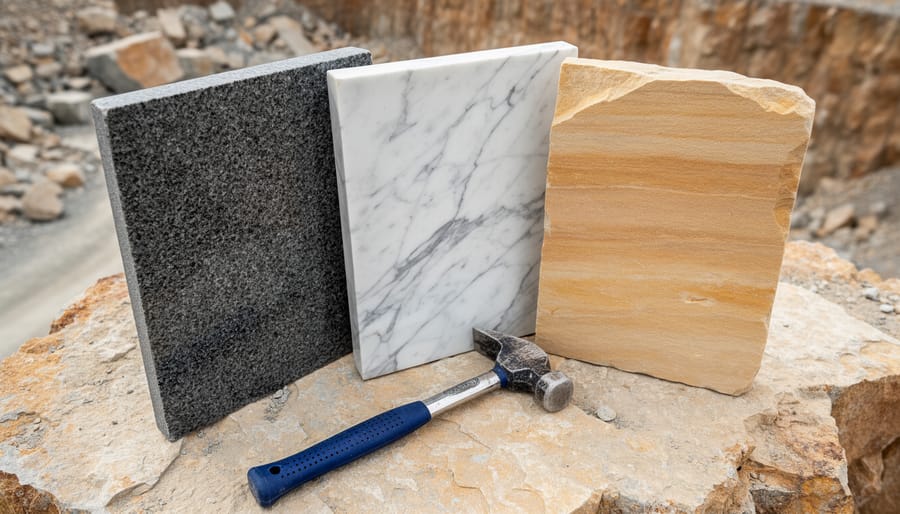
Geological deposits form the foundation of every natural stone surface in your home, workspace, or public building. Understanding these deposits transforms stone selection from aesthetic guesswork into informed decision-making based on millions of years of Earth’s processes.
Every granite countertop, marble floor, and limestone facade originates from specific geological events—volcanic eruptions that crystallized into igneous rock, ancient seabeds compressed into sedimentary layers, or existing rocks transformed under intense heat and pressure into metamorphic stone. These formation processes directly determine the durability, porosity, color consistency, and maintenance requirements of the stone you ultimately install.
Regional geological conditions create distinct stone characteristics. Italian Carrara marble’s pristine white appearance results from metamorphosed limestone in the Apuan Alps, while Brazilian granite’s dramatic patterns emerge from slow-cooling magma chambers deep beneath the earth’s surface. Indian sandstone’s warm, earthy tones reflect desert sediment compression over millennia. Recognizing these geological origins helps predict how stone will perform in specific applications—whether it can withstand freeze-thaw cycles, resist acidic substances, or maintain its appearance in high-traffic areas.
This knowledge empowers practical decisions. Designers specify appropriate stone types for climate conditions, homeowners select surfaces matching their lifestyle demands, and industry professionals source materials that deliver long-term value. Geological literacy bridges the gap between a stone’s ancient formation and its modern application, ensuring selections that satisfy both aesthetic vision and functional requirements for decades to come.
The Three Rock Families Behind Your Natural Stone
Igneous Stones: Born from Molten Rock
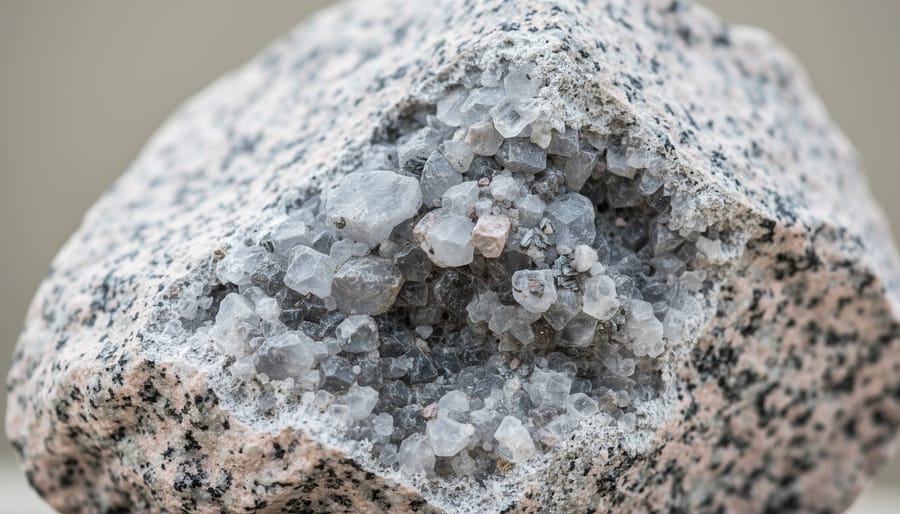
Igneous stones form through the crystallization of molten rock, creating some of the most durable and visually distinctive building materials available. When magma from deep within the Earth’s mantle slowly cools beneath the surface, minerals have time to organize into interlocking crystals, producing what geologists call intrusive igneous rocks. Granite exemplifies this process perfectly—its characteristic speckled appearance results from visible crystals of quartz, feldspar, and mica that grew as the magma cooled over thousands of years.
The cooling rate directly influences the stone’s final characteristics. Slower cooling creates larger, more visible crystals, while rapid cooling produces finer-grained stones. This crystalline structure gives granite its exceptional strength and resistance to weathering, making it ideal for countertops, flooring, and exterior cladding. Other popular igneous stones include basalt, formed from faster-cooling lava, and gabbro, granite’s darker cousin.
The interlocking crystal structure also explains why igneous stones polish so beautifully—light reflects off the various mineral surfaces, creating depth and movement. Understanding this formation process helps designers and consumers appreciate why igneous stones command premium prices and perform exceptionally well in high-traffic applications.
Sedimentary Stones: Layers of Ancient History
Sedimentary stones form through one of nature’s most patient processes: the gradual accumulation and compression of sediments over millions of years. As layers of organic material, mineral fragments, and calcium carbonate settle at the bottom of ancient seas, lakes, and riverbeds, they compact under immense pressure, eventually transforming into solid stone.
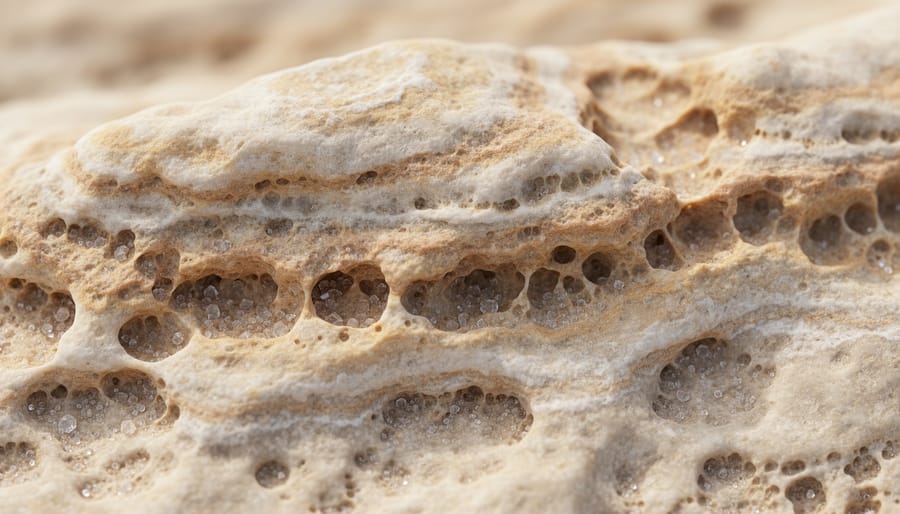
Limestone develops primarily from marine organisms like coral and shells, whose calcium-rich remains accumulate on ocean floors. Over time, these deposits cement together, creating a dense, workable stone prized for its versatility in construction and design. Travertine forms through a similar but faster process, as calcium carbonate precipitates from mineral-rich hot springs and creates distinctive porous layers with unique banding patterns. Sandstone results from the compression of sand particles, typically quartz, bound together by natural minerals that act as cement.
The signature layered appearance of sedimentary stones tells the story of their formation. Each visible stratum represents a distinct period of deposition, creating beautiful striations and color variations that make these materials particularly appealing for architectural applications. These layers also influence how the stone splits and cuts, affecting both its structural properties and aesthetic potential. Understanding this formation process helps designers and consumers select appropriate stones for specific projects, ensuring both visual appeal and functional performance.
Metamorphic Stones: Transformed by Heat and Pressure
Metamorphic stones represent nature’s ultimate transformation, created when existing rocks are subjected to intense heat and pressure deep within the Earth’s crust. Unlike igneous or sedimentary stones, these materials begin as one rock type and are fundamentally altered by geological forces, resulting in entirely new characteristics and striking visual features.
Marble forms when limestone or dolomite undergoes metamorphism, typically at temperatures between 1,400 and 1,600 degrees Fahrenheit. This process recrystallizes the calcium carbonate, creating the smooth texture and distinctive veining that makes marble prized for elegant countertops and sculptures. The colorful patterns and swirls result from mineral impurities present during transformation.
Slate develops from shale or mudstone compressed under tremendous pressure, creating its characteristic ability to split into thin, flat layers. This cleavage property makes slate ideal for roofing, flooring, and wall cladding.
Quartzite emerges when sandstone rich in quartz undergoes metamorphism, fusing the sand grains into an incredibly dense, durable stone. The result is harder than granite and highly resistant to etching and staining, making it increasingly popular for high-performance countertops.
The unique veining, color variations, and patterns in metamorphic stones tell the story of their geological journey, with each slab offering one-of-a-kind visual characteristics that cannot be replicated in manufactured materials.
What Makes a Stone Deposit Worth Quarrying
Deposit Size and Consistency
The size and uniformity of geological deposits directly determine whether a quarry can produce the consistent, large-format slabs demanded by modern construction and design projects. Extensive deposits formed under stable geological conditions over millions of years yield stone with minimal variation in color, veining, and structural integrity. These large-scale formations allow quarriers to extract substantial blocks that can be cut into matching slabs, essential for book-matching designs and maintaining visual continuity across expansive installations like hotel lobbies, commercial facades, and open-plan residential spaces.
Conversely, smaller or inconsistent deposits often produce stone with unpredictable characteristics, making it difficult to fulfill large orders with uniform appearance. This is why deposit quality standards play such a crucial role in commercial viability. Quarries operating in substantial, geologically stable deposits can maintain reliable inventory and consistent quality over decades, providing architects and designers with the confidence that specified materials will match from project inception through completion, even when additional stone is needed years later.
Geological Purity and Structural Integrity
The mineral composition and structural characteristics of stone directly determine its suitability for specific applications. Pure deposits with consistent mineral structures produce higher-grade stone with predictable performance characteristics, while impurities or structural weaknesses can limit functionality and aesthetic appeal.
Mineral purity affects both appearance and durability. Marble formed from relatively pure limestone deposits exhibits uniform color and fine grain structure, making it ideal for sculptural work and high-end interior applications. Conversely, deposits with mineral inclusions may display unique veining patterns that some designers prize, though these can also indicate potential weak points.
Structural integrity stems from the geological conditions during formation. Stones formed under consistent pressure and temperature develop tight crystalline bonds, resulting in superior strength and weather resistance. Natural fissures, bedding planes, or micro-fractures within deposits compromise structural soundness and affect block grading quality during extraction.
Understanding these geological factors helps professionals select appropriate stone for specific projects. Exterior cladding demands high structural integrity and low porosity, while interior decorative applications may prioritize aesthetic qualities over maximum durability. By evaluating mineral composition and structural characteristics, architects and designers can match stone properties to performance requirements, ensuring both beauty and longevity in their projects.
Accessibility and Extraction Feasibility
Not all geological deposits are created equal when it comes to commercial viability. The accessibility of a stone deposit plays a crucial role in determining whether it can be economically quarried and brought to market.
Location is the first consideration. Deposits situated near existing infrastructure, transportation routes, and processing facilities significantly reduce extraction costs. Remote locations require substantial investment in road construction, equipment transport, and worker accommodations, which can make even high-quality stone deposits economically unfeasible.
Depth matters considerably. Surface or near-surface deposits allow for open-pit quarrying, which is far less expensive than underground mining. Stones buried beneath hundreds of feet of overburden require extensive excavation before reaching the valuable material, dramatically increasing costs. The deeper the deposit, the more expensive the extraction becomes.
The surrounding geology also influences feasibility. Deposits with minimal fracturing and consistent composition yield larger, more usable blocks. Conversely, heavily fractured formations or those interspersed with unwanted materials require more selective extraction, increasing waste and labor costs. Water table levels, soil stability, and the presence of other minerals all factor into the complexity and expense of quarrying operations.
These accessibility factors ultimately influence the final price consumers pay for natural stone, making location and extraction conditions as important as the stone’s inherent beauty and durability.
Famous Stone Deposits Around the World
Carrara, Italy: The Gold Standard for Marble
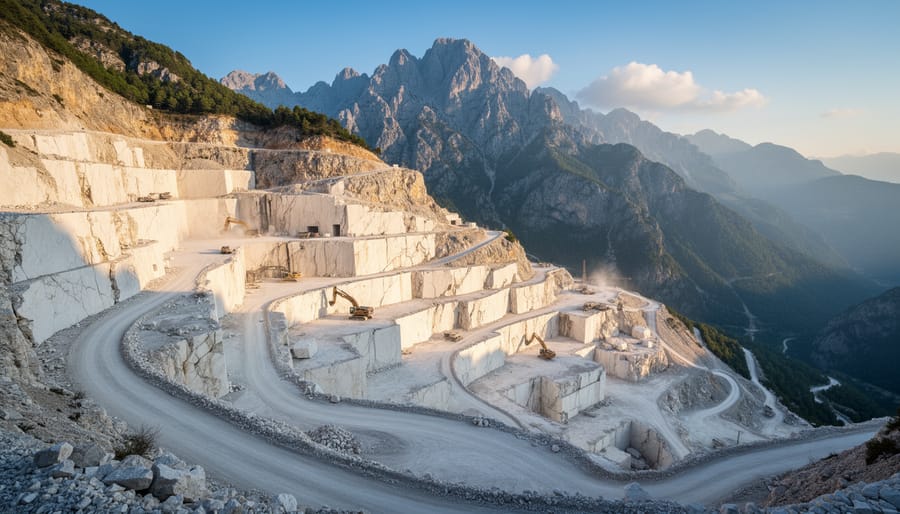
The Apuan Alps of northwestern Tuscany harbor one of the world’s most renowned geological treasures. Formed during the Alpine orogeny approximately 30 million years ago, these metamorphic deposits transformed ancient limestone into the pristine white marble that has defined architectural excellence for over two millennia. The intense heat and pressure from tectonic collisions recrystallized the carbonate minerals, creating the distinctive pure white to blue-gray stone with minimal veining that Carrara is famous for.
Roman emperors prized this marble for its fine grain structure and workability, using it for monuments like the Pantheon and Trajan’s Column. The geological conditions produced a remarkably uniform composition with exceptional compressive strength and translucency, qualities that remain unmatched today. The region’s complex folding created multiple quarry zones, each with subtle variations in color and pattern. Modern extraction methods combined with authentic stone sourcing verification ensure that today’s Carrara marble maintains the same geological integrity that made it the standard against which all other marbles are measured, continuing a legacy that bridges ancient craftsmanship with contemporary design applications.
Vermont and Georgia: America’s Marble Belt
The “Marble Belt” stretching from Vermont through western New England to Georgia represents one of North America’s most significant marble deposits, formed during intense metamorphic events over 400 million years ago. When ancient limestone beds were subjected to extreme heat and pressure during continental collisions, the calcium carbonate recrystallized into the marble prized today for its durability and aesthetic appeal.
Vermont’s Danby quarries produce exceptionally pure white marble with minimal veining, while Georgia’s Tate region yields marble with distinctive gray and pink variations. These differences stem from the presence of trace minerals during metamorphism—iron oxides create warm tones, while graphite produces gray streaking. The metamorphic intensity also determines hardness and density, with higher-grade metamorphism producing denser, more durable stone ideal for high-traffic applications.
Understanding these regional characteristics helps designers select appropriate marble for specific projects, whether specifying pure Vermont white for elegant interiors or choosing Georgia’s subtly colored varieties for exterior facades requiring greater weather resistance.
Brazil and India: Granite Powerhouses
Brazil and India dominate global granite production, thanks to their ancient geological foundations. Both countries sit atop massive Precambrian shield regions—areas of crystalline rock that formed over 500 million years ago through intense heat and pressure deep within the Earth’s crust.
Brazil’s granite deposits span vast areas of its interior, particularly in the states of Espírito Santo, Bahia, and Minas Gerais. These regions yield an extraordinary variety of granite colors and patterns, from the popular Giallo Ornamental to exotic blues and blacks. The country’s geological diversity stems from multiple tectonic events that created distinct mineral compositions across different zones.
India’s granite belt extends across southern states like Karnataka, Andhra Pradesh, and Tamil Nadu. The ancient Dharwar Craton, one of Earth’s oldest rock formations, produces durable granites prized for their uniform structure and polished finish. Indian granites, including popular varieties like Absolute Black and Kashmir White, have become staples in construction and design projects worldwide. These shield regions continue producing the majority of granite used in residential and commercial applications globally.
Turkey and Iran: Travertine Treasures
Turkey and Iran contain some of the world’s most spectacular travertine formations, created through ongoing hydrothermal and spring activity. In these regions, carbon dioxide-rich groundwater dissolves limestone deep underground, then rises to the surface through fissures and faults. As this mineral-saturated water emerges at hot springs, the drop in pressure and temperature causes calcium carbonate to precipitate rapidly, forming travertine deposits.
The famous terraces at Pamukkale, Turkey, exemplify this process beautifully. Here, thermal springs at 95°F continuously deposit layers of creamy white and honey-toned travertine, creating cascading pools that have built up over millennia. Iranian deposits near Mashhad and western regions follow similar formation patterns, though variations in mineral content and water temperature produce distinctive color ranges from ivory to rich walnut tones. The constant water flow in these active spring systems creates the characteristic porous texture and banded patterns that make travertine so desirable for architectural applications, from flooring to wall cladding.
Spain and Portugal: Premium Limestone Sources
The Iberian Peninsula stands as one of Europe’s premier sources of high-quality limestone, with deposits formed over 150 million years ago when ancient seas covered the region. As marine organisms accumulated on the seafloor and underwent compression over millennia, they created the dense, durable limestone now quarried throughout Spain and Portugal.
Spanish limestone, particularly from regions like Alicante and Valencia, exhibits exceptional uniformity and minimal veining, making it ideal for contemporary architecture and interior design. Portuguese limestone from areas near Lisbon offers a warmer, cream-toned aesthetic with subtle fossil inclusions that add character to residential and commercial projects.
These Mediterranean deposits benefit from their marine origins, resulting in stone with superior workability and weather resistance. The fine-grained structure allows for precise cutting and polishing, while the natural density ensures longevity in both interior flooring and exterior facades. Modern quarrying techniques in these regions maintain sustainable practices while delivering consistent quality that meets international construction standards, making Iberian limestone a trusted choice for projects ranging from minimalist home designs to landmark public buildings.
How Regional Geology Affects Your Stone Selection
Reading the Story in Stone Patterns
Natural stone tells its formation story through visible patterns that both captivate the eye and inform performance expectations. Veining patterns reveal the intensity and direction of geological forces during formation. Dramatic, sweeping veins in marble indicate metamorphic pressure that created dense, durable stone, while subtle, uniform veining suggests gentler formation conditions. These patterns aren’t merely decorative—they map the internal structure that influences how the stone will split, polish, and wear over time.
Color variations provide clues about mineral composition and environmental conditions during formation. Rich greens in serpentine indicate magnesium-rich environments, while warm rust tones signal iron oxide presence. These minerals directly affect durability, stain resistance, and maintenance requirements. Granite with consistent color distribution throughout typically offers more predictable performance than highly variegated specimens.
Texture reveals crystalline structure and formation speed. Fine-grained limestone formed from gradual sediment accumulation offers uniform density, while coarse-grained granite with visible crystals cooled slowly deep underground, creating exceptional hardness. Understanding these visual indicators helps predict how stone will perform in specific applications, from high-traffic flooring to delicate countertops, ensuring selections match both aesthetic vision and functional demands.
Matching Stone Origin to Application Needs
Understanding the geological origin of stone is essential for selecting materials that will perform optimally in specific applications. Stones formed under particular conditions possess characteristics that make them naturally suited to certain environments.
Granite, created through slow cooling deep within the earth’s crust, develops exceptional density and low porosity. These geological properties make it highly resistant to heat, scratches, and moisture absorption, explaining why granite from igneous deposits excels in kitchen countertops where durability is paramount. Similarly, its resistance to freeze-thaw cycles makes it ideal for exterior cladding in cold climates.
Marble, formed through metamorphism of limestone under intense heat and pressure, offers elegance but requires careful placement. Its geological composition makes it more susceptible to acid etching, so it performs better in bathrooms and decorative applications rather than high-traffic kitchens where acidic substances are common.
Limestone and travertine, sedimentary stones formed in ancient marine environments, exhibit natural porosity that requires sealing. They work beautifully in climate-controlled interiors but need protective treatments for outdoor use or wet areas.
By matching a stone’s geological properties to the demands of your specific application, you ensure longevity, maintain appearance, and avoid costly replacements or repairs.

Sustainability and Local Deposits
Choosing stone from regional geological deposits offers significant environmental and economic advantages that extend beyond the finished product. Transportation represents one of the largest contributors to the carbon footprint of natural stone, so sourcing materials closer to your project site dramatically reduces fuel consumption and emissions. When you select locally quarried stone, you’re minimizing the environmental impact associated with long-distance shipping while often reducing project costs.
Supporting regional quarries also strengthens local economies and preserves traditional stone-working skills within communities. These quarries typically employ local workers and contribute to the economic vitality of their regions. Additionally, many regional operations demonstrate strong commitments to sustainable quarrying practices, including land rehabilitation and water conservation measures.
Regional stone also offers practical benefits for architects and designers. Proximity to the source allows for easier site visits to select materials and ensures better communication with quarry operators regarding specific project requirements. Furthermore, using stone native to your region creates architectural harmony with the local landscape and geological heritage, resulting in designs that feel authentically connected to their environment.
Understanding the geological forces that shaped natural stone over millions of years provides invaluable insight for anyone selecting materials for their next project. Every slab tells a story of Earth’s dynamic history—from ancient seabeds compressed into limestone, to volcanic eruptions creating granite, to metamorphic transformations producing marble. This knowledge transforms stone selection from a purely aesthetic choice into an informed decision grounded in science.
When you appreciate that the marble in your kitchen originated as limestone deposited 200 million years ago, then subjected to intense heat and pressure deep within Earth’s crust, you gain a deeper respect for the material itself. The veining patterns that make each slab unique aren’t just decorative—they’re physical records of mineral-rich fluids flowing through fractures during metamorphism. The durability differences between stone types make perfect sense once you understand the conditions that formed them.
This geological perspective also helps you ask better questions. Rather than simply choosing based on color and pattern, you can inquire about a stone’s mineral composition, formation environment, and regional characteristics. Where was it quarried? What geological processes created its distinctive features? How do these factors affect its performance in your intended application?
Don’t hesitate to engage your suppliers in conversations about stone origins. Reputable providers appreciate clients who value the geological story behind their materials and can offer detailed information about formation history and quarry locations. This transparency ensures authenticity and helps you select stone whose natural properties align with your project requirements.
Natural stone represents one of Earth’s most remarkable products—a building material literally forged over geological timescales. By understanding the deposits that yield these materials, you make choices that honor both the stone’s inherent qualities and the ancient processes that created them. This knowledge transforms natural stone from a simple construction material into a meaningful connection with our planet’s deep history.


