Stone restoration projects fail most often not from poor craftsmanship, but from cost estimation blind spots that emerge weeks into the work. Traditional 2D blueprints and spreadsheet budgets cannot account for the stone-specific variables that separate accurate bids from budget disasters—hidden deterioration beneath surfaces, volumetric calculations for specialty materials, and the timeline dependencies that cascade through multi-phase heritage projects.
5D cost estimation transforms this landscape by integrating three spatial dimensions with schedule and cost data into a single, dynamic model. When applied to stone restoration, this approach captures what conventional methods miss: the exact cubic footage of deteriorated limestone requiring replacement, the sequencing costs of scaffolding around ornamental details, and real-time budget adjustments as conditions reveal themselves during careful restoration work.
Unlike general construction applications, stone restoration demands estimation methods that respect material uniqueness. No two marble panels weather identically; sandstone degradation follows patterns invisible to standard measurements. 5D estimation built on 3D digital models allows restoration teams to quantify these variables before committing resources, linking every square foot of deteriorated facade to specific material costs, labor hours, and project milestones.
For property owners managing historic buildings, this methodology means predictable budgets without sacrificing craftsmanship quality. Architects gain confidence specifying authentic restoration approaches rather than cheaper alternatives driven by estimation uncertainty. Restoration contractors can bid competitively while protecting profit margins, knowing their numbers reflect actual project complexity.
The following guide explains how 5D cost estimation functions specifically for stone projects, demonstrates its tangible benefits through documented case studies, and provides practical steps for implementation regardless of project scale.
What Is 5D Cost Estimation in Stone Restoration?
The Evolution from 2D Drawings to 5D Models
Stone restoration estimation has undergone a remarkable transformation over the past few decades. Traditionally, estimators relied on manual measurements, hand-drawn sketches, and visual assessments to calculate project costs. Craftsmen would physically measure damaged areas with tape measures and calipers, photograph deterioration patterns, and produce 2D drawings that captured only width and height. This labor-intensive approach often missed critical details, particularly on complex architectural elements or hard-to-reach areas.
The introduction of digital photography and CAD software in the 1990s marked the first significant shift, allowing professionals to create more precise 2D technical drawings. However, these methods still required substantial time on-site and left room for measurement errors that could lead to costly project overruns.
The leap to 3D modeling brought spatial depth into the equation, enabling estimators to understand volume and surface area more accurately. Laser scanning technology revolutionized data collection, capturing millions of data points in minutes to create detailed point clouds of stone facades, monuments, and architectural elements.
Today’s 5D estimation integrates these 3D models with two additional critical dimensions: cost and time. This comprehensive approach combines laser scanning accuracy with real-time cost databases and project scheduling tools. For stone restoration, this means capturing the exact condition of deteriorated limestone, calculating precise material quantities needed for repair, and generating accurate budgets while projecting realistic completion timelines—all from a single integrated digital model.
How Digital Documentation Captures Stone Conditions for Cost Analysis
Quantifying Stone Deterioration Digitally
Traditional methods of assessing stone deterioration rely heavily on visual inspection and manual measurements, which can miss subtle damage and produce inconsistent results. Digital 3D modeling transforms this process by capturing stone surfaces with millimeter-level precision, creating detailed baseline records that reveal the true extent of damage.
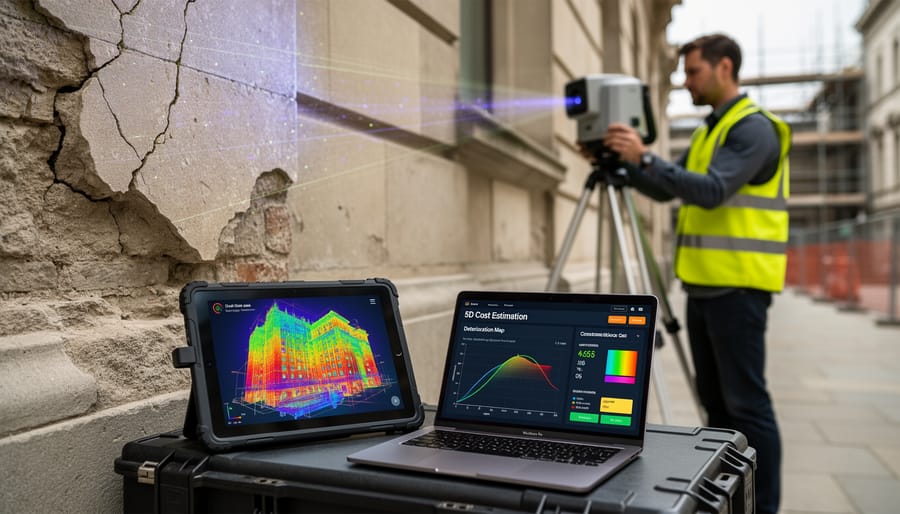
Advanced laser scanning and photogrammetry technologies generate point clouds containing millions of data points, each representing a specific location on the stone surface. By comparing scans taken over time or against original architectural drawings, restoration professionals can quantify exactly how much material has been lost through weathering, spalling, or erosion. This data produces accurate volume calculations essential for ordering replacement stone or repair materials.
The technology excels at measuring crack propagation by tracking width, depth, and length with remarkable accuracy. Digital models can identify hairline fractures invisible to the naked eye and monitor how existing cracks expand over time. This information proves invaluable for determining whether stabilization, consolidation, or replacement is necessary.
Surface mapping also reveals areas of material degradation where stone has softened or become friable without obvious visual changes. These digital deterioration maps guide material quantity calculations by identifying zones requiring different treatment approaches, from light cleaning to complete replacement. The precision eliminates guesswork from estimates, ensuring project budgets reflect actual conditions rather than conservative approximations that often inflate costs or underestimate needs.
Breaking Down the Cost Components in 5D Stone Restoration Models
Material Costs: From Stone Replacement to Consolidants
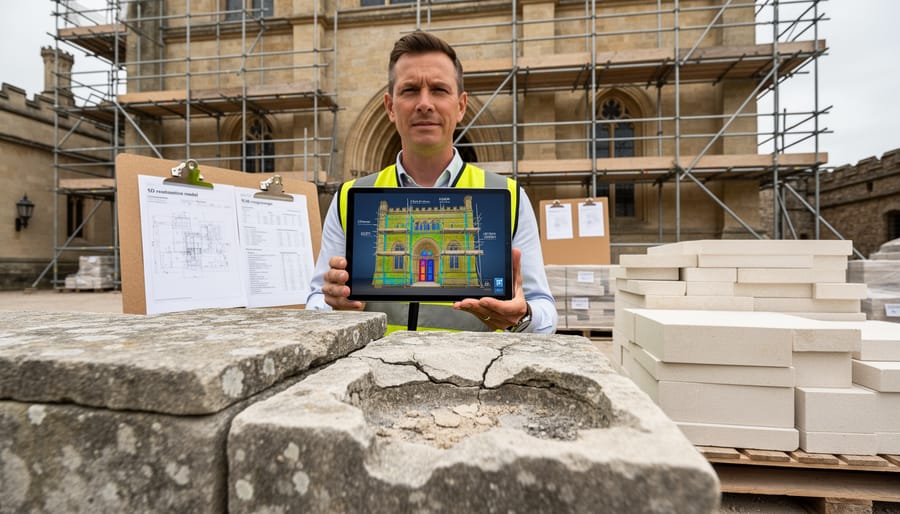
The precision of 3D models transforms material estimation from educated guesswork into exact science. When a 5D system scans damaged stonework, it captures precise measurements of every crack, spall, and deteriorated area. This data directly calculates required quantities for each intervention type.
For replacement stone, the system measures void volumes down to the cubic inch, accounting for irregular shapes that manual measurements might miss. This prevents over-ordering expensive stone varieties or discovering mid-project shortages. The model factors in cutting waste based on block dimensions and grain direction requirements.
Mortar calculations consider joint depths and widths across entire façades, differentiating between repointing needs and total joint replacement. The system tracks different mortar specifications required for various stone types and exposure conditions within a single building.
Consolidant requirements prove particularly challenging to estimate manually, as penetration depths vary by stone porosity and decay severity. 5D models use condition mapping overlaid on measured surface areas to calculate realistic volumes, preventing costly material waste or inadequate treatment coverage.
Cleaning material estimates incorporate surface area calculations, stone type specifications, and soiling severity assessments. The system accounts for different consumption rates between methods like chemical cleaning, steam cleaning, or laser ablation, ensuring accurate budgeting for the specified approach.
Labor Cost Integration
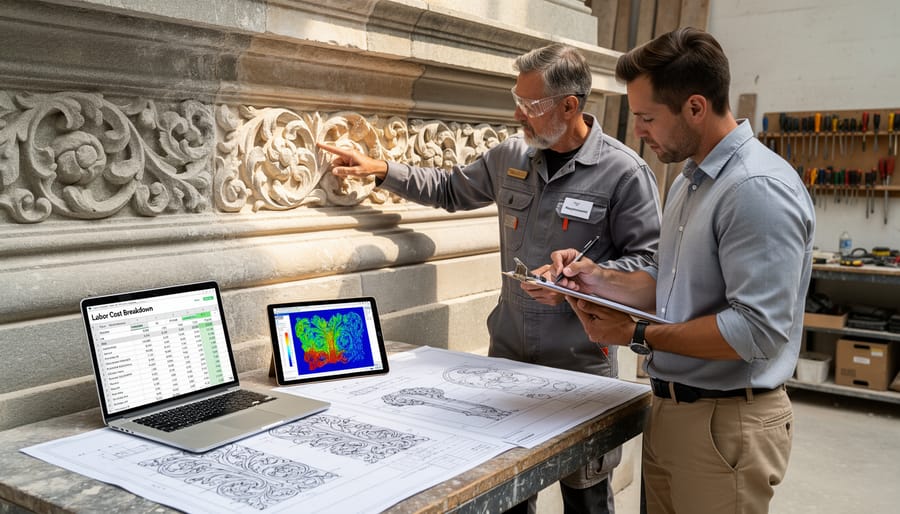
Labor costs represent a significant portion of stone restoration budgets, typically accounting for 60-70% of total project expenses. In 5D cost estimation, each restoration techniques receives specific labor hour allocations based on surface area calculations and complexity factors extracted from the 3D model.
The system assigns baseline labor rates for standard operations: carving intricate details might require 8-12 hours per square foot, while chemical cleaning averages 0.5-1 hour per square foot, and repointing mortar joints falls between 2-4 hours per square foot. These rates adjust automatically based on accessibility scores, with scaffolding requirements or confined spaces adding 15-30% to base estimates.
Surface complexity analysis further refines calculations. The model evaluates ornamental features, deterioration severity, and material hardness, applying multipliers to baseline hours. A heavily weathered Corinthian capital, for instance, receives higher labor allocation than a simple flat surface. This granular approach connects physical restoration challenges directly to workforce planning and budget forecasting, eliminating guesswork from traditional estimation methods while providing justifiable cost breakdowns for client presentations.
Equipment and Scaffolding Expenses
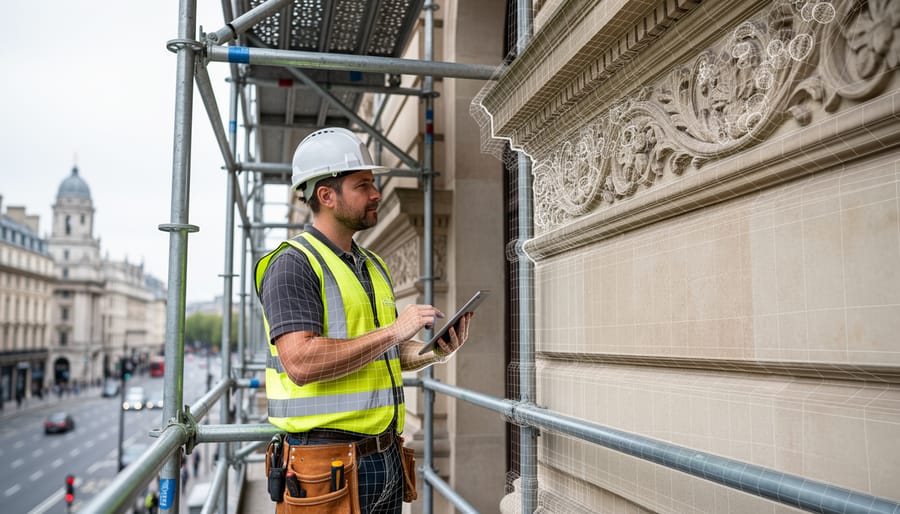
The 3D model in 5D cost estimation revolutionizes how restoration teams calculate equipment expenses by analyzing building geometry and access constraints. Traditional methods often underestimate scaffolding needs or overlook site-specific challenges, leading to budget overruns. With a detailed digital model, estimators can precisely measure facade areas requiring coverage, identify optimal scaffold placement points, and calculate exact linear footage needed. The software analyzes building height, setbacks, and architectural features to determine whether standard scaffolding suffices or if suspended platforms and specialized lifts are necessary. For stone restoration projects involving ornate cornices or intricate stonework at varying elevations, the model reveals access limitations that dictate equipment selection. This includes determining crane requirements for material hoisting, boom lift specifications for detailed inspection work, and safety equipment quantities. The geometry-based approach also accounts for ground conditions and staging areas, ensuring rental durations reflect actual project phasing rather than rough estimates. By visualizing equipment deployment throughout the project timeline, teams avoid costly idle time and schedule conflicts, while property managers gain transparency into why certain equipment investments are essential for safe, efficient stone restoration work.
Time Scheduling and Its Impact on Costs
The fifth dimension in 5D cost estimation incorporates time as a critical cost factor. Unlike traditional methods that treat time as a separate consideration, 5D modeling integrates project phasing and duration directly into cost calculations. For stone restoration projects, this temporal element significantly impacts expenses through several factors.
Weather conditions play a substantial role in natural stone work. Cold temperatures can prevent proper mortar curing, while excessive moisture compromises cleaning processes. The 5D model accounts for seasonal constraints, adjusting timelines and associated costs accordingly. Winter work often requires temporary enclosures and heating, directly increasing expenses that the model captures in real-time.
Site logistics also evolve throughout project phases. Early demolition stages require different equipment and access arrangements than later restoration phases. The 5D approach tracks these changing requirements, calculating how extended timelines affect scaffolding rentals, equipment costs, and labor allocation. This dynamic modeling reveals the true cost impact of project delays or accelerated schedules, enabling informed decision-making for property owners and restoration teams.
Real Benefits: Why 5D Estimation Matters for Stone Restoration Stakeholders
For Property Owners and Building Managers
For property owners and building managers overseeing historic or high-value properties, 5D cost estimation transforms financial planning for stone restoration projects. Traditional estimation methods often require padding budgets with 15-25% contingencies to cover unexpected discoveries during restoration work. With 5D estimation, you can reduce these contingency reserves significantly because the detailed modeling identifies potential issues before work begins. This means your capital allocation is more accurate from the start, making it easier to secure appropriate financing and justify expenditures to stakeholders or boards.
The time-phased cost projections help you understand exactly when funds will be needed throughout the project lifecycle, allowing for better cash flow management and coordination with other building operations. You’ll receive clear visualizations showing how different restoration approaches impact both immediate costs and long-term maintenance expenses, enabling truly informed decision-making. Perhaps most valuably, 5D estimation dramatically reduces those costly mid-project surprises that can derail budgets and timelines. When restoration contractors discover hidden deterioration or structural complications, you’ll already have accounted for these possibilities in your financial planning, protecting your project from budget overruns and the difficult conversations they create with ownership or investment committees.
For Architects and Restoration Designers
For architects and restoration designers, 5D cost estimation transforms the design process from educated guesswork into data-driven decision-making. This technology allows you to test multiple restoration scenarios virtually before committing to a final approach. Want to compare the cost difference between repairing deteriorated limestone versus selective replacement? You can model both options in the 5D environment and instantly see how each choice affects your project timeline and budget.
The real-time cost feedback proves invaluable during client presentations. Instead of saying “we’ll get back to you on that,” you can adjust design parameters on the spot and show clients exactly how different material selections or restoration techniques impact their investment. This transparency builds trust and accelerates approval processes.
The system also helps you identify potential value engineering opportunities early in the design phase. By visualizing how costs accumulate across different building elements and timeframes, you can strategically phase restoration work to align with client budgets without compromising the project’s architectural integrity. This capability is particularly valuable for historic properties where maintaining authentic character while managing costs requires careful planning and precise material specifications.
For Contractors and Craftspeople
For contractors and craftspeople working with natural stone, 5D cost estimation transforms project management from reactive problem-solving to proactive planning. This technology enables precise material ordering by calculating exact quantities of stone, mortar, sealants, and finishing products needed for each project phase. You’ll reduce waste significantly—often by 15-20%—when you know precisely how much material each restoration area requires before making purchases.
The time-sequencing component helps you organize crew assignments more efficiently, identifying which tasks can run concurrently and which must follow specific sequences. This prevents costly downtime and ensures you’re not paying workers to wait for materials or previous phases to complete. The detailed documentation generated by 5D estimation also serves as powerful protection against scope creep and payment disputes. When clients question billing or request changes, you have comprehensive visual records showing exactly what was included in the original scope versus additional work. This clarity strengthens your professional reputation and reduces the time spent on dispute resolution, allowing you to focus on craftsmanship rather than paperwork.
Case Study: 5D Modeling in a Historic Stone Facade Restoration
The Westminster Heritage Building restoration project in downtown Boston provides a compelling illustration of how 5D cost estimation transforms stone facade work from guesswork into precision planning. This 1920s limestone and granite structure required comprehensive exterior restoration, involving approximately 12,000 square feet of stone repair and replacement.
Using traditional estimation methods, the initial project budget came in at $847,000 with a standard contingency of 15 percent added for unforeseen issues. The estimator spent three weeks conducting site visits, taking measurements, and manually calculating material quantities based on 2D drawings and photographs. The estimate assumed uniform stone deterioration and generic repair specifications across the facade.
When the project team implemented 5D modeling, the results revealed significant discrepancies. Using laser scanning technology and photogrammetry, they created a detailed digital twin of the building facade. This model integrated exact measurements of each deteriorated stone unit, precise documentation of crack patterns, and specific repair requirements for different elevation zones. The 5D approach linked these geometric details directly to cost databases containing current pricing for limestone blocks, granite repairs, specialized mortar mixes, and skilled mason labor rates.
The 5D model revealed the actual project cost would be $1,023,000, representing a 21 percent variance from the traditional estimate. More importantly, the 5D approach identified that the north facade required 40 percent more stone replacement than initially calculated due to freeze-thaw damage invisible from ground-level inspection. The detailed model also showed opportunities to reduce scaffolding costs by 12 percent through optimized staging sequences.
The project completed within 2 percent of the 5D estimate, compared to the industry average variance of 8-15 percent for traditional stone restoration estimates. Total estimation time increased to four weeks, but this investment eliminated three change orders that would have delayed completion by six weeks and added approximately $89,000 in costs.
The key lesson learned was that 5D modeling excels when stone conditions vary significantly across a structure. Projects with uniform stone deterioration may not justify the additional upfront investment, but complex historic facades with diverse repair needs benefit substantially from the granular analysis 5D provides.

Common Challenges and Limitations of 5D Cost Estimation
While 5D cost estimation offers significant advantages for stone restoration projects, it’s important to understand the challenges and limitations before committing to this technology.
The most immediate obstacle is the initial investment. Specialized software platforms, compatible hardware, and necessary training can require substantial upfront costs, typically ranging from several thousand to tens of thousands of dollars depending on the system’s capabilities. For smaller restoration firms working on modest projects, this investment may be difficult to justify, especially when traditional estimation methods have served them adequately.
The learning curve presents another considerable challenge. Team members need time to become proficient with new software systems, understand how to properly integrate scheduling data with cost information, and learn to interpret the generated reports accurately. During this transition period, productivity may temporarily decrease as staff adapt to new workflows. Most firms report requiring three to six months before seeing the full benefits of their 5D systems.
Data processing and model creation also demand significant time investment. Creating detailed digital models of existing stone structures, particularly historic buildings with complex architectural features, requires careful documentation and precise measurements. For straightforward projects like single-wall repairs or small monument restoration, the time spent building a 5D model might exceed the actual project duration, making traditional estimation more practical.
Additionally, 5D estimation relies heavily on accurate data input. Garbage in, garbage out applies here. If project specifications, material costs, or timeline estimates are incorrect, the sophisticated analysis becomes meaningless. Smaller projects with limited scope often don’t benefit from this level of detail and may be better served by experienced estimators using conventional methods.
Understanding these limitations helps restoration professionals make informed decisions about when 5D estimation genuinely adds value versus when simpler approaches remain appropriate for their specific project needs and business scale.
Getting Started: What Stone Restoration Projects Should Consider 5D Estimation?
Not every stone restoration project requires the investment in 5D cost estimation. Understanding when this technology makes the most sense will help you maximize value and avoid unnecessary expenses.
Generally, 5D modeling becomes cost-effective for projects exceeding $100,000 in estimated restoration work. At this threshold, the comprehensive planning and risk mitigation that 5D provides typically offset the additional upfront modeling costs. Projects involving historic buildings, multi-phase restoration schedules, or complex stone replacement work particularly benefit from the time-based visualization and scheduling components that distinguish 5D from traditional estimation methods.
Consider implementing 5D estimation when your project involves multiple stone types requiring different restoration approaches, when working within occupied buildings where timing matters critically, or when stakeholder coordination is complex. Projects with tight deadlines, strict budget constraints, or regulatory compliance requirements also justify the enhanced precision that 5D delivers.
When hiring restoration contractors who offer 5D estimation services, ask specific questions to ensure they provide genuine value. Start by requesting examples of previous 5D models they’ve created for similar stone restoration work. Ask which software platforms they use and how they integrate material costs, labor rates, and timeline data into their models. Determine whether they’ll provide interactive access to the model throughout the project or simply deliver static reports.
Critical questions include: How do you account for unforeseen conditions commonly discovered during stone restoration? What level of detail do your models include for material matching and sourcing timelines? How frequently will cost estimates be updated as the project progresses? Can you demonstrate how the model will help us make real-time decisions about scope changes or value engineering opportunities?
Request references from previous clients who used their 5D services specifically for stone work, not just general construction. The specialized knowledge required for historic stone restoration differs significantly from new construction, and your contractor’s 5D capabilities should reflect this expertise.
5D cost estimation represents a transformative advancement in how the stone restoration industry approaches project planning and financial management. By integrating time-sensitive cost data with detailed three-dimensional models, this methodology delivers unprecedented accuracy in predicting expenses and timelines for complex restoration work. The technology’s ability to identify potential issues before they escalate into costly problems makes it an invaluable tool for preserving our architectural heritage.
However impressive the technology may be, it ultimately serves a higher purpose: ensuring that historic stone structures can be preserved responsibly for future generations while managing limited conservation budgets effectively. The precision offered by 5D estimation means fewer budget overruns, reduced material waste, and better-informed decision-making throughout the restoration process. This translates directly to more projects being completed successfully and more heritage sites receiving the care they deserve.
Adoption of 5D cost estimation in stone restoration is accelerating across the industry. What was once considered cutting-edge technology accessible only to large firms is becoming increasingly mainstream as software becomes more user-friendly and affordable. Forward-thinking restoration professionals recognize that this approach is not merely optional but essential for remaining competitive in an industry where accuracy and accountability are paramount. As the technology continues to evolve and integrate with other digital tools, 5D estimation is poised to become the standard practice in stone restoration project management within the next decade.