Natural stone surfaces represent a significant investment in any residential or commercial space, yet most traditional sealers merely coat the surface, creating a barrier destined to wear, peel, or yellow over time. Penetrating sealers work differently. They migrate below the stone’s surface, bonding chemically with the material to create protection from within while maintaining the stone’s natural appearance and breathability.
This technology addresses the fundamental challenge in stone preservation: protecting against stains, moisture, and deterioration without compromising the aesthetic qualities that made natural stone desirable in the first place. Unlike topical coatings that sit on the surface and alter texture or create unwanted sheen, penetrating sealers become part of the stone’s structure. They fill microscopic pores and capillaries, blocking pathways for liquids and contaminants while allowing water vapor to escape, preventing the moisture entrapment that leads to efflorescence, freeze-thaw damage, and structural deterioration.
The distinction matters because different stone types present unique challenges. Dense granites require different sealer formulations than porous limestone or travertine. Polished marble in a kitchen faces different threats than honed slate in an outdoor installation. Understanding these variables determines whether your sealer performs for two years or twenty.
Recent advances in polymer chemistry have produced sealers with fluorochemical and siloxane technologies that outperform traditional silicone-based products, offering superior oil and water repellency with longer service life. For professionals specifying materials and homeowners protecting substantial investments, choosing the right penetrating sealer system and applying it correctly represents the difference between stone that ages gracefully and surfaces that require costly restoration or replacement within a few years.
Understanding Penetrating Sealers: How They Work Below the Surface
The Chemistry Behind Stone Penetration
Unlike topical coatings that sit on the surface, penetrating sealers work at the molecular level to protect natural stone from within. The secret lies in their chemistry: these sealers use specially formulated molecules that are small enough to enter the microscopic pores and capillaries that exist naturally in stone materials like granite, marble, limestone, and travertine.
The active ingredients in penetrating sealers are typically siloxane or silane-based compounds dissolved in a carrier solvent. When applied to stone, the solvent helps transport these tiny molecules deep into the porous structure. Think of it like water soaking into a sponge, except these molecules are engineered specifically to bond with the stone’s minerals.
Once inside the stone, a chemical reaction begins. As the carrier solvent evaporates, the sealer molecules cure and form a water-repellent barrier within the stone’s pores. This process, called polymerization, creates a hydrophobic zone that blocks water, oils, and other contaminants from penetrating while still allowing the stone to breathe. Water vapor can escape, preventing moisture from becoming trapped inside, which is essential for maintaining the stone’s structural integrity and preventing damage from freeze-thaw cycles.
The result is invisible protection that doesn’t alter the stone’s natural appearance or texture. Because the barrier exists below the surface rather than on top of it, the stone maintains its original color, finish, and tactile quality while gaining significant resistance to staining and moisture damage.
What Makes a Sealer ‘Penetrating’
Understanding what makes a sealer “penetrating” is fundamental to choosing the right protection for natural stone. Unlike surface coatings that create a film on top of the stone, penetrating sealers work by soaking into the stone’s porous structure, bonding chemically with the material below the surface.
The defining characteristic of penetrating sealers lies in their molecular composition. These products contain small particles, typically silicone, siloxane, or fluoropolymer compounds, that are small enough to enter the microscopic pores and capillaries within natural stone. Once inside, these molecules form a protective barrier that repels water, oils, and other contaminants while remaining invisible to the eye.
This subsurface protection offers a critical advantage: breathability. Because penetrating sealers don’t create a surface film, they allow moisture vapor to escape from within the stone. This vapor transmission is essential for preventing damage from trapped moisture, which can cause discoloration, efflorescence, and structural deterioration. Proper professional stone sealing techniques leverage this breathability to maintain the stone’s natural properties.
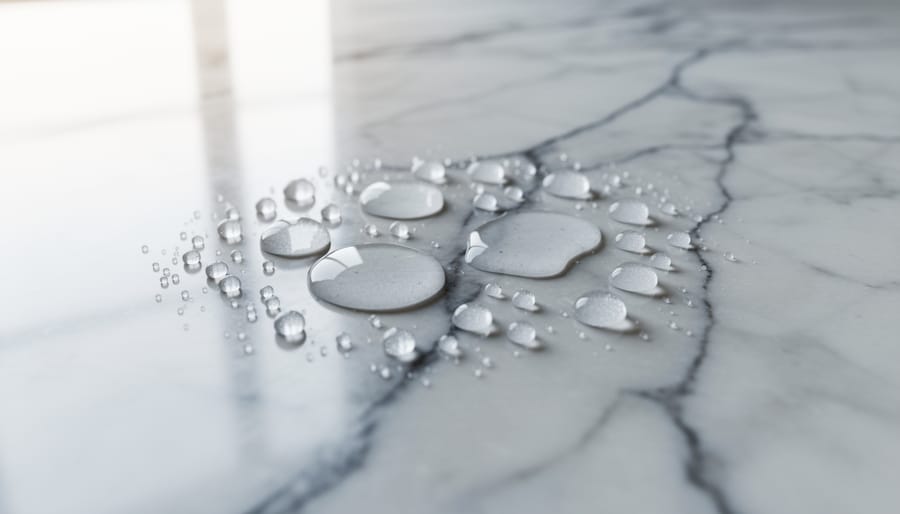
The interaction with porosity is another key distinguishing factor. Penetrating sealers actually fill the stone’s pores rather than covering them, creating hydrophobic or oleophobic properties from within. This means liquids bead up on the surface and can be easily wiped away before staining occurs, all while preserving the stone’s natural texture, appearance, and slip resistance. Unlike topical coatings that can wear away, peel, or yellow over time, penetrating sealers maintain their effectiveness longer because they’re protected within the stone itself.
The Innovation Factor: Modern Advances in Penetrating Sealer Technology
Nano-Technology in Stone Sealing
Nano-technology has revolutionized stone sealing by utilizing microscopic particles that are exponentially smaller than traditional sealer molecules. These nano-particles, typically measuring between 1-100 nanometers, can penetrate deeper into the stone’s microscopic capillary structure, creating protection at a molecular level that conventional sealers simply cannot achieve.
The key advantage of nano-particle sealers lies in their size-to-performance ratio. Because these particles are thousands of times smaller than the pores in natural stone, they travel deeper into the substrate, filling microscopic voids and forming protective bonds within the stone matrix rather than just near the surface. This deeper penetration translates to longer-lasting protection against water, oil, and staining agents while creating an invisible barrier that doesn’t alter the stone’s natural appearance.
Unlike film-forming sealers that create a surface coating, nano-technology maintains the stone’s essential breathability. The microscopic spacing between nano-particles allows water vapor to escape from within the stone, preventing moisture entrapment that can lead to efflorescence, spalling, or freeze-thaw damage. This breathability is particularly crucial for exterior applications and high-moisture environments like bathrooms and pool areas.
Modern nano-sealers also demonstrate superior resistance to UV degradation and chemical exposure compared to traditional penetrating sealers. The molecular bonding created by nano-particles provides protection that won’t wash away or degrade as quickly, extending the intervals between reapplication. For dense stones like granite or polished marble, nano-technology offers enhanced stain resistance without compromising the stone’s natural beauty or tactile qualities.
Water-Based vs. Solvent-Based Formulations
Modern penetrating sealers come in two primary formulations, each with distinct characteristics. Water-based sealers have gained significant popularity due to their low VOC content, making them environmentally friendly and safer for indoor applications. They emit minimal odor during application, dry quickly, and clean up easily with soap and water. These formulations work exceptionally well on most natural stone types and meet strict environmental regulations in commercial settings.
Traditional solvent-based sealers contain petroleum-based carriers that provide deeper penetration in certain dense stones like granite. They typically offer longer-lasting protection and perform better in extreme weather conditions. However, they release higher levels of volatile organic compounds, require adequate ventilation during application, and necessitate chemical solvents for cleanup.
Performance-wise, both formulations create effective moisture barriers when properly applied. Water-based options have advanced considerably, now matching solvent-based products in durability for most residential and commercial applications. The choice often depends on specific project requirements: water-based for interior spaces with ventilation concerns, and solvent-based for challenging outdoor environments or particularly dense stone materials. Many professionals now default to water-based formulations unless project conditions specifically demand solvent-based alternatives.
Oil and Stain Repellent Innovations
Modern penetrating sealers have evolved beyond simple water resistance to provide dual-action protection against both water-based and oil-based stains. These advanced formulations combine hydrophobic properties, which repel water and water-soluble contaminants, with oleophobic characteristics that resist oil, grease, and petroleum-based substances. This comprehensive approach addresses the full spectrum of potential staining agents that natural stone encounters in real-world applications, from kitchen spills and cosmetics to food oils and automotive fluids. The technology works by modifying the stone’s surface tension at a molecular level, causing liquids to bead up rather than penetrate the porous structure. This dual protection is particularly valuable for high-traffic areas and food preparation surfaces where various substances may come into contact with the stone, ensuring your investment remains pristine without altering its natural appearance or breathability.
Which Natural Stones Benefit Most from Penetrating Sealers
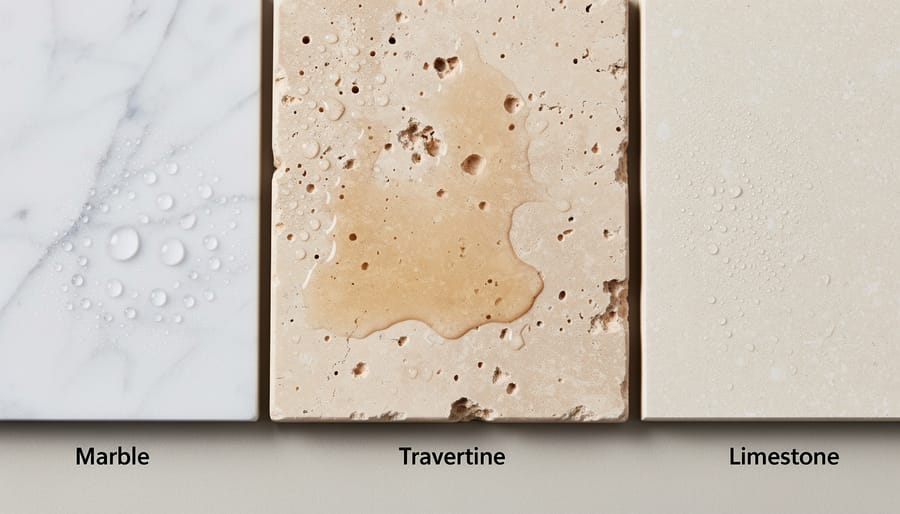
Porous Stones: Marble, Limestone, and Travertine
Marble, limestone, and travertine stand out as the most porous natural stones, making them excellent candidates for penetrating sealers. These calcium-based materials feature interconnected pore networks that readily absorb liquids, which means they’re vulnerable to staining from spills, moisture damage, and etching from acidic substances. Their high porosity, however, becomes an advantage when using penetrating sealers.
Unlike denser stones such as granite, these porous varieties allow penetrating sealers to sink deeply into their structure, creating comprehensive protection from within. The sealer molecules bond chemically with the stone matrix, filling microscopic voids while maintaining the material’s natural breathability. This is particularly crucial for natural stone bathroom floors and kitchen countertops where moisture exposure is constant.
The benefits are substantial: reduced water absorption, enhanced stain resistance, and protection against freeze-thaw damage in outdoor applications. Travertine, with its characteristic holes and cavities, especially benefits from penetrating sealers that can reach deep into its unique structure. Meanwhile, polished marble receives invisible protection that doesn’t alter its lustrous finish, and limestone gains durability without sacrificing its soft, natural appearance.
Granite and Dense Stones: When Penetration Matters
While granite and other dense stones like quartzite and compact marble feature low porosity that resists water absorption, penetrating sealers remain the preferred protective solution for several important reasons. These stones aren’t completely impervious—they contain microscopic pores that can still absorb liquids over time, particularly oils and acidic substances that penetrate more readily than water.
Penetrating sealers offer distinct advantages for dense stones compared to topical alternatives. They preserve the natural polished finish that makes these materials desirable, avoiding the plastic-like sheen or yellowing that surface coatings can create. In high-traffic commercial applications like hotel lobbies or restaurant countertops, penetrating sealers protect without compromising the stone’s durability or slip resistance.
The key is selecting formulations specifically designed for low-porosity materials. These advanced sealers use smaller molecular structures that can penetrate tight pore networks, typically requiring longer dwell times during application to ensure proper absorption. For honed or leathered granite finishes, which expose more surface area than polished varieties, penetrating sealers become even more critical. They provide invisible protection that maintains the stone’s natural texture while guarding against staining from kitchen oils, wine, and everyday use—protection that keeps these premium stones looking pristine for decades.
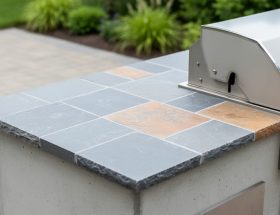
Outdoor Applications: Bluestone, Sandstone, and Slate
Outdoor natural stone installations face unique challenges that make penetrating sealers the ideal protective solution. Bluestone, sandstone, and slate are particularly vulnerable to freeze-thaw cycles, UV exposure, and moisture infiltration—conditions that topical sealers struggle to address effectively.
Penetrating sealers excel outdoors because they work beneath the surface, allowing stone to breathe while repelling water. This vapor permeability is critical for exterior applications, where trapped moisture can cause spalling, efflorescence, and structural damage during temperature fluctuations. Unlike film-forming products that peel and degrade under UV exposure, penetrating formulas maintain protection without visible wear.
Bluestone patios benefit from reduced staining and easier maintenance, while sandstone retains its natural texture without the slippery surface common with topical coatings. Slate walkways sealed with penetrating products resist water absorption that leads to flaking and delamination.
For maximum durability, choose penetrating sealers specifically formulated for exterior use, offering enhanced UV stability and deeper penetration. Application timing matters—seal during mild weather when stone is completely dry. This approach ensures long-lasting protection that preserves the authentic appearance of natural stone in demanding outdoor environments.
Application Techniques That Maximize Sealer Performance
Surface Preparation: The Foundation of Effective Sealing
Proper surface preparation is non-negotiable for penetrating sealer success. Unlike topical sealers that mask preparation flaws with surface coating, penetrating formulas require direct access to the stone’s porous structure to form molecular bonds deep within.
Begin by thoroughly cleaning the surface to remove dirt, oils, previous treatments, and efflorescence. Use pH-neutral cleaners specifically formulated for natural stone, as acidic or alkaline products can damage sensitive materials like marble or limestone. For new installations, including marble floor installation projects, ensure all grout haze and construction residues are completely removed.
Drying time is equally critical. Stone must be completely dry before sealer application, typically requiring 24-72 hours depending on porosity, humidity, and ambient temperature. Moisture trapped beneath the surface prevents sealer penetration and can cause hazing or discoloration.
Before full application, conduct an absorption test by applying water droplets to inconspicuous areas. Water should bead slightly on properly sealed stone but absorb within minutes on unsealed surfaces. Test the sealer on a small, hidden section first to verify color enhancement meets expectations and confirm compatibility with your specific stone type.
Application Methods: Spray, Brush, or Roller
Selecting the right application method ensures optimal sealer penetration and protection. Each technique offers distinct advantages depending on your project scope and stone characteristics.
Spray application delivers the fastest coverage for large areas like expansive patios, driveways, or commercial flooring. Using a pump sprayer or professional-grade equipment allows even distribution with minimal product waste. This method works exceptionally well on porous stones like limestone and sandstone, where the fine mist penetrates quickly into the surface. However, indoor applications require proper ventilation and masking of adjacent surfaces.
Brush application provides precision control for smaller projects, edges, and detailed stonework. Natural bristle or synthetic brushes work the sealer into grout lines and textured surfaces effectively. This hands-on approach suits countertops, backsplashes, and intricate architectural elements where targeted coverage matters most. Brushing also helps identify areas requiring additional coats as you work.
Roller application strikes a balance between speed and control, making it ideal for medium-sized projects like interior floors and shower walls. Lint-free microfiber rollers distribute sealer uniformly across smooth to moderately textured surfaces. This method minimizes airborne particles compared to spraying while covering more area than brushing alone.
For dense stones like granite, any method works well since penetration depends more on dwell time than application technique. Conversely, highly porous travertine benefits from spray or brush methods that encourage deeper absorption into the stone’s cavities.
Timing and Multiple Coats: Getting It Right
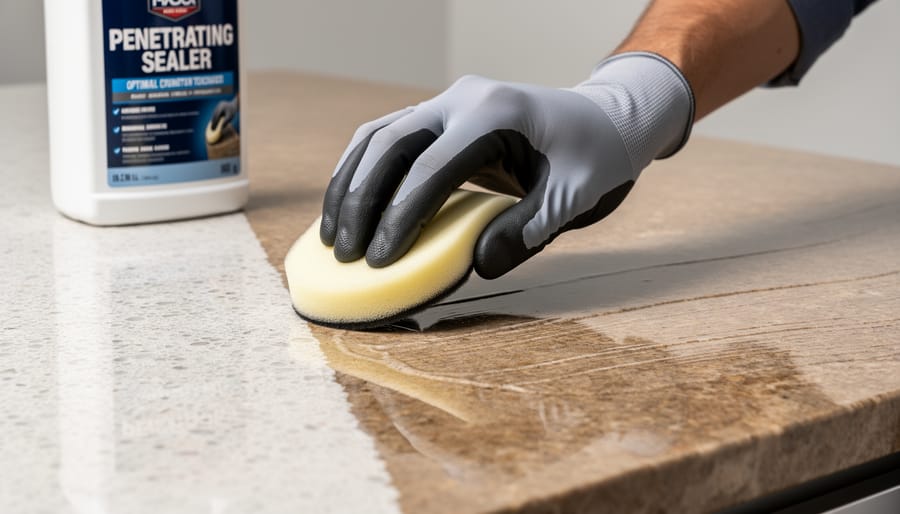
Proper timing between coats directly impacts sealer performance and longevity. After the initial application, wait 15-30 minutes before assessing whether a second coat is necessary. The stone’s appearance provides clear guidance: if the surface looks uniformly saturated with a slight sheen, one coat may suffice. However, if some areas appear dry or absorb the sealer rapidly, apply a second coat immediately to those sections.
Most natural stones require only one or two applications, though highly porous varieties like limestone or travertine may need additional coats. Apply subsequent coats while the previous layer remains wet to ensure proper penetration and bonding. If the surface has dried completely, you’ve waited too long between applications.
Curing time varies by product formulation and environmental conditions. Water-based penetrating sealers typically cure within 24-48 hours, while solvent-based products may require 72 hours or longer. During this period, protect the surface from moisture exposure and heavy traffic. Temperature and humidity significantly affect curing; optimal conditions range between 50-80 degrees Fahrenheit with moderate humidity. Allow at least 24 hours before light foot traffic and 72 hours before returning furniture or exposing the surface to water.
Common Application Mistakes to Avoid
The most common mistake is applying sealer to damp or recently cleaned stone. Always allow 24-48 hours of drying time, as moisture trapped beneath the sealer prevents proper penetration and bonding. Over-application is equally problematic—excess sealer creates a hazy surface film rather than penetrating deeply. Apply thin, even coats and remove any standing sealer within 5-10 minutes. Skipping the test application on a small, inconspicuous area can lead to unexpected discoloration or finish changes. Never use penetrating sealers on polished surfaces designed to remain glossy, as they may dull the finish. Finally, inadequate surface preparation—failing to remove stains, efflorescence, or old coatings—significantly compromises bonding and effectiveness.
Real-World Performance: Case Studies and Results
Residential Kitchen Countertops: A 5-Year Test
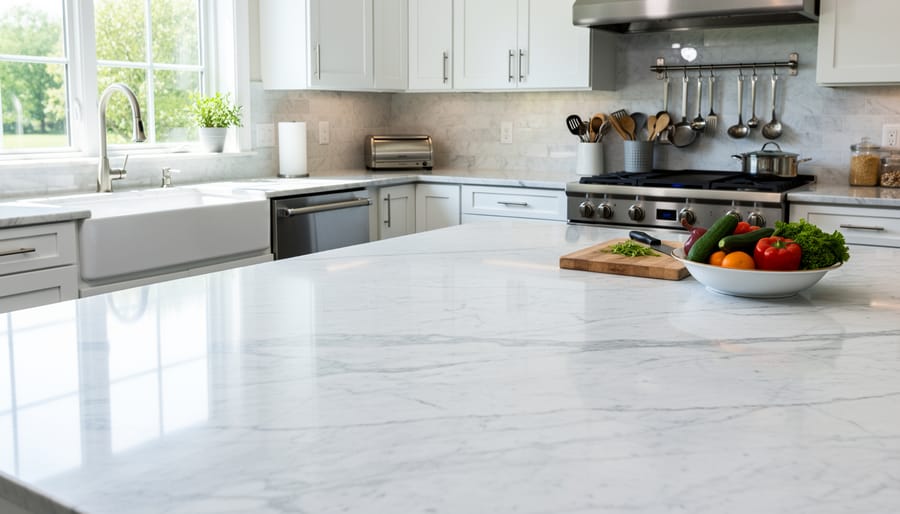
In 2019, we began monitoring three Carrara marble kitchen countertops in residential homes, each treated with different penetrating sealers. The goal was to document real-world performance under daily use, including exposure to coffee, wine, cooking oils, and acidic foods.
The countertop treated with a high-quality fluoropolymer-based penetrating sealer demonstrated remarkable resilience. After five years of intensive use, the marble showed minimal staining and maintained its original appearance. Water still beaded on the surface, indicating the sealer remained active deep within the stone’s pores. Minor etching from citrus exposure occurred, as expected with marble, but no permanent discoloration developed.
In contrast, the surface treated with a standard topical sealer showed wear within 18 months, requiring reapplication. The third countertop, sealed with an entry-level penetrating product, developed noticeable staining around the sink and cooking areas by year three.
Photographic documentation taken at six-month intervals clearly illustrates the superior longevity of premium penetrating sealers. Homeowners reported simple maintenance with pH-neutral cleaners kept the treated surfaces looking nearly new throughout the testing period, validating the cost-effectiveness of investing in quality sealing technology upfront.
Commercial Flooring in High-Traffic Areas
A high-end hotel lobby in Chicago provides compelling evidence of penetrating sealer performance under demanding conditions. The property installed French limestone flooring across 12,000 square feet of entrance and reception areas, treating the stone with a penetrating silane-siloxane sealer before opening.
After three years of constant foot traffic averaging 2,500 daily visitors, the flooring shows remarkable durability. The facilities manager reports that the limestone maintains its original appearance without visible etching or staining, despite exposure to tracked-in salt, moisture, and spilled beverages. The sealed surface requires only daily dust mopping and weekly neutral pH cleaning, significantly reducing maintenance costs compared to the marble flooring in their sister property.
The penetrating sealer proved particularly valuable during winter months when salt and ice melt posed threats to the stone’s integrity. While the sealer prevents moisture and contaminant absorption, it leaves the stone’s natural slip resistance intact, an essential safety feature for commercial applications.
Most importantly, the treated limestone has not required resealing, demonstrating the longevity advantage of penetrating sealers over topical products. The hotel estimates saving approximately 40 percent on stone maintenance costs compared to industry benchmarks for unsealed natural stone in similar high-traffic environments.
Maintenance and Longevity: What to Expect
Testing Sealer Effectiveness Over Time
Regular testing helps you maintain optimal protection and avoid costly damage from delayed resealing. The most reliable method is the water droplet test: place several drops of water on your stone surface and observe for 5-10 minutes. If water beads up and remains on the surface, your sealer is still effective. If water darkens the stone or absorbs within a few minutes, resealing is needed.
For high-traffic areas, perform this test every six months. In kitchens and bathrooms where moisture exposure is constant, quarterly testing provides better protection monitoring. Different stone types show varying absorption rates, so establish a baseline when your sealer is fresh to recognize changes over time.
Professional installers often use a more quantitative approach by timing how long water takes to penetrate. Record these intervals and watch for significant decreases, which indicate sealer breakdown. Dense stones like granite typically maintain protection for 3-5 years, while porous stones such as limestone or sandstone may require annual resealing.
Pay special attention to heavily used surfaces like countertops and entryway floors. These areas experience accelerated wear and may need spot treatment between full resealing applications. Document your test results to identify patterns and optimize your maintenance schedule.
Cleaning Products That Won’t Compromise Your Sealer
Choosing the right cleaning products is essential for maintaining natural stone sealed with penetrating sealers. pH-neutral cleaners specifically formulated for stone are your safest choice, as they effectively remove dirt without damaging the sealer’s chemical structure. Avoid acidic cleaners like vinegar or citrus-based products, which can etch stone surfaces and degrade sealer effectiveness. Similarly, alkaline cleaners with high pH levels can compromise the molecular bonds within the sealer.
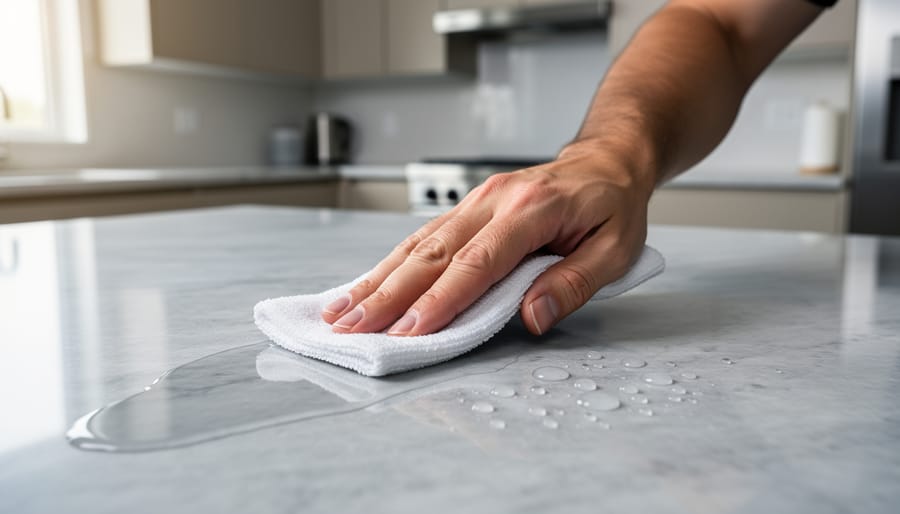
For routine cleaning, use gentle dish soap diluted in warm water or commercial stone cleaners with neutral pH ratings between 7 and 10. Microfiber cloths or soft mops prevent scratching while lifting dirt effectively. Avoid abrasive scrubbers or harsh chemicals like bleach, ammonia, or general-purpose household cleaners that strip away sealer protection over time.
When dealing with spills, blot immediately rather than wiping to prevent spreading. For tougher stains, use poultice treatments designed for sealed stone. Regular maintenance with compatible products not only preserves your sealer’s integrity but extends its lifespan, reducing the frequency of reapplication and protecting your investment for years.
Comparing Costs: Investment vs. Long-Term Value
Understanding the true cost of penetrating sealers requires looking beyond the initial price tag. While these products typically cost between $40 to $150 per gallon, compared to topical sealers at $30 to $80 per gallon, the long-term value proposition shifts dramatically when you factor in durability and maintenance requirements.
A penetrating sealer generally covers 100-200 square feet per gallon on most natural stone surfaces, meaning a 500-square-foot installation might require 3-5 gallons at $120-$750 total material cost. Professional application adds $2-$5 per square foot, though DIY application is straightforward for homeowners with basic skills. Initial investment for that same 500-square-foot space ranges from $1,120 to $3,250 installed.
The true value emerges over time. Penetrating sealers last 3-10 years depending on traffic and stone type, while topical sealers require reapplication every 1-3 years. Over a 10-year period, you might reseal once with a penetrating product versus three to five times with topical alternatives. This translates to significant savings in both materials and labor costs.
Additional considerations include maintenance expenses. Penetrating sealers don’t alter surface texture or require special cleaning products, allowing you to use standard pH-neutral cleaners. Topical sealers often need specific maintenance products and may require professional stripping before reapplication, adding $1-$3 per square foot to each renewal cycle.
Prevention of damage represents perhaps the greatest value. A single etching repair or stain removal treatment costs $200-$500, while replacing damaged stone sections runs thousands of dollars. Quality penetrating sealers effectively prevent most common damage scenarios, protecting your original investment. When evaluating options, calculate total 10-year ownership costs rather than focusing solely on upfront expenses to make the most informed decision.
Penetrating sealers represent a significant advancement in natural stone protection, offering a scientifically-grounded approach that preserves the inherent beauty of stone while providing robust defense against staining, moisture damage, and environmental wear. Unlike traditional surface coatings that sit atop the stone and eventually deteriorate, penetrating sealers work at the molecular level, bonding within the stone’s porous structure to create lasting protection without altering appearance or breathability.
For both new installations and restoration projects, these innovative sealers deliver exceptional value. They extend the lifespan of natural stone surfaces, reduce maintenance requirements, and protect significant investments in materials and installation. Whether you’re sealing marble countertops, limestone flooring, granite outdoor features, or travertine showers, understanding the specific characteristics of your stone type and environmental conditions ensures optimal product selection and application results.
The technology behind penetrating sealers continues to evolve, with water-based formulations offering improved environmental profiles and solvent-based options providing maximum penetration for dense stones. Success depends on proper surface preparation, selecting the right sealer chemistry for your specific stone and application, and following manufacturer guidelines for application and curing times.
When making decisions about stone protection, consider factors beyond initial cost. Evaluate longevity, maintenance requirements, performance characteristics, and compatibility with your specific stone type. Consulting with experienced professionals can provide valuable insights, particularly for large-scale or high-value projects. By choosing penetrating sealers and applying them correctly, you’re investing in long-term stone preservation that maintains natural beauty while delivering reliable, invisible protection.