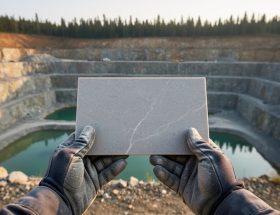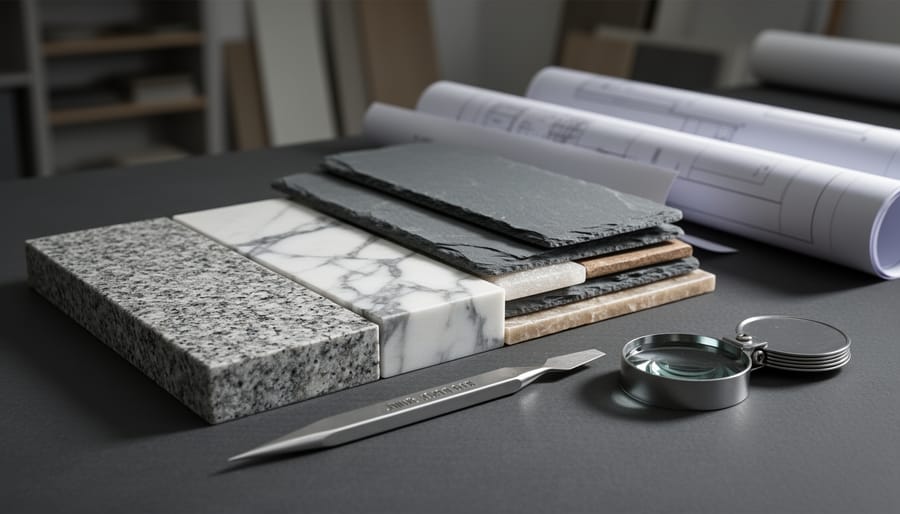
Understanding mineral properties forms the foundation of effective natural stone selection for any architectural or design project. Every natural stone—from granite countertops to marble flooring—derives its performance characteristics from five fundamental mineral properties: hardness, cleavage, luster, color, and specific gravity. These properties determine whether a stone can withstand heavy foot traffic, resist scratching, maintain its appearance over decades, and suit specific structural requirements.
Hardness measures a mineral’s resistance to scratching and abrasion, directly impacting durability in high-use areas. Cleavage describes how a mineral breaks along specific planes, influencing both cutting precision and structural integrity. Luster defines the way light reflects from a mineral’s surface, affecting aesthetic appeal and finish options. Color results from chemical composition and impurities, creating the distinctive patterns that make each stone unique. Specific gravity indicates density and weight, crucial for structural load calculations and installation planning.
For architects specifying materials, designers selecting finishes, or homeowners investing in stone surfaces, these five properties translate abstract mineralogy into practical selection criteria. Recognizing how these characteristics interact helps predict long-term performance, maintenance requirements, and suitability for specific applications—whether specifying lobby flooring that endures thousands of daily footsteps or selecting a statement piece that captures natural beauty while meeting technical demands.
What Makes a Mineral a Mineral: The Foundation of Stone Performance
Before you can appreciate the beauty and durability of natural stone surfaces in your home or commercial project, it’s essential to understand what lies beneath: minerals. Every slab of marble, granite, limestone, or travertine you encounter is composed of crystalline minerals—naturally occurring, inorganic solids with specific chemical compositions and ordered atomic structures.
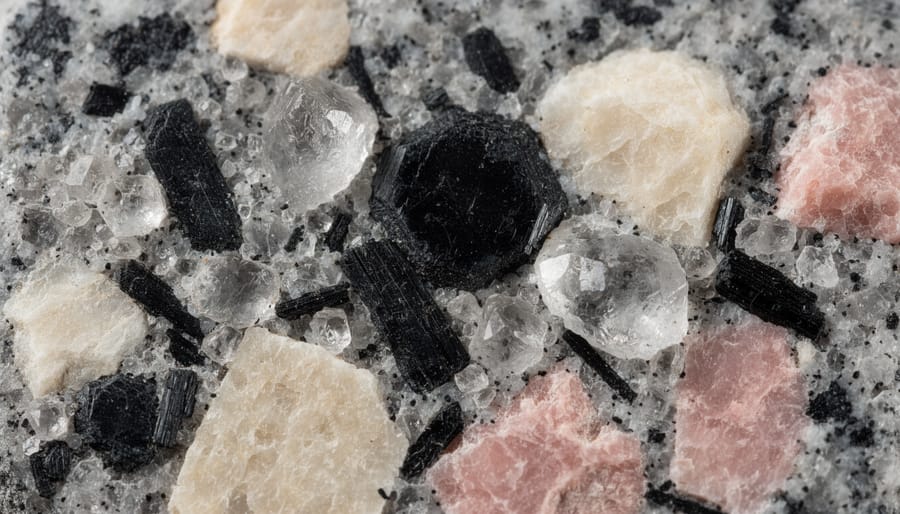
Think of minerals as the building blocks, like individual LEGO pieces that combine to create something larger and more complex. A single granite countertop, for example, contains multiple common minerals in stone including quartz, feldspar, and mica. Each mineral contributes its own characteristics—hardness, color, luster, and structural stability—to the final product.
The five fundamental properties that define every mineral directly influence how natural stone performs in real-world applications. When these minerals crystallize together over millions of years under specific geological conditions, their combined properties determine whether a stone is suitable for high-traffic flooring, delicate bathroom vanities, or exterior facades exposed to weathering.
Understanding these mineral properties isn’t just academic knowledge—it’s the foundation for making informed decisions about stone selection. The hardness of constituent minerals affects scratch resistance, their crystal structure influences how stone breaks or cleaves during fabrication, and their chemical composition determines resistance to acids and staining. This knowledge empowers you to choose stone that performs beautifully for decades rather than disappointing after just a few years.
Hardness: Your Stone’s Resistance to Scratches and Wear
The Mohs Scale in Practical Terms
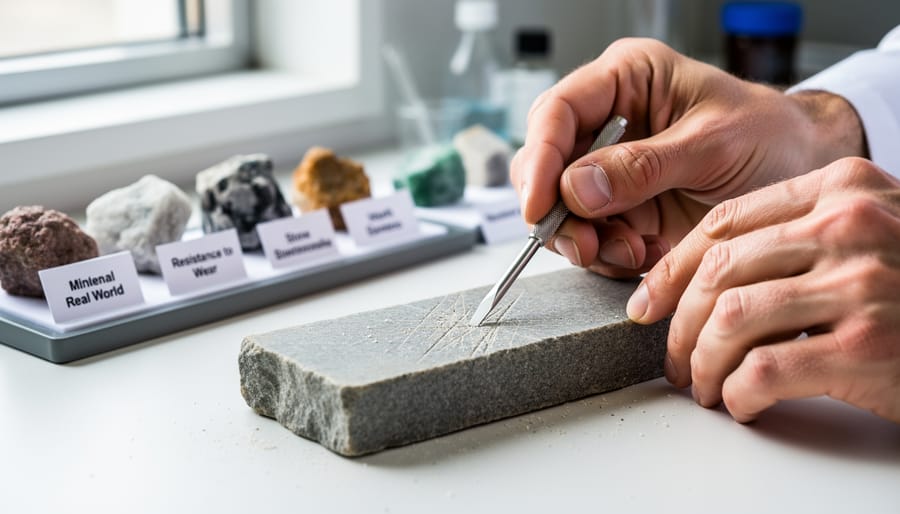
The Mohs scale ranks minerals from 1 (talc, the softest) to 10 (diamond, the hardest). Understanding where natural stone falls on this scale helps you make smart design choices for different applications.
For flooring and high-traffic areas, you need minerals rating 6 or above. Granite typically rates 6-7, making it ideal for kitchen countertops and commercial lobbies that endure constant wear. Marble, softer at 3-4, scratches more easily under foot traffic but works beautifully for bathroom vanities and decorative wall cladding where impact resistance matters less.
Here’s a practical benchmark: if a mineral rates below 5, a steel knife can scratch it. This means limestone and travertine, both around 3-4, require more maintenance in busy households but offer stunning aesthetics for protected spaces like fireplace surrounds.
The hardness also affects installation and maintenance costs. Harder stones resist etching from acidic cleaners and everyday spills, reducing long-term upkeep. Softer stones demand gentler care products and may need professional resealing more frequently. When selecting stone, balance the Mohs rating against your project’s functional demands and maintenance commitment to ensure lasting beauty and performance.
How Hardness Affects Your Stone Choice
Understanding hardness is essential when selecting natural stone for your project, as different applications demand different levels of durability. For high-traffic kitchen countertops, choose harder stones like granite (Mohs 6-7) or quartzite (Mohs 7), which resist scratching from knives and daily use. Marble (Mohs 3-4), while stunning, works better in low-traffic areas like bathroom vanities or decorative wall features where its susceptibility to scratches won’t pose practical problems.
Bathroom floors require stones that balance hardness with slip resistance. Granite and slate perform well here, offering durability against daily foot traffic while maintaining their finish. For exterior cladding, prioritize stones rating 6 or higher on the Mohs scale to withstand weathering and environmental wear.
Commercial spaces with heavy foot traffic, such as hotel lobbies or office buildings, need extremely durable options like granite or basalt. Softer stones like limestone may work in residential hallways but typically require sealing and more frequent maintenance. Always consider not just the stone’s beauty, but whether its hardness matches your specific use case to ensure longevity and minimize costly replacements.
Cleavage and Fracture: How Stone Breaks Under Stress
Understanding Cleavage Planes
Cleavage describes how minerals break along specific, flat planes determined by their internal atomic structure. When force is applied, minerals with cleavage naturally split along these predetermined directions, creating smooth, predictable surfaces. This property directly impacts how stone fabricators cut and shape natural materials for architectural and design applications.
Some minerals exhibit perfect cleavage in one or more directions, making them easier to split but potentially more vulnerable during installation. Slate, for example, cleaves beautifully into thin sheets, which is why it works so well for roofing and flooring. Granite, conversely, has poor or no cleavage, meaning it fractures irregularly rather than splitting along predictable planes. This characteristic makes granite more difficult to quarry but also more durable and resistant to chipping during handling and installation.
Understanding a stone’s cleavage helps professionals anticipate how the material will behave during cutting, finishing, and long-term use. Fabricators adjust their techniques based on cleavage patterns, while designers consider this property when selecting stones for specific applications where durability or splitting characteristics matter most.
Fracture Patterns and Impact Resistance
Fracture describes how a mineral breaks when subjected to force, and understanding these patterns is essential for predicting how stone will perform under stress. Conchoidal fracture, characterized by smooth, curved surfaces resembling broken glass, is common in quartz-rich materials. This fracture type indicates strong internal bonding, making stones like granite and quartzite exceptionally impact-resistant for high-traffic flooring and countertops.
Uneven or irregular fracture patterns suggest less predictable break points, which can be problematic in applications requiring precise cutting or heavy loads. Stones with uneven fracture may chip more easily along edges, making them less ideal for sharp corners or thin installations.
In practical terms, materials with predictable fracture patterns allow fabricators to work more efficiently and reduce waste during cutting. For architects specifying exterior cladding or structural elements, selecting stones with favorable fracture characteristics ensures better long-term durability against thermal stress and physical impacts, ultimately reducing maintenance costs and extending the material’s service life.
Luster: More Than Just Aesthetics
Polished Perfection vs. Natural Finish
A mineral’s luster directly determines what kind of surface finish is achievable and how easily that finish can be maintained. High-luster minerals like granite and marble can be polished to a mirror-like shine because their crystal structure allows light to reflect uniformly off the surface. This polished finish enhances color depth and pattern visibility, making it ideal for luxury countertops and feature walls. However, polished surfaces show fingerprints, water spots, and scratches more readily, requiring regular maintenance with pH-neutral cleaners.
Conversely, minerals with lower luster or uneven crystal structures work better with honed, leathered, or flamed finishes. These matte or textured surfaces hide imperfections and daily wear, making them practical for high-traffic commercial spaces and outdoor applications. Understanding luster helps designers match surface treatments to functional requirements—a polished finish for dramatic visual impact in lobbies, or a honed finish for slip-resistant flooring in bathrooms. The mineral’s inherent luster sets the baseline for what’s technically possible during fabrication.
Specific Gravity: The Density Factor in Installation
Why Weight Matters in Stone Selection
Understanding a stone’s weight directly impacts structural planning and installation success. Dense materials like granite typically weigh 165-170 pounds per square foot at one-inch thickness, while lighter stones such as limestone average 135-145 pounds per square foot. These differences have significant practical consequences.
For floor installations, structural engineers must verify that the building’s load-bearing capacity can support the stone’s weight plus any additional loads like furniture and foot traffic. Historic renovations particularly require careful assessment before installing heavy stone flooring over existing structures.
Wall-mounted applications demand robust anchoring systems proportional to the stone’s density. A dense marble backsplash needs stronger adhesives and potentially mechanical fasteners compared to lighter alternatives. Inadequate support can lead to tiles detaching over time, creating safety hazards and costly repairs.
Countertop installations require proper cabinet reinforcement, especially for overhangs where cantilevers create additional stress points. Standard cabinetry designed for laminate countertops often needs reinforcement to safely support natural stone. Professional fabricators typically specify support brackets at specific intervals based on the stone’s weight and overhang distance, ensuring long-term stability and preventing cracking or collapse.
Crystal Structure: The Hidden Property That Controls Everything
From Microscopic to Macroscopic
A mineral’s microscopic crystal structure directly dictates the performance characteristics of the stone you specify for a project. The arrangement of atoms within crystal systems creates pathways and weaknesses that manifest as measurable properties in slabs and tiles.
Porosity offers a prime example. Minerals with tightly packed cubic or hexagonal crystal systems typically produce denser stone with lower porosity, making them ideal for wet environments like bathrooms and outdoor applications. Conversely, minerals with more open crystal arrangements may create stone with higher absorption rates, requiring sealing and careful placement decisions.
Crystal structure also governs mechanical strength. Minerals with strong ionic or covalent bonding across all three dimensions—such as those in cubic systems—typically yield harder, more impact-resistant stone. Meanwhile, minerals with layered crystal structures may cleave along specific planes, affecting both fabrication techniques and durability in high-traffic installations.
Thermal properties trace back to how atoms vibrate within their crystal lattice. Dense, uniform crystal systems generally conduct heat more efficiently, influencing everything from thermal mass in passive solar design to heat resistance around fireplaces.
Chemical resistance depends on bond strength within the crystal structure. Silicate minerals with three-dimensional frameworks resist acidic solutions better than carbonate minerals, making material selection critical for kitchen countertops exposed to citrus and wine.
Putting It All Together: Choosing Stone Based on Mineral Properties
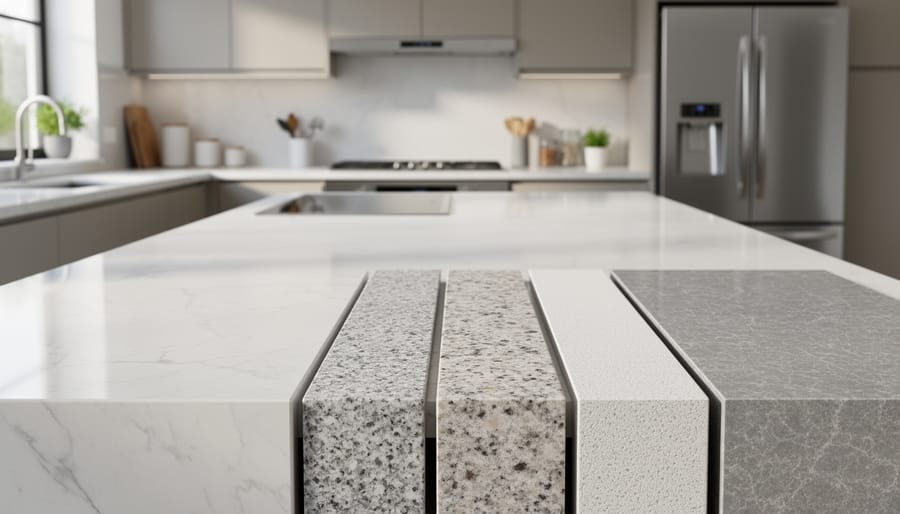
Quick Reference: Matching Properties to Applications
Selecting the right stone for your project becomes straightforward when you match mineral properties to specific applications. For high-traffic commercial lobbies and retail spaces, prioritize minerals with hardness ratings above 6 on Mohs scale—granite and quartzite excel here due to their exceptional durability. Kitchen countertops demand non-porous stones with low absorption rates; granite and quartz composites typically absorb less than 0.4% water, preventing staining from oils and acids.
For exterior cladding and facades, consider cleavage patterns and how stones will respond to freeze-thaw cycles. Stones with uniform crystal structures and minimal cleavage planes, like granite, resist weathering better than highly foliated materials. Bathroom applications benefit from understanding both hardness and luster—polished marble maintains its reflective finish in low-traffic vanity areas, while textured granite provides slip resistance for shower floors.
Color retention depends on mineral composition and specific gravity. Dense stones with tightly bonded crystal structures maintain their appearance longer when exposed to UV light and cleaning chemicals. When specifying stone for fireplaces or outdoor kitchens, thermal shock resistance becomes critical—denser minerals with higher specific gravity generally perform better under temperature fluctuations. Always request technical data sheets showing these five fundamental properties before making final material selections.
Understanding these five fundamental mineral properties—hardness, luster, color, cleavage, and streak—provides the essential foundation for making informed decisions about natural stone selection. Whether you’re a homeowner choosing countertops, an architect specifying facade materials, or a designer sourcing statement pieces, these properties directly impact how stone performs in real-world applications. Hardness determines durability and maintenance needs, luster affects visual appeal, color influences design cohesion, cleavage guides fabrication possibilities, and streak helps verify authenticity.
By evaluating stones through this framework, you can balance aesthetic preferences with practical performance requirements, ensuring your selections will stand the test of time while achieving your design vision. For specific projects requiring detailed analysis and recommendations, we encourage you to consult with experienced stone professionals who can assess your unique needs, environmental conditions, and application requirements to guide you toward the ideal natural stone solution.