Every material investment deserves a transparent roadmap for long-term maintenance, yet natural stone has lacked the objective evaluation framework common in other industries. When consumers purchase electronics, they consult iFixit’s repairability scores to understand how easily products can be serviced, upgraded, or restored. This same logic applies to natural stone surfaces, where the ability to repair scratches, refresh finishes, and extend lifespan directly impacts total ownership costs and sustainability.
Natural stone selections shouldn’t rely solely on aesthetic appeal or initial price points. Marble may captivate with its veining, but its softness demands frequent professional refinishing. Granite resists damage admirably, yet certain varieties stain permanently without proper sealing protocols. Quartzite promises durability but challenges even experienced fabricators during repair attempts. These practical considerations determine whether your investment appreciates or depreciates over decades of use.
The iFixit repairability scoring system translates effectively to stone evaluation by measuring key factors: ease of scratch removal, stain remediation success rates, polish restoration requirements, chip repair feasibility, and accessibility of maintenance tools. A material scoring 9 out of 10 might require only DIY buffing compounds for minor damage, while a 3-rated stone demands professional equipment and specialized expertise for basic maintenance.
This assessment framework transforms abstract material properties into actionable selection criteria. Rather than discovering your kitchen countertop requires costly professional restoration every two years, you’ll understand maintenance realities before installation. The following analysis examines popular stone varieties through repairability metrics, connecting laboratory hardness ratings and porosity measurements to real-world refinishing scenarios, lifecycle expenses, and ownership satisfaction. Make informed decisions that balance beauty with practical longevity.
Understanding Repairability Scoring for Stone Surfaces
The iFixit Philosophy Applied to Natural Materials
iFixit revolutionized how consumers evaluate electronics repairability through a systematic scoring framework that examines three core principles: ease of disassembly, tool requirements, and documentation availability. This methodology empowers buyers to make informed decisions based on long-term ownership costs rather than initial purchase price alone.
When applied to natural stone, these principles translate remarkably well. Just as iFixit assesses whether a smartphone screen can be replaced without specialized equipment, we can evaluate whether marble countertops can be refinished with standard polishing tools or require professional-grade machinery. The ease of disassembly becomes the accessibility of the stone surface for maintenance—can scratches be addressed through simple honing, or does damage penetrate so deeply that replacement becomes the only option?
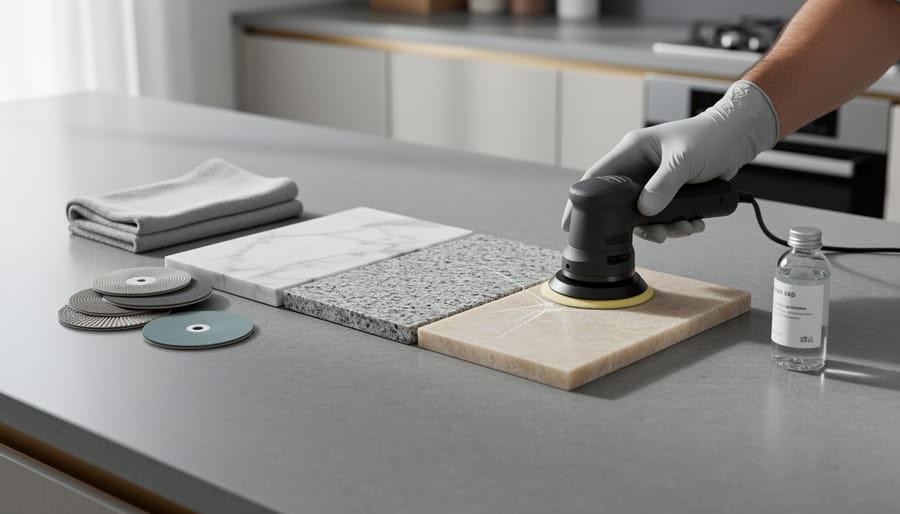
Tool requirements take on particular significance in stone assessment. Some materials like granite respond well to DIY diamond polishing pads and handheld grinders available at hardware stores. Others, such as certain quartzites, demand industrial polishers and specialized abrasives that only professionals possess. This distinction directly impacts lifetime maintenance costs and determines whether homeowners can perform routine care independently.
Documentation availability mirrors iFixit’s emphasis on repair guides. For natural stone, this encompasses the existence of manufacturer care instructions, availability of technical data sheets specifying porosity and hardness ratings, and accessibility of proven restoration techniques. Materials with well-documented maintenance protocols score higher because owners can confidently address issues as they arise, extending surface lifespan while controlling costs.
Key Repairability Factors for Stone Surfaces
When evaluating stone surfaces through a repairability lens, six critical factors determine how well a material can be maintained, restored, and kept looking pristine throughout its lifespan.
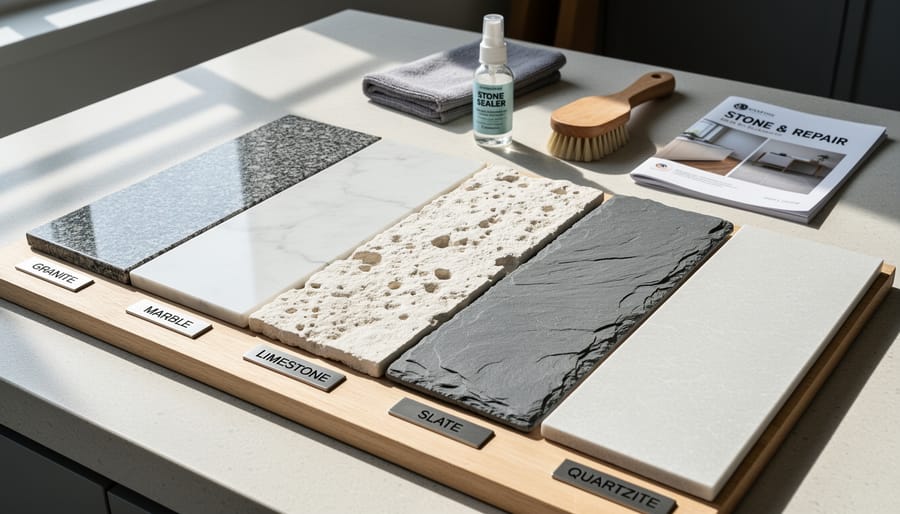
Surface hardness plays a fundamental role in a stone’s ability to resist damage. Measured on the Mohs scale, harder stones like granite (6-7) typically withstand daily wear better than softer materials like marble (3-4). However, extreme hardness can sometimes complicate restoration work, requiring specialized equipment and expertise.
Porosity directly impacts a stone’s vulnerability to staining and moisture damage. Dense, low-porosity stones such as granite naturally resist absorption, while porous materials like limestone require more frequent sealing and careful maintenance. This characteristic significantly affects long-term repairability and ownership costs.
Scratch resistance varies considerably across stone types. While some scratches can be buffed out through professional polishing, deeper damage may require more intensive restoration. Understanding a material’s susceptibility to scratching helps predict maintenance frequency and feasibility.
Stain reversibility determines whether discoloration can be successfully removed. Some stones respond well to poulticing treatments, while others permanently absorb certain substances. This factor heavily influences the practical repairability score, as irreversible damage shortens usable lifespan.
Restoration accessibility considers whether homeowners can perform basic maintenance or require professional intervention. Stones that accept DIY sealing and cleaning rank higher than those demanding specialized refinishing.
Finally, availability of professional services in your region affects practical repairability. Even highly repairable stones become problematic if qualified technicians are scarce or prohibitively expensive, making this a crucial consideration for material selection.
Repairability and Refinishing Comparison for Selection
Granite: The High-Durability, Moderate-Repair Option
Granite earns a solid 7/10 on the repairability scale, balancing exceptional durability and damage resistance with moderate repair complexity. Its crystalline structure withstands heat, scratches, and impacts far better than most countertop materials, meaning repairs are infrequent under normal use conditions.
When damage does occur—typically etching from acidic substances or chips from heavy impacts—granite presents specific challenges. Minor scratches often require professional honing with progressively finer diamond abrasives, followed by polishing to restore the original finish. This multi-step process demands specialized equipment and expertise that most homeowners lack.
Surface etching can sometimes be addressed with DIY polishing compounds on lighter damage, but deeper issues require professional intervention. The mineral composition varies significantly between granite types, meaning repair techniques must be adapted accordingly. Darker granites often show damage less visibly, while lighter varieties may require more frequent attention.
Professional refinishing can restore granite to near-original condition, but achieving factory-level polish quality remains challenging without industrial equipment. Sealing requirements add ongoing maintenance considerations, though modern sealants have simplified this process considerably. Overall, granite’s exceptional longevity and resistance to everyday wear offset its moderate repair difficulty, making it a practical long-term investment.
Marble: Maximum Refinishability with Regular Maintenance Needs
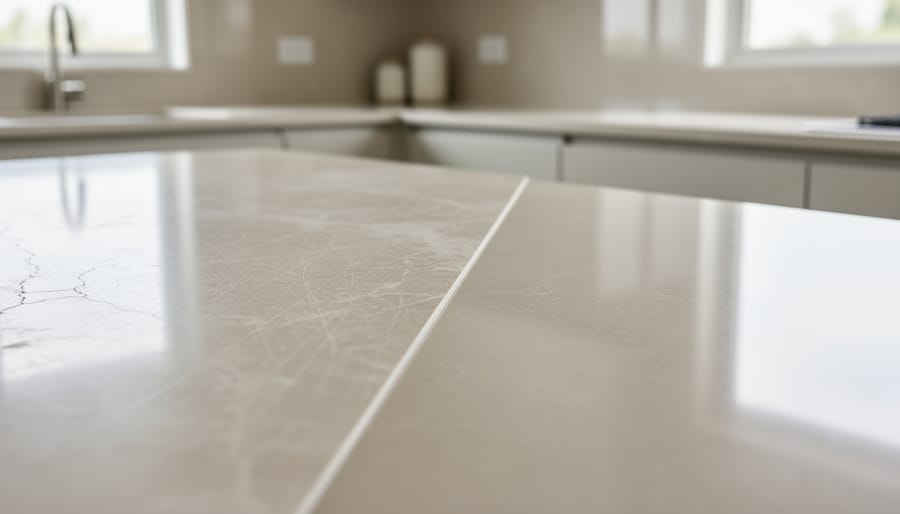
Marble earns one of the highest repairability scores among natural stones due to its exceptional refinishing potential. The calcium carbonate composition that makes marble vulnerable to acids and staining also makes it remarkably responsive to professional restoration. Unlike harder stones, marble can be honed, polished, and refinished multiple times throughout its lifespan, with skilled technicians able to remove deep scratches, etches, and even severe damage through grinding and repolishing techniques.
This refinishability comes with a trade-off: marble requires more frequent maintenance intervention than granite or quartzite. Acidic substances like wine, citrus juice, and certain cleaning products can etch the surface within minutes, creating dull spots that compromise the finish. Regular sealing every 6-12 months is essential to prevent staining, and owners must commit to careful daily maintenance to preserve appearance between professional services.
The accessibility of repair gives marble a significant advantage in lifecycle assessment. While initial costs may be similar to other premium stones, the ability to repeatedly restore marble surfaces to like-new condition extends functional life considerably. Professional refinishing typically costs a fraction of replacement, making marble an economically sound choice for those willing to invest in proper care protocols and periodic restoration.
Limestone and Travertine: Moderate Scores Across the Board
Limestone and travertine occupy the middle ground in repairability scoring, typically earning 5-6 out of 10 points. These sedimentary stones offer distinct advantages and challenges that balance each other in the overall assessment.
On the positive side, their softer composition makes repair interventions significantly easier than harder stones. Scratches respond well to basic honing and polishing procedures, while etching from acidic substances can often be remedied through professional refinishing. The porous nature that makes these stones vulnerable to staining also means they readily accept color-matching compounds and repair mortars, making damage less visually apparent after treatment.
However, this same porosity demands consistent maintenance. Regular sealing is essential rather than optional, typically required every 6-12 months depending on location and use intensity. Water absorption rates mean spills require immediate attention, and high-traffic areas show wear patterns more quickly than denser alternatives.
The moderate score reflects this trade-off: while repairs are accessible and relatively affordable when needed, the frequency of required maintenance reduces the overall ease-of-ownership rating. For consumers prioritizing straightforward repair procedures over minimal intervention needs, limestone and travertine present viable options with realistic maintenance expectations built into their lifecycle costs.
Quartzite: Durability vs. Specialized Repair Requirements
Quartzite earns high marks for day-to-day durability, requiring minimal maintenance beyond basic cleaning with pH-neutral cleaners. Its exceptional hardness resists scratching, etching, and heat damage better than most natural stones. However, this same hardness creates challenges when repairs become necessary. Unlike softer materials that homeowners can address with DIY polishing compounds, quartzite damage demands professional intervention.
When chips, cracks, or significant etching occur, specialized diamond-embedded tooling and expert color-matching skills become essential. Professional stone restoration technicians use industrial-grade polishers and resins formulated specifically for dense metamorphic stone. The repair complexity means higher service costs compared to marble or limestone restoration. While comparing granite and quartzite reveals similar repair requirements, quartzite’s superior density often requires more aggressive equipment settings and additional labor time. This creates a paradox: the material least likely to need repairs is among the most expensive to fix when damage does occur, affecting its overall repairability score despite excellent durability ratings.
Soapstone: The DIY-Friendly Repair Champion
Soapstone earns the highest repairability rating among natural stone countertops, functioning as the industry’s repair champion. This metamorphic stone’s unique composition allows homeowners to address common wear and tear without professional intervention. Minor scratches disappear through light sanding with fine-grit sandpaper, while deeper gouges require progressively coarser grits before finishing with a smooth polish.
The maintenance protocol couldn’t be simpler: apply food-safe mineral oil to enhance the stone’s natural patina and conceal surface imperfections. Unlike granite or marble requiring specialized compounds and equipment, soapstone restoration demands only materials available at any hardware store. This accessibility translates to minimal lifecycle costs and extended surface longevity.
The stone’s soft composition, rating 2.5-3.5 on the Mohs hardness scale, makes it inherently workable. What some perceive as a weakness becomes a significant advantage for repairability. Homeowners can refinish entire sections during a weekend, eliminating service call expenses. This DIY-friendly nature, combined with soapstone’s resistance to acids and heat, positions it as the most maintainable option for budget-conscious consumers prioritizing long-term value over initial cost considerations.
Refinishing Methods and Accessibility Ratings
Surface Polishing and Honing
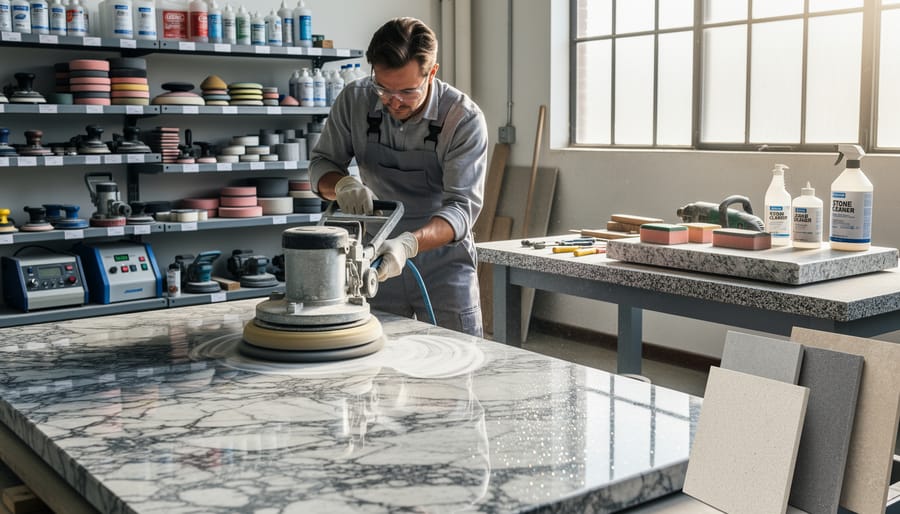
Surface restoration varies significantly between stone types, directly impacting repairability scores. Marble and limestone typically require professional intervention for polishing, as improper technique can create uneven finishes or worsen damage. These softer stones score lower on DIY repairability due to the precision equipment needed and the skill required to avoid wave patterns or burn marks.
Granite and engineered quartz present moderate DIY accessibility. Homeowners can successfully address minor scratches using progressive-grit diamond pads and variable-speed polishers, though achieving factory-level shine remains challenging. Professional refinishing yields 85-95% success rates for restoring original luster, while careful DIY attempts typically reach 70-80% restoration quality.
Honed finishes prove more forgiving than polished surfaces for DIY repair across all stone types. The matte texture masks minor inconsistencies, making touch-up work less apparent. Essential tools include diamond hand pads (50-3000 grit), proper safety equipment, and patience for the multi-stage process.
Success rates correlate strongly with stone hardness and finish type. Harder stones like granite tolerate amateur polishing better than softer marbles. For valuable installations or extensive damage, professional restoration remains the recommended approach, preserving both aesthetics and property value while avoiding irreversible mistakes that could necessitate complete replacement.
Crack and Chip Repair Techniques
Minor surface damage doesn’t necessarily require professional intervention. For granite and quartzite, epoxy-based filling systems work effectively on chips smaller than one inch. The repair difficulty rates 3/10, with color-matching kits widely available at hardware stores. Expect repairs to be visible upon close inspection but functionally sound for 5-7 years.
Marble presents greater challenges due to its translucent quality. Standard epoxy creates opaque patches that stand out against the stone’s natural depth. Specialized polyester resins with translucent properties yield better results, though the difficulty increases to 6/10. Color-matching requires layering multiple tints to replicate veining patterns. Successful repairs blend at arm’s length but remain detectable in direct lighting.
Limestone and travertine offer the most forgiving repair experience, rating 2/10 in difficulty. Their naturally porous, matte appearance disguises filled areas effectively. Lightweight epoxy pastes applied with putty knives create seamless patches that age alongside the surrounding stone.
Structural cracks exceeding hairline width demand professional assessment. Repairs involving pin insertion or resin injection require specialized equipment and rate 9/10 in difficulty. These interventions restore stability but rarely achieve invisible results, particularly in polished finishes where surface disruption reflects light differently than intact areas.
Stain Removal and Etching Correction
Chemical damage and etching present different repairability challenges depending on stone composition. Calcium-based stones like marble and limestone score lower (4-6/10) for acid resistance, as etching removes surface material and requires professional honing or polishing to restore appearance. These resurfacing processes are feasible but costly, reducing the overall repairability score.
Granite and quartzite demonstrate superior chemical resistance, earning 8-9/10 scores since most household acids won’t penetrate their dense crystalline structure. Minor surface stains typically respond well to poulticing—a paste treatment that draws contaminants from porous stone. This DIY-friendly technique significantly boosts repairability scores for oil-based stains on moderately porous materials.
Porosity directly impacts treatment success. Dense stones with absorption rates below 0.5% allow easier stain extraction, while highly porous varieties may retain deep discoloration permanently. For assessment purposes, stones requiring only poulticing score 7-8/10, those needing light resurfacing score 5-6/10, and materials requiring complete refinishing or replacement drop to 3-4/10.
Professional grinding and repolishing can restore most natural stone surfaces, but accessibility matters. Large-format slabs in kitchens generally score one point higher than intricate bathroom installations where equipment maneuverability limits repair options.
Cost-Benefit Analysis: Repair Scores vs. Lifecycle Investment
Initial Investment vs. Repair Accessibility
Understanding the relationship between initial stone investment and future repairability can significantly impact your total ownership experience. Higher-scoring stones on the repairability scale don’t always carry premium price tags, making this comparison essential for budget-conscious decisions.
Granite exemplifies excellent value, combining moderate initial costs with high repairability scores (8-9/10). Its resistance to damage means fewer repairs, while its dense structure responds well to professional refinishing when needed. Marble presents a different equation: higher upfront costs paired with moderate repairability (6-7/10) due to acid sensitivity and softer composition. However, its refinishing potential extends lifespan considerably, affecting lifecycle investment costs.
Quartzite occupies the premium tier with both elevated initial pricing and superior repairability scores (9/10), justifying costs through minimal maintenance requirements and exceptional refinishing outcomes. Soapstone offers moderate pricing with good repairability (7/10), though its unique maintenance needs require homeowner involvement.
For residential kitchens with moderate budgets, granite delivers optimal cost-to-repairability ratios. Commercial applications benefit from quartzite’s durability despite higher entry costs. Design-focused projects might accept marble’s maintenance requirements for aesthetic returns. Matching stone selection to actual usage patterns, expected wear, and refinishing accessibility ensures your investment aligns with both immediate budget constraints and long-term performance expectations.
Professional Service Availability and Pricing
The accessibility of qualified stone restoration professionals varies significantly by region, directly impacting practical repairability scores. Urban areas typically have multiple specialists experienced in marble, granite, and limestone restoration, while rural locations may require professionals to travel considerable distances, increasing service costs substantially.
Typical professional restoration pricing ranges from $3 to $8 per square foot for basic honing and polishing of common materials like granite and marble. More complex repairs involving crack filling, epoxy treatments, or stain removal can cost $10 to $25 per square foot. Exotic stones requiring specialized knowledge and materials may command premium rates of $30 or more per square foot, particularly when dealing with delicate varieties like onyx or soapstone.
This cost variation directly affects the repairability equation for different stone types. While granite’s widespread availability makes finding affordable service relatively easy, rare imported marbles may require specialists who command higher fees and longer wait times. Geographic location also influences pricing, with metropolitan markets offering more competitive rates due to higher specialist density.
For property owners in remote areas, the limited availability of qualified technicians may push certain stone types lower on the practical repairability scale, despite their inherent material properties scoring well. Transportation fees and minimum service charges can make minor repairs economically impractical, favoring more durable, lower-maintenance stone selections for these locations.
Making Selection Decisions Based on Repairability Needs
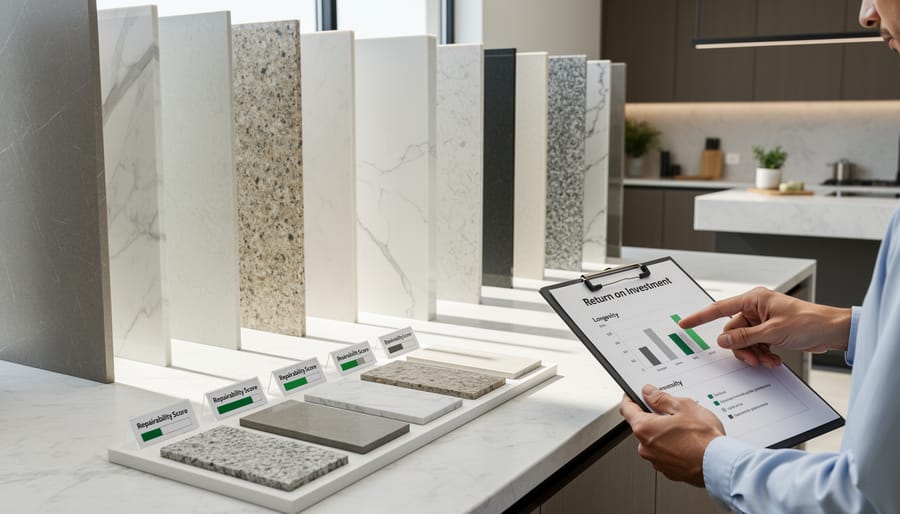
Understanding how to apply repairability scores to your specific project ensures you select stone that performs well throughout its lifecycle. This decision-making framework helps align technical scores with practical requirements.
For high-traffic commercial spaces like hotel lobbies or retail environments, prioritize stones scoring 7 or higher. These materials withstand frequent refinishing without significant thickness loss. Granite and quartzite excel in these applications, tolerating aggressive restoration while maintaining structural integrity. The initial investment pays dividends through reduced replacement frequency and lower long-term maintenance costs.
Residential kitchens present different considerations. Moderate-traffic environments allow flexibility in material selection decisions. Homeowners willing to embrace patina development might choose marble scoring 5-6, accepting periodic professional refinishing as part of ownership. Those seeking minimal intervention should opt for materials scoring 8 or above, where routine cleaning suffices for years between restorations.
Bathroom applications typically involve lower traffic but higher moisture exposure. Here, stain resistance becomes equally important as repairability. Dense stones like granite offer superior performance, while porous materials require more frequent sealing regardless of repairability scores.
Budget constraints also influence decisions. Calculate total cost of ownership by combining purchase price with projected refinishing expenses over ten years. A stone scoring 8 might cost more initially but require half the professional interventions of a material scoring 5, ultimately proving more economical.
Match maintenance capabilities to stone requirements. Properties with dedicated facilities management can handle lower-scoring stones through regular professional care. Homeowners preferring hands-off maintenance should select higher-scoring options requiring only basic cleaning protocols. Consider aesthetic priorities too—some designers value the evolving character of softer stones despite lower repairability scores, while others prioritize unchanging appearance over decades.
When selecting natural stone for your next project, a repairability score provides invaluable objective criteria that extends far beyond surface aesthetics. By evaluating factors like refinishing accessibility, material hardness, surface porosity, and long-term maintenance requirements, you can make informed decisions that balance initial investment with lifecycle value. This approach transforms stone selection from a purely visual choice into a strategic decision grounded in practical ownership experience.
The sustainability benefits of repairable materials cannot be overstated. Choosing stones with high repairability scores means selecting surfaces that can be restored rather than replaced, significantly reducing waste and environmental impact. Materials like marble and limestone, despite requiring more frequent maintenance, offer exceptional refinishing potential that can extend their useful life for generations. Even harder materials like granite and quartzite benefit from understanding their repairability profiles, allowing you to set realistic expectations for care and restoration.
As you evaluate countertop, flooring, and cladding options, prioritize long-term refinishing potential alongside color, pattern, and price. Ask suppliers about honing and polishing accessibility, stain removal techniques, and expected maintenance intervals. Request case studies demonstrating successful restoration projects. By incorporating repairability criteria into your decision-making process, you invest in surfaces that maintain their beauty and functionality while supporting sustainable building practices that benefit both your project and the environment.