
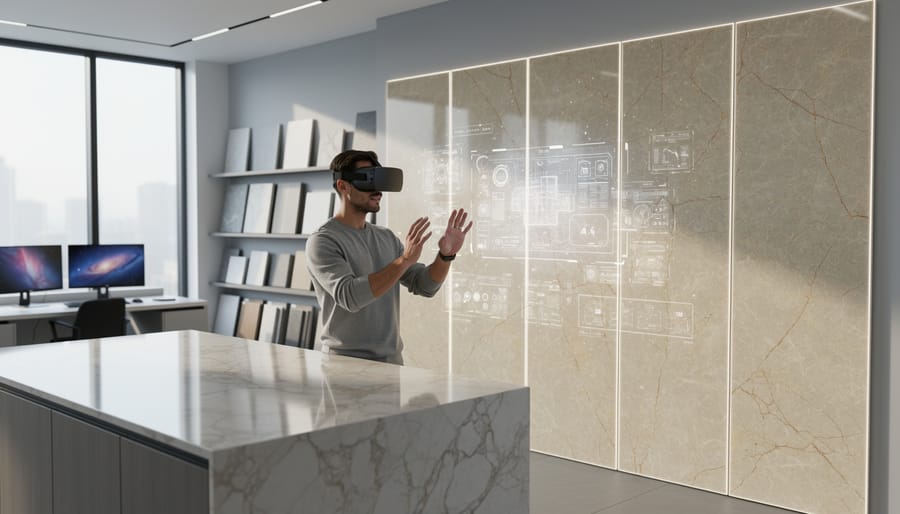
Visualize your natural stone installation before a single slab is cut. Virtual reality prototyping transforms how architects, designers, and fabricators approach stone projects by creating immersive 3D environments where materials, patterns, and spatial relationships come alive at full scale. Walk through a marble-clad lobby, examine vein matching across multiple slabs, or test different edge profiles on a quartzite countertop—all before committing to fabrication costs or irreversible cuts.
This technology addresses the fundamental challenge in natural stone design: each piece is unique, and traditional 2D drawings or physical samples cannot fully convey how variations in color, veining, and texture will appear in the completed space. VR prototyping bridges this gap by rendering digital twins of actual stone slabs within accurate architectural models, allowing stakeholders to make informed decisions with unprecedented confidence.
The process combines high-resolution scanning of physical stone materials with specialized VR software that simulates lighting conditions, viewing angles, and scale. Designers can iterate rapidly, testing alternative layouts or stone selections in minutes rather than weeks. Clients gain clarity on their investment, reducing revision requests and change orders. Fabricators minimize material waste by confirming layouts before cutting.
For projects involving rare or expensive stones, where mistakes carry significant financial consequences, VR prototyping has evolved from an innovative tool to a practical necessity that saves time, reduces costs, and elevates design outcomes.
Why Natural Stone Projects Need Virtual Reality
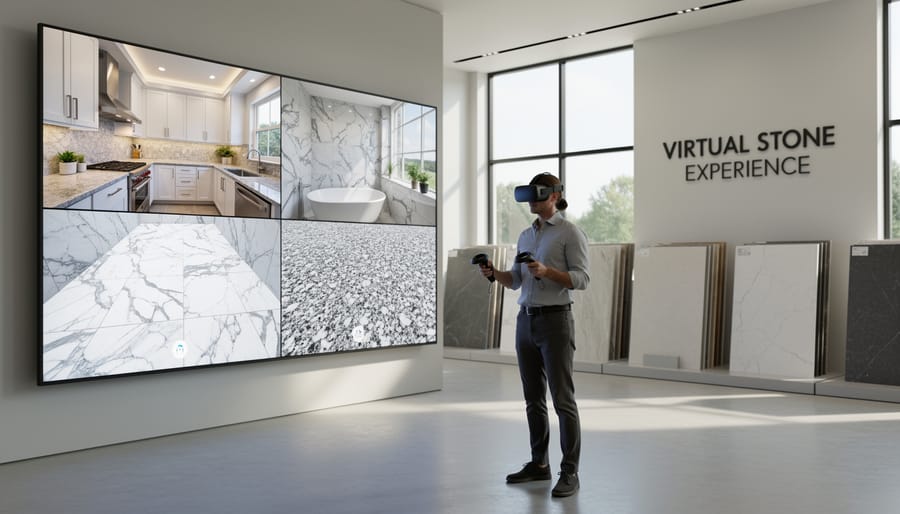
The Sample Paradox: When Small Pieces Don’t Tell the Whole Story
Natural stone’s inherent beauty lies in its complexity—the swirling veins of marble, the crystalline depth of granite, the organic variations in quartzite. Yet traditional selection methods force designers and clients to make significant decisions based on impossibly small representations of these materials.
A 4×4 inch sample or even a high-resolution photograph can never adequately represent how a slab will appear once installed. These fragments might capture a corner of dramatic veining or miss it entirely, showing only a monotonous section that misrepresents the stone’s character. The scale problem becomes even more pronounced with book-matched or sequence-matched installations, where the relationship between multiple slabs creates the final visual impact.
Lighting conditions further complicate matters. A sample viewed under fluorescent showroom lights will look dramatically different than the same stone installed in a residential kitchen with natural daylight streaming through windows. Reflective properties, depth perception, and color temperature all shift based on the viewing environment.
This disconnect between sample and reality has historically led to two common outcomes: pleasant surprises when installed stone exceeds expectations, or disappointing mismatches when the final result fails to meet the vision. The stakes are particularly high given natural stone’s investment level—a miscalculation means living with an expensive mistake or undertaking costly replacements.
Virtual reality prototyping directly addresses this fundamental limitation by allowing stakeholders to experience stone selections at full scale, in accurate lighting conditions, within the actual architectural context where they’ll be installed.
The High Stakes of Getting It Wrong
Making the wrong material choice in a natural stone project carries significant financial and logistical consequences that extend far beyond initial disappointment. When stone selections fail to meet project requirements, the costs multiply quickly. Removal and replacement of installed natural stone can range from $15 to $40 per square foot, often exceeding the original installation cost. This doesn’t account for the substantial expenses associated with project delays, which can cascade through construction timelines and impact multiple trades.
Material waste represents another critical concern. Natural stone is a finite resource, and incorrect selections can result in thousands of pounds of premium material being discarded or relegated to less prominent applications. For high-end projects featuring rare marbles or exotic granites, this waste can translate to tens of thousands of dollars in losses. The environmental impact of quarrying, processing, and transporting replacement stone compounds the problem.
Beyond direct costs, project delays strain client relationships and damage professional reputations. When architects or designers select stone that doesn’t perform as envisioned or fails to achieve the desired aesthetic once installed at scale, the resulting corrections can extend timelines by weeks or months. This is particularly problematic in commercial projects where opening dates are tied to revenue projections. Virtual reality prototyping addresses these risks by enabling stakeholders to experience and evaluate stone selections in context before committing to irreversible decisions, dramatically reducing the likelihood of costly mistakes.
What VR Prototyping Actually Looks Like for Stone Projects
From Slab to Digital Space: The Technology Behind It
Transforming a physical stone slab into a virtual reality experience begins with capturing its unique characteristics through advanced scanning technologies. The most common method is photogrammetry, which involves taking hundreds of high-resolution photographs of a stone slab from multiple angles. Specialized software then analyzes these images, identifying common points across different photos to construct a detailed three-dimensional representation of the stone’s surface, including its natural veining, color variations, and texture.
Once captured, these digital files undergo processing to create accurate 3D models. This is where 3D digital modeling techniques come into play, refining the raw scan data into assets suitable for VR environments. Technical specialists optimize these models to balance visual fidelity with performance, ensuring they display smoothly in virtual reality without sacrificing the stone’s authentic appearance.
The integration phase involves importing these models into VR platforms where they can be viewed, manipulated, and placed within virtual spaces. Advanced rendering techniques simulate how light interacts with the stone’s surface, replicating the subtle reflections and depth that make natural stone distinctive. This includes mapping physical properties like glossiness, translucency, and surface irregularities.
The entire process typically takes between a few hours to several days per slab, depending on size and detail requirements. The result is a digital twin that accurately represents the physical stone, allowing designers and clients to experience how specific slabs will look in their intended environment before any cutting or installation occurs. This technology bridges the gap between traditional material selection and modern design visualization.
Walking Through Your Space Before Construction Begins
The virtual reality experience begins by creating a detailed digital replica of your actual space, whether it’s a kitchen, bathroom, lobby, or exterior facade. This virtual environment serves as your testing ground for exploring different natural stone options before making any physical commitments.
Once inside your VR headset, you can walk freely through your space, examining how various stone selections appear from every angle. The experience goes far beyond looking at static samples or catalog images. You can stand at your kitchen counter and look down at different granite options, walk across a virtual marble floor to see the veining pattern flow throughout the room, or step back to view how a stone wall appears from the entrance.
The real power of VR prototyping lies in the environmental controls at your fingertips. With simple hand gestures or controller inputs, you can adjust lighting conditions to see how your selected stone appears during different times of day. Morning sunlight streaming through windows creates different visual effects than evening ambient lighting, and VR lets you preview both scenarios instantly.
You can also experiment with various configurations and layouts. Swap between book-matched slabs, change the orientation of veining patterns, or compare different edge profiles on countertops. Unlike AR visualization technology that overlays digital elements onto your existing space, VR creates a completely immersive environment where you can test dramatic changes without limitations.
This interactive exploration helps you make confident decisions about expensive materials, reducing the anxiety that often accompanies selecting natural stone sight unseen. You’ll understand exactly how your chosen stone will perform aesthetically in your specific environment before fabrication begins.
Real-World Applications: Where VR Prototyping Makes the Biggest Impact
Kitchen Countertops and Backsplashes
Virtual reality transforms one of the most challenging aspects of kitchen design: selecting and positioning natural stone countertops and backsplashes. Before VR, homeowners relied on small samples that couldn’t convey the full visual impact of large-format installations, particularly with dramatic veining patterns in materials like marble or quartzite.
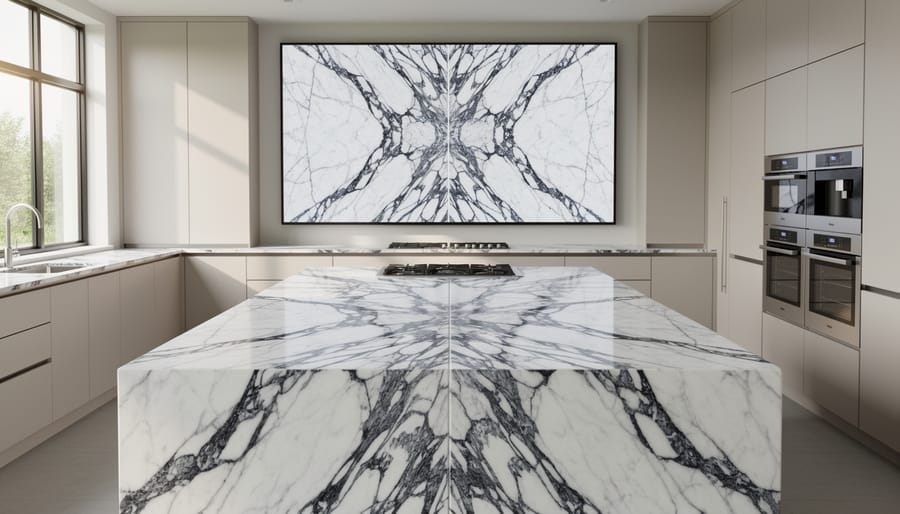
VR prototyping allows clients to visualize entire slabs in their actual kitchen space, examining how veining flows across countertops and continues into backsplash areas. This technology proves invaluable for book-matching decisions, where fabricators mirror adjacent slabs to create symmetrical patterns. Homeowners can preview different matching orientations and select the most visually appealing arrangement before any cutting begins.
The technology also reveals how stone coordinates with existing or planned cabinetry, hardware, and fixtures. A busy veining pattern that looked stunning in the showroom might overwhelm a kitchen with ornate cabinetry, while a subtle stone could disappear against certain cabinet colors. VR eliminates these costly surprises by showing the complete picture.
For island installations, clients can virtually walk around the space, ensuring the most attractive portions of the slab face high-visibility areas. This level of precision minimizes material waste and maximizes the aesthetic investment in premium natural stone.
Commercial Lobby and Feature Walls
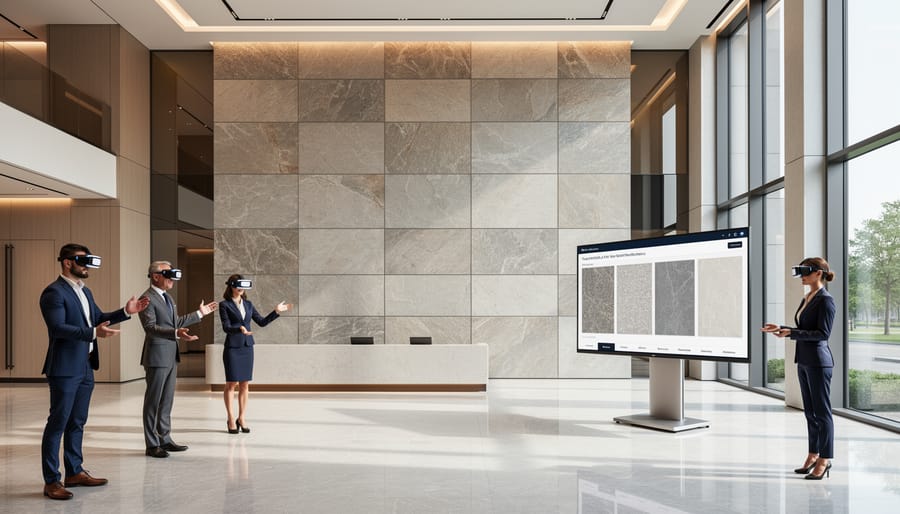
For corporate headquarters, hotels, and upscale retail environments, first impressions are everything. VR prototyping enables designers to evaluate how monumental stone installations will shape visitor perception before construction begins. When a hospitality group considers marble for a grand lobby feature wall, VR allows stakeholders to experience the space at full scale, assessing how veining patterns flow across multiple slabs and how lighting conditions affect the stone’s appearance throughout the day.
This technology proves particularly valuable when selecting stone for brand-defining installations. A commercial client can virtually walk through their lobby, examining how a dramatic bookmatched quartzite wall reinforces their brand identity. Decision-makers who might struggle to envision the final result from 2D renderings can now provide meaningful feedback early in the design process.
VR also facilitates BIM software integration, allowing teams to coordinate stone installations with architectural elements, lighting fixtures, and mechanical systems. This coordination minimizes costly field conflicts and ensures the stone selection enhances rather than competes with other design elements. For projects where stone represents a significant portion of the budget and serves as a signature design feature, VR prototyping reduces risk while elevating the final outcome.
Bathroom Renovations
Bathrooms present unique challenges for stone selection, where moisture, steam, and artificial lighting can dramatically alter a stone’s appearance. VR prototyping allows you to experience how marble, granite, or quartzite performs in these demanding conditions before installation begins. By simulating morning natural light versus evening ambient lighting, you can observe how water droplets affect the stone’s reflective qualities and whether your chosen material maintains its visual appeal when wet.
The technology enables you to experiment with various fixture combinations alongside different stone options. Preview how a dramatic veined marble backsplash pairs with specific faucet finishes, or test whether your preferred granite coordinates with shower hardware. You can also evaluate practical concerns like slip resistance on flooring and maintenance visibility on different finishes. This comprehensive preview eliminates the costly mistake of discovering incompatibilities after installation, ensuring your bathroom stone selections deliver both aesthetic impact and functional performance in real-world wet conditions.
Exterior Cladding and Facades
Virtual reality prototyping transforms how architects and designers evaluate exterior cladding decisions for natural stone facades. By creating immersive 3D environments, VR allows stakeholders to experience how different stone varieties appear under changing natural light conditions throughout the day and across seasons. This capability is particularly valuable when selecting materials like limestone, granite, or travertine, where subtle color variations and surface textures respond dramatically to sunlight angles and atmospheric conditions.
Designers can simulate morning shadows, midday brightness, and golden hour illumination to understand how the stone will perform aesthetically over time. This helps identify potential issues like unwanted glare, unexpected color shifts, or insufficient contrast between architectural elements. VR prototyping also enables teams to test multiple stone options side-by-side in context, comparing how different finishes—polished, honed, or textured—interact with surrounding landscape and building elements. This evaluation process reduces costly mistakes and ensures the final facade achieves the intended visual impact, ultimately saving time and resources while delivering superior design outcomes.
The Practical Benefits: Beyond Pretty Pictures
For Homeowners: Confidence in Major Investments
Selecting natural stone for countertops, flooring, or feature walls represents a significant financial commitment with permanent results. VR prototyping transforms this high-stakes decision from an anxious leap of faith into a confident, informed choice.
Traditional methods leave homeowners relying on small samples and imagination to envision how a particular marble or granite will appear once installed. This uncertainty often leads to second-guessing and post-installation disappointment when the stone doesn’t meet expectations in their actual space.
Virtual reality eliminates this guesswork entirely. By immersing yourself in a full-scale digital replica of your room with the exact stone slabs you’re considering, you experience the material’s veining patterns, color variations, and reflective properties under different lighting conditions. You can walk around your virtual kitchen, observing how morning sunlight interacts with the stone differently than evening ambient light.
This comprehensive preview builds genuine confidence in your selections. You’ll know exactly what you’re getting before fabrication begins, reducing the risk of costly changes or regret. The technology also facilitates better communication with your designer or fabricator, ensuring everyone shares the same vision. When you can literally see your finished space before installation, you invest with peace of mind rather than uncertainty.
For Designers and Architects: Better Client Communication
For design professionals, VR prototyping transforms client presentations from abstract concepts into immersive experiences. Instead of explaining how veining patterns will flow across marble countertops or how travertine will appear in different lighting conditions, you can simply transport clients into the finished space. This immediate visual understanding dramatically reduces the gap between professional vision and client expectations.
Traditional 2D renderings often leave room for interpretation, leading to costly revisions when clients realize the final result differs from what they imagined. VR eliminates this ambiguity by allowing clients to explore materials at full scale, observing how natural stone variations affect the overall aesthetic. They can walk through their kitchen, examining granite backsplashes from multiple angles, or experience how limestone flooring transitions between rooms.
This technology works seamlessly alongside AI-powered design software to create comprehensive design workflows. Clients provide more confident feedback during initial presentations, reducing revision cycles and accelerating project timelines. The result is stronger client relationships built on transparency and shared understanding, with fewer surprises during installation and higher satisfaction rates upon completion.
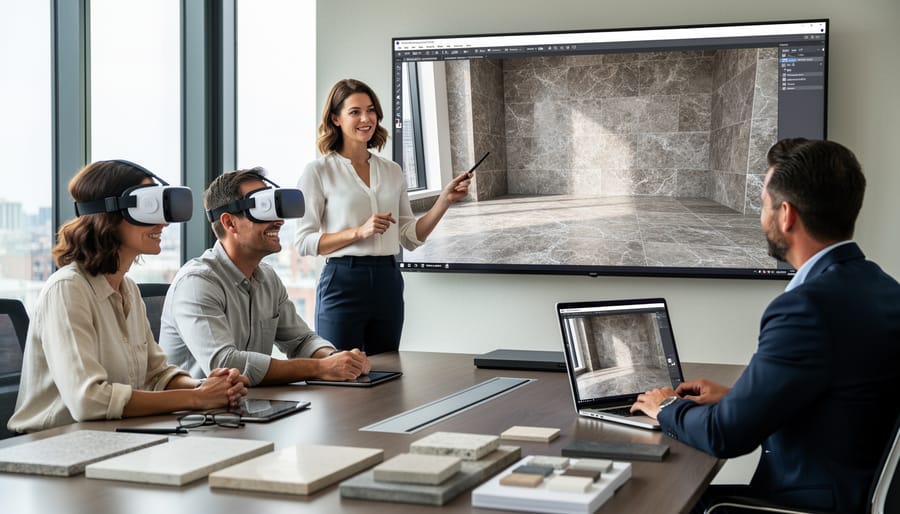
For Fabricators and Installers: Fewer Mistakes and Returns
For fabricators and installers, VR prototyping represents a significant shift in how projects move from design to execution. By allowing clients to approve exact layouts, vein patterns, and edge details before any stone is cut, VR dramatically reduces the risk of costly mistakes. Traditional templating methods can miss crucial spatial relationships or fail to communicate how a particular slab’s veining will appear in the installed context.
With VR prototyping, fabricators receive client sign-off on the precise piece of stone they’ll be working with, eliminating confusion about which section of a slab to use or how to orient complex patterns. This clarity reduces material waste from incorrect cuts and minimizes the expensive scenario of having to reorder and refabricate pieces.
Installation teams benefit equally, as they arrive on-site with confidence that what they’re installing matches client expectations precisely. The likelihood of post-installation disputes drops considerably when clients have already experienced and approved their stone selections in a realistic virtual environment. This translates to fewer callbacks, reduced warranty claims, and stronger client relationships built on clear communication and delivered expectations.
How to Access VR Prototyping for Your Stone Project
What to Look for in a VR-Enabled Stone Provider
When evaluating potential partners for VR-enabled stone selection, start by asking about the technology they use. Inquire whether they offer headset-based immersive VR or web-based 3D visualization, as each serves different needs. Request examples of previous projects to assess the visual quality and realism of their virtual stone representations.
Ask specific questions about their scanning and modeling process. How do they capture the unique veining, color variations, and surface characteristics of each slab? The best providers use high-resolution scanning technology that accurately represents the stone’s natural beauty, including its translucency and texture. Request information about how frequently they update their digital inventory to ensure you’re viewing available materials.
Understand their workflow integration capabilities. Can their VR system import your architectural drawings or existing design files? Does it allow real-time modifications to stone placement, orientation, and book-matching options? The most valuable platforms enable you to experiment with multiple design scenarios during a single session.
Inquire about technical support and training. Will they provide guided sessions to help you navigate the VR environment effectively? Ask whether you can access the virtual prototypes remotely or if you need to visit their facility.
Finally, discuss turnaround times and costs. Some providers offer VR prototyping as a complimentary service for qualified projects, while others charge fees. Clarify what’s included and whether you’ll receive exportable files or renderings for presentation to clients or stakeholders.
Preparing for Your VR Prototyping Session
Before your VR prototyping session, gather essential information to maximize the experience. Have your space dimensions ready, including room measurements, ceiling heights, and any architectural constraints. Bring inspiration images showing preferred stone types, colors, and vein patterns you’re considering. If you’ve selected specific slabs, provide their dimensions and any photos of the actual material.
Your design professional will need details about lighting conditions in the space, as natural stone appearance changes dramatically under different light sources. Note the placement of windows, existing fixtures, and preferred lighting styles. Also prepare information about adjacent materials like cabinetry, flooring, and wall colors that will interact with your stone selection.
During the session, expect an interactive experience where you’ll view full-scale stone installations in a virtual replica of your space. You’ll be able to walk around, examine vein patterns at different angles, and test multiple stone options side-by-side. Most sessions last 30-60 minutes and allow real-time adjustments to layouts, edge profiles, and material combinations. Your designer can instantly swap stone selections, letting you compare options that would be impossible to visualize through traditional samples alone.
The Future is Already Here: Industry Adoption and What’s Next
VR prototyping isn’t just a futuristic concept—it’s already transforming how leading stone fabricators and design firms operate today. Major architectural firms are integrating VR walkthroughs into their standard design workflows, allowing clients to experience stone selections in context before a single slab is purchased. Progressive fabricators have invested in VR capabilities to differentiate themselves in competitive markets, reducing revision requests by up to 60% and accelerating project timelines.
The technology is becoming increasingly accessible. Early VR systems required significant investment in specialized hardware and technical expertise. Today’s solutions range from affordable smartphone-based viewers to sophisticated room-scale systems, with cloud-based platforms eliminating the need for expensive local computing power. This democratization means even smaller fabrication shops can offer VR experiences to their clients.
Integration with existing design tools is accelerating adoption. VR platforms now seamlessly connect with parametric design tools, CAD software, and digital stone libraries, creating unified workflows from initial concept through fabrication. Real-time rendering engines have advanced to the point where material changes can be visualized instantly, making design iterations faster than ever.
Looking ahead, augmented reality (AR) will complement VR by allowing on-site visualization through tablets or smart glasses. Artificial intelligence will suggest optimal stone selections based on project parameters and lighting conditions. Haptic feedback technology will eventually let users “feel” stone textures virtually. As these technologies mature and costs continue declining, VR prototyping will transition from competitive advantage to industry standard, fundamentally changing how we design and select natural stone.
Virtual reality prototyping fundamentally transforms how we approach natural stone selection, replacing uncertainty with confidence. Rather than relying on small samples or imagination alone, you can now experience your stone choices at full scale, in context, before making irreversible decisions. This technology eliminates the anxiety that comes with investing in premium materials, ensuring that what you envision is precisely what you’ll receive.
The peace of mind that VR prototyping provides is invaluable. When you can walk through your space, observe how light interacts with your selected stone throughout the day, and verify that veining patterns align with your design vision, you’re no longer guessing. You’re making informed decisions backed by immersive, realistic visualization.
As you plan your next natural stone project, seek out fabricators and design professionals who offer VR prototyping capabilities. This investment in technology translates directly into confidence in your choices. Whether you’re selecting marble for a kitchen backsplash or granite for a commercial lobby, experiencing your stone before installation ensures satisfaction with your final result. Embrace this innovation and transform your selection process from hopeful anticipation to absolute certainty.