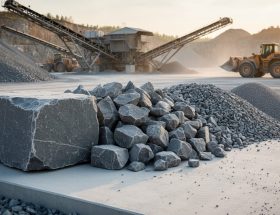
Before a single stone block leaves the quarry, it undergoes rigorous examination to detect internal flaws invisible to the naked eye. Non-destructive testing (NDT) methods have revolutionized quality control in natural stone extraction, allowing quarry operators to assess structural integrity, identify hidden fractures, and predict long-term performance without damaging the material. These sophisticated techniques—ranging from ultrasonic pulse velocity measurements to ground-penetrating radar—serve as the critical gateway between raw extraction and architectural application.
For architects specifying stone façades, understanding NDT methods means confidence that materials will perform as expected for decades. For consumers investing in premium natural stone countertops or flooring, these testing protocols represent an invisible quality assurance layer that protects against premature failure. The quarry industry has embraced these technologies not merely as optional enhancements but as essential safeguards that differentiate professionally extracted stone from inferior products.
The economic implications are substantial. Detecting defects at the quarry stage prevents costly failures during fabrication, installation, or worse, after project completion. Each NDT method addresses specific material characteristics—some excel at measuring density variations, others identify moisture content or detect microscopic cracks that could propagate under stress. Together, they form a comprehensive diagnostic framework that transforms stone selection from educated guesswork into data-driven decision-making, ensuring that every block meets exacting standards before entering the global supply chain.
Why Block Integrity Testing Matters at the Quarry Stage
Testing stone blocks while they’re still at the quarry might seem like an extra step, but it’s actually one of the most cost-effective quality control measures in the entire supply chain. When quarry operators identify internal defects before extraction, they avoid the substantial costs of cutting, transporting, and processing flawed material that will ultimately be rejected or downgraded later in production.
The economics are straightforward: extracting a block from the quarry face requires significant investment in equipment, labor, and time. If that block contains hidden fractures, voids, or inconsistent mineral composition, every subsequent step—from transportation to sawing to polishing—represents money spent on material that may never reach its full market value. A comprehensive block grading system based on early testing prevents these losses by sorting blocks according to their actual structural integrity before they leave the quarry.
Beyond cost savings, early detection supports meaningful waste reduction throughout the production cycle. When fabricators receive blocks that weren’t properly tested, they often discover defects only after expensive slabbing operations, resulting in unusable pieces that must be discarded or relegated to lower-value applications. This affects everyone downstream—architects may face project delays, installers deal with supply shortages, and consumers ultimately pay higher prices to cover these inefficiencies.
Perhaps most importantly, quarry-stage testing ensures that the stone’s visual and structural qualities match what customers expect. A block that appears perfect on the surface may harbor internal weaknesses that only become apparent during installation or, worse, years later through premature cracking or deterioration. Non-destructive testing eliminates these uncertainties before they become expensive problems.
Understanding Non-Destructive Testing (NDT)
Non-destructive testing (NDT) refers to a suite of evaluation techniques used to assess the structural integrity and quality of stone blocks without causing any damage to the material. In natural stone quarrying, NDT methods allow professionals to examine internal characteristics—such as hidden fractures, density variations, and structural weaknesses—while preserving the stone’s commercial value and aesthetic appeal.
Unlike destructive testing methods that require breaking or cutting samples, NDT techniques provide critical quality data while keeping blocks intact and market-ready. This distinction matters significantly in an industry where material costs are high and each block represents substantial investment. A single premium granite or marble block can be worth thousands of dollars, making preservation during testing economically essential.
The core principle behind NDT is simple: use external measurements and non-invasive technologies to gather internal information. Methods such as ultrasonic testing, ground-penetrating radar, and acoustic emission monitoring send energy waves through stone, measuring how these signals respond to internal features. Variations in wave speed, reflection patterns, or acoustic signatures reveal what lies beneath the surface without requiring a single cut.
The benefits extend beyond cost savings. NDT enables quarry operators to evaluate entire blocks rather than small samples, providing more comprehensive quality assessments. For architects and designers specifying natural stone, this means greater confidence in material consistency and performance. Industry professionals gain assurance that the stone selected for their projects has been thoroughly vetted using modern, scientifically-validated methods that protect both quality and investment value.
Primary NDT Methods Used in Modern Quarries
Ultrasonic Testing
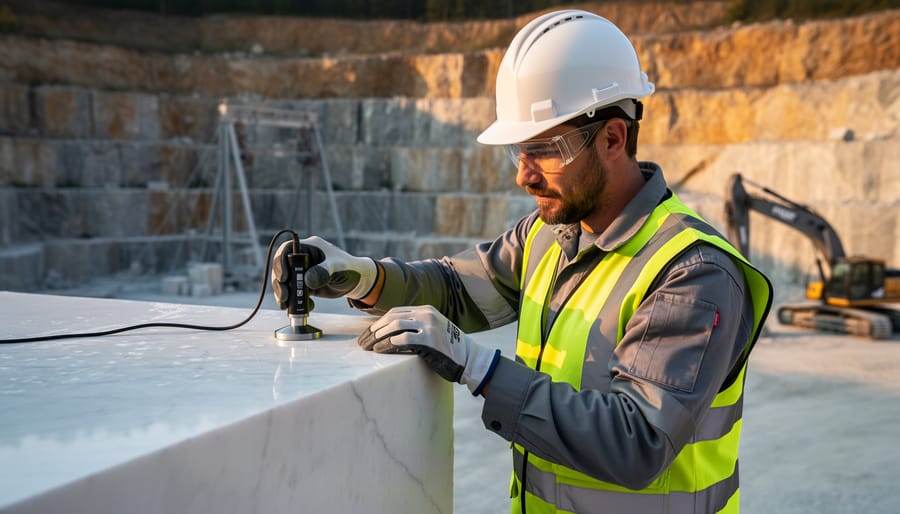
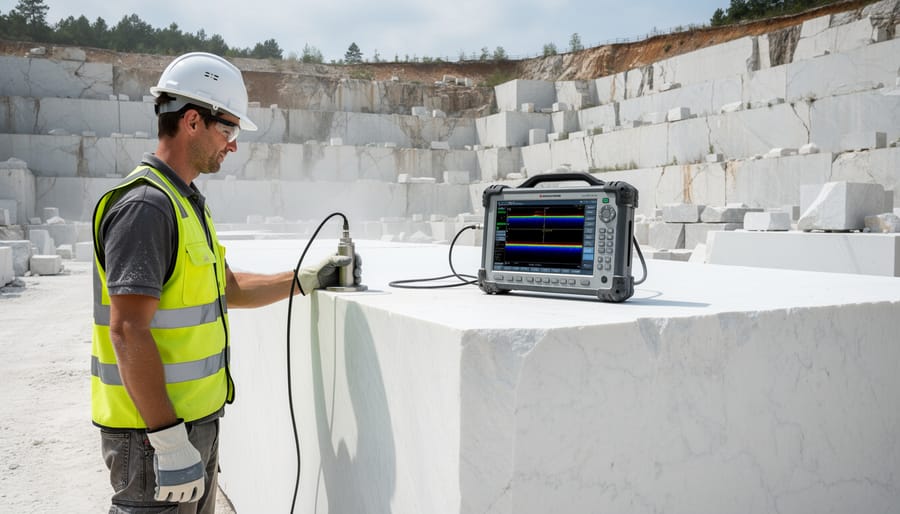
Ultrasonic testing harnesses high-frequency sound waves to reveal what the naked eye cannot see—internal flaws, micro-cracks, and density variations hidden deep within marble and granite blocks. This technology works on a simple principle: ultrasonic waves travel through solid stone at predictable speeds, but when they encounter voids, cracks, or changes in material density, they either slow down, scatter, or reflect back to the sensor.
During testing, a technician applies a transducer to the stone surface, which emits ultrasonic pulses that penetrate the block. A receiving transducer on the opposite side or the same surface captures these waves. The instrument measures the time it takes for waves to travel through the material and analyzes signal strength and pattern changes. Healthy, homogeneous stone produces consistent, strong signals, while compromised areas create telltale disruptions in the wave pattern.
For marble blocks, ultrasonic testing proves particularly valuable in detecting microfractures that might compromise structural integrity or aesthetic appeal once the stone is cut and polished. In granite, this method excels at identifying hidden veins, weathering damage, and density inconsistencies that could affect load-bearing applications.
The technology offers significant advantages in quarry settings: it’s fast, non-invasive, and provides immediate digital results that can be documented for quality assurance records. Modern portable ultrasonic equipment allows quarry operators to evaluate blocks on-site before transportation, reducing waste and ensuring only sound material reaches fabricators and end users. This preventive approach protects both supplier reputations and project investments, making ultrasonic testing an industry standard for premium stone selection.
Visual and Optical Inspection
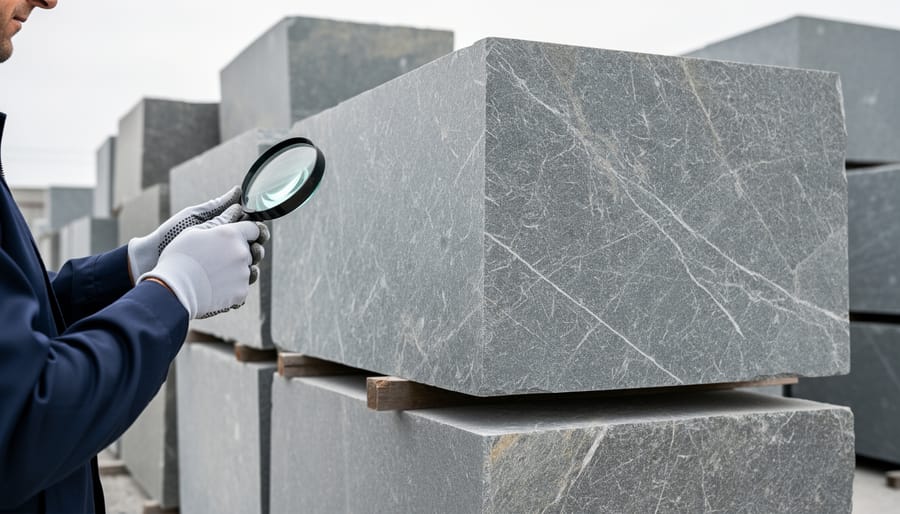
Visual and optical inspection remains the foundation of non-destructive testing in stone quarries, combining human expertise with cutting-edge technology. Trained inspectors examine freshly cut blocks for surface irregularities, color variations, and veining patterns that may signal internal weaknesses or structural concerns.
The human eye, when backed by years of experience, can detect subtle clues invisible to automated systems. Inspectors look for hairline cracks, variations in crystalline structure, and unusual mineral deposits that might compromise the stone’s integrity. These surface indicators often reveal what lies beneath, allowing professionals to predict how a block will perform during fabrication and installation.
Modern optical technologies enhance this traditional approach. High-resolution cameras, fiber-optic scopes, and specialized lighting systems help inspectors identify micro-fractures and evaluate depth penetration of surface flaws. Digital imaging allows for detailed documentation and comparison across multiple blocks, ensuring consistency in quality assessment.
Advanced techniques like photogrammetry create three-dimensional models of stone blocks, revealing surface topology and potential stress points. Infrared thermography detects temperature variations that indicate density differences or hidden voids. These tools work alongside visual inspection rather than replacing it, providing quantifiable data that supports expert judgment and helps quarries maintain rigorous quality standards before blocks enter production.
Acoustic Emission Testing
Acoustic Emission Testing (AET) represents one of the most sophisticated approaches to detecting hidden defects in stone blocks. This method works by using sensitive sensors to detect and analyze the high-frequency sound waves naturally emitted when materials experience internal stress. As microscopic cracks expand or existing fractures shift under load, they release energy in the form of acoustic waves—essentially, the stone “talks” about its structural weaknesses.
During quarry operations, technicians attach acoustic sensors to stone blocks and apply controlled stress, either through mechanical loading or thermal changes. The sensors pick up acoustic emissions that indicate active crack growth, delamination between layers, or other internal defects that might not be visible on the surface. Advanced software analyzes the frequency, amplitude, and location of these signals to map internal damage and predict where future fractures might occur.
What makes AET particularly valuable is its ability to assess dynamic processes rather than static conditions. Unlike ultrasonic testing that sends signals through the stone, acoustic emission passively listens to what the stone reveals under stress. This provides insights into how blocks will behave during cutting, transportation, and installation—critical information for high-value architectural projects where failure isn’t an option.
The technology proves especially useful for evaluating large-format slabs and complex stone varieties with natural variations. By identifying blocks with active defects before they leave the quarry, suppliers can prevent costly failures downstream and ensure that only structurally sound material reaches fabricators and end users.
Ground Penetrating Radar (GPR)
Ground Penetrating Radar represents one of the most sophisticated non-destructive testing technologies available for quarry operations today. This advanced method uses high-frequency electromagnetic waves to create detailed subsurface images of stone blocks, revealing internal structures, fractures, and anomalies that would otherwise remain hidden until cutting begins.
The GPR system works by transmitting radar pulses into the stone block and measuring the reflections that bounce back from different layers and features within the material. When the radar waves encounter changes in density, moisture content, or composition—such as cracks, voids, or mineral variations—they produce distinct signals that sophisticated software translates into visual maps. These detailed scans can penetrate several meters deep, making GPR particularly valuable for assessing large blocks destined for high-value architectural projects.
What sets GPR apart from other testing methods is its ability to create three-dimensional representations of a block’s interior structure. Quarry operators can identify problematic zones before investing in cutting and processing, significantly reducing waste and ensuring that only sound material reaches fabrication facilities. This technology proves especially useful for detecting hairline fractures that might not show visible surface indicators but could compromise the stone’s structural integrity once installed.
For architects and designers specifying natural stone for critical applications, understanding that suppliers use GPR technology provides confidence in material consistency and quality. The technology has become increasingly common in operations producing premium stone products, where the cost of the equipment is easily justified by the reduction in material loss and the ability to guarantee superior quality to clients.
Rebound Hammer Testing
Rebound hammer testing offers a straightforward, cost-effective method for evaluating stone block integrity at the quarry. This technique uses a spring-loaded hammer that strikes the stone surface, measuring how far it rebounds. The rebound distance correlates directly with the material’s surface hardness and compressive strength—harder, denser stone produces higher rebound values, while softer or damaged areas show lower readings.
Quarry technicians conduct multiple tests across different locations on each block, creating a hardness map that reveals inconsistencies. Significant variations between readings may indicate internal fractures, weathering, or compositional differences that could affect the stone’s structural performance. This testing method proves particularly valuable for identifying surface defects and verifying uniformity across large blocks before they’re processed.
The primary advantages include portability, speed, and minimal operator training requirements. However, surface moisture, texture, and carbonation can influence results, so technicians typically take multiple readings and average them for accuracy. While rebound hammer testing provides excellent preliminary assessment data, it works best when combined with other methods to ensure comprehensive quality evaluation of natural stone blocks.
What These Tests Actually Reveal
Non-destructive testing methods reveal a comprehensive picture of what lies beneath a stone block’s surface, identifying defects that could compromise performance long before the material reaches your project site. Understanding what these tests actually detect helps architects and consumers make informed decisions about stone quality and suitability.
Microcracks represent one of the most critical findings. These hairline fractures, often invisible to the naked eye, can propagate over time when subjected to freeze-thaw cycles or structural loads. Ultrasonic testing excels at detecting these microscopic flaws by measuring how sound waves travel through the stone matrix. When waves encounter even tiny discontinuities, the signal changes, revealing potential weak points.
Geological faults and bedding plane weaknesses are another major concern. These natural features, formed during the stone’s creation millions of years ago, can create planes of weakness within otherwise sound material. Ground-penetrating radar and seismic methods map these internal structures, allowing quarry operators to orient cuts strategically or reject blocks with unfavorable fault patterns.
Water infiltration pathways emerge as significant indicators of long-term durability. Moisture can enter through porous networks or interconnected fissures, leading to staining, efflorescence, or freeze damage in finished installations. Electrical resistivity testing identifies these moisture-prone zones by measuring how easily electrical current passes through the stone, since water dramatically affects conductivity.
Density variations and vein patterns also affect both aesthetics and structural performance. Inconsistent density can indicate areas of weathering or mineral alteration, while certain vein orientations may create visual appeal but structural vulnerability. Acoustic emission monitoring and radiographic imaging reveal these internal characteristics, enabling quality grading that matches stone blocks to appropriate applications based on their specific internal profiles.
Real-World Impact: From Quarry to Your Project
Consider the renovation of a high-end hotel lobby in Manhattan where imported marble began developing hairline cracks within eighteen months of installation. The investigation revealed internal micro-fissures that ultrasonic testing at the quarry would have detected before extraction. The replacement cost exceeded $400,000, not including business disruption and reputational damage.
Contrast this with a residential kitchen project in Colorado where the supplier provided documentation of comprehensive non-destructive testing performed on each block. Three years later, the Calacatta marble countertops remain flawless despite daily use and temperature fluctuations. The homeowner paid a modest premium upfront but avoided the devastating expense of premature failure.
Commercial applications demonstrate even more dramatic impacts. A commercial plaza in Texas specified granite pavers backed by quality assurance protocols including acoustic emission testing. The quarry identified and rejected blocks with internal weaknesses that would have failed under heavy foot traffic and weather exposure. Five years post-installation, the pavers show minimal wear while a neighboring project using untested stone required sections to be replaced within two years.
These examples illustrate a fundamental principle: investing in quarry-level testing represents insurance against costly failures. When fabricators and consumers demand documentation of non-destructive testing results, they create accountability throughout the supply chain. The upfront transparency protects everyone from the quarry operator to the end user, ensuring natural stone delivers the longevity and beauty it promises.
What This Means for Stone Buyers and Professionals
Whether you’re specifying stone for a major commercial project or selecting materials for your home, understanding a supplier’s testing protocols is essential to ensuring quality and longevity.
Start by asking quarry operators and stone suppliers specific questions about their quality control practices. What non-destructive testing methods do they employ before extraction? Can they provide documentation of ultrasonic or ground-penetrating radar assessments? Reputable suppliers should readily share information about their testing procedures and welcome these inquiries as signs of an informed buyer.
Look for quality certifications that indicate rigorous testing standards. Industry certifications from organizations like the Natural Stone Institute or regional stone associations often require documented testing protocols. Request technical data sheets that include density measurements, porosity levels, and absorption rates—all indicators that proper evaluation has occurred.
When reviewing samples, ask about the block’s origin within the quarry. Stones from well-tested blocks with documented integrity assessments are less likely to develop unexpected issues during fabrication or installation. Request information about any detected internal flaws and how they were identified and managed.
For larger projects, consider specifying that suppliers use verified non-destructive testing methods as part of your procurement requirements. This contractual language protects your investment and ensures accountability.
Finally, work with fabricators and installers who understand the importance of quarry-level testing. They can help interpret technical documentation and identify potential concerns before installation begins. By prioritizing properly vetted stone from the outset, you minimize the risk of costly replacements, structural failures, and aesthetic disappointments down the line.

Non-destructive testing represents the invisible shield protecting your natural stone investment from quarry to installation. These sophisticated yet practical methods ensure that every block leaving the quarry meets rigorous standards for structural integrity, aesthetic consistency, and long-term performance. By detecting internal flaws, variations, and potential weaknesses before cutting and fabrication, NDT saves time, reduces waste, and guarantees that the stone you select will deliver the beauty and durability you expect for decades to come.
The value of comprehensive quarry testing practices extends far beyond the extraction site. When quarries invest in ultrasonic testing, ground-penetrating radar, and other NDT technologies, they demonstrate a commitment to quality that directly benefits end users. This quarry-level diligence translates into fewer installation surprises, reduced maintenance costs, and confidence that your natural stone will maintain its stunning appearance throughout its lifespan. Whether you’re an architect specifying materials for a commercial project or a homeowner planning a kitchen renovation, understanding these testing methods empowers you to ask informed questions about sourcing and quality certifications, ultimately ensuring your natural stone delivers both immediate visual impact and enduring value.