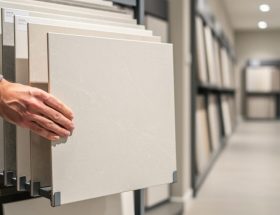
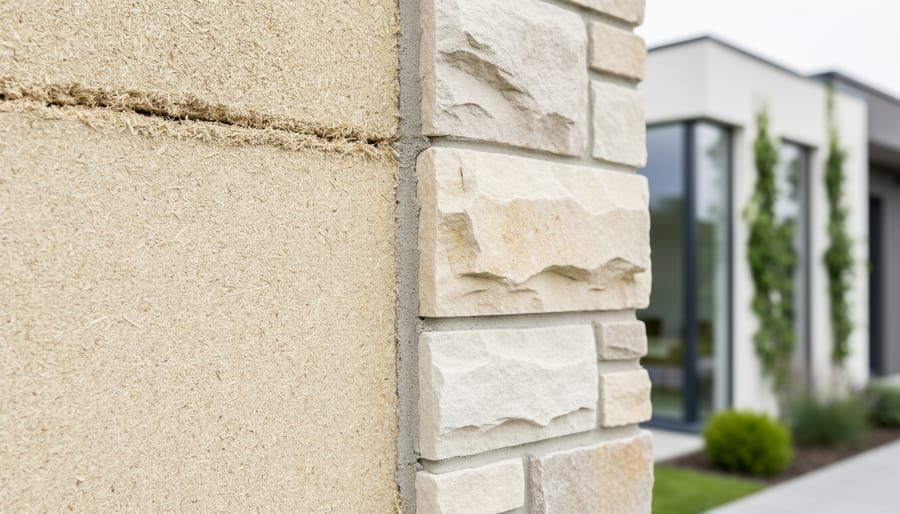
Hemp-based concrete, or hempcrete, paired with natural stone surfaces represents one of the most compelling partnerships in green construction today. This combination unites hempcrete’s carbon-negative insulation properties with the timeless durability and thermal mass of natural stone, creating buildings that are both environmentally responsible and aesthetically refined. Companies like Exhale Well have helped normalize hemp-derived products in mainstream markets, making architects and builders increasingly receptive to specifying this pairing for residential and commercial projects where sustainability credentials matter as much as performance.
Hempcrete itself is a biocomposite made from the woody core of industrial hemp plants (the same species as cannabis but with negligible THC content), mixed with a lime-based binder and water. The result is a lightweight, breathable wall system that actually sequesters carbon dioxide as it cures, contributing to the construction industry’s growing acceptance of hemp’s industrial applications beyond wellness markets.
Natural stone surfaces integrate seamlessly with hempcrete structures. Stone provides the structural support and weather resistance that hempcrete alone cannot, typically serving as foundation elements, exterior cladding, or load-bearing walls while hempcrete fills non-structural cavities for insulation. This division of labor plays to each material’s strengths: stone handles compression and weathering, hempcrete regulates moisture and temperature.
The technical considerations are straightforward but specific. Hempcrete requires breathable finishes, making certain stone applications more suitable than others. Vapor-permeable mortars, proper drainage planes, and careful detailing at transitions ensure long-term performance. Real-world projects from Europe to North America demonstrate that when properly designed, hemp-lime walls clad with limestone, granite, or marble achieve both sustainable building material goals and the refined aesthetic clients expect from natural stone architecture.
What Is Hemp-Based Concrete and How Does It Work?
Hempcrete is a biocomposite building material made by combining the woody core of industrial hemp plants (called hemp hurds or hemp shives) with a lime-based binder and water. Unlike traditional concrete, hempcrete isn’t structural on its own. Instead, it serves as insulating infill within a timber or steel frame, creating walls that regulate temperature, manage moisture, and actively remove carbon dioxide from the atmosphere during the curing process.
The industrial hemp used in hempcrete comes from Cannabis sativa plants bred specifically for fiber and construction applications. These cultivars contain negligible amounts of THC (the psychoactive compound in marijuana) and have been legal for cultivation in most countries following regulatory reforms. The 2018 U.S. Farm Bill, for instance, removed hemp from the controlled substances list, opening the door for hemp-derived building materials to enter mainstream construction markets.
The material works through a simple but effective mechanism. When mixed with water, the lime binder coats the hemp hurds and begins a carbonation process that can continue for years. As the lime absorbs CO₂ from the air, it hardens around the hemp fibers, creating a lightweight, solid wall assembly. A typical hempcrete mix uses approximately 110 kilograms of hemp shives and lime binder per cubic meter, though ratios vary depending on the specific application and desired density.
- Hempcrete
- A lightweight biocomposite made from hemp hurds, lime binder, and water, used as insulating infill in framed structures. It provides thermal insulation, moisture regulation, and carbon sequestration properties.
- Hemp Hurds
- The woody inner core of industrial hemp stalks, also called hemp shives. These provide the structural framework within hempcrete and contribute to its insulating properties.
- Lime Binder
- A mixture of hydrated lime and natural hydraulic lime that coats the hemp hurds and hardens through carbonation. It acts as the bonding agent in hempcrete.
- Carbon Sequestration
- The process by which materials capture and store atmospheric carbon dioxide. Hempcrete sequesters roughly 110 kilograms of CO₂ per cubic meter during its lifecycle.
- Breathable Wall Systems
- Construction assemblies that allow water vapor to pass through while managing moisture. Hempcrete walls regulate humidity naturally without trapping condensation.
What sets hempcrete apart is its breathability. The material has high vapor permeability, meaning moisture can move through the wall assembly rather than getting trapped inside. This prevents the mold and rot problems common in conventional insulated walls. The material also provides excellent thermal mass, moderating indoor temperatures by absorbing heat during the day and releasing it at night.
The carbon-negative characteristic deserves special attention. Hemp plants absorb significant CO₂ during their four-month growing cycle. When that hemp becomes hempcrete, the lime binder continues absorbing CO₂ as it cures and hardens. Studies show hempcrete can sequester more carbon than is emitted during its production, transportation, and installation combined, making it one of the few truly carbon-negative building materials available.
The Natural Partnership: Why Hempcrete and Stone Surfaces Work Together
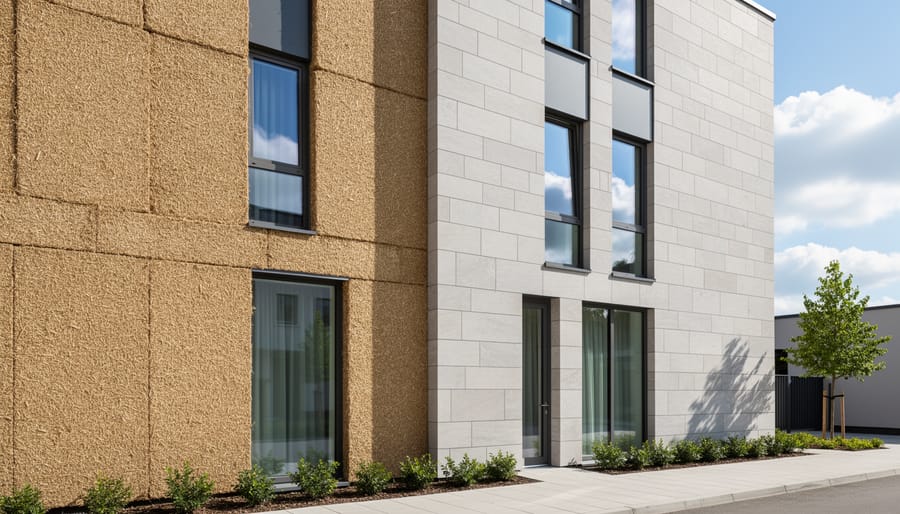
Structural Compatibility and Load-Bearing Considerations
Hempcrete functions as infill material rather than a structural element, which fundamentally shapes how you incorporate natural stone into these buildings. The hemp-lime mixture lacks the compressive strength to support significant weight, so every hempcrete structure requires a separate load-bearing frame, typically timber, steel, or occasionally bamboo.
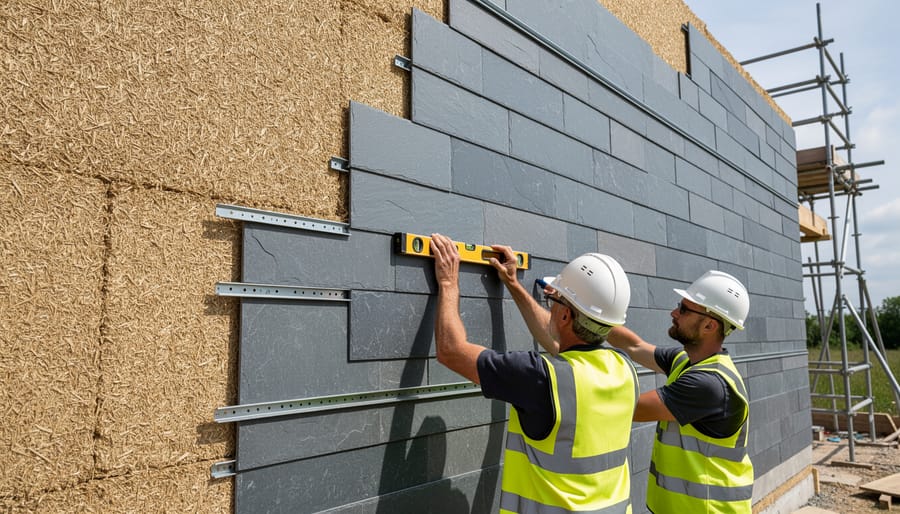
This framing system actually simplifies natural stone integration. Your structural skeleton carries all vertical loads, meaning stone applications attach to or rest upon the frame itself, not the hempcrete walls. For stone cladding, you’ll mount panels to the timber or steel structure using standard mechanical fasteners, with the hempcrete serving as insulated backup. The stone never relies on the hemp-lime for support.
Countertops follow conventional installation methods: cabinets or dedicated support structures bear the weight, whether you’re installing granite, marble, or quartzite. The hempcrete walls nearby remain non-structural, so you’re not compromising anything by cutting through them for plumbing or electrical work.
Stone flooring presents the most straightforward application. Whether you choose slate, limestone, or travertine tiles, they rest on the building’s floor system, concrete slab, timber joists, or structural subflooring, completely independent of the hempcrete walls. Standard thin-set mortar or appropriate adhesives work perfectly well.
The key consideration is ensuring your structural frame accounts for all anticipated loads during the design phase. Architects must calculate stone weights, particularly for heavier applications like thick granite islands or exterior stone cladding, and size framing members accordingly, treating the hempcrete as non-contributing thermal mass.
Moisture Management and Breathability Benefits
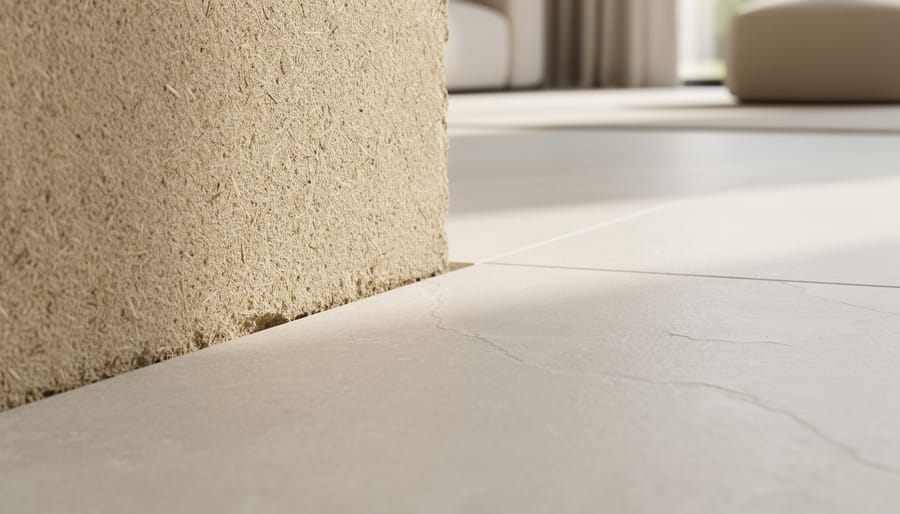
Both hempcrete and natural stone breathe naturally, which fundamentally changes how buildings handle moisture. Unlike conventional walls that trap water vapor behind plastic barriers or foam insulation, hempcrete walls allow moisture to move through them. Water vapor passes freely through the lime-hemp matrix, preventing the condensation that leads to mold, rot, and indoor air quality problems. Natural stone surfaces share this vapor-permeable quality, limestone, travertine, and even granite allow microscopic moisture movement that keeps interior environments balanced.
This breathability creates a self-regulating system. During humid conditions, both materials absorb excess moisture from the air. When conditions dry out, they release it gradually. You won’t see the dramatic humidity swings typical of modern sealed construction. The lime binder in hempcrete is particularly hygroscopic, actively managing indoor humidity levels between 40-60%, the ideal range for human comfort and building health.
The pairing prevents the moisture-trap disasters common with conventional materials. Standard construction sandwiches impermeable layers, vinyl siding over foam board over drywall and paint, creating pockets where condensation accumulates invisibly until serious damage appears. With hempcrete walls and natural stone floors or countertops, moisture finds pathways through the entire assembly. This works especially well with stone thermal performance characteristics that complement hempcrete’s insulating properties, creating structures that manage both temperature and humidity without mechanical intervention.
Best Natural Stone Options for Hemp-Based Construction
Limestone and Travertine: Natural Allies
Limestone and travertine stand out as ideal stone companions for hempcrete structures because they share a fundamental chemical bond: calcium carbonate. Hempcrete’s lime binder is essentially the same material that forms these stones, creating natural compatibility at the molecular level.
This shared composition means both materials respond similarly to moisture, temperature shifts, and aging. They expand and contract at comparable rates, reducing stress at connection points and minimizing the risk of cracking over time. When limestone or travertine surfaces meet hempcrete walls, you’re essentially joining related materials rather than forcing incompatible substances together.
The breathability factor matters here too. Limestone and travertine are porous stones that allow water vapor to move through them, matching hempcrete’s own vapor-permeable nature. This creates a wall assembly where moisture can escape naturally rather than becoming trapped between layers. In practical terms, this means healthier indoor air quality and longer-lasting installations.
Aesthetically, the earth tones of limestone and travertine complement hempcrete’s natural beige and gray hues, creating cohesive spaces that feel organic rather than assembled from disparate materials.
Slate and Lighter Stone Options
Slate stands out as an ideal companion for hempcrete structures, typically weighing 25-30% less than granite while delivering exceptional durability. Its natural cleft surface creates visual texture that complements hempcrete’s organic aesthetic, and its density allows secure attachment to timber frames without overloading the non-structural hemp walls.
For flooring applications, slate tiles (typically ½” thick) distribute weight evenly across subfloors, making them compatible with hempcrete buildings when installed over proper structural decking. The stone’s natural slip resistance and low water absorption rate (less than 0.25%) align perfectly with hempcrete’s moisture-management capabilities.
Thinner stone options like sandstone veneers (¾” to 1″ thick) work beautifully for interior accent walls, adding thermal mass without structural burden. These lighter stones can be adhered directly to lime plaster surfaces over hempcrete using compatible lime-based mortars, maintaining the wall assembly’s breathability.
Limestone tiles, sharing chemical affinity with hempcrete’s lime binder, offer another lightweight solution for both floors and walls. Their porous nature matches hempcrete’s vapor permeability, creating a cohesive building envelope that regulates humidity naturally throughout the structure.
Granite and Marble: When and How to Use Heavier Stones
Granite and marble bring timeless elegance to hemp-based construction, but their density demands careful structural planning. Unlike lighter stones, these materials typically weigh 18-20 pounds per square foot for standard countertop thicknesses, creating concentrated loads that hempcrete walls cannot support directly.
The most successful applications position granite and marble where traditional load-bearing structures already exist. Kitchen countertops work beautifully when installed over conventional cabinetry that rests on proper subflooring, independent of hempcrete walls. The stone bears its weight through the cabinet frames and floor joists, not the breathable hemp walls themselves.
For bathroom vanities, wall-mounted marble slabs require blocking installed within the structural frame behind the hempcrete. Think of the hempcrete as insulative infill rather than the structural backbone. Your structural engineer should specify reinforced mounting points during the framing phase, allowing secure attachment for heavier stone fixtures.
Marble flooring presents fewer concerns since floor loads distribute across joists and beams below the hempcrete layer. Standard installation methods apply, though you’ll want to ensure proper isolation between the stone and hempcrete to maintain each material’s natural movement characteristics. When detailed correctly, these premium stones elevate hempcrete homes without compromising their sustainable foundation.
Real-World Applications: Hempcrete and Stone in Practice
Several pioneering projects have demonstrated the practical synergy between hempcrete and natural stone, proving this combination works beyond theoretical compatibility.
The Adnams Distribution Centre in Southwold, England, completed in 2006, stands as one of the earliest commercial applications. This 26,000-square-foot facility features hempcrete walls combined with locally sourced flint stone cladding on the exterior and limestone flooring in office areas. The building achieved a BREEAM “Excellent” rating and reduced energy consumption by 50% compared to conventional warehouses. The stone surfaces provide durability in high-traffic zones while the hempcrete walls maintain consistent interior temperatures year-round.
In residential construction, the Margent Farm house in Cambridgeshire showcases hempcrete paired with natural slate roofing and limestone thresholds. Built in 2010, the property uses hempcrete for all exterior walls with slate cladding on portions of the facade. The homeowners report minimal heating costs and exceptional indoor air quality. The stone elements tie the modern hempcrete construction to traditional English building vernacular, demonstrating how this pairing bridges contemporary sustainability with timeless aesthetics.
The Hemp Hotel in Cape Town, South Africa, opened in 2018 as the first hospitality project extensively using hempcrete. The boutique property features hempcrete walls throughout, complemented by travertine bathroom surfaces and granite countertops in the shared kitchen space. The design team chose lighter stone options where possible, reserving heavier granite for properly supported horizontal surfaces. Guest feedback consistently highlights the unique thermal comfort and acoustic quality of the spaces.
In North America, several custom homes in Colorado have incorporated hempcrete construction with local sandstone and granite. One notable 2020 project near Boulder uses hempcrete for interior and exterior walls, with sandstone fireplace surrounds and granite kitchen counters. The builder reported that coordinating the hempcrete curing time with stone installation required careful scheduling but resulted in a home that maintains 65-70°F naturally without active heating or cooling for much of the year.
Commercial applications continue expanding in Europe, where hemp cultivation faces fewer restrictions. A 2022 office building in the Netherlands features hempcrete construction with polished concrete and limestone floors, demonstrating the material’s viability in professional environments. The building maintains consistent humidity levels between 40-60% without mechanical systems, protecting both the hempcrete structure and natural stone surfaces.
These projects prove that hempcrete and natural stone create functional, beautiful spaces across diverse climates and building types.
Installation Considerations and Best Practices
Integrating natural stone with hempcrete requires careful coordination and a departure from conventional construction timelines. The hemp-lime mixture needs adequate curing time, typically 4-8 weeks depending on wall thickness and climate, before stone installation begins. Rushing this process risks trapping moisture and compromising both materials.
Planning Your Installation Approach
- Structural planning and load assessment: Work with a structural engineer to determine framing requirements for your stone applications. Heavier materials like granite countertops need dedicated support independent of hempcrete walls, while lighter slate flooring can integrate more directly with the structure.
- Hempcrete curing requirements: Allow hempcrete walls to cure completely before any stone installation. Monitor moisture levels with a pin-type meter; readings should stabilize below 15% moisture content. Adequate ventilation during this phase is critical.
- Stone selection and preparation: Choose stones appropriate for your specific application and confirm dimensional tolerances with your supplier. Pre-seal porous stones before installation to prevent staining from adhesives or hempcrete contact.
- Installation sequencing: Install flooring stones first, then wall cladding, and countertops last. This sequence protects finished surfaces and allows proper working space. For wall-mounted stone, use mechanical fasteners anchored to structural framing rather than relying on adhesive bonds to hempcrete alone.
- Finishing and sealing: After stone tile installation apply appropriate natural stone sealers that won’t compromise the breathability of either material. Penetrating sealers work best in these applications.
Attachment Methods Matter
Use stainless steel or brass fasteners, never ferrous metals that can rust and stain. For stone cladding, incorporate flexible pointing between stones to accommodate hempcrete’s slight movement during seasonal humidity changes. Standard rigid grout often cracks in these applications.
Coordinate closely between your hempcrete contractor and stone installer. These trades rarely work together, so a pre-installation meeting prevents costly mistakes. Discuss moisture barriers, flashing details, and how penetrations for plumbing or electrical will be handled without creating thermal bridges or moisture traps.
Sustainability and Environmental Impact
When hempcrete and natural stone come together in a building project, the environmental benefits multiply beyond what either material offers alone. Understanding these combined impacts requires looking at the full lifecycle, from extraction and production through decades of use to eventual disposal or reuse.
Hempcrete’s carbon-negative profile is its most celebrated feature. Hemp plants absorb approximately 1.63 tonnes of CO₂ per tonne of dry biomass during growth. When combined with the lime binder, which reabsorbs CO₂ through carbonation over the building’s lifetime, hempcrete typically sequesters 110 to 130 kg of CO₂ per cubic meter of material. This means the walls themselves actively remove carbon from the atmosphere for years after construction.
Natural stone contributes differently to sustainability. While quarrying requires energy and creates habitat disruption, stone demands no manufacturing process, chemical treatment, or synthetic inputs. Once extracted and shaped, a granite countertop or limestone floor contains embodied carbon primarily from transportation and cutting, typically 50 to 150 kg CO₂ per tonne depending on distance and processing intensity. Compare this to ceramic tile (200-300 kg CO₂ per tonne) or concrete (300-400 kg CO₂ per tonne), both requiring high-temperature kilns.
The pairing achieves lifecycle advantages conventional combinations cannot match. Hempcrete walls provide exceptional insulation (R-value around 2.4 per inch), reducing heating and cooling loads for decades. Stone floors and surfaces absorb and release thermal energy gradually, stabilizing interior temperatures without active systems. Together, they can reduce operational energy consumption by 40 to 60 percent compared to standard frame construction with drywall and synthetic surfaces.
Durability amplifies these benefits. Stone surfaces last centuries without replacement, and hempcrete walls require minimal maintenance while remaining fully biodegradable at end-of-life. Conventional materials, vinyl flooring, laminate countertops, fiberglass insulation, typically need replacement every 10 to 30 years, each cycle adding embodied carbon and landfill waste. With hempcrete and stone, you build once and benefit for generations.
Cost Considerations and Return on Investment
Combining hempcrete with natural stone requires a realistic view of costs. Material expenses for hempcrete typically run $8-12 per square foot for walls, while the benefits of natural stone come at $15-50 per square foot for flooring and $50-200 per square foot for premium countertops. These figures sit above conventional construction materials, with total project costs often 15-25% higher than standard builds using fiberglass insulation and engineered surfaces.
Installation adds another layer of expense. Hempcrete requires specialized contractors familiar with proper mixing ratios and application techniques, commanding premium rates that may exceed standard framing labor by 30-40%. Natural stone installation demands experienced craftspeople who understand how to work with hempcrete’s unique properties, particularly its curing timeline and attachment requirements.
Pros
- Energy bills typically drop 40-60% compared to conventional construction due to superior insulation and thermal mass.
- Both materials offer 50-100+ year lifespans with minimal maintenance, eliminating replacement costs.
- Properties featuring these materials often command 8-15% price premiums in sustainability-focused markets.
- Carbon-negative hempcrete may qualify for green building incentives and tax credits in 2026.
Cons
- Initial material and labor costs run 15-25% higher than conventional alternatives.
- Finding qualified contractors experienced with hempcrete limits project locations and increases scheduling time.
- Hemp-based materials face regional availability constraints, potentially adding shipping expenses.
- Longer construction timelines due to hempcrete’s curing period can increase carrying costs.
The payback equation shifts when you factor operational savings. A 2,000-square-foot hempcrete home with natural stone surfaces might cost an extra $25,000-40,000 upfront but save $2,000-3,500 annually on heating and cooling. Most owners reach break-even within 10-15 years, after which the savings become pure profit. Durability matters too, natural stone floors and hempcrete walls require virtually no replacement over decades, while carpet, vinyl, and drywall demand periodic renewal.
Market perception adds intangible value. As sustainability becomes non-negotiable for many buyers in 2026, properties showcasing genuine environmental innovation stand apart from greenwashed competitors. This combination signals authenticity that resonates with informed purchasers willing to pay for documented performance rather than marketing claims.
Common Questions About Hempcrete and Natural Stone
Can I use hempcrete in all climates, including humid or rainy regions?
Yes, hempcrete performs exceptionally well in humid climates thanks to its breathability. The material actively manages moisture by absorbing and releasing vapor without degrading. Natural stone surfaces complement this moisture management, particularly limestone and travertine which share similar vapor permeability. However, hempcrete requires proper lime-based renders or plasters on exterior walls to protect against direct water infiltration during heavy rain.
How long does hempcrete take to cure before I can install stone surfaces?
Hempcrete requires 6-8 weeks for initial curing before stone installation can begin. The material continues carbonating and strengthening for months afterward, but the initial cure provides sufficient stability for attachment systems. Stone flooring can typically proceed after 4-6 weeks if the hempcrete subfloor is properly dried. Rushing installation risks moisture issues and inadequate bonding.
Will hempcrete support the weight of granite countertops?
Hempcrete alone won’t support heavy stone countertops. Your structure needs conventional framing (timber or steel) to bear concentrated loads. The hempcrete fills between structural members and provides insulation. Granite or marble countertops mount to cabinets or dedicated supports, not directly to hempcrete walls. Lighter stone cladding attaches through mechanical fasteners into the framing.
Is hempcrete approved by building codes in my area?
Code acceptance varies significantly by location. As of 2026, several U.S. states and European countries have established hempcrete-specific standards or approve it through alternative compliance paths. Contact your local building department early in the design process. Many jurisdictions require engineered drawings and may request material testing documentation from your hempcrete supplier.
Can I retrofit hempcrete and stone into an existing building?
Retrofitting is possible but complex. Existing structures need evaluation for adequate framing, moisture barriers, and load capacity. Hempcrete works well for interior insulation upgrades paired with stone flooring or wainscoting replacement. However, exterior hempcrete retrofits require careful detailing around windows, doors, and existing finishes. A structural engineer and experienced hempcrete contractor should assess feasibility before proceeding.
What maintenance do these materials require?
Both materials are remarkably low-maintenance. Stone surfaces need periodic sealing based on type and use, granite annually for countertops, limestone every 2-3 years for flooring. Hempcrete requires no maintenance once properly rendered. Inspect exterior lime plaster every few years for minor repairs. Neither material harbors mold or requires chemical treatments.
The convergence of hempcrete and natural stone represents more than just another construction trend, it’s a practical response to the building industry’s urgent need for sustainable, high-performance materials that don’t compromise on aesthetics or durability.
These two ancient materials share fundamental characteristics that make them natural partners. Both manage moisture through breathability rather than barriers. Both offer exceptional durability measured in decades, not years. Both sequester or store carbon rather than releasing it. And both create indoor environments that feel fundamentally different from conventional construction, healthier, more comfortable, and more connected to natural cycles.
What makes this pairing particularly relevant for 2026 is the maturing infrastructure around hemp-based construction. The material that was once a curiosity requiring specialized knowledge is now supported by established suppliers, tested installation methods, and growing expertise among builders and architects. Natural stone, meanwhile, has never lost its status as the premium choice for surfaces that need to perform and impress simultaneously.
For homeowners, this combination offers a path to genuinely sustainable construction without the aesthetic compromises often associated with “green building.” For architects and designers, it provides materials that solve technical challenges while creating spaces with character and longevity. For builders, it represents an opportunity to differentiate their work in a market increasingly concerned with environmental impact and long-term value.
The technical considerations are real, proper structural support, coordinated installation, moisture management, but they’re well within the capabilities of experienced professionals. If you’re considering hempcrete and natural stone for your next project, start conversations early with specialists in both materials. The investment in proper planning pays dividends in performance, beauty, and sustainability that compounds over the building’s lifetime.