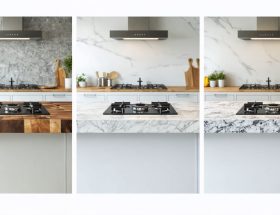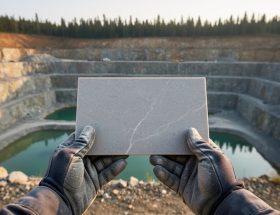
Quartz countertops cost between $50 and $150 per square foot installed, with most homeowners paying $75 to $100 per square foot for mid-range options. This pricing positions quartz as a premium countertop material, typically costing 10-30% more than granite but offering distinct advantages that justify the investment for many buyers.
The total cost depends on four primary factors: material quality and brand selection, where entry-level options like basic patterns start at $50 per square foot while luxury collections featuring realistic veining can exceed $150; edge profile complexity, with standard edges included in base pricing but decorative options like ogee or waterfall edges adding $10-30 per linear foot; installation requirements, including cutouts for sinks and cooktops at $100-200 each; and regional labor rates, which vary significantly between metropolitan and rural markets.
Understanding these cost components allows you to accurately budget your project and identify where to allocate resources for maximum value. Unlike natural stone countertops that require ongoing sealing and maintenance, quartz offers a different value proposition through its non-porous surface, consistent patterning, and minimal upkeep requirements. This comprehensive guide breaks down per-square-foot costs, compares quartz against alternative materials, and provides real-world pricing scenarios to help you determine whether quartz delivers the return on investment your project demands.
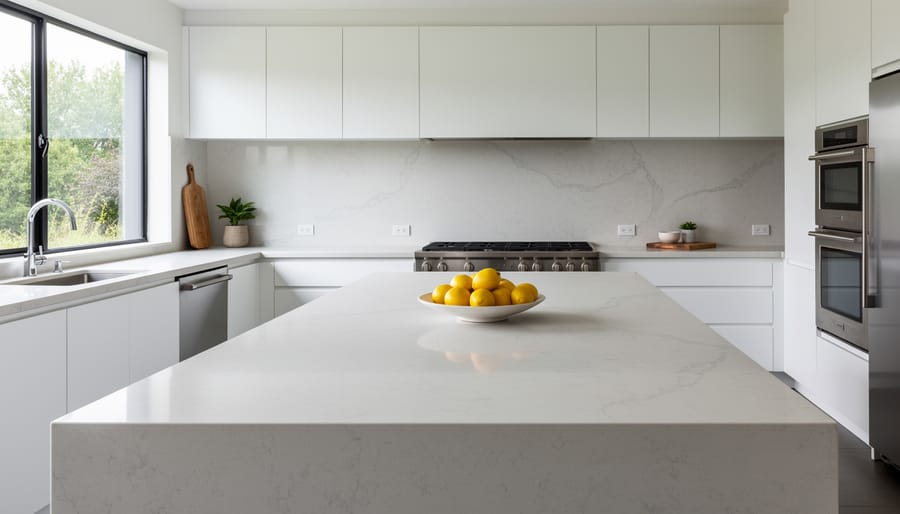
Current Quartz Countertop Pricing: What to Expect Per Square Foot
Material Costs by Quality Tier
Understanding quartz countertop costs requires familiarity with the three main quality tiers available in today’s market. Each tier offers distinct characteristics that justify its price point.
Entry-level quartz, priced between $40-60 per square foot, provides solid performance for budget-conscious buyers. These options typically feature simpler patterns, limited color selections, and thinner slabs (around 2cm). Brands in this category often use standard manufacturing processes with basic veining and solid colors. While aesthetically simpler, these countertops still deliver quartz’s core benefits: durability, low maintenance, and non-porous surfaces resistant to staining.
Mid-range quartz falls between $60-80 per square foot and represents the sweet spot for most homeowners. This tier includes more sophisticated patterns that better mimic natural stone, enhanced color depth, and improved consistency in veining. Manufacturers in this range invest in advanced digital imaging technology to create more realistic stone appearances. You’ll find popular brands offering 3cm thickness as standard, along with better warranties and more extensive color libraries.
Premium quartz, ranging from $80-150+ per square foot, delivers exceptional aesthetics and innovation. These top-tier products feature cutting-edge designs, including dramatic veining that closely replicates rare marble and granite varieties. Premium options often incorporate larger format slabs (reducing seams), innovative finishes like leathered or honed textures, and proprietary technologies for enhanced performance. Some luxury brands also offer customization options and extended warranties, making them ideal for high-end residential projects and commercial applications where aesthetics are paramount.
Installation and Additional Fees
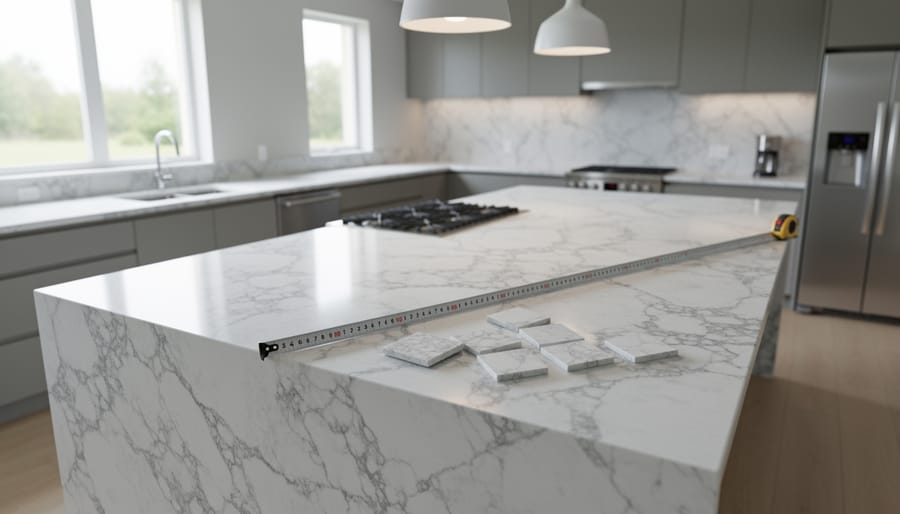
Understanding countertop installation costs beyond the material price per square foot is essential for accurate budgeting. Professional installation typically adds $35 to $85 per square foot to your total project cost, depending on job complexity and regional labor rates.
Edge treatments significantly impact the final price. Standard edges like eased or beveled come included with most fabricators, while premium profiles such as ogee, dupont, or waterfall edges add $10 to $30 per linear foot. Custom edge designs can increase costs further.
Sink cutouts represent another common expense, ranging from $100 to $300 per cutout depending on sink type. Undermount sinks require more precise cutting and polishing than drop-in models, affecting the price. Cooktop cutouts follow similar pricing structures but may cost slightly more due to exact specifications required.
Backsplash installation adds $40 to $70 per square foot when using matching quartz material. This includes both fabrication and installation labor. A standard four-inch backsplash costs less than a full-height option extending to upper cabinets.
Additional fees often include seam placement for larger countertops, typically $150 to $300 per seam, and removal of existing countertops at $100 to $300. Some fabricators charge trip fees for measurements and template creation, ranging from $75 to $200. Always request itemized quotes to understand exactly where your investment goes and avoid unexpected charges during project completion.
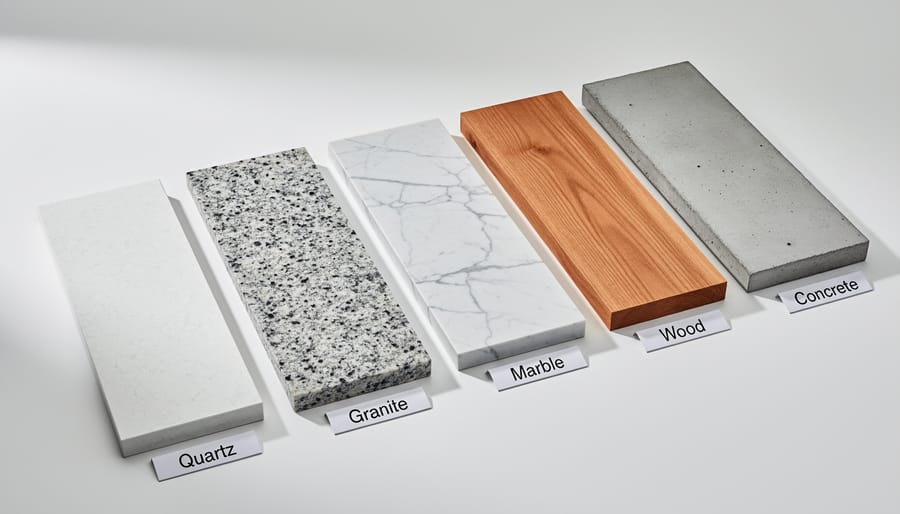
The Complete Cost-Benefit Comparison: Quartz vs. Other Countertop Materials
Quartz vs. Granite: The Closest Competition
When it comes to premium countertop materials, quartz and granite remain the top contenders for most homeowners. Understanding their differences helps you make an informed investment decision.
Cost-wise, the materials are remarkably similar. Granite typically ranges from $40 to $100 per square foot installed, while quartz falls between $50 and $120 per square foot. Mid-range options from both materials hover around $60-80 per square foot, making initial investment nearly identical for comparable quality levels.
The quartz versus granite durability debate reveals important distinctions. Both materials resist scratches and heat effectively, but quartz edges ahead in maintenance requirements. Granite needs annual sealing to prevent staining, while quartz remains non-porous and never requires sealing. This translates to lower lifetime maintenance costs for quartz.
From an aesthetic standpoint, granite offers unique, one-of-a-kind natural patterns that appeal to homeowners seeking organic beauty. Quartz provides more consistent patterns and broader color options, including solid hues impossible to achieve with natural stone.
Resale value remains strong for both materials. Real estate professionals report that premium countertops—whether quartz or granite—typically recoup 70-85% of their installation costs during home sales. The deciding factor often comes down to personal preference: choose granite for irreplaceable natural variation or quartz for predictable appearance and zero-maintenance convenience.
Quartz vs. Marble: Beauty vs. Practicality
Marble countertops captivate with their timeless elegance and unique veining patterns that form naturally over millions of years. Each slab tells a geological story, offering one-of-a-kind beauty that engineered quartz cannot replicate. However, this natural splendor comes with practical considerations that directly impact long-term costs.
Quartz countertops provide engineered durability that resists staining, scratching, and etching without requiring sealing. This translates to minimal maintenance expenses over the material’s lifespan. Marble, while stunning, is a porous, calcium-based stone vulnerable to acidic substances like lemon juice, wine, and vinegar. These can etch the surface permanently, requiring professional restoration that costs $200 to $500 per incident.
The marble maintenance requirements include regular sealing every six to twelve months at approximately $100 to $200 per application, plus specialized cleaning products. Over a 15-year period, marble maintenance can add $2,000 to $4,000 to your initial investment.
For homeowners prioritizing practicality and lower lifetime costs, quartz delivers superior value. However, design purists who appreciate marble’s authentic natural character may find the additional maintenance worthwhile for the unmatched aesthetic it provides.
Quartz vs. Budget Alternatives
When comparing quartz to budget-friendly alternatives, understanding the cost-to-value relationship helps determine which material best fits your project needs.
Laminate countertops cost $10-50 per square foot installed, making them the most economical option. While laminate has improved dramatically in appearance, it lacks heat resistance, scratches easily, and typically lasts 10-15 years. For temporary solutions or rental properties, laminate makes financial sense. However, for primary residences where you plan to stay long-term, quartz’s 25-30 year lifespan and superior durability often justify the higher initial investment.
Solid surface materials like Corian range from $50-100 per square foot installed, positioning them between laminate and mid-range quartz. These offer seamless installations and repairability but don’t match quartz’s hardness or heat resistance. They work well for bathrooms and laundry rooms where extreme durability isn’t essential.
Butcher block costs $40-100 per square foot installed and provides warmth and character that engineered materials can’t replicate. However, it requires regular maintenance, doesn’t tolerate moisture well, and needs refinishing every few years. Consider butcher block for kitchen islands or accent areas rather than primary work surfaces.
Quartz justifies its premium in high-traffic kitchens, homes with young children, or properties where resale value matters. The material’s virtually maintenance-free nature and consistent long-term performance eliminate the hidden costs of repairs, refinishing, and early replacement that budget options often require.
Lifetime Cost Analysis
Understanding total ownership costs provides crucial perspective beyond initial installation expenses. Over a 10-year period, quartz countertops typically cost between $3,500 and $8,000 for a standard kitchen, including installation ($3,000-$7,500) plus minimal annual maintenance ($50-100 for specialized cleaners). The sealed, non-porous surface requires no professional sealing or special treatments, making ongoing costs predictable and low.
Granite presents similar upfront costs ($2,500-$7,000 installed) but requires annual sealing ($100-300 if professionally done) and potential repair for chips or cracks ($200-500 per incident). Over 10 years, total granite ownership ranges from $4,000 to $10,000, depending on maintenance consistency.
Marble demands significantly higher long-term investment. Initial costs run $3,500-$10,000, with frequent sealing requirements (twice yearly at $150-400 each), stain treatments ($200-600), and potential refinishing ($500-1,500 every 5-10 years). Twenty-year marble ownership can exceed $15,000-$20,000.
Laminate offers the lowest entry point ($800-2,500) but typically requires replacement within 10-15 years due to wear, water damage, or delamination, effectively doubling costs. Quartz’s durability and low maintenance make it cost-competitive over extended timeframes, particularly when comparing against materials requiring professional upkeep or premature replacement.
The Hidden Costs and Long-Term Value of Quartz
Maintenance Cost Savings Over Time
Quartz countertops deliver substantial maintenance cost savings compared to natural stone options like granite and marble. While these savings may seem modest annually, they compound significantly over the typical 15-20 year lifespan of kitchen countertops.
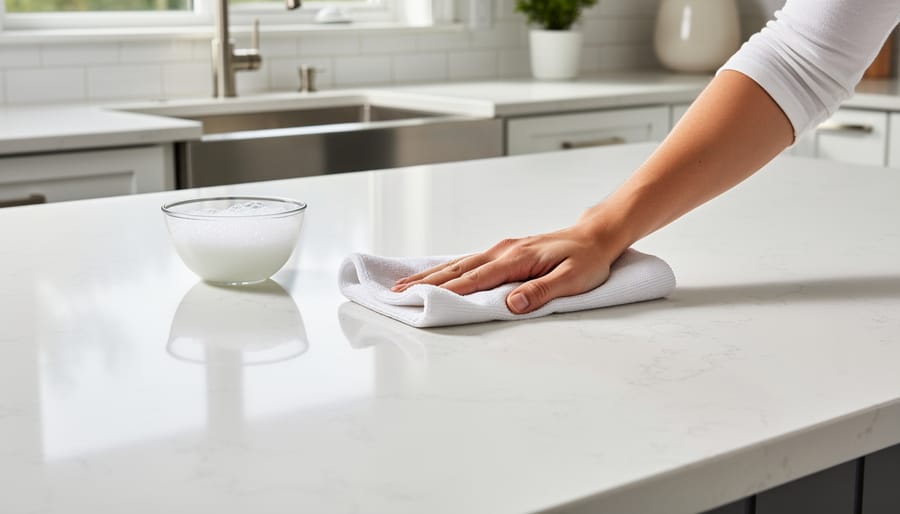
Natural stone countertops require professional sealing every 1-3 years, costing between $150-$300 per application. Over 20 years, this maintenance alone totals $1,000-$3,000. Quartz requires no sealing whatsoever due to its engineered, non-porous surface.
Specialized cleaning products represent another ongoing expense. Natural stone demands pH-neutral cleaners specifically formulated for stone surfaces, averaging $8-$15 per bottle with monthly replacement. Standard household cleaners work perfectly on quartz, saving approximately $100-$180 annually, or $2,000-$3,600 over two decades.
Repair costs favor quartz as well. While both materials can chip or crack under extreme impact, natural stone is more susceptible to staining and etching from acidic substances like lemon juice or wine. Professional stain removal and honing services for natural stone range from $200-$600 per incident. Quartz’s stain resistance virtually eliminates these emergency repair expenses.
Conservative estimates show quartz owners save $3,500-$7,000 in maintenance costs over 20 years compared to natural stone alternatives, offsetting much of the initial price difference and improving the overall value proposition.
ROI and Home Resale Considerations
Quartz countertops typically deliver a moderate return on investment, recouping approximately 50-70% of their installation cost at resale. This positions them competitively within kitchen upgrades, though actual returns depend on your local market, overall home value, and installation quality.
From a resale perspective, quartz appeals to modern homebuyers who prioritize low-maintenance materials and contemporary aesthetics. Real estate professionals consistently note that updated kitchens with quality countertops—whether quartz, granite, or marble—significantly reduce time on market and increase buyer interest. However, the premium you paid for quartz over laminate rarely translates dollar-for-dollar at sale.
The real value proposition extends beyond pure ROI calculations. Consider that quartz countertops typically last 15-25 years with minimal maintenance, requiring no sealing unlike natural stone alternatives. When you factor in the avoided costs of periodic sealing, repairs, and replacements associated with less durable materials, the lifetime value becomes more compelling.
For homeowners planning to stay in their residence 5-10 years or longer, the return on investment should be measured in daily utility and enjoyment rather than resale metrics alone. The durability, stain resistance, and ease of maintenance translate to tangible lifestyle benefits that spreadsheets cannot capture.
Industry professionals note that quartz performs best in mid-range to upper-mid-range homes where buyers expect quality finishes. In luxury markets, natural stone options may command higher perceived value, while budget-conscious markets may not fully reward the quartz premium. Align your countertop investment with your home’s overall value bracket for optimal returns.
When Quartz Makes Financial Sense (And When It Doesn’t)
Best-Case Scenarios for Quartz Investment
Quartz countertops deliver exceptional value in specific scenarios where durability, low maintenance, and long-term performance justify the investment. Understanding these situations helps determine if quartz aligns with your priorities and budget.
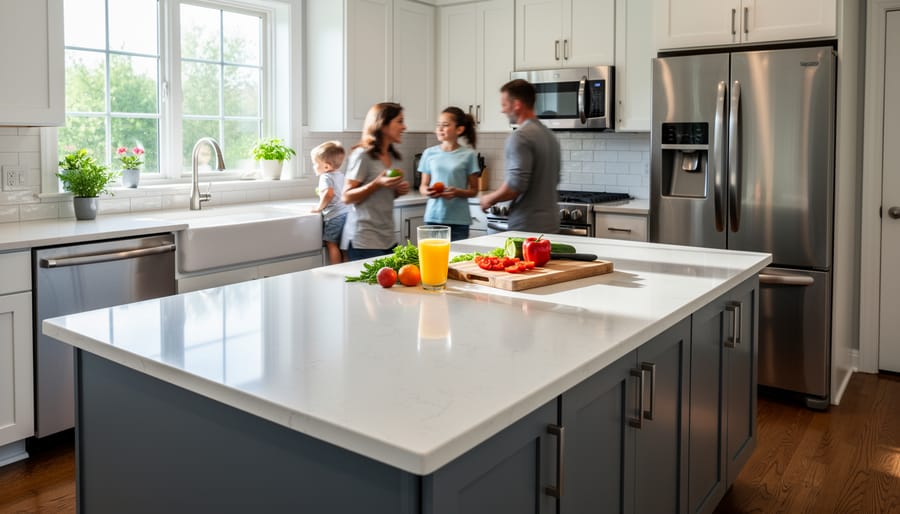
Busy families with young children benefit significantly from quartz’s non-porous surface, which resists staining from juice spills, crayon marks, and food mishaps. Unlike natural stone that requires periodic sealing, quartz needs only soap and water for daily cleaning, saving time and eliminating maintenance costs over the countertop’s lifespan.
Rental property owners find quartz particularly cost-effective for tenant turnover situations. The material withstands heavy use without showing wear, requires no special care instructions for renters, and maintains its appearance between leases. While the upfront cost per square foot exceeds laminate alternatives, the reduced replacement frequency and minimal maintenance create superior long-term returns on investment.
High-traffic kitchens where cooking happens daily benefit from quartz’s resistance to heat damage, scratches, and bacterial growth. Home chefs who prep meals frequently appreciate the consistent, worry-free surface that doesn’t require the careful attention natural stone demands.
Resale considerations also favor quartz in mid-range to upper-mid-range home markets. Real estate data shows modern buyers actively seek low-maintenance materials, and quartz countertops often recoup 70-80 percent of installation costs in added home value. The material’s contemporary aesthetic appeals to design-conscious buyers who view updated kitchens as purchase priorities, making quartz a strategic investment when planning to sell within five to ten years.
When to Consider Alternatives
While quartz offers excellent value for many homeowners, certain situations may warrant exploring alternatives. If you’re working with a particularly tight budget, laminate countertops provide a durable, attractive option at $10-$40 per square foot installed—significantly less than even entry-level quartz. For budget-conscious projects, these modern laminates have improved dramatically in both appearance and longevity.
Design purists seeking the authentic veining and depth of natural stone may find greater satisfaction with granite or marble, despite quartz’s realistic patterns. Natural stone offers unique character that engineered materials cannot fully replicate, making it ideal for homes where distinctive aesthetics justify the additional maintenance requirements.
Low-traffic spaces like laundry rooms, outdoor kitchens, or secondary bathrooms might not require quartz’s premium durability. In these areas, tile, butcher block, or solid surface materials can deliver adequate performance at lower price points, allowing you to allocate your budget toward high-impact spaces.
Consider alternatives if you prioritize heat resistance beyond quartz’s limitations. Granite and soapstone naturally withstand higher temperatures, making them preferable for avid cooks who frequently work with hot cookware.
Finally, if you’re committed to sustainability and prefer materials with minimal processing, natural stone options require less manufacturing energy than engineered quartz. While both have environmental considerations, some homeowners prioritize materials closer to their natural state. Evaluating your specific priorities—budget constraints, aesthetic preferences, functional requirements, and lifestyle needs—will guide you toward the countertop material that delivers optimal value for your unique situation.
Smart Shopping Strategies to Maximize Value
Getting the best value on quartz countertops requires strategic planning and informed decision-making. Start by timing your purchase during off-peak seasons, typically late fall through early spring, when fabricators have more capacity and may offer competitive pricing to maintain steady workflow.
Request detailed quotes from at least three fabricators, ensuring each breakdown includes material costs, fabrication, edge profiles, cutouts, and installation. This transparency allows you to compare accurately and identify where costs may be negotiable. Many fabricators bundle services, so ask about package pricing that might reduce overall expenses.
Consider selecting popular quartz colors and patterns rather than premium or designer collections. Mid-range options often provide identical durability and performance at 30-40% lower costs. Remnants from larger projects can work exceptionally well for smaller installations like bathroom vanities or kitchen islands, sometimes reducing material costs by half.
Simplify your edge profile selection. Standard edges like eased or quarter-round cost significantly less than elaborate profiles such as ogee or waterfall edges, which require additional fabrication time. Similarly, minimize the number of seams by working with your fabricator to optimize slab layout, reducing both material waste and labor costs.
Negotiate directly with fabricators rather than through big-box retailers, who typically add markup to cover overhead. Local fabricators often have more flexibility on pricing and can provide personalized service. Ask about cash discounts, which some businesses offer to reduce credit card processing fees.
Avoid unnecessary upgrades like integrated sinks or elaborate backsplashes unless they fit your budget comfortably. Focus investment on the countertop surface itself, where quality directly impacts longevity. Finally, verify what warranty coverage includes and confirm the fabricator’s experience level, as proper installation prevents costly repairs that can negate any initial savings.
When evaluating quartz countertops at $50 to $120 per square foot installed, the investment extends far beyond the initial price tag. While natural stones like granite may cost slightly less upfront in some cases, quartz delivers exceptional value when you factor in its minimal maintenance requirements, impressive durability, and consistent performance over decades of use.
The decision ultimately comes down to your specific circumstances. If you prioritize low maintenance and worry-free ownership, quartz justifies its cost through eliminated sealing expenses and reduced replacement risk. For those working with tighter budgets, entry-level quartz options starting around $50 per square foot offer excellent quality without premium pricing. Conversely, if you’re drawn to the unique character and natural variation of stone, alternatives like granite or marble might better align with your aesthetic vision despite different maintenance needs.
Consider your lifestyle honestly. Do you cook frequently? Have young children? Prefer minimal upkeep? Quartz excels in these scenarios. Calculate not just immediate costs but projected expenses over 15 to 20 years, including maintenance, repairs, and potential replacement. For most homeowners, quartz represents a sound investment that balances upfront affordability with long-term value, making it a practical choice that won’t disappoint.