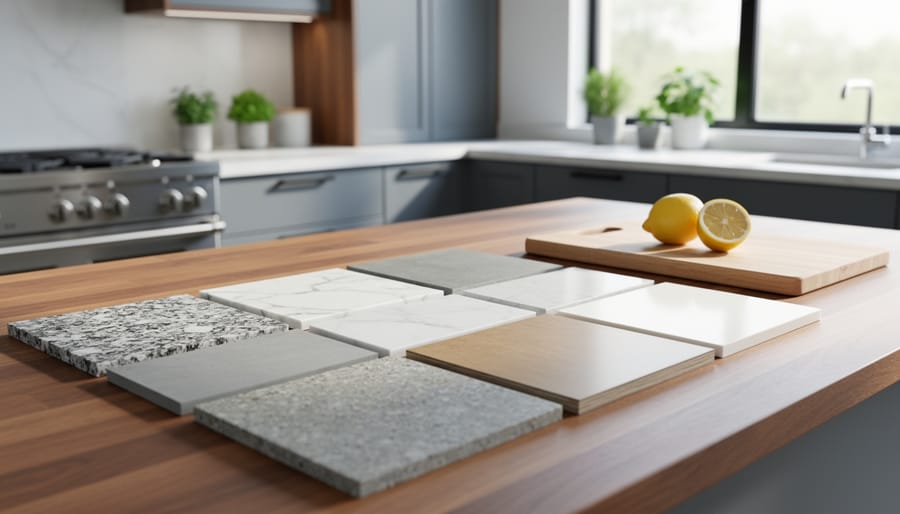
Your kitchen countertop choice will impact your daily life for decades, influencing everything from meal preparation efficiency to home resale value. With costs ranging from $15 to $300+ per square foot installed, understanding the differences between granite, quartz, marble, quartzite, butcher block, laminate, concrete, and solid surface materials prevents costly mistakes and buyer’s remorse.
Each material brings distinct advantages and limitations. Natural stones like granite and marble offer timeless beauty with unique patterns that synthetic materials cannot replicate, while engineered quartz provides consistency and low maintenance. Budget-friendly laminates have evolved dramatically in appearance, yet lack the durability and heat resistance of stone alternatives. Butcher block adds warmth but requires regular sealing, and concrete delivers industrial aesthetics with significant weight considerations.
The right choice depends on your specific priorities. Heavy cooking demands heat-resistant, stain-proof surfaces. Busy families need materials that withstand impact and require minimal upkeep. Design enthusiasts may prioritize unique veining and color variation. Budget constraints, lifestyle habits, and long-term home plans all factor into this decision.
This comprehensive comparison examines eight major countertop materials across durability, maintenance requirements, cost analysis, aesthetic qualities, and practical performance. You’ll discover which materials resist scratching and staining, which require professional installation, and how each option performs under real-world kitchen conditions. Understanding these differences ensures your investment aligns with both your immediate needs and future expectations, transforming your kitchen into a functional space that reflects your personal style.
How to Choose the Right Countertop Material for Your Needs
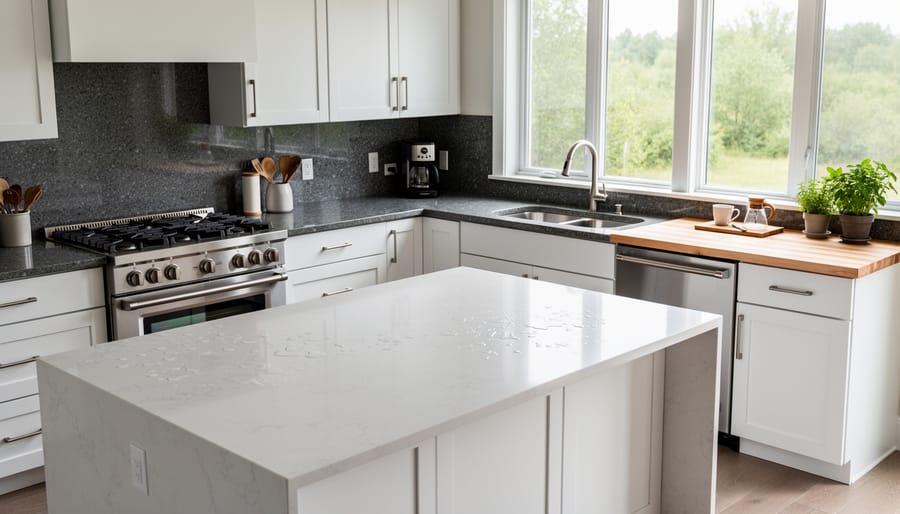
Key Factors to Consider
When choosing the right material for your kitchen countertops, several critical factors will influence both your immediate satisfaction and long-term experience.
Durability varies significantly across materials. Natural stone options like granite and quartzite rank among the hardest surfaces, resisting scratches and chips effectively. Marble offers timeless beauty but requires more careful handling. Engineered quartz provides consistent durability, while softer materials like soapstone and butcher block develop a natural patina over time.
Maintenance requirements range from minimal to demanding. Granite and quartzite need periodic sealing but handle daily use easily. Marble requires more diligent care to prevent etching from acidic substances. Quartz demands virtually no maintenance beyond regular cleaning, making it ideal for busy households.
Cost considerations extend beyond initial investment. Granite typically ranges from moderate to high-end pricing, depending on rarity and origin. Marble and quartzite often command premium prices. Quartz falls in the mid-to-high range, while laminate and tile offer budget-friendly alternatives. Factor in installation complexity and long-term maintenance costs for accurate total ownership expenses.
Heat resistance is crucial for cooking enthusiasts. Natural stone materials withstand hot pots and pans effectively, though trivets remain recommended. Quartz can discolor or crack under extreme heat exposure.
Stain resistance depends largely on porosity. Properly sealed natural stone performs well, while quartz naturally resists staining. Marble’s porous nature makes it more susceptible without vigilant sealing.
Aesthetic versatility allows for personalized design expression. Each material offers unique visual characteristics, from granite’s dramatic veining to quartz’s consistent patterns, ensuring options for every design vision.
Matching Materials to Kitchen Usage
Your cooking habits and lifestyle should directly influence your countertop choice. For households with heavy cooking routines, granite and quartzite offer superior heat resistance, allowing you to place hot pots directly on the surface without worry. These materials also withstand the wear from frequent knife work and food preparation better than softer options.
Families with young children benefit from forgiving surfaces like granite that hide minor scratches and don’t show every fingerprint. Avoid materials requiring constant vigilance about spills, such as unsealed marble or porous concrete. For frequent entertainers, consider larger slabs of natural stone that minimize seams and create stunning visual focal points while providing ample prep space.
Light users who rarely cook extensively can explore more delicate options like marble, accepting its maintenance requirements in exchange for unmatched elegance. Similarly, weekend cooks might prioritize aesthetics over durability. Assess your honest usage patterns rather than aspirational habits when making this significant investment in your kitchen’s functionality and longevity.
Natural Stone Countertops: Granite, Marble, and Quartzite
Granite Countertops
Granite has long been a premier choice for kitchen countertops, prized for its exceptional durability and timeless appeal. This natural stone ranks 6-7 on the Mohs hardness scale, making it highly resistant to scratches, chips, and everyday wear. When properly sealed, granite countertops can last a lifetime, often outlasting the kitchen itself.
One of granite’s most significant advantages is its outstanding heat resistance. You can place hot pots and pans directly on the surface without causing damage, though using trivets remains a recommended practice. This makes granite particularly suitable for avid cooks and busy households where kitchen efficiency matters.
The aesthetic versatility of granite is remarkable. Available in hundreds of colors and patterns—from subtle whites and grays to dramatic blacks, blues, and reds—each slab is unique. Natural variations in veining and mineral deposits ensure no two countertops are identical, adding distinctive character to any kitchen design.
Sealing is the primary maintenance requirement for granite. Most installations need resealing every 1-3 years, depending on the specific stone type and usage patterns. This process is straightforward and takes minimal time. Our comprehensive granite buying guide provides detailed information on selecting and maintaining your countertops.
Cost typically ranges from $40-$100 per square foot installed, positioning granite in the mid-to-upper price range. Premium exotic varieties can exceed this range, while common colors remain more affordable.
A common misconception is that granite requires intensive daily maintenance. In reality, routine cleaning with mild soap and water is sufficient. Another myth suggests granite harbors bacteria, but properly sealed granite is non-porous and highly sanitary.
Granite excels in high-traffic kitchens, outdoor applications, and spaces where durability and natural beauty are priorities.
Marble Countertops
Marble countertops have adorned kitchens for centuries, offering timeless elegance that few materials can match. The natural veining patterns created by mineral deposits make each slab unique, with color variations ranging from classic white Carrara to dramatic Calacatta and warm Emperador tones. This inherent beauty makes marble a preferred choice for homeowners seeking sophisticated aesthetics.
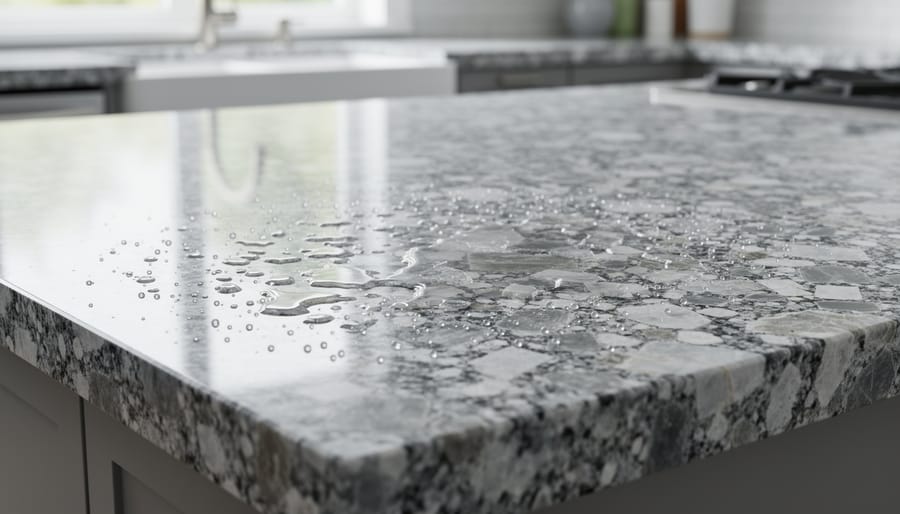
However, understanding marble’s characteristics is essential when selecting marble countertops. As a softer, more porous natural stone, marble requires different care than granite or quartz. The calcium carbonate composition makes it susceptible to etching from acidic substances like lemon juice, vinegar, or wine. These reactions create dull spots rather than stains, appearing as lighter areas on the surface.
Proper sealing is crucial for marble countertops, typically required every 6-12 months depending on usage. Quality sealers protect against staining but cannot prevent etching, which is a chemical reaction rather than absorption. Many homeowners embrace these natural changes as part of marble’s evolving patina, viewing them as character rather than damage.
Cost varies significantly based on marble type and origin, generally ranging from $75-$250 per square foot installed. Rare varieties with dramatic veining command premium prices.
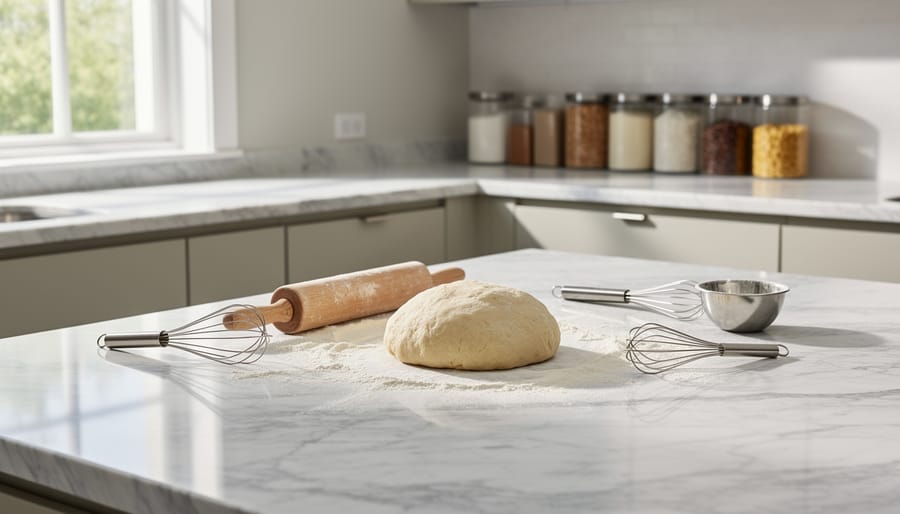
Marble excels in specific kitchen applications. Baking enthusiasts particularly appreciate marble’s naturally cool surface, ideal for working with pastry dough and chocolate. Installing marble in dedicated baking zones while using more durable materials elsewhere offers practical compromise.
The etching myth requires clarification: etching is manageable with reasonable precautions. Using cutting boards, coasters, and promptly wiping spills prevents most issues. Professional honing can restore etched surfaces, and many homeowners find the maintenance worthwhile for marble’s unparalleled beauty and the sophisticated ambiance it creates.
Quartzite Countertops
Quartzite is a natural metamorphic stone frequently mistaken for engineered quartz due to their similar names, yet they are entirely different materials. Formed when sandstone undergoes intense heat and pressure deep within the earth, quartzite develops exceptional hardness that rivals granite, making it one of the most durable natural stones available for countertops.
The material’s natural beauty is striking, featuring dramatic veining and color variations ranging from pure white and soft grays to warm golds and cool blues. Each slab is genuinely unique, offering the authentic character that only natural stone can provide. This distinctive appearance has contributed significantly to quartzite’s rising popularity among homeowners and designers seeking sophisticated, high-end aesthetics.
Quartzite excels in heat resistance, allowing hot pots and pans to be placed directly on the surface without damage. Its dense composition also makes it highly resistant to scratches and etching, outperforming many other natural stones in daily durability tests.
However, quartzite requires periodic sealing, typically once or twice yearly, to maintain stain resistance. This maintenance requirement is essential since the stone is naturally porous. When properly sealed, quartzite handles everyday spills and use remarkably well.
Price positioning falls in the premium range, generally comparable to or slightly higher than high-end granite, typically between 60 to 120 dollars per square foot installed. The investment reflects both the material’s exceptional performance characteristics and its limited availability compared to more common stone options. As awareness grows about quartzite’s superior durability combined with natural beauty, it continues gaining market share among discerning buyers seeking long-lasting elegance.
Engineered and Manufactured Materials
Quartz (Engineered Stone)
Engineered stone countertops consist of 93-95% crushed natural quartz crystals combined with polymer resins and pigments, creating a manufactured surface that bridges the gap between natural stone and synthetic materials. This composition yields a dense, uniform product that addresses some of natural stone’s traditional limitations while introducing its own considerations.
The primary advantage of quartz surfaces lies in their non-porous structure. Unlike granite or marble, quartz requires no sealing and resists staining from wine, coffee, and acidic substances without special treatment. This characteristic makes maintenance remarkably straightforward—routine cleaning with mild soap and water is typically sufficient. For busy households or commercial kitchens, this ease of care represents significant value.
Color consistency distinguishes quartz from natural stone options. Manufacturing processes allow precise control over patterns and hues, ensuring slabs match perfectly across large installations. This predictability appeals to designers seeking specific aesthetic outcomes, though some homeowners prefer natural stone’s inherent variation and organic beauty.
Heat resistance presents quartz’s most significant limitation. Polymer resins can discolor or damage when exposed to temperatures above 300 degrees Fahrenheit, requiring trivets and hot pads for cookware. Natural stones like granite tolerate direct heat exposure far better, an important consideration for serious cooks.
Cost positioning varies considerably based on brand and design complexity. Entry-level quartz typically starts around $50-70 per square foot installed, while premium collections reach $100-150 or higher. For comprehensive quartz pricing details, factor in edge treatments and installation complexity alongside material costs.
Sustainability considerations include the energy-intensive manufacturing process and petroleum-based resins, though many manufacturers now incorporate recycled content and implement responsible sourcing practices. The material’s durability and longevity help offset initial environmental impacts through decades of service life.
Solid Surface (Corian)
Solid surface countertops, commonly known by the brand name Corian, are engineered materials made from acrylic polymers and natural minerals. Their primary advantage lies in seamless installation—sheets can be joined together with inconspicuous seams and molded into integrated sinks and backsplashes, creating a continuous, hygienic surface ideal for modern kitchen designs.
One of solid surface’s most valuable features is repairability. Minor scratches, burns, and stains can be sanded out, effectively renewing the surface without replacement. This makes them particularly appealing for busy households where countertops endure daily wear.
However, heat resistance is limited compared to natural stone options. Hot pots and pans can damage the surface, requiring trivets or hot pads for protection. The material can also scratch more easily than quartz or granite, though as mentioned, repairs are straightforward.
Design flexibility is exceptional, with solid surfaces available in numerous colors and patterns, including options that mimic natural stone. The material’s thermoformability allows for creative edge profiles and custom shapes that would be difficult or impossible with other materials.
Pricing falls in the mid-range category, typically between laminate and natural stone options. Solid surface works best in households prioritizing seamless aesthetics, easy maintenance, and repairability over extreme durability, making them suitable for family kitchens, bathrooms, and commercial applications where design continuity matters.
Laminate Countertops
Laminate countertops have evolved significantly from their dated 1980s reputation, now offering sophisticated patterns that convincingly mimic natural stone, wood, and concrete at a fraction of the cost. Typically ranging from $20 to $50 per square foot installed, laminate remains the most budget-friendly countertop option available today.
Modern manufacturing techniques produce high-definition prints and textured surfaces that deliver impressive aesthetic results. Laminate resists stains when properly sealed and requires minimal maintenance—simple soap and water cleaning suffices for daily upkeep. The material installs quickly and comes in countless colors and patterns, making it ideal for rental properties, temporary renovations, or tight budgets.
However, laminate presents notable limitations. The material cannot withstand heat from hot pans, scratches relatively easily, and shows visible seams in larger installations. Once damaged, repairs prove difficult since the printed surface layer cannot be refinished like natural stone. Edge wear around sinks represents a common failure point where moisture penetrates the particle board core.
Real estate professionals consistently note that laminate countertops offer minimal return on investment compared to natural stone or quartz alternatives. This material works best for short-term living situations, secondary spaces like laundry rooms, or projects where immediate budget constraints outweigh long-term value considerations.
Alternative and Specialty Materials
Butcher Block and Wood
Butcher block and wood countertops bring unmatched warmth and organic character to kitchens, creating inviting spaces with natural grain patterns and honey-toned aesthetics. Typically crafted from maple, walnut, cherry, or oak, these surfaces cost between $40-$200 per square foot installed, positioning them as a mid-range option.
The primary consideration with wood countertops is maintenance intensity. They require regular oiling (monthly for heavily used areas) to prevent drying and cracking, and periodic sanding removes stains and scratches. This refinishing capability is a significant advantage—wood countertops can be restored to like-new condition multiple times throughout their lifespan.
Sanitation concerns warrant attention. Wood is porous and can harbor bacteria if not properly sealed and maintained. Professional food-safety experts recommend avoiding wood surfaces near sinks and primary food preparation zones, though properly maintained butcher block performs adequately for most kitchen tasks.
Best placement strategies include using wood for kitchen islands, breakfast bars, or secondary work surfaces rather than perimeter countertops. This approach maximizes aesthetic appeal while minimizing exposure to water and heavy wear. Wood pairs beautifully with more durable materials like natural stone for a balanced, functional kitchen design.
Concrete Countertops
Concrete countertops offer exceptional customization possibilities, allowing you to create truly unique surfaces tailored to your specific kitchen design. You can integrate custom colors, aggregates, embedded objects, and personalized edge profiles that reflect your individual style. This material has gained popularity for delivering an industrial aesthetic that complements modern, minimalist, and urban-inspired interiors.
The installation process requires skilled professionals, as concrete countertops are typically cast-in-place or precast in specialized facilities. Proper fabrication is critical to achieving optimal results and preventing common issues like surface imperfections or structural weaknesses.
Sealing requirements represent a significant maintenance consideration. Concrete is naturally porous and must be sealed regularly—typically every one to three years depending on the sealer type and usage patterns. Without proper sealing, these surfaces are susceptible to staining from oils, acids, and everyday kitchen spills.
Cracking potential is an inherent concern with concrete countertops. While minor hairline cracks often develop over time and are sometimes considered part of the material’s character, larger cracks can compromise both aesthetics and functionality. Proper reinforcement during fabrication and controlled curing conditions help minimize this risk.
Cost variability is substantial, ranging from moderate to high-end depending on customization complexity, size, finish details, and whether you choose precast or cast-in-place installation. Basic designs may compete with mid-range materials, while elaborate custom work can exceed premium natural stone pricing.
Stainless Steel and Soapstone
For homeowners seeking distinctive alternatives, stainless steel and soapstone offer compelling characteristics worth considering. Stainless steel countertops bring commercial kitchen sophistication to residential spaces, delivering exceptional heat resistance and superior sanitation properties. The non-porous surface resists bacteria and stands up to intense use, though it requires consistent cleaning to minimize fingerprints and visible scratches. While the industrial aesthetic appeals to modern design sensibilities, stainless steel typically costs between $75-150 per square foot installed and can be noisy during food preparation.
Soapstone presents an entirely different appeal as a naturally non-porous metamorphic stone. Unlike granite or marble, soapstone requires no sealing, making it remarkably low-maintenance while providing natural resistance to stains, acids, and bacteria. The material develops a rich patina over time, darkening as natural oils penetrate the surface—a characteristic many homeowners embrace as it adds depth and character. Available in subtle gray and green-gray tones with natural veining, soapstone offers moderate heat resistance and a soft, tactile quality. Pricing ranges from $70-120 per square foot, positioning it as a premium natural stone option. Both materials serve specific design visions and functional requirements that mainstream options cannot replicate.
Side-by-Side Comparison: Performance and Practicality
Durability and Longevity Rankings
When evaluating countertop materials for long-term performance, granite and quartzite consistently rank highest for durability. Granite offers exceptional scratch and heat resistance, maintaining its appearance for decades with minimal maintenance. Quartzite, being even harder than granite, provides superior scratch resistance and can withstand daily kitchen demands without showing wear.
Quartz engineered stone delivers excellent durability with high scratch resistance, though extreme heat can cause damage. Its non-porous nature prevents staining, making it highly practical for busy kitchens. Soapstone, while softer and more prone to scratches, develops a desirable patina over time and can be easily sanded to remove surface damage.
Marble requires more careful consideration. Though it can last generations with proper care, it’s susceptible to etching from acidic substances and scratches more easily than granite or quartzite. However, many homeowners embrace these characteristics as part of marble’s living finish.
Laminate and butcher block rank lower in longevity, typically requiring replacement within 10-20 years. Concrete countertops vary widely in durability depending on sealing and installation quality. Understanding these pros and cons helps you select materials matching your lifestyle and longevity expectations.
Maintenance Reality Check
Let’s address the elephant in the room: all countertops require maintenance, but some demand significantly more effort than others. Granite needs annual sealing in most kitchens, though high-traffic areas may require more frequent attention. Simply perform a water droplet test—if it darkens the stone within minutes, it’s time to reseal. Marble requires the same sealing schedule but adds daily vigilance against acidic spills like lemon juice or wine, which etch the surface within seconds.
Quartzite sits between granite and marble for maintenance, needing annual sealing but offering better resistance to etching. Quartz engineered surfaces eliminate sealing entirely, requiring only soap and water for daily cleaning. However, harsh chemicals and abrasive cleaners can dull the resin binder over time.
Laminate demands the least maintenance but shows wear patterns faster, with seams potentially lifting after years of moisture exposure. Butcher block requires monthly oiling and immediate attention to water pooling, which causes warping and staining.
The reality: natural stone’s maintenance becomes routine rather than burdensome for most homeowners. Five minutes annually for sealing protects your investment for decades, while daily cleaning remains consistent across all materials.
Heat and Stain Resistance Comparison
Understanding how materials respond to daily kitchen hazards helps predict long-term satisfaction. Granite tolerates hot pots directly from the stove without damage and resists most stains when properly sealed, though acidic substances like lemon juice require prompt cleanup. Marble’s beauty comes with vulnerability—it etches immediately upon contact with acids, and wine or oil can penetrate if left unsealed. Quartzite performs similarly to granite with excellent heat resistance and minimal staining risk when sealed. Engineered quartz resists staining remarkably well but can discolor or crack from hot pans placed directly on the surface. Butcher block shows burn marks from hot items and stains easily from wine and oils, requiring regular oiling. Laminate melts or scorches from heat and stains permanently from many substances. Concrete needs consistent resealing to prevent staining from oils and acidic foods. These real-world differences significantly impact daily usability and maintenance requirements.
Cost Analysis: Investment vs. Value
Price Ranges by Material
Kitchen countertop pricing varies significantly based on material selection and installation factors. Budget-friendly laminate countertops range from $10-$40 per square foot installed, making them accessible for cost-conscious renovations. Tile countertops fall in a similar range at $18-$35 per square foot.
Mid-range options include butcher block ($40-$80 per square foot), solid surface materials like Corian ($50-$100 per square foot), and concrete ($75-$150 per square foot). Natural stone materials occupy the mid to high-end spectrum, with granite typically ranging from $50-$200 per square foot installed, depending on stone rarity and origin. Marble countertops generally cost $75-$250 per square foot, while quartzite ranges from $80-$200 per square foot.
Engineered quartz surfaces typically fall between $60-$150 per square foot installed. Premium materials like soapstone ($70-$120 per square foot) and exotic natural stones can exceed $300 per square foot for rare varieties.
Cost variations depend on several factors beyond base material price. Slab thickness, ranging from standard 2-centimeter to premium 3-centimeter options, affects pricing. Complex edge profiles like ogee or waterfall edges add $10-$50 per linear foot. Installation complexity, including cutouts for sinks and cooktops, backsplash requirements, and transportation distance, further impact total project costs.
Long-Term Value Considerations
When evaluating countertop materials for long-term value, natural stone options consistently rank highest for return on investment. Granite and marble typically recoup 80-100% of installation costs in home resale value, while engineered quartz maintains 75-90% returns. Budget-friendly options like laminate and tile generally add minimal resale value but serve well in rental properties or short-term ownership scenarios.
Lifetime cost analysis over 15-20 years reveals surprising results. While granite requires a $2,000-4,000 initial investment, minimal maintenance costs—primarily annual sealing at $100-200—keep total ownership expenses low. Conversely, butcher block’s lower upfront cost ($1,500-3,000) accumulates higher maintenance expenses through regular oiling and potential refinishing. Quartz offers the best maintenance-free experience but lacks appreciation potential compared to natural stone.
Replacement likelihood varies significantly by material. Properly maintained granite and soapstone can last 30-50 years without replacement, making them genuine lifetime investments. Laminate typically requires replacement within 10-15 years due to wear and delamination. Concrete may need resealing every 3-5 years and potential crack repairs. When calculating true value, factor in both tangible costs and intangible benefits like timeless aesthetics and durability that natural stone uniquely provides throughout decades of use.
Making Your Final Decision
After comparing materials, narrow your choices by revisiting your top priorities. If durability and heat resistance matter most, granite and quartzite should remain on your list. For maintenance-free convenience, quartz leads. Budget-conscious renovators might focus on laminate or tile, while those seeking unique character will gravitate toward marble or soapstone.
Create a shortlist of two to three materials that align with your cooking habits, aesthetic preferences, and budget. Visit showrooms to see full slabs rather than relying on small samples—veining patterns, color variations, and overall appearance differ dramatically when viewing the complete piece. Bring cabinet samples or photos to test combinations in proper lighting conditions.
When consulting suppliers and fabricators, ask specific questions about the material’s origin, thickness options, and edge profiles. Inquire about their warranty coverage, what it includes, and how long it lasts. Request references from recent installations and ask to see examples of their work. Verify whether pricing includes templating, fabrication, delivery, and installation, or if these are separate charges.
For natural stone selections, understand that each slab is unique. Request to view and approve your specific slab before fabrication begins. Check for existing fissures, pits, or color inconsistencies that might affect appearance or performance.
Discuss sealing requirements and maintenance protocols directly with your fabricator. Ask about their experience with professional installation of your chosen material and verify their installers are properly trained and insured.
Finally, request a detailed timeline from template to installation. Quality fabrication typically takes two to four weeks, so plan accordingly. Don’t rush this decision—your countertops will serve you for decades when properly selected and installed.
Selecting the ideal kitchen countertop material ultimately comes down to aligning your choice with your specific lifestyle, aesthetic preferences, and budget constraints. There is no universally superior option—a busy family household has different requirements than a showcase kitchen that sees minimal use. Consider how you actually use your kitchen: do you cook frequently, entertain often, or prioritize easy maintenance over character? Your honest assessment of daily habits should guide your decision more than trends or assumptions.
Natural stone options like granite, marble, and quartzite offer exceptional longevity and timeless appeal when matched appropriately to your needs. While these materials require thoughtful selection and proper sealing protocols, their ability to develop character over decades rather than showing wear makes them particularly valuable investments. The key lies in understanding each stone’s specific properties—choosing heat-resistant granite for avid cooks or accepting marble’s patina development as part of its charm.
Before making your final decision, request samples, visit showrooms, and speak with fabricators about real-world performance. The countertop you select will serve you for years or even decades, making thorough research now a worthwhile investment in your home’s functionality and value.