
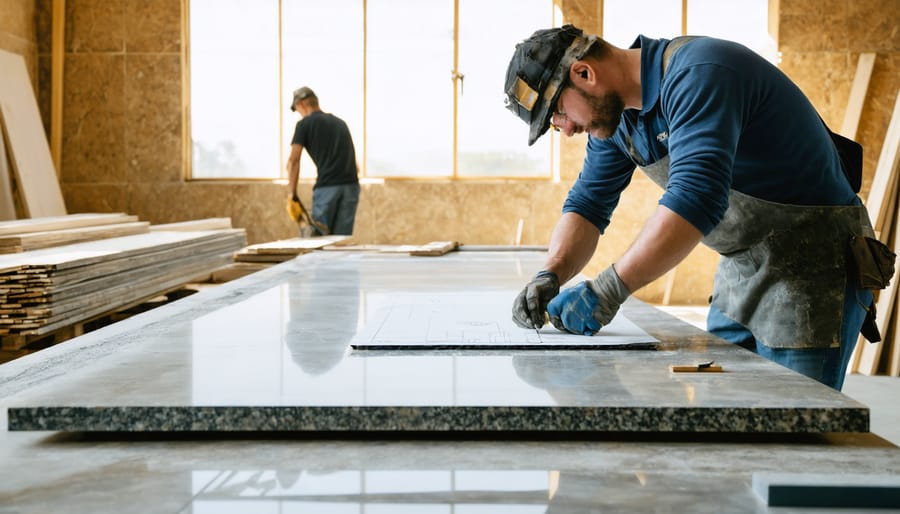
Evaluate natural stone investments using net present value calculations that account for durability spanning 50-100 years, comparing lifecycle costs against alternatives like porcelain or engineered materials that require replacement every 15-20 years. A granite countertop installation costing $8,000 delivers superior ROI when amortized over decades, particularly in high-traffic commercial applications where replacement downtime creates additional expense.
Structure financing through home equity lines of credit offering 6-8% interest rates for residential projects, while commercial developers should explore construction loans with interest-only periods during renovation phases. Material costs typically consume 40-50% of natural stone project budgets, with fabrication and installation representing the remaining investment—ratios that shift dramatically based on stone rarity and project complexity.
Calculate payback periods by quantifying property value increases, which average 5-7% for luxury stone installations in kitchens and bathrooms according to remodeling impact studies. Commercial properties experience faster returns through reduced maintenance labor and enhanced tenant retention in premium spaces featuring marble lobbies or limestone facades.
Budget for contingencies representing 15-20% of total project costs to address substrate preparation, unexpected structural modifications, or material overage requirements. Natural stone projects demand this buffer due to variables in slab selection, vein matching requirements, and the irreversible nature of stone fabrication decisions. Strategic capital allocation in the planning phase prevents costly mid-project compromises that diminish both aesthetic outcomes and long-term asset value.

The Three Pillars of Natural Stone Project Economics
Capital Resources: Beyond the Sticker Price
Understanding the financial requirements of a natural stone project extends far beyond the initial material costs. While the stone pricing guide provides baseline material expenses, the complete capital picture includes fabrication, installation, substrate preparation, and potential structural modifications.
Upfront costs typically represent 60-70% of total project expenditure. Financing options vary considerably based on project type. Residential renovations often utilize home equity lines of credit (HELOCs) or renovation loans with terms ranging from 5-30 years. Commercial projects may leverage construction loans, equipment financing, or capital leases. Some suppliers offer direct financing programs, particularly for high-value materials, which can simplify procurement while potentially offering competitive rates.
Cash flow considerations profoundly impact project execution. Projects requiring 50% deposits can strain liquidity, making payment schedules a crucial negotiation point. Phased installations allow budget spreading but may increase overall costs due to multiple mobilizations.
Capital availability directly influences material selection and project scope. Limited budgets often necessitate compromises: reducing square footage coverage, selecting lower-tier stone varieties, or simplifying edge profiles and finishes. Conversely, adequate capitalization enables premium material selection, intricate designs, and contingency reserves for unforeseen conditions.
Strategic capital allocation requires balancing immediate affordability against long-term value. While financing extends purchasing power, interest costs must factor into total investment calculations. Understanding your capital position before material selection prevents costly redesigns and ensures projects align with both aesthetic aspirations and financial realities.
Natural Resources: Stone Quality as an Asset
When selecting natural stone for a project, understanding material quality as a capital asset fundamentally changes the decision-making process. Like any investment, stone quality directly impacts both initial costs and long-term returns, making strategic selection essential for maximizing value.
Stone type represents the primary pricing driver. Marble, granite, quartzite, limestone, and slate each occupy distinct price points based on extraction costs, processing requirements, and market demand. A premium Calacatta marble commands significantly higher prices than standard granite, but this premium reflects genuine scarcity and distinctive aesthetic qualities that may justify the investment for specific applications.
Geographic origin profoundly affects both cost and value proposition. Italian Carrara marble carries prestige and proven durability from centuries of use, while domestically quarried stones often provide comparable quality at reduced transportation costs. Understanding origin allows buyers to distinguish between paying for genuine quality versus brand perception alone.
Rarity functions as a value multiplier. Limited-availability stones from depleted or restricted quarries appreciate over time, making them potentially superior long-term investments. However, rarity must align with aesthetic appeal and practical durability to translate into genuine asset value.
Quality indicators include color consistency, veining patterns, structural integrity, and finish potential. Higher-grade selections within the same stone type may cost 30-50% more initially but deliver superior longevity and reduced maintenance expenses. A Grade A granite slab resists staining and etching better than Grade B material, reducing lifecycle costs through decreased sealing frequency and potential repair needs.
Treating stone selection as capital allocation means evaluating total cost of ownership rather than simply comparing per-square-foot prices. Premium materials often justify their initial investment through extended service life, reduced maintenance requirements, and enhanced property values.
Human Resources: The Cost of Expertise
The expertise behind natural stone installation represents a critical yet often underestimated component of project budgeting. Unlike material costs that appear on itemized estimates, the value of skilled labor directly influences both immediate results and long-term performance, making human resources a decisive factor in total cost of ownership.
Professional stone fabricators, installers, and designers bring specialized knowledge that protects your investment. A skilled fabricator understands how to read stone’s natural veining patterns, determining optimal cutting strategies that minimize waste while maximizing aesthetic impact. Experienced installers recognize substrate requirements, ensuring proper adhesion and preventing costly callbacks from delamination or cracking. These competencies prevent expensive failures that can double or triple initial project costs.
The quality differential between experienced and inexperienced labor becomes apparent immediately upon installation and continues affecting value throughout the stone’s lifecycle. Precision cutting reduces lippage between tiles, eliminating uneven surfaces that trap dirt and compromise appearance. Proper seam placement in countertops creates virtually invisible joints, while poor workmanship produces distracting lines that diminish visual appeal. Expert installation also ensures correct waterproofing and support structures, preventing water damage and structural issues that necessitate complete reinstallation.
Understanding labor costs within your capital budget requires recognizing that premium expertise typically commands 20-40% higher rates than general contractors. However, this premium frequently proves economical when considering reduced material waste, faster completion times, and elimination of warranty claims. Regional variations in craftsperson availability also impact pricing, with metropolitan areas offering more specialists but at premium rates, while rural locations may require travel expenses for qualified professionals.
Capital Budgeting Fundamentals for Natural Stone Projects

Initial Investment vs. Lifecycle Value
Understanding the true cost of a natural stone project requires looking beyond the initial price tag. Upfront expenses typically include raw materials, professional labor, specialized installation equipment, and surface preparation. For a mid-range residential project like a kitchen countertop installation, homeowners might invest $4,000-$8,000 for granite or marble, while premium stones like quartzite or rare marbles can exceed $12,000. Commercial applications naturally scale higher based on square footage and complexity.
However, evaluating natural stone purely on installation costs misses the bigger financial picture. Lifecycle value analysis reveals where natural stone truly differentiates itself. Unlike synthetic alternatives requiring replacement every 10-15 years, properly maintained natural stone installations routinely last 30-50 years or longer. Historical buildings demonstrate this longevity, with century-old marble floors still functioning beautifully.
Maintenance costs remain remarkably low compared to other premium materials. Annual sealing (costing $100-$300 for residential applications) and basic cleaning represent the primary ongoing expenses. When amortized over decades, these costs become negligible. Meanwhile, laminate or tile alternatives often require repairs, grout replacement, or complete reinstallation within 15 years, accumulating hidden costs that quickly erode initial savings.
Property value enhancement represents another critical factor. Real estate professionals consistently report that natural stone features—particularly in kitchens and bathrooms—increase home values by 4-8 percent and accelerate sales. Appraisers recognize stone installations as permanent improvements rather than cosmetic upgrades. This appreciation directly impacts investment returns when homeowners eventually sell.
A 30-year analysis typically reveals that natural stone’s cost-per-year drops significantly below synthetic alternatives once replacement cycles, maintenance differences, and property value gains factor into calculations. This long-term perspective transforms what appears expensive initially into a financially sound decision.
Payback Period and ROI Calculations
Understanding the financial return on your natural stone investment helps justify the initial expense and supports informed decision-making. While natural stone typically costs more upfront than alternatives, calculating the payback period reveals when accumulated savings offset this premium.
The basic payback period formula divides the additional initial cost by annual savings. For example, if granite countertops cost $3,000 more than laminate but save $200 annually in maintenance and replacement costs, the payback period is 15 years. Since quality granite lasts 50+ years while laminate requires replacement every 10-15 years, the long-term value becomes clear.
Energy efficiency calculations add another dimension. A natural stone thermal mass wall costing $8,000 more than standard framing might reduce heating and cooling costs by $600 annually, yielding a 13-year payback period. Over a 30-year mortgage, this generates $10,000 in net savings.
Property value enhancement accelerates ROI significantly. Real estate data shows natural stone features can increase home values by 5-10%. On a $400,000 home, a $15,000 marble bathroom renovation might add $25,000 in resale value, delivering immediate positive ROI plus ongoing maintenance savings.
Consider total cost of ownership rather than initial price alone. Include maintenance frequency, replacement cycles, energy impacts, and resale value in your calculations. Many natural stone investments achieve payback within 10-20 years while providing a lifetime of performance and aesthetic appeal that manufactured materials cannot match.
Financing Options That Make Natural Stone Accessible
Home Equity and Renovation Loans
For homeowners considering natural stone installations, leveraging existing property equity offers a strategic financing pathway. Home equity loans and home equity lines of credit (HELOCs) typically provide lower interest rates compared to personal loans or credit cards, making them attractive options for substantial stone projects like kitchen countertops, bathroom remodeling, or exterior cladding.
Home equity loans function as second mortgages with fixed interest rates and predictable monthly payments, ideal for projects with defined budgets. HELOCs offer flexible, revolving credit with variable rates, suitable for phased renovations or projects with evolving scope. Both options allow borrowing against accumulated property value, often up to 80-85% of home equity.
Interest rate considerations prove particularly significant for residential stone projects. Current rates for home equity products generally range from 6-10%, depending on creditworthiness and loan-to-value ratios. When conducting a total cost analysis, homeowners should factor in closing costs, annual fees, and potential tax deductibility if the improvement adds property value.
The advantage extends beyond favorable rates. Since natural stone installations typically increase property value by 5-15%, homeowners effectively invest equity into an appreciating asset. This transforms renovation spending into value creation, particularly important when financing premium materials like marble, granite, or quartzite that offer exceptional durability and timeless appeal.
Contractor Financing and Payment Plans
Many stone suppliers and installation contractors offer in-house financing to make premium natural stone projects more accessible. These programs typically feature payment plans ranging from 6 to 24 months, with some extending up to 60 months for larger installations. Interest rates vary considerably, from promotional 0% APR for qualified buyers during specific periods to 8-15% for standard terms.
Contractor financing often includes streamlined approval processes, sometimes requiring only basic credit checks rather than extensive financial documentation. This convenience appeals to homeowners who want to begin projects quickly or prefer consolidating their stone purchase and installation into a single financing arrangement.
These options make particular sense for mid-sized projects ($5,000-$25,000) where traditional home equity loans or personal loans might involve disproportionate application effort. They also benefit customers with strong credit who qualify for promotional rates, effectively providing interest-free capital.
However, traditional lending through banks or credit unions often offers lower rates for larger projects exceeding $25,000, especially when secured by home equity. Credit card financing, while convenient, typically carries higher interest rates than both contractor and traditional loan options. Compare the total cost including interest, origination fees, and prepayment penalties before committing. Request detailed payment schedules and understand whether the financing company services loans directly or sells them to third-party lenders.
Commercial and Construction Financing
For architects and commercial developers undertaking large-scale natural stone projects, specialized financing options can make the difference between feasibility and postponement. Construction loans remain the most common vehicle for commercial stone installations, offering draw schedules that align with project milestones. These loans typically cover material procurement, fabrication, and installation phases, with funds released as each stage completes.
Business credit lines provide flexibility for design firms and contractors who manage multiple stone projects simultaneously. This revolving credit structure allows professionals to purchase materials as opportunities arise without reapplying for financing, particularly valuable when securing limited-availability stone varieties or negotiating volume discounts with quarries.
Project-specific financing structures have emerged as sophisticated alternatives for high-value commercial developments. These arrangements may include joint ventures between developers and stone suppliers, equipment leasing for specialized fabrication tools, or performance-based payment schedules tied to project completion benchmarks. Some stone fabricators now offer trade credit terms extending 60 to 90 days, enabling contractors to complete installations and receive client payments before material costs come due.
For public sector projects, municipal bonds and tax-increment financing can fund stone applications in civic buildings, plazas, and infrastructure improvements. Understanding these diverse financing mechanisms allows professionals to structure deals that optimize cash flow while delivering exceptional natural stone installations that enhance property values and architectural distinction.
Making the Capital Allocation Decision: Stone vs. Alternatives
Total Cost of Ownership Analysis
Understanding the true cost of stone materials requires looking beyond the initial purchase price to evaluate long-term financial implications. Over a 15-20 year ownership period, natural stone often demonstrates superior value retention compared to engineered alternatives.
Natural stone, particularly granite and marble, typically requires minimal intervention beyond routine sealing every 1-3 years, costing approximately $200-400 per application for average kitchens. Porcelain and quartz surfaces may appear maintenance-free initially, but both materials can experience issues over extended timelines. Porcelain tiles may require grout resealing and potential replacement of cracked units, while quartz can develop yellowing or surface damage that cannot be repaired like natural stone can be refinished.
Replacement cycles significantly impact total ownership costs. Natural stone installations frequently last 20-30 years or longer without replacement, whereas trendy materials may become dated within 10-15 years, prompting costly renovations. Porcelain tile installations average $15-25 per square foot installed, while quartz ranges from $60-120 per square foot. Natural stone occupies a similar price range but offers substantially better longevity.
Resale value considerations prove equally important. Real estate data consistently shows that homes featuring authentic marble or granite surfaces command premium prices, with kitchen upgrades yielding 50-80% return on investment. Conversely, engineered materials may not offer the same competitive advantage, as discerning buyers recognize the difference in quality and authenticity.
When factoring in maintenance costs, expected lifespan, and resale impact, natural stone frequently emerges as the economically sound choice for long-term property owners, delivering both functional durability and sustained aesthetic appeal that protects your capital investment.
When Premium Stone Makes Financial Sense
Premium stone represents a strategic investment that delivers measurable returns in specific applications. Understanding when higher-grade materials justify their cost premium requires analyzing both immediate needs and long-term value creation.
High-traffic commercial environments provide the clearest case for premium stone investment. Luxury hotels, corporate lobbies, and upscale retail spaces experience thousands of footsteps daily. Premium granite or marble with superior hardness ratings maintains its appearance for decades with minimal maintenance, while lower-grade alternatives show wear patterns within years. The enhanced durability translates to reduced replacement costs and eliminated business disruption from renovation downtime. A hotel lobby investing $150,000 in premium stone flooring may avoid $80,000 in refinishing costs over a 15-year period compared to mid-grade options.
Luxury residential applications also warrant premium materials when resale value matters. Kitchen countertops and bathroom vanities crafted from book-matched marble or exotic granite create distinctive focal points that appeal to discerning buyers. Properties featuring premium stone command 8-12% higher resale values in competitive markets, according to industry analysis. The investment particularly makes sense in high-end neighborhoods where buyers expect exceptional materials.
Historical preservation projects requiring period-appropriate stone also justify premium grades. Matching original materials maintains architectural integrity and often satisfies regulatory requirements. The specialized nature of these applications makes premium stone selection non-negotiable for successful project outcomes.
Resource Optimization Strategies That Reduce Costs
Smart Material Selection and Sourcing
Strategic material selection significantly impacts both project budgets and outcomes. Start by clearly defining your aesthetic priorities, then explore options within your price range. Premium stone varieties like Calacatta marble command higher prices, but equally stunning alternatives exist at lower price points. Consider stones with similar visual characteristics but different origins or classifications.
Working with remnants offers substantial savings, particularly for smaller projects like bathroom vanities, fireplace surrounds, or accent walls. Fabricators often have leftover pieces from larger jobs available at 30-50% discounts. While remnants limit size options, creative design approaches can incorporate multiple pieces effectively.
Locally-sourced stone reduces transportation costs and supports regional economies. Stone quarried within 500 miles typically costs 15-25% less than imported varieties while offering unique regional characteristics. Research quarries in your area to discover options that align with both budget and design vision.
Timing purchases strategically can yield significant savings. Fabricators and suppliers often offer discounts during slower seasons, typically late fall and winter. Planning purchases during these periods, when demand decreases, provides negotiating leverage. Additionally, attending stone industry trade shows exposes buyers to promotional pricing and direct manufacturer relationships. Building rapport with local suppliers may unlock access to special pricing on overstocked materials or discontinued lines that still meet quality standards.
Labor Efficiency and Project Planning
Labor represents one of the most significant variable costs in natural stone projects, often accounting for 40-60% of total installation expenses. Effective project planning directly impacts these costs and can mean the difference between staying on budget and significant overruns.
Detailed upfront planning minimizes costly delays and rework. Before installation begins, conduct thorough site assessments to identify potential complications like uneven substrates, moisture issues, or access limitations. Creating precise measurements and detailed layout plans reduces material waste and prevents labor-intensive corrections during installation.
Proper site preparation dramatically improves labor efficiency. Ensuring surfaces are level, clean, and structurally sound before stone arrives allows installers to work without interruption. Pre-coordinating with other trades prevents scheduling conflicts that can idle expensive skilled labor.
Selecting experienced contractors may appear more expensive initially, but their expertise typically reduces overall project costs. Skilled installers work faster, make fewer errors, and understand how to handle unforeseen challenges without extensive troubleshooting time. Request detailed proposals that break down labor costs by task, allowing you to compare efficiency rather than just hourly rates.
Common mistakes that inflate labor costs include inadequate material ordering leading to installation delays, poor communication causing rework, and rushing installations without proper curing time. Investing time in comprehensive planning and contractor selection protects against these expensive pitfalls while ensuring quality results.
Real-World Case Study: Residential Kitchen Renovation
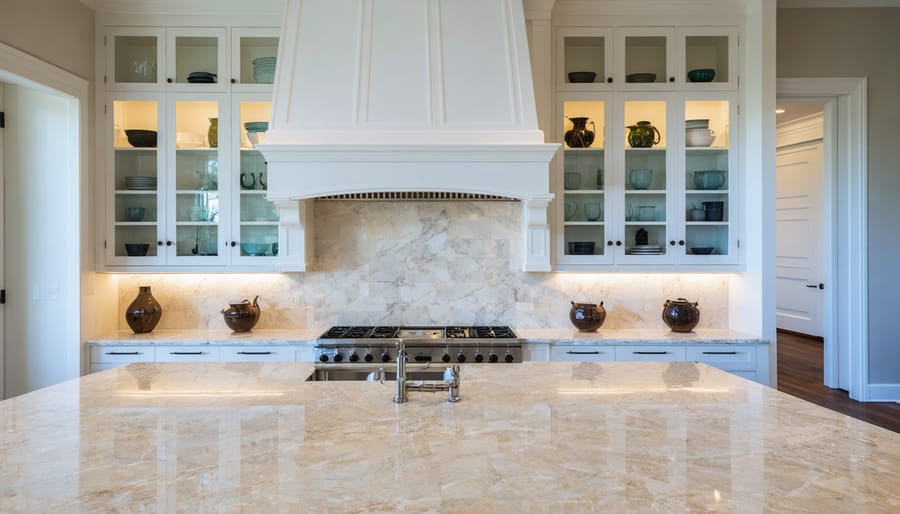
The Johnson family’s 2019 kitchen renovation in suburban Chicago provides a comprehensive illustration of how capital, natural, and human resources intersect in a residential marble project. Their investment centered on installing 45 square feet of Calacatta Gold marble countertops, including a kitchen island and perimeter counters.
The capital investment breakdown totaled $8,750. Material costs accounted for $4,950 at $110 per square foot for premium-grade marble slabs. Fabrication and installation added $2,700, including custom edge profiling and sink cutouts. The human resource component comprised three days of skilled labor from certified stone fabricators. Additional capital allocation included $650 for plumbing modifications and $450 for reinforced cabinetry to support the marble’s weight.
The Johnsons pursued a hybrid financing approach. They allocated $5,000 from their home improvement savings as initial capital, representing 57 percent of the total investment. The remaining $3,750 came from a home equity line of credit at 4.2 percent interest, which they repaid over 18 months, adding approximately $150 in total interest costs.
After five years, the outcome assessment revealed compelling returns on their investment. A professional appraisal in 2024 indicated the kitchen renovation contributed $12,400 to the home’s market value, representing a 42 percent return on their marble investment alone. The natural resource proved remarkably durable, requiring only routine sealing twice annually at $75 per application. Total maintenance costs over five years amounted to $750, bringing the true investment to $9,650.
Beyond financial metrics, the Johnsons reported significant lifestyle returns. The marble surface maintained its aesthetic appeal without etching or staining when properly maintained, contradicting their initial durability concerns. This case demonstrates how strategic capital allocation toward quality natural stone, combined with skilled human resources for installation, can deliver both quantifiable financial returns and sustained functional value in residential applications.
Real-World Case Study: Commercial Lobby Installation
A mid-sized technology firm recently completed a 3,500-square-foot commercial lobby renovation, replacing worn carpeting with honed Carrara marble flooring. This project provides valuable insight into how capital budgeting principles apply to real-world natural stone installations.
The total project investment totaled $147,000, broken down as follows: materials ($68,000), professional installation ($42,000), substrate preparation ($18,000), sealing and finishing ($12,000), and contingency ($7,000). The company structured financing through a combination of capital reserves (60%) and a five-year commercial equipment loan (40%) at 6.2% interest, resulting in manageable monthly payments of $1,138.
The client’s capital budgeting analysis projected tangible and intangible returns. Expected annual maintenance savings compared to carpet replacement cycles amounted to $8,500, while reduced cleaning costs added another $3,200 yearly. The company also factored in a 15% reduction in lobby HVAC costs due to marble’s thermal mass properties, yielding an additional $2,100 in annual energy savings.
Beyond quantifiable metrics, the installation delivered measurable brand value. Client surveys conducted six months post-installation showed a 23% improvement in first-impression ratings, directly correlating with increased tenant lease renewals in the building. The human capital investment proved equally significant, with the project requiring coordination between the facility manager, design consultant, and installation team, demonstrating how skilled labor transforms raw materials into functional assets.
The calculated ROI reached 9.8% annually when combining direct cost savings with estimated brand value improvements. The payback period extended to 10.7 years, falling within the company’s acceptable range for permanent facility improvements. After three years of operation, the floor shows minimal wear, requiring only routine maintenance that costs 68% less than projected carpet upkeep would have demanded.
This case illustrates how comprehensive capital budgeting transforms natural stone selection from a subjective design choice into a data-driven investment decision, balancing upfront capital expenditure against long-term performance and aesthetic value.
Understanding the intricate relationship between capital allocation, natural resources, and human expertise transforms how you approach natural stone projects. Rather than viewing stone installations as simple expenses, this comprehensive perspective reveals them as strategic investments that deliver lasting value across financial, aesthetic, and functional dimensions.
The decision-making framework presented throughout this article equips you with tools to evaluate projects holistically. By considering initial capital requirements alongside long-term maintenance costs, environmental sustainability, and the skilled labor necessary for proper installation, you can make informed choices that align with both immediate budgets and future objectives. Natural stone’s durability and timeless appeal often justify higher upfront costs when analyzed through proper capital budgeting techniques like net present value or payback period calculations.
The interplay between these three resource categories is clear: capital provides the financial foundation, natural stone offers the raw material with inherent value appreciation potential, and human expertise ensures quality execution that maximizes your investment’s lifespan and aesthetic impact. This synergy creates outcomes where the whole exceeds the sum of its parts.
As you move forward with your natural stone project, take these actionable steps: conduct a thorough cost-benefit analysis using the methodologies discussed, explore financing options that preserve working capital, and partner with experienced professionals who understand material properties and installation best practices. Request detailed project proposals that itemize all three resource categories, allowing transparent evaluation of where your investment dollars are directed. By applying this integrated framework, you position your project for success measured not just in immediate results, but in decades of enduring beauty and functionality.