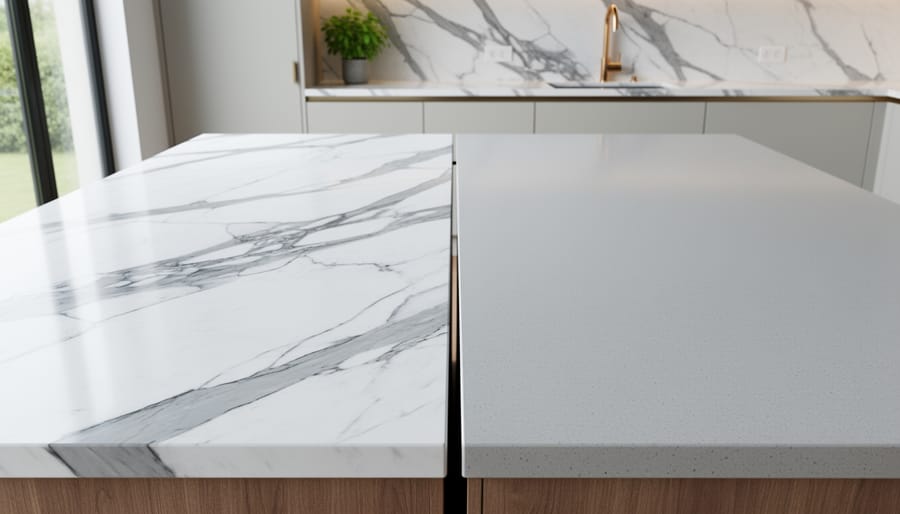
Yes, marble typically costs more than quartz—expect to pay $50-$200 per square foot installed for marble versus $50-$150 for quartz. However, this conventional wisdom oversimplifies a nuanced purchasing decision that depends on the specific grade, origin, and rarity of each material.
The price gap exists because marble is a natural stone requiring extensive quarrying, transportation, and skilled fabrication, while quartz is an engineered product with more predictable manufacturing costs. Premium Calacatta or Statuario marble can reach $300+ per square foot, far exceeding most quartz options. Yet basic marble varieties sometimes cost less than designer quartz collections with complex patterns or premium finishes.
Beyond initial price, consider the total ownership cost. Marble requires regular sealing, careful maintenance, and accepts etching from acidic substances—factors that add expense over time. Quartz offers superior durability and virtually zero maintenance, potentially offsetting its upfront cost through decades of use.
Your decision hinges on more than price alone. Marble delivers unmatched natural beauty and prestige that many homeowners and designers consider irreplaceable. Quartz provides consistency, resilience, and peace of mind. Understanding where each material excels—and what you’re truly paying for—ensures you choose the surface that delivers maximum value for your specific project and lifestyle needs.
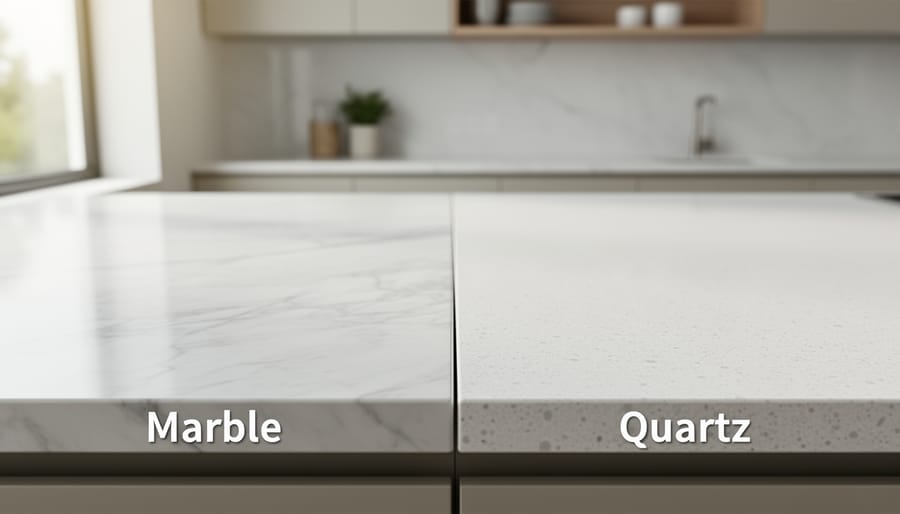
The Direct Price Comparison: Marble vs. Quartz Countertops
Material Cost Breakdown
Material costs vary significantly within each category. Marble slabs typically range from $40 to $200+ per square foot, depending on variety and quality. Budget-friendly Carrara marble starts around $40-$60 per square foot, while mid-tier options like Statuario run $80-$150. Premium Calacatta marble commands $150-$250 or more per square foot due to its dramatic veining and rarity. For comprehensive details, see our marble countertop cost guide.
Quartz countertops generally cost $50-$120 per square foot for material alone. Standard quartz brands start at $50-$70 per square foot, offering consistent patterns and reliable performance. Mid-range options run $70-$90 per square foot with more varied designs. Designer quartz brands like Caesarstone’s luxury lines or Cambria’s premium collections reach $90-$150 per square foot, sometimes exceeding marble prices. Our quartz countertop pricing guide breaks down these costs further.
The overlap in pricing means premium quartz can actually cost more than entry-level marble, challenging the assumption that marble always represents the more expensive choice.
Installation Costs: Why Marble Requires More
Marble installation typically adds 20-30% to your project costs compared to quartz, and there are solid reasons why. The material’s natural properties demand specialized expertise and extra precautions throughout the fabrication and installation process.
Unlike engineered quartz, marble is softer and more porous, requiring careful handling to prevent chipping, cracking, or staining during transport and installation. Professional installers must work more slowly and deliberately, which translates to higher labor costs. The installation requirements for marble include additional steps that quartz doesn’t need.
Sealing represents another cost factor. Marble must be professionally sealed before installation and resealed regularly afterward to protect against stains and etching. Many installers include the initial sealing in their quote, but this extra step adds both time and materials to the overall expense.
Fabrication complexity also drives up costs. Marble’s natural veining requires careful pattern matching to create a cohesive look, and fabricators must assess each slab individually for potential weak points or fissures. This attention to detail, while necessary for a quality installation, requires more skilled labor hours than the more uniform composition of quartz demands.
What Makes Marble More Expensive
Rarity and Quarrying Challenges
Natural marble forms through metamorphic processes over millions of years, making genuine deposits geographically limited. Unlike engineered quartz, which manufacturers can produce consistently, marble extraction depends on locating quality stone formations. This scarcity directly impacts pricing.
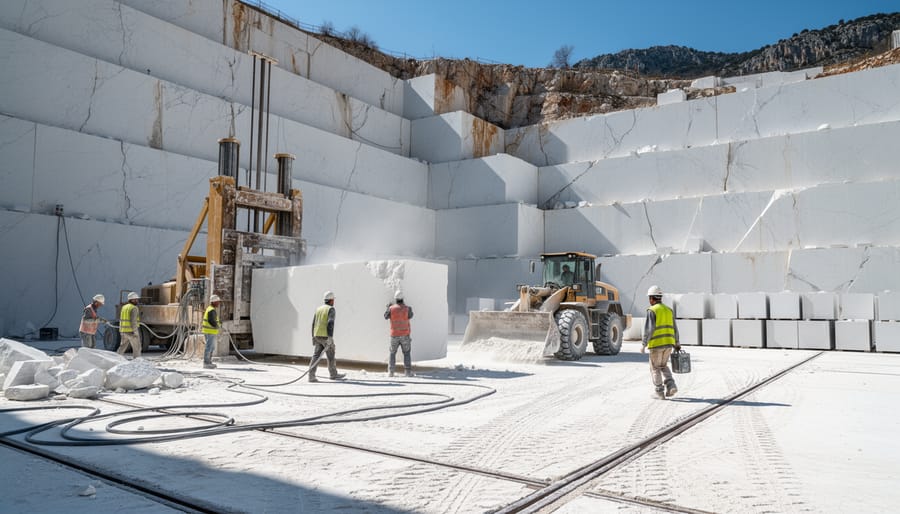
Quarrying marble presents significant challenges that add to costs. Workers must carefully extract massive blocks from mountainsides without causing fractures, requiring specialized equipment and expertise. The process generates substantial waste—sometimes 50-70% of excavated material proves unusable due to natural fissures or imperfections. Transportation from remote quarry locations to processing facilities adds further expense, particularly for Italian Carrara or Greek Thassos varieties.
Certain marble types command extraordinary premiums based on rarity and aesthetics. Calacatta marble, distinguished by dramatic veining and limited availability, costs 2-3 times more than standard Carrara. Statuario marble, prized for its pure white background and bold gray veining, reaches even higher price points. Regional variations matter too—Italian marbles typically exceed domestic alternatives due to their established reputation and unique geological characteristics. These factors explain why premium marble selections significantly outprice quartz, though standard marble varieties may fall within comparable price ranges.
Processing and Transportation
The transportation and processing stages significantly impact the final cost of both materials. Marble requires quarrying from natural deposits, which involves heavy machinery, skilled labor, and careful extraction to preserve slab integrity. Each marble slab must be cut from massive blocks, then polished to achieve its signature luster—a labor-intensive process that adds substantially to costs. Transportation presents another challenge, as marble slabs are extremely heavy and fragile, requiring specialized equipment and careful handling to prevent cracking or chipping during transit from quarry to fabricator to installation site.
Quartz countertops, being engineered products, follow a more standardized manufacturing process. Production facilities grind natural quartz crystals and combine them with resins and pigments in controlled factory settings. This industrial approach allows for greater efficiency and consistency, though it still requires sophisticated equipment and quality control measures. Transportation costs for quartz remain significant due to weight, but the material’s engineered durability makes it less vulnerable to damage during shipping compared to natural marble.
The geographic distance between quarries and your location also affects pricing. Imported marble from Italy or Greece carries higher freight costs than domestically sourced quartz, potentially adding hundreds to thousands of dollars to your project budget depending on slab quantity and origin.
Waste Factor and Selection
Marble’s natural variations create significant waste during fabrication, directly impacting your project costs. Unlike quartz’s uniform composition, marble slabs feature unpredictable veining patterns, color shifts, and structural characteristics that require careful planning during cutting and installation. Fabricators typically factor in 15-25% waste for marble countertops compared to just 10-15% for quartz, and you’ll pay for this excess material.
The selection process itself adds expense. When choosing marble, you’re often selecting specific slabs at the supplier, which may require multiple visits and transportation costs. Premium applications like book-matched or quarter-matched installations, where adjacent slabs mirror each other for dramatic visual impact, require purchasing multiple slabs from the same block. This coordinated selection carries premium pricing, sometimes adding 20-40% to material costs, as suppliers must keep paired slabs together and you’re paying for the cohesive aesthetic rather than random pieces.
Natural stone yards also charge holding fees if you need time to finalize your selection, and popular marble varieties may require you to purchase entire bundles rather than individual slabs. Structural inconsistencies within marble, such as fissures or soft veining, can render portions of a slab unusable, further increasing waste. Fabricators must work around these natural features, resulting in more offcuts and less efficient material usage. While quartz’s engineered consistency allows for precise cutting with minimal waste, marble demands artistic judgment and flexibility, translating to higher costs throughout the fabrication process.
Long-Term Cost Considerations Beyond the Purchase Price
Maintenance and Sealing Requirements
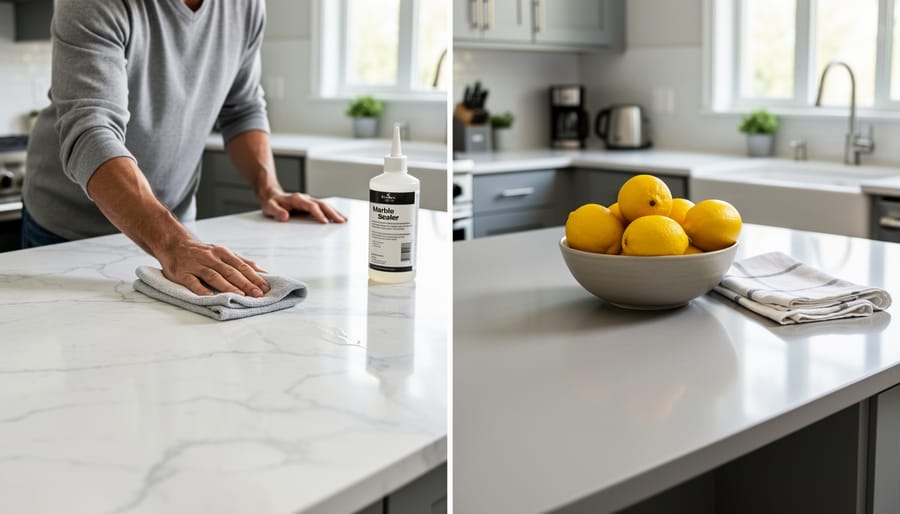
Beyond the initial purchase price, ongoing maintenance represents a significant cost difference between marble and quartz. Marble requires annual professional sealing to protect against stains and etching, typically costing between $100-300 per treatment depending on countertop size. Homeowners must also invest in pH-neutral cleaning products specifically formulated for natural stone, avoiding acidic cleaners that can damage the surface. This specialized marble maintenance adds $50-100 annually to your budget.
In contrast, quartz surfaces are engineered to be virtually maintenance-free. The non-porous material never requires sealing and can be cleaned with standard household cleaners and soap, making it exceptionally cost-effective over time. While the upfront price of quartz may be comparable or slightly higher than some marble varieties, the absence of recurring maintenance expenses often makes quartz more economical over a 10-15 year period. For busy households or commercial applications where low maintenance is paramount, this difference in upkeep requirements can be a decisive factor in material selection.
Repair and Refinishing Potential
One of marble’s most significant advantages over quartz is its restoration potential, which can offset initial costs over the material’s lifetime. Marble surfaces can be professionally honed, repolished, and refinished multiple times throughout their lifespan. Deep scratches, etches from acidic substances, and even minor chips can typically be ground down and buffed out by experienced stone restoration specialists. This process restores the surface to near-original condition, effectively extending the countertop’s useful life by decades.
In contrast, quartz countertops offer limited repair options. Because quartz is an engineered product with resin binders throughout, damage often penetrates beyond the surface layer. Deep scratches, burns, or chips in quartz cannot be sanded out without affecting the pattern and exposing different material layers beneath. While minor surface scratches may be buffed, significant damage usually requires complete slab replacement.
This difference matters financially. A professional marble restoration typically costs between $3 to $7 per square foot, while replacing damaged quartz sections can run into thousands of dollars. For homeowners planning to stay in their homes long-term, marble’s renewable surface represents a tangible value proposition that impacts the total cost of ownership calculation beyond the initial installation price.
Impact on Home Resale Value
The choice between marble and quartz countertops can significantly influence your home’s resale value, though the impact varies by market segment. In luxury real estate markets, marble installations typically yield a 4-7% higher return on investment compared to quartz, according to recent National Association of Realtors data. High-end buyers perceive authentic marble as a premium feature that justifies elevated asking prices, particularly in kitchens and master bathrooms.
Conversely, quartz demonstrates stronger ROI performance in mid-range homes priced between $250,000-$500,000. In these markets, buyers prioritize low-maintenance features and durability over prestige materials. Real estate agents report that quartz countertops appeal to young families and busy professionals who value practicality, making homes move faster with comparable pricing to marble installations.
Market location also matters considerably. Urban markets with competitive housing inventories favor marble in upscale properties, while suburban areas show roughly equal appreciation for both materials. The key consideration is matching your countertop investment to your home’s overall value and target buyer demographic.
When Quartz Actually Costs More Than Marble
While marble typically commands premium prices, several scenarios can flip this expectation on its head, making quartz the more expensive option.
Designer and premium quartz brands like Caesarstone, Cambria, and Silestone often price their top-tier collections at $100-$150 per square foot or higher. These luxury quartz lines feature complex patterns, dramatic veining, and unique finishes that rival natural stone aesthetics. When compared to standard marble varieties like basic Carrara, which ranges from $40-$70 per square foot installed, premium quartz can cost nearly double.
Complex fabrication requirements also drive up quartz costs. Unlike marble, quartz slabs cannot be repaired once damaged, making fabrication riskier and more expensive. If your project involves intricate edge profiles, cutouts for undermount sinks, or challenging installation conditions, fabricators may charge premium rates for quartz work. Some fabricators also maintain separate facilities for natural stone and engineered materials, potentially adding overhead costs.
The specific marble variety you select matters significantly. Abundant domestic marbles from quarries in Vermont or Georgia often cost less than imported quartz. Standard white or beige marble varieties without dramatic veining can be surprisingly affordable, particularly when sourced regionally, eliminating international shipping costs.
Additionally, remnant or closeout marble pieces offer substantial savings for smaller projects like bathroom vanities or kitchen islands. These perfectly usable pieces become available when fabricators complete larger jobs, sometimes selling at 50-70 percent below standard pricing. Comparable quartz remnants remain relatively expensive due to consistent demand.
When choosing the right material, consider these pricing variables alongside aesthetic preferences and durability requirements. The conventional wisdom about marble costing more doesn’t always hold true, especially when comparing entry-level natural stone against premium engineered products.
Making the Right Choice for Your Budget and Lifestyle
Choose Marble If…
Despite the higher price point, marble remains the ideal choice in specific situations. If you’re designing a traditional or luxury home where timeless elegance is paramount, marble’s unique veining and natural beauty create an irreplaceable aesthetic that quartz simply cannot replicate. The material’s historical prestige and organic patterns justify the investment for high-end residential projects.
Marble also makes sense for low-traffic areas like powder rooms, bathroom vanities, or decorative fireplace surrounds where durability concerns are minimal. In these applications, you’ll enjoy marble’s luxurious appearance without the wear-and-tear challenges that accompany kitchen countertops.
Consider marble if you have a realistic budget for ongoing maintenance and understand the commitment required. Homeowners who appreciate patina and view aging as character development rather than damage will find marble rewarding. Professional sealing every 6-12 months and immediate spill cleanup become part of the ownership experience.
Finally, if you’re renovating a premium property where authentic natural stone adds measurable resale value, marble’s investment can pay dividends. Discerning buyers in luxury markets often specifically seek genuine marble, recognizing it as a hallmark of quality construction that distinguishes a property from standard installations.
Choose Quartz If…
Quartz delivers exceptional value for busy households where performance matters most. If your kitchen sees heavy daily use—from cooking multiple meals to homework sessions and entertaining—quartz’s superior durability makes it the practical choice. The engineered surface resists chips, scratches, and heat damage better than marble, eliminating worry about everyday wear and tear.
Choose quartz when maintenance time is limited. Unlike marble’s demanding care routine requiring regular sealing and careful cleaning, quartz needs only soap and water. There’s no annual sealing appointment to remember or special cleaners to purchase, translating to long-term savings in both time and maintenance costs.
For families with young children or avid home cooks, quartz eliminates staining concerns that make marble owners hesitate before using their countertops. Acidic foods like tomato sauce, lemon juice, and wine won’t etch or discolor the surface. You can cook confidently without constantly wiping up spills or using cutting boards and trivets religiously.
Budget-conscious buyers also benefit from quartz’s predictable pricing and minimal lifetime costs. While initial investment may match marble, you’ll avoid future expenses for repairs, professional cleaning, or premature replacement due to etching and staining damage.
Budget-Friendly Alternatives
Achieve marble’s elegant appearance without the premium price by choosing marble-look quartz, which mimics natural veining at lower cost with better durability. Consider using genuine marble strategically in smaller applications like bathroom vanities or backsplashes rather than expansive kitchen countertops. Lower-grade marble varieties such as Carrara or locally-sourced options offer authentic stone character at reduced prices compared to premium Calacatta or Statuario. Another cost-effective approach combines materials—install quartz for high-traffic kitchen areas while reserving marble for display surfaces. These alternatives deliver marble’s timeless aesthetic while maintaining budget control and often reducing long-term maintenance expenses.
When comparing these two premium countertop materials, marble typically costs 10-40% more than quartz initially, with average marble installations ranging from $75-250 per square foot versus quartz at $60-150 per square foot. However, making your decision based solely on upfront costs overlooks critical factors that impact long-term value.
Both materials offer distinct advantages depending on your priorities. Marble delivers unmatched natural beauty and heat resistance, making it ideal for baking enthusiasts and those valuing authentic luxury aesthetics. Quartz provides superior durability, stain resistance, and virtually maintenance-free ownership—perfect for busy households and high-traffic kitchens.
The true cost comparison extends beyond installation. Factor in sealing expenses for marble every 6-12 months, potential etching repairs, and the value of your time spent on maintenance. Conversely, consider quartz’s longevity and minimal upkeep requirements.
Your lifestyle, cooking habits, aesthetic preferences, and willingness to maintain your surfaces should drive this decision more than price alone. A well-maintained marble countertop in a carefully managed kitchen can last generations, while quartz offers peace of mind for families prioritizing convenience. Evaluate your total cost of ownership over 15-20 years, not just the installation invoice, to determine which material represents better value for your specific situation.