Showing 601 Result(s)
Close-up of gloved hands guiding a chalk-marked stone veneer through a wet tile saw with a diamond blade and visible water spray, with blurred workshop tools and stacked veneer in the background.
Home Improvement and DIY

How to Cut Stone Veneer Without Damaging Your Material (Or Yourself)

Measure twice and mark your cutting line with a pencil or chalk directly on the stone veneer face, ensuring precision before making any cuts. Select a diamond blade specifically rated for natural stone—wet-cutting blades reduce dust by up to 90% and extend blade life significantly. Set up your work area with proper ventilation, position the stone on a stable surface, and always cut from the finished face to prevent chipping on visible edges.
Stone veneer transforms spaces with authentic texture and timeless appeal, but achieving professional results during …

Eye-level view of a natural stone quarry with large cut limestone blocks in the foreground, a truck loading slabs, and a distant processing facility with water-settling ponds and recycled aggregate piles under warm evening light, mountains beyond.
Sustainability and Environmental Impact

Why Your Natural Stone’s Environmental Impact Starts Long Before Installation

Understanding the complete environmental footprint of natural stone requires examining every phase from quarry extraction to final disposal. Life cycle analysis (LCA) provides this comprehensive view, measuring energy consumption, carbon emissions, water usage, and waste generation across each stage of a material’s existence. For natural stone, this cradle-to-grave assessment reveals surprising insights that challenge common assumptions about sustainability.
Natural stone’s environmental profile differs dramatically from synthetic alternatives, primarily because it requires no chemical manufacturing or intensive …

Close-up of an abrasive waterjet nozzle cutting a precise curved path in a white marble slab, with water spray and smooth kerf visible against a softly blurred fabrication shop background.
Emerging Stone Technologies

Why Water Jet Cutting Creates the Most Precise Stone Shapes Without Breaking Your Slab

Water jet stone cutting transforms raw slabs into intricate architectural elements using pressurized water streams reaching 60,000 PSI, mixed with fine abrasive particles that slice through marble, granite, and quartzite with tolerances as tight as 0.005 inches. This technology eliminates the heat, vibration, and structural stress associated with traditional saw cutting, preserving the stone’s natural integrity while enabling complex curves, inlays, and three-dimensional shapes previously achievable only through hand-carving. Modern fabrication shops deploy computerized waterjet systems to produce everything from kitchen countertops …

Architect, contractor, and client discuss natural stone slabs and finish samples around a studio table, pointing to veining details, with a softly blurred fabrication workshop in the background.
Stone Project Planning

Why Your Stone Project Will Fail Without These Stakeholder Conversations

Identify every person and organization with influence over your stone project’s success before breaking ground. Map decision-makers, budget approvers, design teams, installers, building occupants, and maintenance staff into clear categories based on their authority level and project interest. This upfront stakeholder analysis prevents costly miscommunications about material expectations, installation timelines, and long-term care requirements that derail natural stone projects.
Establish communication protocols tailored to each stakeholder group’s needs and technical knowledge. Architects require detailed specifications …

Diamond wire and CNC saws cutting a thin natural stone slab with recirculating water feeding settling tanks, in a clean fabrication shop; stacked slabs, rooftop solar panels, and an electric forklift in the softly blurred background.
Innovation and Technology

How Natural Stone Technology is Reshaping Sustainable Building

Natural stone stands at the forefront of sustainable building materials, yet its environmental credentials depend entirely on the technologies employed throughout its lifecycle. Modern natural stone innovations have transformed extraction, processing, and installation practices to minimize ecological impact while maximizing material performance.
Specify water recycling systems at quarries that recapture and reuse 90-95% of water during cutting operations, dramatically reducing…

Backlit translucent onyx kitchen island countertop glowing with warm amber veining, photographed at a 45-degree angle in a sleek modern kitchen with blurred cabinetry, pendant lights, and bar stools in the background.
Interior Applications

Transform Your Kitchen with Illuminated Stone Countertops

Illuminated stone countertops represent a transformative intersection of natural beauty and modern lighting technology, where translucent stone materials like onyx, quartzite, and certain marble varieties are backlit to create stunning, luminous focal points in residential and commercial spaces. This innovative application has gained significant traction among homeowners and designers seeking to elevate interior aesthetics beyond conventional surface treatments, making it essential to understand which stones possess the translucency required for effective illumination and how LED systems are integrated during fabrication and installation…

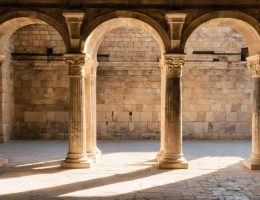
Low-angle view of weathered white marble temple columns in warm evening light, with softly blurred silhouettes of distant standing stones and a rock-cut stupa in the background.
Historical and Cultural Context

Why Ancient Civilizations Chose These Stones for Their Most Sacred Spaces

Stone has anchored humanity’s most sacred spaces for millennia, serving as silent witnesses to prayers, rituals, and spiritual transformations across every major civilization. From the megalithic circles of Stonehenge to Jerusalem’s Western Wall, from Buddhist stupas carved into mountainsides to the marble altars of Renaissance cathedrals, rock endures as the fundamental building block of religious architecture and ceremony.
This enduring relationship between stone and spirituality transcends mere practicality. While durability and permanence make stone an obvious choice for structures meant to last generations, the …

Close-up of a technician applying a clear penetrating sealer with a white microfiber pad to a honed marble countertop, with gentle water beading visible and a modern kitchen softly blurred in the background.
Technical Aspects

Why Penetrating Sealers Outperform Surface Coatings on Natural Stone

Natural stone surfaces represent a significant investment in any residential or commercial space, yet most traditional sealers merely coat the surface, creating a barrier destined to wear, peel, or yellow over time. Penetrating sealers work differently. They migrate below the stone’s surface, bonding chemically with the material to create protection from within while maintaining the stone’s natural appearance and breathability.
This technology addresses the fundamental challenge in stone preservation: protecting against stains, moisture, and deterioration without compromising the aesthetic qualities that made natural …

Mason installing a limestone rainscreen panel onto thermally broken stainless steel brackets over mineral wool continuous insulation and a red fluid-applied air barrier, with scaffolding and stacked stone softly blurred in the background
Construction and Building

Why Your Stone Building Envelope Is Leaking Energy (And How to Fix It)

The thermal building envelope represents the critical barrier between interior conditioned space and exterior climate conditions, and when executed properly with natural stone, it delivers both exceptional energy performance and enduring architectural beauty. This protective assembly controls heat flow, manages moisture migration, and maintains occupant comfort while significantly reducing operational costs over a building’s lifetime.
Stone facades present unique thermal challenges and opportunities that differ fundamentally from conventional cladding systems. The material’s inherent thermal mass, varying conductivity …

Close-up of a waterjet cutting nozzle precisely cutting a geometric pattern into a white marble slab, water spray visible, with stacked stone slabs and a CNC arm blurred in the background of a bright workshop.
Installation and Manufacturing

How Modern Stone Cutting Technology Is Transforming Architecture and Design

Modern stone fabrication techniques have transformed architectural and design possibilities through precision technologies that reduce material waste by up to 40% while achieving tolerances within millimeters. Waterjet cutting systems slice through granite, marble, and quartzite without generating heat, preserving stone integrity and enabling intricate patterns impossible with traditional methods. CNC machining automates complex three-dimensional carving, producing consistent results across large …