
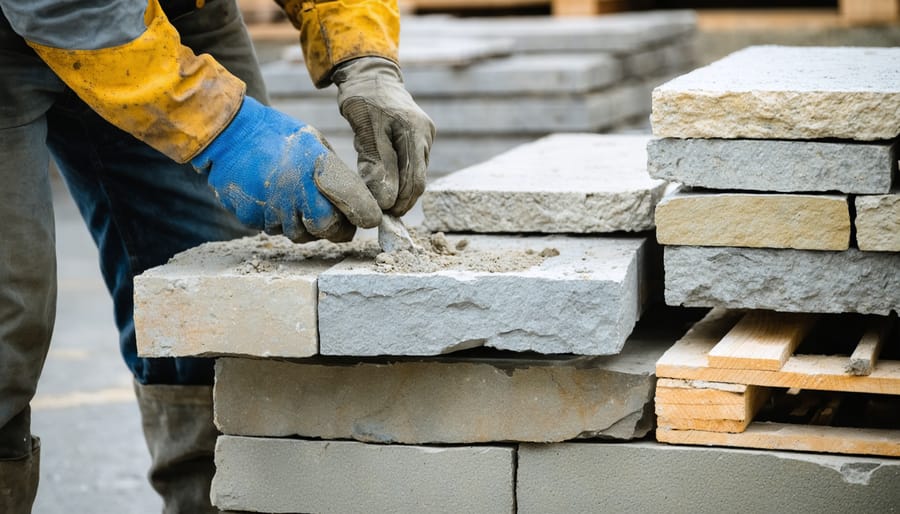
**Expect to pay between $15 and $40 per square foot for stone masonry labor**, with the final cost hinging on project complexity, stone type, and regional market conditions. This significant price range reflects the skilled craftsmanship required to work with natural stone—a material that demands precision, experience, and an understanding of each stone’s unique characteristics.
Budget $15-20 per square foot for straightforward veneer installations using manufactured stone or standard patterns. Mid-range projects involving natural stone with moderate complexity typically run $25-30 per square foot, while intricate designs featuring premium materials, curved elements, or heritage restoration work can reach $40 or more per square foot.
**Understanding these labor costs requires context beyond simple averages.** Geographic location significantly impacts pricing, with metropolitan areas commanding premium rates due to higher operational costs and demand. The mason’s expertise level directly correlates with cost—a master craftsman with decades of experience charges more than an apprentice, but delivers superior results that last generations.
**Material selection drives labor requirements substantially.** Working with irregular flagstone demands more time and skill than uniform cut stone. Thickness variations, surface textures, and stone hardness all affect installation difficulty and, consequently, labor hours required. Pattern complexity—whether running bond, ashlar, or custom designs—multiplies the time investment.
**Current economic factors influence masonry labor rates considerably.** Supply chain constraints, skilled labor shortages, and inflation have elevated costs industry-wide. Understanding these variables empowers you to evaluate quotes accurately and make informed decisions that balance budget constraints with long-term quality expectations.
Average Stone Masonry Labor Costs: What to Expect
Basic Stone Veneer Installation
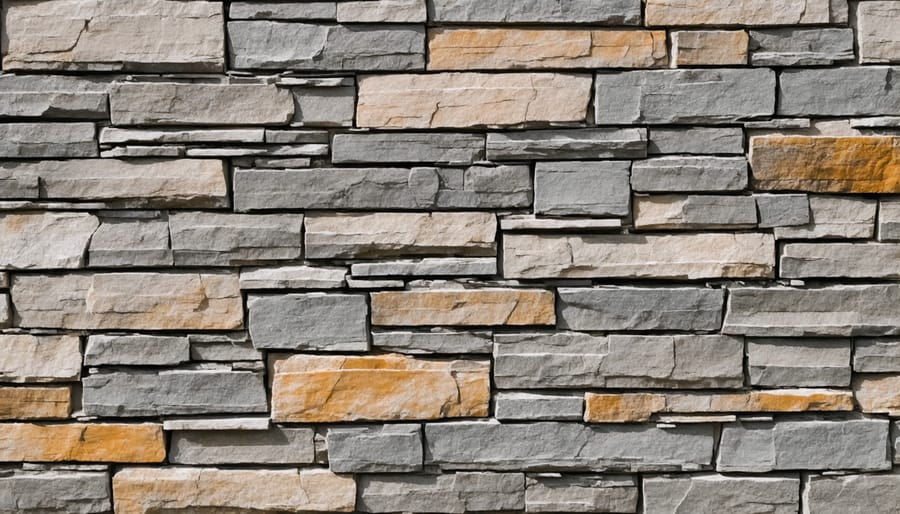
Thin stone veneer installation represents the most budget-friendly masonry option, with labor costs typically ranging from $10 to $18 per square foot. This economical pricing makes it an attractive choice for homeowners and designers seeking the aesthetic appeal of natural stone without the premium cost of full-thickness applications.
The lower labor costs stem from several practical factors. Thin veneer panels, usually ½ to 1½ inches thick, are significantly lighter than traditional stone, eliminating the need for structural reinforcements or specialized foundation work. Masons can install these materials more quickly using mortar and metal lath systems, reducing overall project timelines by 30-50% compared to full-bed stone installation.
Modern manufacturing techniques have dramatically improved stone veneer costs and quality, making this method suitable for both interior accent walls and exterior facades. The straightforward installation process requires fewer specialized tools and less experienced crew members, directly translating to lower hourly rates.
However, proper substrate preparation remains critical—surfaces must be clean, level, and moisture-resistant to ensure lasting adhesion. While material costs add $6-$15 per square foot, the combined expense still positions thin veneer as the most accessible entry point for natural stone projects.
Full-Bed Stone Masonry
Full-bed stone masonry represents the pinnacle of traditional stone construction, where thick stone units are set in substantial mortar beds to create load-bearing walls, foundations, and structural elements. This premium technique commands labor costs ranging from $25 to $40+ per square foot, reflecting the considerable expertise and time investment required.
Unlike veneer applications, full-bed masonry involves working with stones typically 4 inches thick or greater, requiring masons to carefully assess load distribution, proper coursing, and structural integrity. Each stone must be precisely positioned and shimmed to maintain level beds and plumb faces while the substantial mortar joints fully cure. The process demands exceptional physical strength and an intimate understanding of how stones interact under compression.
The labor intensity stems from several factors: handling heavy stone units, mixing and applying larger quantities of mortar, and the meticulous attention to bonding patterns that ensure structural stability. Masons must also account for through-wall ties, drainage planes, and reinforcement integration—elements unnecessary in thin-set veneer work.
Projects requiring full-bed masonry, such as traditional stone foundations, retaining walls, or heritage restoration work, justify the higher investment through their exceptional durability and authentic construction methods that can endure for centuries.
Specialty and Custom Work
When stone masonry transcends standard installations and enters the realm of artistry, labor costs escalate significantly. Intricate patterns like herringbone, basket weave, or custom mosaics require meticulous planning and exceptional craftsmanship, typically commanding $50 to $100 per square foot in labor alone. Curved stone walls, archways, and radius work demand specialized cutting techniques and precise fitting that can push costs to $75-$150 per square foot.
Historic restoration projects represent the pinnacle of specialty masonry work. Matching centuries-old stone types, replicating original cutting methods, and adhering to preservation standards requires master-level expertise. These projects often exceed $100 per square foot for labor, with some complex restoration work reaching $200 per square foot.
Custom stonework for water features, sculptural elements, or one-of-a-kind architectural details involves extensive hand-tooling and artistic skill. Expect to invest $80-$175 per square foot for these bespoke installations. The premium reflects not just technical ability but years of experience translating design concepts into durable stone reality that becomes a permanent focal point of your space.
Six Factors That Drive Stone Masonry Labor Costs
Stone Type and Preparation Requirements
Stone selection significantly impacts labor costs due to variations in workability and physical properties. Granite, the hardest common masonry stone, requires specialized cutting tools and increases installation time by 20-30% compared to softer materials, directly raising labor expenses. Its density also demands additional workers for safe handling of large pieces.
Marble offers moderate workability but requires meticulous care to prevent chipping and staining during installation, adding precision time to each square foot. Limestone, being softer and lighter, cuts more easily and reduces labor hours, making it one of the most cost-effective options for installation.
Fieldstone presents unique challenges—its irregular shapes demand extensive fitting and adjustment, potentially doubling labor time compared to dimensional stone. Each piece requires custom placement and shimming, transforming installation into a puzzle-solving exercise. Additionally, thicker stones (over 3 inches) universally increase handling complexity and labor costs regardless of type, as they require mechanical lifting equipment and additional safety measures.
Installation Complexity and Pattern Design
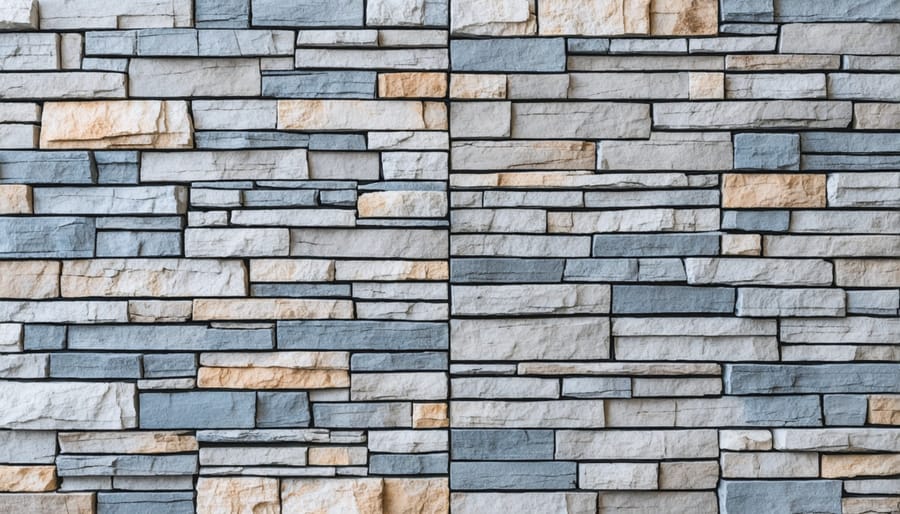
Pattern complexity dramatically influences labor costs, with ashlar (cut stone in regular courses) requiring 30-50% more labor than random rubble work due to precision cutting and fitting demands. Experienced masons command $75-$125 per square foot for ashlar patterns, while random rubble typically ranges $40-$70 per square foot. Corner work adds significant complexity, often requiring custom-cut stones and specialized skill to maintain structural integrity and aesthetic continuity—expect 2-3 times the labor hours compared to flat wall sections.
Custom designs incorporating curves, arches, or decorative medallions require master-level craftsmen and can push costs to $150+ per square foot. These installations demand extensive planning, templating, and field adjustments. The expertise differential matters: a journeyman mason might install 15-20 square feet of simple rubble daily, while complex ashlar patterns reduce output to 8-12 square feet. This productivity gap directly translates to your project timeline and budget, making pattern selection one of your most cost-impactful decisions.
Project Accessibility and Site Conditions
Project location and site conditions significantly impact stone masonry labor costs, often adding 15-50% to base rates. Ground-level work on easily accessible sites represents the most economical scenario, while projects requiring extensive scaffolding, elevated platforms, or working at heights above 10 feet can increase labor costs by $5-$15 per square foot due to additional setup time and safety requirements.
Restricted access sites—such as urban locations with limited parking, narrow entryways, or multi-story buildings without elevator access—slow material delivery and reduce daily productivity. Masons may need smaller equipment or hand-carry materials, extending project timelines. Steep terrain, unstable ground requiring temporary shoring, or weather-exposed locations also demand premium rates.
Working conditions directly affect efficiency: projects in controlled environments allow faster progress than outdoor installations subject to weather delays. When budgeting, factor in scaffolding rental costs ($15-$50 per day per section), safety equipment, and the reduced square footage masons can complete daily in challenging conditions. Discuss site-specific obstacles with contractors early to receive accurate estimates that account for these accessibility variables.
Regional Labor Market Variations
Stone masonry labor costs vary significantly across geographic regions, with metropolitan areas like New York, San Francisco, and Boston commanding $15-25 per square foot, while rural locations may see rates between $8-12 per square foot. This disparity reflects local living costs, demand levels, and available workforce.
Union labor typically costs 20-40% more than non-union alternatives, though union masons often bring standardized training, consistent quality, and comprehensive insurance coverage. In major cities where unions dominate construction trades, this premium becomes standard. Non-union masons in competitive markets may offer lower rates while maintaining quality through reputation and portfolio.
Urban projects face additional cost pressures from limited access, parking restrictions, and stricter permit requirements, while rural sites benefit from lower overhead but may incur travel charges if skilled masons must come from distant areas. Regional material availability also influences labor pricing—masons in areas with local stone quarries often charge less due to familiarity with indigenous materials.
Mason Experience and Specialization
Mason experience levels directly impact both labor rates and project outcomes. Apprentice masons typically charge $25-40 per square foot while developing foundational skills under supervision. Their work suits straightforward installations like basic veneers or simple patterns where structural complexity is minimal.
Journeyman masons, with 4-7 years experience, command $40-65 per square foot and handle most residential and commercial projects competently. They execute complex patterns, manage water drainage details, and work independently on standard installations.
Master masons represent the premium tier at $65-100+ per square foot, justified when projects demand exceptional skill. Their expertise becomes essential for historical restoration matching original techniques, intricate custom stonework requiring artistic interpretation, structural applications where engineering precision is critical, or rare stone types needing specialized handling knowledge.
Specialized skills like dry-stack construction, curved walls, or heritage restoration techniques warrant premium rates regardless of mason tier. When structural integrity, historical accuracy, or complex architectural details are priorities, investing in experienced craftspeople prevents costly repairs and ensures longevity worth multiples of the initial savings from hiring less experienced labor.
Project Scale and Timeline
Project size significantly influences stone masonry labor costs per square foot. Larger projects typically yield lower per-unit costs due to economies of scale—masons can work more efficiently when materials, equipment, and crews remain on-site longer. Small projects under 100 square feet often command premium rates ($30-50/sq ft) as they require the same setup, mobilization, and specialized skills as larger installations. Conversely, projects exceeding 500 square feet may see rates drop 15-25% as fixed costs distribute across more area.
Timeline demands directly impact pricing. Rush jobs requiring expedited schedules or overtime work typically incur 20-40% surcharges, as contractors must prioritize your project over scheduled work. Standard timelines allow masons to work during optimal weather conditions and maintain quality standards.
Seasonal fluctuations affect both availability and cost. Spring and summer represent peak construction seasons when demand drives prices upward and qualified masons book months ahead. Winter projects may offer cost savings of 10-20% but face weather-related delays and potential cold-weather installation challenges requiring specialized techniques and materials.
The Economic Impact of Stone Masonry Labor
Skilled Labor Shortage and Wage Pressure
The stone masonry profession faces a critical workforce challenge that directly impacts project costs. Over the past two decades, the number of skilled stone masons has declined significantly as fewer young workers enter the trade, while experienced craftsmen retire. Industry data shows the average mason is now over 50 years old, creating a widening skills gap that shows no signs of reversing quickly.
This shortage creates substantial wage pressure. When demand for quality stonework exceeds the available workforce, labor rates climb accordingly. Many contractors now pay premium wages—sometimes 30-50% above rates from a decade ago—to retain skilled masons or attract talent from competing projects. These increases reflect not just global economic factors, but the specialized nature of masonry work that requires years of apprenticeship and hands-on experience.
For consumers, this means higher per-square-foot costs and potentially longer project timelines as contractors juggle limited crew availability. The shortage particularly affects complex installations requiring advanced techniques, where only the most experienced masons can deliver quality results.
Training and Apprenticeship Economics
Becoming a skilled stone mason requires substantial time and financial investment, directly impacting labor costs across the industry. Traditional apprenticeship programs typically span three to four years, combining 144 hours of classroom instruction annually with 2,000 hours of hands-on training under experienced craftsmen. During this period, apprentices earn progressively increasing wages—starting at approximately 50% of a journeyman’s rate and advancing to 90% by their final year.
The comprehensive training covers stone cutting techniques, mortar mixing, pattern layout, structural principles, and safety protocols. Many programs also incorporate modern technologies like laser levels and diamond-blade saws alongside traditional hand-tool skills. This extensive preparation ensures masons can handle complex installations safely and efficiently, but it also means fewer qualified professionals enter the field compared to other trades.
The investment in training—shouldered by unions, contractors, and apprentices themselves—contributes to the premium rates skilled masons command. With fewer individuals completing rigorous apprenticeships, the limited supply of qualified craftsmen naturally elevates labor costs. This economic reality explains why stone masonry remains one of the higher-priced construction specialties, typically ranging from $30 to $60 per square foot for labor alone.
Insurance, Overhead, and Business Costs
Stone masonry labor rates reflect more than just the craftsperson’s time on-site. Professional masons must carry comprehensive liability insurance to protect clients and their property, typically adding 8-15% to base labor costs. Workers’ compensation insurance is equally essential in this physically demanding, high-risk trade, contributing another 10-20% depending on state requirements and safety records.
Equipment costs represent another significant overhead factor. While stonework is fundamentally hands-on, masons invest in specialized tools—diamond blades, wet saws, grinders, scaffolding, and mixing equipment—that require regular maintenance and replacement. These capital expenses, along with vehicle costs for transporting materials and tools, typically add 5-10% to quoted rates.
Business overhead—including licensing, bonding, office expenses, estimating time, and continuing education—further influences pricing. Established masonry contractors with proper insurance, modern equipment, and trained crews necessarily charge more than unlicensed operators, but this premium ensures professional results, recourse if issues arise, and compliance with building codes. When comparing quotes, verify that contractors include these essential protections, as unusually low bids often reflect inadequate coverage that transfers risk to you.
Labor vs. Material Costs: Understanding the Balance
Understanding the financial split between labor and materials helps you budget realistically for stone masonry projects. Typically, labor accounts for 40-60% of total project costs, though this ratio varies significantly based on stone type and installation complexity.
For standard projects using readily available materials like bluestone or limestone, the split often falls near 50/50. However, when working with premium stones requiring specialized handling or intricate patterns, labor can climb to 70% of total costs. The material costs per square foot themselves range dramatically—from $5-15 for basic fieldstone to $50+ for rare imported marble.
**Practical Cost Examples:**
A **basic fieldstone veneer wall** (100 square feet) might break down as: Materials $800 (fieldstone at $8/sq ft), Labor $1,200 ($12/sq ft for standard installation), Total: $2,000. Here, labor represents 60% because fieldstone requires careful fitting despite lower material costs.
A **limestone patio** (200 square feet) typically shows: Materials $3,000 (cut limestone at $15/sq ft), Labor $3,000 ($15/sq ft for leveling and mortaring), Total: $6,000—a balanced 50/50 split.
For a **premium marble fireplace surround** (50 square feet): Materials $2,500 (specialty marble at $50/sq ft), Labor $2,000 ($40/sq ft for precision cutting and installation), Total: $4,500. Despite expensive materials, labor remains substantial at 44% due to exacting installation requirements.
Complex patterns, curved elements, or restoration work shift costs further toward labor. A herringbone pattern stone walkway might add 30-40% to labor costs compared to standard running bond layouts. Geographic location also impacts this balance—metropolitan areas typically see higher labor percentages due to increased wage rates, while material costs remain relatively stable across regions.
Getting Accurate Labor Estimates for Your Project
Obtaining accurate labor estimates requires a methodical approach and clear communication with potential contractors. Start by requesting detailed written quotes from at least three licensed stone masons with verifiable portfolios of similar projects. Each quote should itemize labor costs separately from materials, specify the square footage being calculated, and clearly state what’s included in the scope of work.
When interviewing contractors, ask specific questions that reveal their expertise and pricing methodology. Inquire about their experience with your particular stone type, as working with irregular fieldstone demands different skills than installing uniform veneer. Request clarification on how they measure square footage—whether they calculate actual stone coverage or total wall area, as this significantly impacts per-square-foot pricing. Ask about their crew size, project timeline, and whether they carry workers’ compensation insurance and liability coverage.
Several red flags should prompt caution. Be wary of quotes significantly lower than others without clear justification—this often indicates inexperience, corner-cutting on preparation work, or the use of unlicensed subcontractors. Contractors who refuse to provide references, avoid specifics about their methodology, or pressure you for immediate decisions warrant skepticism. Vague estimates that don’t break down labor from materials make meaningful comparison impossible.
When comparing bids, look beyond the bottom line. Evaluate each contractor’s proposed timeline, warranty offerings, and payment schedule. The lowest bid rarely represents the best value if it compromises craftsmanship or durability. Consider each mason’s communication style and professionalism—these traits often predict how they’ll handle inevitable project challenges. Request photos of completed projects similar to yours, and contact previous clients about their experience with workmanship quality and adherence to budgets.
When Higher Labor Costs Actually Save You Money
The counterintuitive truth about stone masonry is that paying premium labor rates—typically $15-25 per square foot versus budget rates of $8-12—often results in lower total ownership costs over time.
Consider a real-world comparison from a 2022 residential project in Virginia. Two homeowners on the same street installed natural stone veneer facades. The first hired experienced masons at $22 per square foot; the second chose contractors bidding $10 per square foot. Within eighteen months, the budget installation showed mortar deterioration, water infiltration behind stones, and efflorescence staining. Repair costs exceeded $8,000, plus the homeowner faced recurring maintenance expenses. The premium installation remained flawless, requiring only routine cleaning.
Quality craftsmanship delivers measurable financial advantages. Skilled masons properly prepare substrates, ensuring adequate moisture barriers and drainage systems. They select and place stones for optimal weight distribution and weather resistance. Their mortar joints are properly tooled and sealed, preventing water penetration that causes freeze-thaw damage. These techniques extend stone installations from 15-20 years to 50-100 years or more.
The mathematics favor quality. A $10,000 premium on labor costs for superior installation avoids $15,000-30,000 in premature repairs or replacement over two decades. You eliminate callback visits, avoid property damage from water intrusion, and maintain curb appeal without constant touch-ups.
Property value preservation represents another crucial factor. Appraisers and discerning buyers recognize quality stonework. Premium installations enhance marketability and support higher asking prices, while visibly deteriorating stone becomes a negotiating liability. The long-term investment value of natural stone depends entirely on installation quality.
Experienced masons also work more efficiently, reducing project timelines and minimizing disruption. Their expertise prevents costly mistakes like improper flashing details or inadequate structural support. When you factor in longevity, reduced maintenance, preserved aesthetics, and protected property values, premium labor rates deliver substantial returns that budget alternatives simply cannot match.
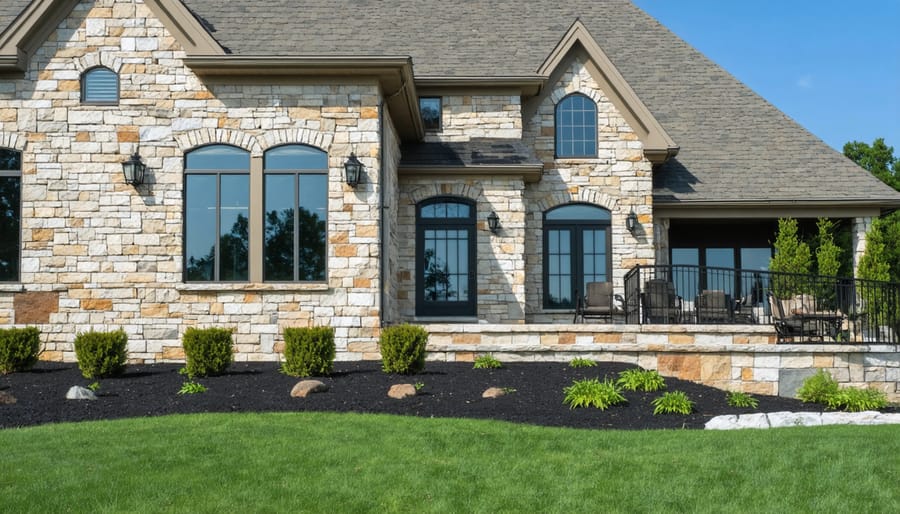
Understanding stone masonry labor costs empowers you to make informed decisions about your natural stone project. While prices typically range from $15 to $50 per square foot for labor alone, remember that the lowest quote isn’t always the best value. Skilled masons bring years of experience, proper techniques, and attention to detail that directly impact your project’s longevity and aesthetic appeal.
When budgeting for natural stone work, allocate funds not just for materials and labor, but also for site preparation, specialized tools, and potential unforeseen challenges. Quality stone masonry is an investment that enhances your property’s value, beauty, and durability for decades. A well-executed stone installation can last generations with minimal maintenance, while poor workmanship often leads to costly repairs.
Request detailed quotes from multiple licensed contractors, verify their credentials and insurance, and examine their previous work. Don’t hesitate to ask about their experience with your specific stone type and project scope. By prioritizing craftsmanship alongside competitive pricing, you’ll ensure your natural stone project delivers lasting satisfaction and returns on your investment.