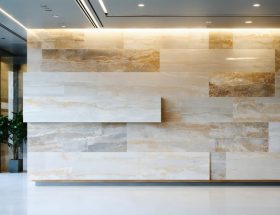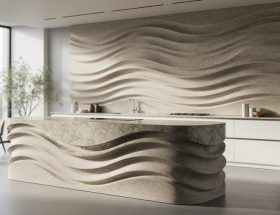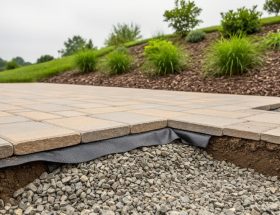
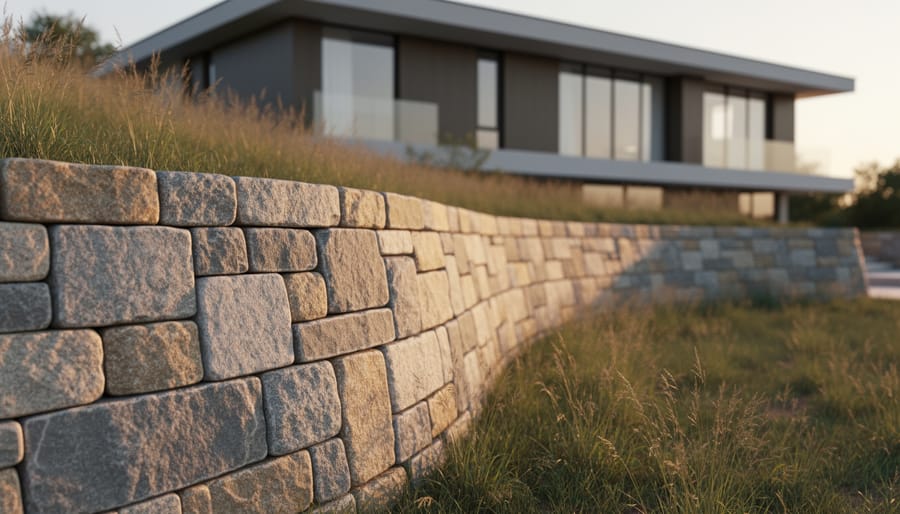
Foundation decorative stone transcends its structural purpose when shaped into organic, curved designs that mirror nature’s inherent geometry. Rather than accepting the conventional straight-edged foundation treatment, today’s most compelling architectural projects embrace fluid stone arrangements that soften building perimeters, create visual movement, and establish harmonious transitions between structure and landscape.
The shift toward curved stone foundations reflects a broader design evolution where rigidity yields to natural forms. Limestone, sandstone, and fieldstone become sculptural elements when installed in flowing patterns that follow terrain contours or create intentional undulations. These installations demand precise planning—curved layouts require careful template creation, modified mortar joints, and strategic stone selection to maintain structural integrity while achieving aesthetic fluidity.
Technical execution separates successful curved stone foundations from compromised installations. Radius calculations determine minimum curve dimensions, typically requiring stones no larger than 8-12 inches for tight curves. Dry-stacking techniques offer flexibility for organic designs, while mortared applications need expansion joints positioned at logical intervals to prevent cracking as curves exert unique stress patterns.
Real-world applications demonstrate the transformative power of this approach. Contemporary mountain retreats feature graduated fieldstone foundations that cascade around building corners, while urban properties employ curved limestone bases that soften modern facades. These designs prove that foundation stone need not be an afterthought but rather an intentional design element that elevates architectural presence and connects buildings authentically to their surroundings.
The Evolution of Foundation Aesthetics: From Hidden to Highlighted
For decades, foundations existed in architectural obscurity—purely utilitarian elements meant to be concealed beneath siding, stucco, or strategic landscaping. The prevailing philosophy treated them as necessary structural components that required camouflage rather than celebration. Homeowners invested thousands in premium exterior finishes while foundations remained an afterthought, typically finished with basic concrete or minimal veneer applications.
This paradigm is experiencing a fundamental shift. Contemporary architecture increasingly recognizes foundations as transitional zones where structure meets earth, offering unique opportunities for design expression. Rather than hiding this crucial interface, forward-thinking architects and designers now celebrate it, transforming foundations into visual anchors that ground buildings within their landscapes.
Decorative stone has emerged as the medium of choice for this transformation, particularly when executed with curved, organic designs. Unlike rigid rectangular patterns that emphasize the artificial nature of construction, curved stone applications create visual fluidity. These flowing designs echo natural geological formations, making foundations feel less like imposed structures and more like organic outcroppings that belong to their surroundings.
The curved stone approach serves multiple aesthetic functions simultaneously. It softens the hard transition between manicured landscapes and architectural elements, provides visual interest at eye level where visitors first encounter a building, and introduces textural depth that changes throughout the day as light shifts across dimensional surfaces. Stone’s inherent color variation and natural weathering patterns further enhance this organic aesthetic, ensuring the foundation appears timeless rather than trendy.
This evolution reflects broader architectural movements toward biomimicry and contextual design—approaches that seek harmony with natural environments rather than dominance over them. Foundation decorative stone with curved profiles represents practical application of these principles, accessible to residential and commercial projects alike.
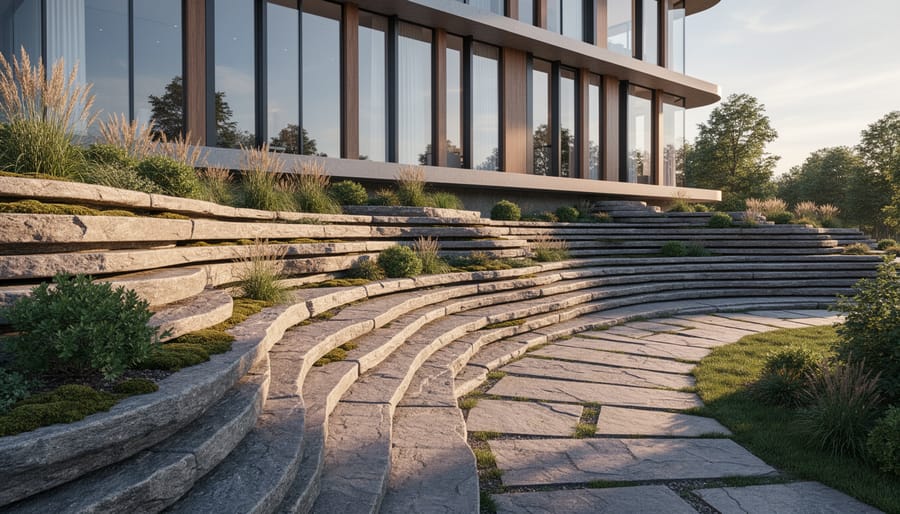
Why Organic Fluidity Matters in Modern Stone Foundation Design
The Psychology of Curves in Architecture
Curves in architecture tap into something deeply human—our inherent connection to the natural world. Unlike sharp angles and rigid lines that dominate conventional construction, curved stone designs mirror the flowing forms we encounter in nature: river-worn boulders, rolling hillsides, and smooth canyon walls. This visual language creates an immediate sense of comfort and familiarity.
Research in environmental psychology shows that curved architectural elements reduce stress and promote feelings of safety. When applied to foundation treatments, these organic shapes soften the transition between building and landscape, making structures feel integrated rather than imposed upon their surroundings. The eye naturally follows curved lines with ease, creating visual movement that draws attention without jarring the senses.
Foundation stonework with gentle arcs and undulating patterns transforms what is typically a purely functional element into an inviting architectural feature. These designs signal approachability and warmth, encouraging interaction with outdoor spaces. For homeowners and designers seeking to create harmonious environments that feel both grounded and alive, curved stone foundations offer a compelling alternative to traditional linear installations.
Blending Built and Natural Environments
Curved stone foundations create a visual dialogue between architecture and nature, softening the transition from built structure to landscape. Unlike rigid geometric foundations that can appear to impose themselves on a site, curved designs echo the organic contours found in natural terrain—meandering streams, rolling hillsides, and weathered rock formations. This approach aligns with biophilic design principles, fostering an innate connection between occupants and the natural world.
When properly executed, curved stone foundations allow buildings to nestle into their surroundings rather than dominate them. The stone’s inherent texture and color variations complement existing landscape elements, while the flowing lines guide the eye naturally from structure to garden, from hardscape to vegetation. This integration proves particularly effective in challenging sites with slopes or irregular topography, where curved foundations can follow elevation changes gracefully.
Strategic placement of native plantings alongside curved stonework further enhances this blending effect. Low-growing perennials, ornamental grasses, and cascading ground covers soften foundation edges, creating layers that blur boundaries between architecture and earth. The result is a cohesive environment where buildings feel like natural extensions of their sites.
Best Natural Stone Types for Curved Foundation Applications
Fieldstone and Irregular Natural Stone
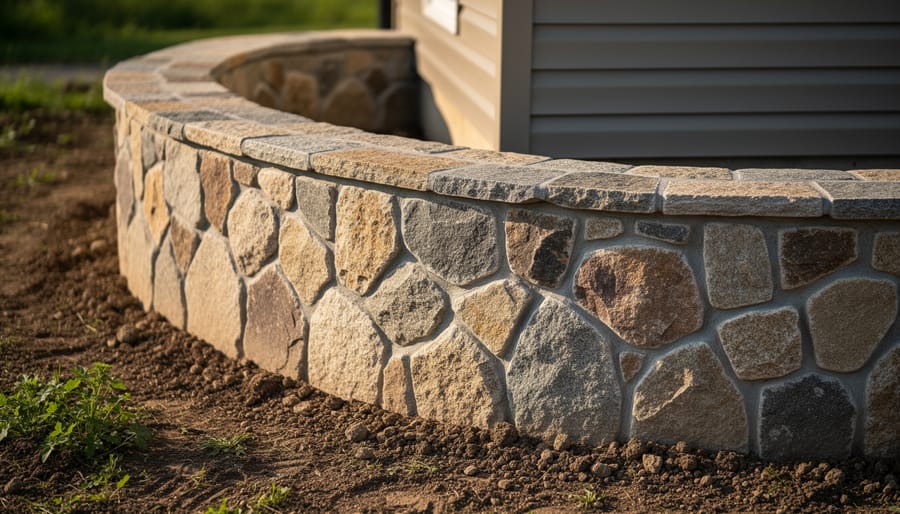
Fieldstone and irregular natural stone are exceptional choices for creating foundation designs that embrace organic fluidity. Unlike cut stone with uniform dimensions, these materials feature varied shapes, textures, and sizes that naturally resist rigid geometric patterns. When installed with curved or flowing designs, fieldstone creates visual movement that echoes natural rock formations and streamside landscapes.
The inherent randomness of irregular stones allows masons to craft foundations that appear as though they’ve emerged from the earth itself rather than being imposed upon it. Each stone’s unique contours can be positioned to complement adjacent pieces, creating sinuous lines that guide the eye along the foundation’s length. This approach works particularly well for homes situated in wooded or naturalistic settings where blending architecture with the landscape is paramount.
Color variation within fieldstone collections adds depth to curved installations, with earth tones shifting subtly across the foundation face. This natural palette combined with irregular sizing prevents the monotony that can occur with repetitive patterns, making fieldstone an ideal material for designers seeking authentic, timeless foundation treatments that celebrate stone’s organic character.
Limestone and Sandstone for Carved Curves
Limestone and sandstone stand out as exceptional choices for curved foundation designs due to their relatively soft, uniform composition. These sedimentary stones can be precisely carved, cut, and shaped to achieve flowing, organic lines that harder materials like granite simply cannot replicate with the same ease or cost-effectiveness.
Limestone’s fine grain structure allows artisans to create intricate radiused corners, serpentine walls, and smooth transitions between foundation elements. The stone responds beautifully to both hand-carving techniques and modern CNC cutting, enabling everything from gentle sweeping curves to tight radii. Sandstone offers similar workability with slightly more texture variation, adding visual interest while maintaining the ability to form graceful arcs.
Both materials accept natural or honed finishes that enhance their sculptural qualities. Their porosity does require proper sealing in foundation applications, but this minor maintenance consideration is well worth the design flexibility they provide. When creating truly distinctive curved foundations, these workable stones transform architectural visions into tangible, flowing realities that complement rather than compete with natural landscape contours.
Granite and Marble for Dramatic Modern Curves
Granite and marble stand as premium choices for dramatic curved foundation designs, offering unmatched durability and visual impact in contemporary architecture. These harder stones, with their inherent strength and density, can be precisely cut and shaped to achieve sweeping, sculptural curves that make powerful architectural statements.
Granite’s exceptional compressive strength makes it ideal for cantilevered curved designs and bold geometric foundations that appear to defy gravity. Available in striking patterns from jet black absolute to dramatic movement in varieties like Tiger Skin or Blue Bahia, granite brings both structural integrity and aesthetic drama to modern projects. Water jet cutting and CNC technology enable these dense materials to be shaped into graceful arcs and compound curves previously impossible with traditional cutting methods.
Marble elevates curved foundations with luxurious sophistication, particularly in statement entryways and focal wall applications. Varieties like Calacatta with bold veining or Statuario with delicate grey striations create flowing visual narratives when book-matched along curved surfaces. The stone’s natural luminosity enhances architectural lighting designs, making curved foundations appear to glow at dusk.
These premium materials require professional installation with proper anchoring systems and structural support, but deliver lasting beauty and timeless appeal that transforms foundations into signature design elements defining a building’s character.
Design Techniques for Creating Organic Flow with Foundation Stone
Radius Planning and Stone Selection
Successful curved foundation designs begin with thoughtful radius planning. Gentle, sweeping curves with radii of at least 3-4 feet create the most natural appearance and simplify installation, while tighter curves require smaller stones and more precise cutting. Consider the viewing distance when determining curve intensity—broader curves read better from street view, while tighter radii can add interest to intimate garden spaces.
Stone selection directly impacts the feasibility of your curved design. For pronounced curves, choose stones in the 4-8 inch range, as smaller pieces naturally accommodate tighter radii without extensive cutting. Larger stones exceeding 12 inches work best for gentle, flowing curves or straight sections that transition into curves. Mixed sizing creates the most organic effect, mimicking natural stone formations where various sizes nestle together.
Thickness consistency matters for structural stability. Maintain relatively uniform stone depth (typically 3-5 inches for veneer applications) throughout curved sections to ensure proper mortar bonding and weather resistance. Test your layout before mortaring by dry-fitting stones along the planned curve, adjusting placement to minimize cutting while maintaining consistent joint spacing. This preview step helps identify potential issues and reduces material waste during installation.
Pattern and Joint Treatment
The visual success of curved stone foundations depends heavily on how individual stones relate to one another through careful joint spacing and arrangement. Unlike rigid, grid-based patterns, organic designs require a more intuitive approach to stone placement that emphasizes natural flow and movement.
Joint spacing plays a crucial role in reinforcing curves. Narrower joints, typically ranging from 3/8 inch to 3/4 inch, help maintain visual continuity along curved lines, allowing the eye to follow the sweep of the design without interruption. Conversely, wider joints can fragment the appearance and work against the fluid aesthetic. The mortar itself becomes part of the design language—recessed joints create shadow lines that accentuate individual stone shapes, while flush joints emphasize the overall surface as a unified plane.
Mortar color selection significantly impacts the final result. Light-colored mortars can highlight the geometry of each stone, creating a more pronounced pattern, while mortars that closely match the stone color minimize visual breaks and enhance flow. For curved applications, slightly tooled or weathered joint finishes often appear more natural than perfectly smooth strikes.
Stone arrangement strategies like stone pattern mixing add depth and interest while maintaining organic movement. Varying stone sizes and orientations—larger stones anchoring key curves with smaller pieces filling transitions—creates rhythm without repetition. Skilled masons often “dry-lay” sections before final installation, adjusting placement until the arrangement feels effortless and directional, guiding viewers’ eyes along the intended path of the foundation’s curves.
Installation Considerations for Curved Foundation Stone
Installing decorative stone on curved foundations presents unique challenges that require careful planning and specialized techniques. Unlike straight applications, curved designs demand flexibility in both material selection and installation methods to achieve seamless, visually striking results.
The primary challenge involves managing the stone’s ability to follow the curve without creating unsightly gaps or uneven spacing. Smaller stone units naturally accommodate curves more easily than larger pieces. Fieldstone, stacked ledgestone, and smaller cut stones work exceptionally well for curved applications, as they can be adjusted incrementally to maintain consistent reveals and alignment. Conversely, large-format veneer panels may require cutting and custom fitting, increasing labor time and material waste.
Foundation preparation becomes even more critical with curved installations. The substrate must be perfectly smooth and properly sloped to ensure adequate drainage while supporting the stone’s weight uniformly along the curve. Any irregularities become magnified on curved surfaces, potentially causing installation failures. A reinforced wire lath or metal framework often provides essential support, particularly on tighter radius curves where mortar alone may not secure the stones adequately.
Mortar application requires modified techniques for curved work. Installers must pay special attention to maintaining consistent joint widths while accommodating the stone’s directional changes. Dry-stacking methods can offer advantages on gentler curves, allowing for easier adjustments and a more organic appearance, though they require precision fitting and occasional anchoring systems.
Layout planning proves essential before installation begins. Creating a template or using flexible guides helps visualize how stones will transition around curves. Starting from focal points and working outward ensures symmetrical flow, while occasionally stepping back to assess the overall pattern prevents alignment issues.
Professional installation is strongly recommended for curved foundation projects, as the complexity demands experience with both stonework and geometric principles. Skilled masons understand how to select and position individual stones to maintain visual rhythm while accommodating structural requirements. They also possess the tools and expertise to cut stones precisely when necessary, minimizing waste while achieving crisp, professional results that enhance your home’s architectural character.
Real-World Applications: Case Studies in Curved Stone Foundation Design
The transformative power of curved decorative stone foundations becomes evident when examining recent projects that showcase innovative design solutions and masterful material selection.
A contemporary lakeside residence in Minnesota demonstrates how organic curves can harmonize architecture with natural surroundings. The design team selected locally quarried limestone with warm beige tones and subtle fossil inclusions to create a gently undulating foundation that mirrors the shoreline’s natural contours. The stone was cut into varying heights, from 18 to 24 inches, and installed with tight joints to emphasize the flowing lines. This custom stonework approach resulted in a foundation that appears to emerge organically from the landscape, blurring boundaries between built environment and nature. The lighter stone color reflects sunlight beautifully, creating dynamic shadows that shift throughout the day and accentuate the curved geometry.
In downtown Seattle, a boutique hotel renovation showcased how curved stone foundations can revitalize urban architecture. Designers chose dark charcoal granite with silver flecking to create a bold, sculptural base for the historic building. The foundation features dramatic convex curves at the corner entries, drawing pedestrians toward the entrances while providing visual weight and permanence. The granite’s polished finish contrasts with rougher upper facades, establishing a sophisticated dialogue between traditional and contemporary elements. The curved design also solved practical challenges, allowing improved drainage and creating covered alcoves for plantings that soften the urban hardscape.
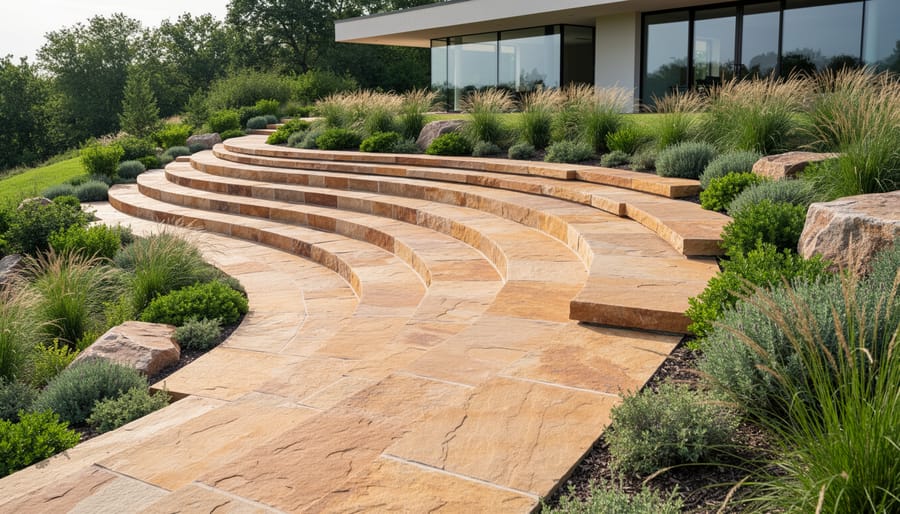
A Southwestern estate in Arizona presents another compelling example, where locally sourced sandstone in rust and terra cotta hues forms sweeping curved foundations that echo desert canyon walls. The design incorporates varying stone sizes and textures, with larger boulders anchoring corners and transitional curves flowing into smaller, more uniform pieces. This gradation creates visual movement and reinforces the organic aesthetic. Strategic lighting positioned at the foundation’s base transforms the curved walls into sculptural elements after dark, casting dramatic shadows that emphasize depth and dimensionality. The project demonstrates how thoughtful stone selection and curved design can root contemporary architecture firmly within regional context while achieving timeless elegance.
Maintenance and Longevity of Curved Stone Foundations
Curved decorative stone foundations require thoughtful maintenance to preserve both their aesthetic appeal and structural performance. The flowing nature of these designs means that attention to detail during upkeep is essential for long-term success.
Regular cleaning forms the foundation of proper maintenance. For most natural stone varieties, a gentle approach works best: use a soft-bristle brush and pH-neutral cleaner specifically formulated for stone. Avoid acidic cleaners on limestone or marble, as they can etch the surface. Pressure washing should be approached cautiously, keeping the nozzle at least 12 inches from the stone and using a wide spray pattern to prevent surface damage or mortar erosion. Clean curved foundations at least twice annually, paying special attention to areas where dirt and organic matter accumulate in recessed joints.
Sealing protects stone from moisture penetration, staining, and weathering. Apply a breathable penetrating sealer appropriate for your specific stone type within the first year of installation, then reapply every three to five years depending on exposure conditions and stone porosity. Test sealers on a small, inconspicuous area first to ensure they don’t alter the stone’s appearance. For curved installations, work in manageable sections to ensure even coverage along contoured surfaces.
Inspect mortar joints regularly for signs of deterioration. The complex geometry of curved designs can place additional stress on joints, making periodic evaluation critical. Address minor cracks promptly through repointing to prevent water infiltration that could compromise the foundation’s integrity. When repairs are necessary, match both the mortar composition and color to maintain visual continuity along the curved profile.
Winter protection matters in freeze-thaw climates. Ensure proper drainage away from the foundation and consider applying additional sealer before cold weather arrives. Remove ice carefully using plastic shovels rather than metal tools that could chip or scratch stone surfaces.
The marriage of foundation decorative stone with organic curved designs represents more than an aesthetic choice—it’s a transformative approach that reimagines how buildings meet the earth. By replacing rigid, conventional foundation treatments with flowing stone applications that mirror natural formations, homeowners and designers unlock a powerful design language that speaks to both timeless elegance and contemporary innovation.
For architects and designers, this approach offers a distinctive competitive advantage. Projects featuring curved stone foundations create memorable first impressions that distinguish properties in competitive markets while honoring the inherent beauty of natural materials. The versatility of stone allows for customization across architectural styles, from minimalist modern homes to rustic retreats, proving that organic fluidity transcends trend-driven design.
Homeowners who embrace this philosophy invest in lasting value. Natural stone foundations crafted with flowing lines don’t merely enhance curb appeal—they create harmonious transitions between built structures and surrounding landscapes. This integration fosters a sense of place and belonging that flat, linear foundations rarely achieve.
The technical considerations may require careful planning and skilled craftsmanship, but the results justify the investment. As demonstrated through real-world applications, curved stone foundations withstand the test of time both structurally and aesthetically, aging gracefully while maintaining their visual impact.
Moving forward, consider how natural stone’s inherent variations in color, texture, and form can be channeled through curved design principles to create foundations that aren’t just structural necessities but integral elements of architectural expression that celebrate the beauty found in nature’s fluid forms.