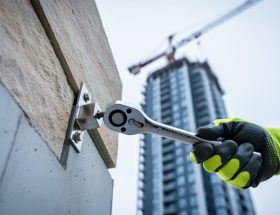

Understanding ASCE 7 wind load requirements is essential for any stone cladding project’s structural integrity and longevity. The American Society of Civil Engineers standard ASCE 7 provides the framework for calculating wind pressures that stone facades must withstand, with requirements varying significantly based on building height, geographical location, exposure conditions, and terrain characteristics.
Stone cladding systems face unique challenges under wind loads. Unlike lighter facade materials, natural stone’s mass creates different stress patterns on anchoring systems, while its rigidity means less deflection tolerance. Wind creates both positive pressures pushing against the facade and negative suction forces pulling outward, with corner and edge zones experiencing pressure coefficients up to four times higher than field areas. These forces transfer directly through anchors and support systems to the building structure.
Proper building code compliance requires accurate wind load calculations from the project’s earliest design phases. Design professionals must determine the basic wind speed from ASCE 7 wind maps, apply exposure categories reflecting surrounding terrain, calculate velocity pressure based on height above ground, and incorporate importance factors for the building’s risk category. Component and cladding pressures differ substantially from main wind force resisting system values, making these calculations critical for stone panel sizing and anchor specification.
This comprehensive guide explains how ASCE 7 wind load standards apply specifically to stone cladding installations, providing practical strategies for compliance, testing protocols, and real-world solutions that ensure your stone facade performs safely throughout its service life.
Understanding Wind Loads on Building Facades
How Wind Creates Pressure and Suction Forces
When wind strikes a building facade, it creates two distinct types of forces that affect stone cladding systems: positive pressure (pushing) and negative pressure (pulling or suction). Understanding both is essential for proper facade design and ASCE 7 compliance.
Positive pressure occurs on the windward side of a building—the side directly facing the wind. As air hits the facade, it compresses against the surface, creating an inward pushing force. While significant, this force is relatively straightforward to design for since it acts in the same direction as gravity, helping to seat cladding panels against their anchors.
Negative pressure, or suction, develops on the leeward sides, roof areas, and building corners where wind flow accelerates and creates a vacuum effect. This pulling force acts outward, attempting to lift stone panels away from the building structure. Think of how a tablecloth lifts when you blow across a table—wind moving rapidly over a surface creates lower pressure, generating suction.
For stone cladding, suction forces present the greater design challenge. These outward-acting forces work against gravity and directly stress the anchoring system, potentially causing catastrophic failure if underestimated. Building corners and parapets experience the highest suction forces due to wind acceleration around these features, sometimes reaching magnitudes 2-3 times greater than positive pressures on flat wall sections.
ASCE 7 accounts for both pressure types through specific calculation methods that help designers determine the actual forces stone cladding systems must withstand at different building locations.
Why Stone Cladding Is Particularly Vulnerable
Natural stone cladding faces unique wind load challenges due to its inherent material properties and installation requirements. The significant weight of stone panels—often ranging from 15 to 30 pounds per square foot—creates substantial gravitational forces that, when combined with lateral wind pressure, place considerable stress on anchoring systems. Unlike lighter cladding materials that may flex slightly under wind pressure, stone’s rigid nature means it cannot absorb or dissipate wind forces through deformation. Instead, all wind loads transfer directly to connection points.
These connection points represent the system’s most vulnerable element. Stone panels typically rely on discrete mechanical anchors—often just four to six per panel—to resist both positive and negative wind pressures. This concentrated load transfer creates potential failure points, particularly when anchors are improperly sized, incorrectly positioned, or installed in substrates with inadequate capacity. The brittle nature of stone compounds this vulnerability; unlike ductile materials that exhibit warning signs before failure, stone can fracture suddenly when stress concentrations exceed its tensile strength at anchor locations or panel edges, making proper ASCE 7 wind load calculations essential for system integrity.
What ASCE 7 Actually Requires
Key ASCE 7 Wind Load Calculation Factors
Understanding wind load calculations requires familiarity with several critical factors that ASCE 7 uses to determine the forces your stone cladding system must withstand. These variables work together to create a comprehensive picture of wind resistance requirements for your specific project.
Building height plays a fundamental role in wind load calculations. Taller structures experience greater wind pressures, particularly at upper levels where exposure to wind forces increases significantly. ASCE 7 accounts for this by applying height-based pressure coefficients that escalate as you move higher on the building facade. For stone cladding projects, this means anchor systems and attachment methods may need to be more robust on upper floors compared to lower levels.
Geographic location directly influences design wind speeds, which form the foundation of all ASCE 7 wind load calculations. The standard provides detailed wind speed maps based on historical weather data across the United States. Coastal regions, tornado-prone areas, and hurricane zones typically require higher design wind speeds, translating to stronger fastening requirements for stone cladding installations.
Exposure category describes the terrain surrounding your building site. ASCE 7 defines three primary categories: Exposure B for urban and suburban areas with numerous obstructions, Exposure C for open terrain with scattered obstacles, and Exposure D for flat, unobstructed coastal areas. Buildings in Exposure D face the highest wind pressures due to minimal wind-breaking elements, requiring more substantial stone cladding attachment systems.
The importance factor accounts for a building’s intended use and occupancy. Essential facilities like hospitals receive higher importance factors, requiring greater wind resistance margins. This factor ensures that critical structures maintain integrity during extreme weather events, protecting both the building envelope and occupants. For stone facades on high-importance buildings, this typically necessitates additional testing and more conservative design approaches.
Components and Cladding vs. Main Wind Force Resisting System
ASCE 7 recognizes that different building elements experience wind forces in distinct ways, which is why the standard separates requirements for Components and Cladding (C&C) from the Main Wind Force Resisting System (MWFRS). Understanding this distinction is essential for properly designing stone cladding installations.
The MWFRS refers to the structural framework that keeps a building stable—columns, beams, shear walls, and bracing systems that transfer wind loads to the foundation. These elements resist overall lateral forces acting on the entire building structure.
Components and Cladding, by contrast, includes exterior envelope elements like stone panels, windows, and curtain walls. These elements don’t contribute to the building’s overall structural stability but must independently resist localized wind pressures. Stone cladding experiences higher peak pressures than the MWFRS because wind creates concentrated forces at corners, edges, and discontinuities in the building envelope.
ASCE 7 prescribes different pressure coefficients for C&C elements, often resulting in higher design pressures than those applied to the main structure. For stone facades, this means attachment systems, anchors, and individual panels must withstand greater forces than you might expect from whole-building calculations alone.
This differentiation impacts stone installation in several ways. Anchoring systems require careful engineering to handle these elevated pressures. Panel sizes may need adjustment in high-pressure zones. Edge and corner details demand special attention since these areas experience the greatest wind effects. Just as buildings must meet fire safety compliance standards, stone cladding systems must demonstrate adequate strength for their specific component classification under ASCE 7 guidelines.
Critical Design Considerations for ASCE 7 Compliance
Anchor and Attachment System Requirements
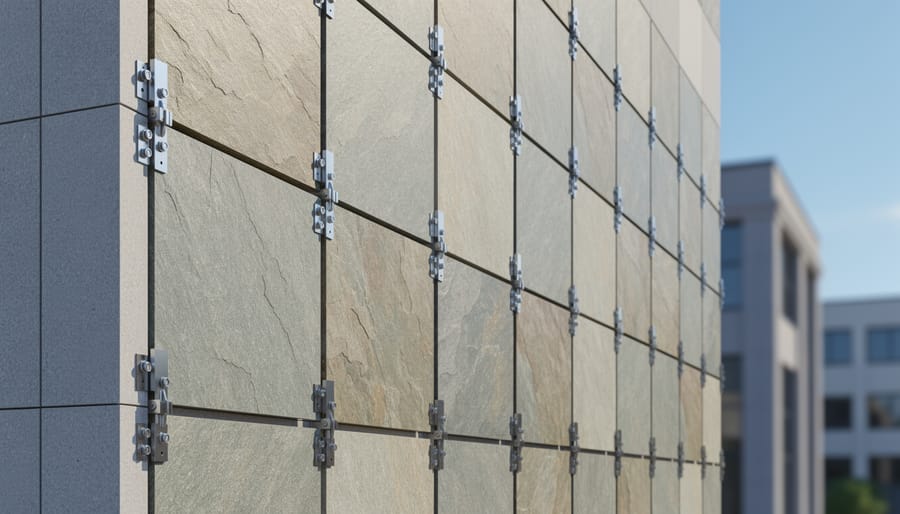
Proper anchoring systems form the critical connection between stone cladding and the building structure, ensuring safe load transfer under ASCE 7 wind conditions. These mechanical attachment systems must be engineered to resist both positive and negative wind pressures while accommodating thermal movement and preventing stress concentrations that could damage the stone.
Anchor spacing requirements depend on panel size, stone thickness, and calculated wind loads for your specific project location. Most code-compliant installations utilize stainless steel anchors, typically Type 304 or 316, positioned at intervals determined by structural calculations. The standard configuration places four to six anchors per panel for medium-sized units, though larger panels may require additional support points to distribute loads evenly.
Load transfer mechanisms vary by system type. Kerf anchors slot into saw cuts in the stone edges, while dowel pins insert into drilled holes. Undercut anchors provide superior holding strength by creating a mechanical lock within the stone itself. Each anchor type must demonstrate adequate pull-out strength through testing, typically requiring a 4:1 safety factor against calculated design loads.
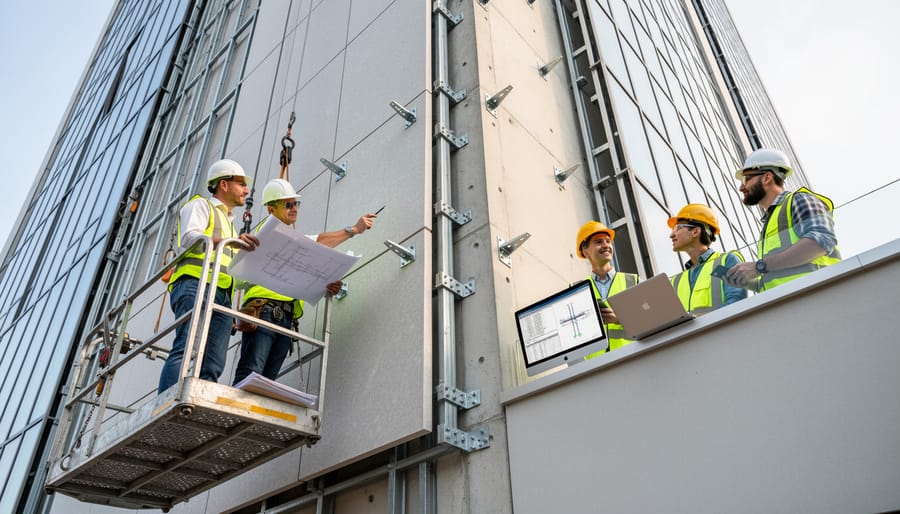
The supporting framework, whether steel or aluminum, must possess sufficient strength and rigidity to resist deflection under peak wind events. Rail systems should limit deflection to L/175 or L/240, depending on stone brittleness and joint width. Connection details between the anchor and support structure require particular attention, as this interface experiences the highest stress concentrations. Similar to seismic certification requirements, anchor systems must undergo rigorous testing to validate their performance under extreme loading conditions, with documentation provided for code officials during the permitting process.
Panel Size and Weight Limitations
Wind loads directly dictate the maximum size and weight of stone panels permissible for exterior cladding applications. Higher wind pressures require either thicker, heavier panels with greater structural capacity or smaller panel dimensions to reduce the total load on anchorage systems. ASCE 7 calculations establish design pressures that engineers use to determine safe panel configurations for specific building locations and heights.
As a general guideline, panels on high-rise buildings or coastal installations subjected to extreme wind events often cannot exceed 15-20 square feet without requiring specialized anchorage systems or increased thickness. The relationship between panel size and wind load is exponential—doubling panel dimensions quadruples the surface area exposed to wind forces. This means larger panels demand proportionally stronger anchoring systems and potentially thicker stone to resist bending and breakage.
Stone thickness typically ranges from 1.25 inches to 2 inches for standard applications, but wind load analysis may necessitate 3-inch thick panels or thicker in high-exposure conditions. Engineers balance aesthetic preferences for larger, uninterrupted stone surfaces against the structural realities of wind resistance, anchoring capacity, and building movement. When design pressures exceed typical ranges, consider reducing panel dimensions, increasing thickness, incorporating additional support points, or specifying stone types with higher flexural strength to maintain both safety and design intent.
Stone Type and Flexural Strength Considerations
Not all natural stone materials respond equally to wind-induced stress, making material selection a critical component of ASCE 7 compliance for facade projects. Understanding the flexural strength characteristics of different stone types helps ensure both safety and longevity.
Granite typically offers superior flexural strength, ranging from 1,500 to 3,000 psi, making it highly suitable for high-wind applications and thin panel installations. Its dense composition and minimal porosity contribute to excellent resistance against wind-driven forces. Limestone and sandstone, with flexural strengths between 500 and 1,500 psi, require more conservative design approaches, including thicker panels or closer anchoring intervals when used in wind-exposed locations.
Marble falls in the middle range, though its strength can vary significantly based on grain structure and mineral composition. Designers should request comprehensive testing data for specific quarry lots rather than relying on general material classifications.
Beyond flexural strength, consider the stone’s freeze-thaw resistance in combination with wind loads, as moisture infiltration during high-wind rain events can compromise structural integrity over time. Proper material selection involves analyzing both the anticipated wind pressures calculated per ASCE 7 and the stone’s tested performance characteristics. When specifying stone for facades exceeding 40 feet in height or in high-velocity hurricane zones, always verify that material strength exceeds design loads by appropriate safety factors.
Regional Wind Zone Variations and Their Impact
Hurricane-Prone Regions and Coastal Applications
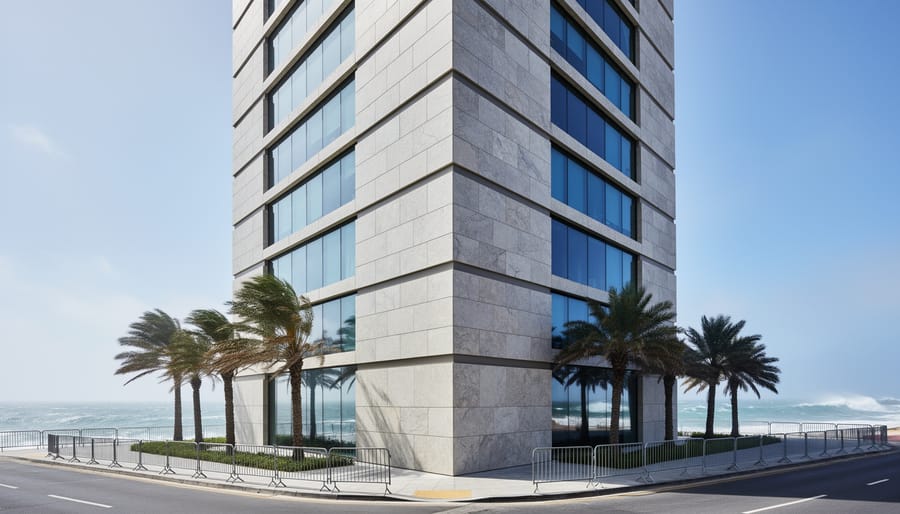
Coastal environments and hurricane-prone regions present unique challenges for stone cladding systems due to extreme wind speeds, wind-driven rain, and airborne debris. ASCE 7 designates these areas as Risk Category III or IV zones, requiring enhanced design pressures and more rigorous performance standards.
In these high-wind coastal zones, stone anchoring systems must accommodate significantly increased wind loads, often exceeding 150 mph design wind speeds. This necessitates stronger mechanical anchors, reduced panel spans, and additional intermediate support points. Stainless steel anchoring components become essential to resist corrosion from salt-laden air, while anchor embedment depths typically increase by 25-50 percent compared to standard applications.
Impact resistance is another critical consideration. ASCE 7 references testing protocols for windborne debris, requiring stone panels and their support systems to withstand impacts from projectiles traveling at high velocities. This often means specifying thicker stone panels, typically 2 inches minimum, and incorporating backup attachment systems.
Stone selection also matters in coastal applications. Dense, low-porosity stones like granite perform better than more porous materials, resisting moisture penetration and maintaining structural integrity during prolonged wind-driven rain events. Enhanced sealant systems and drainage provisions become mandatory to prevent water infiltration that could compromise anchoring systems or cause freeze-thaw damage in northern coastal regions.
Regular inspection and maintenance schedules are more frequent in hurricane-prone areas, ensuring anchor integrity remains uncompromised throughout the building’s lifespan.
High-Rise and Exposed Building Considerations
Building height and exposure conditions dramatically amplify wind pressures on stone cladding systems. ASCE 7 accounts for this through exposure categories (B, C, and D) and height-based pressure coefficients. A stone facade on a 30-story building in open terrain experiences significantly higher wind loads than the same installation on a three-story suburban structure.
As buildings rise above surrounding structures, they encounter faster wind speeds and increased turbulence. ASCE 7 uses velocity pressure exposure coefficients that increase with height, meaning upper-story stone panels face substantially greater forces than ground-level installations. For tall buildings in Exposure Category D (flat, unobstructed areas), wind pressures can triple compared to sheltered, low-rise conditions.
This multiplication effect requires robust anchoring systems, thicker stone panels, or additional support mechanisms for high-rise applications. Corner and edge zones experience particularly intense suction forces, often demanding enhanced fastener spacing and specialized installation details. Engineers must calculate wind loads for each building zone and elevation to ensure stone cladding systems meet safety standards throughout the entire facade. Regular testing and quality control become essential as building height increases.
Testing and Verification Methods
Wind Tunnel and Chamber Testing
Before stone panels are installed on a building facade, they undergo rigorous wind tunnel and chamber testing to verify their performance under simulated wind conditions. These standardized tests replicate the wind pressures and suction forces that cladding systems will experience throughout their service life.
Wind tunnel testing involves creating scale models of buildings and exposing them to controlled airflow patterns. Engineers measure pressure distributions across different facade areas, identifying zones that experience the highest wind loads. This data helps validate design calculations and ensures that anchor points and support systems can withstand anticipated forces.
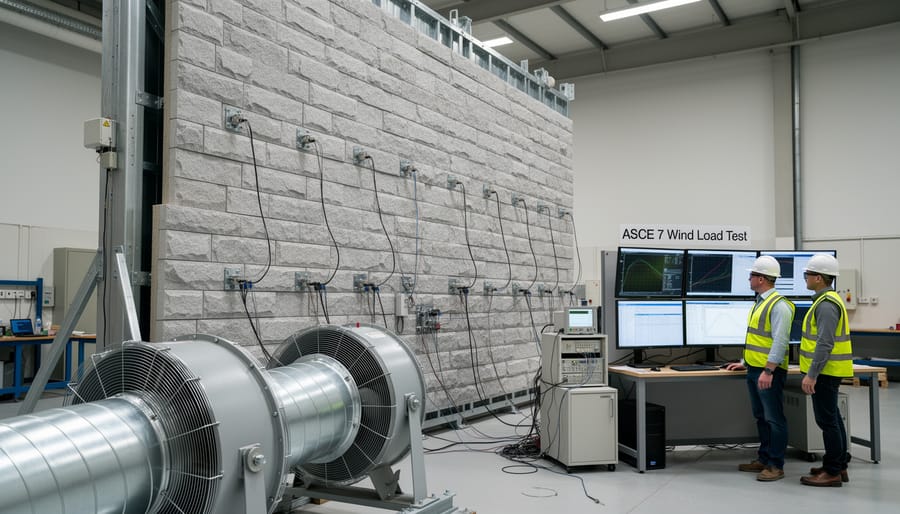
Dynamic testing in specialized chambers subjects full-scale stone panel assemblies to cyclic positive and negative pressures that mimic real-world wind events. Test protocols typically follow ASTM E330 standards, applying pressures that exceed design loads by specific safety factors. Panels must demonstrate no structural failure, excessive deflection, or water infiltration during these tests.
Mock-up testing evaluates complete wall sections including panels, anchors, air barriers, and structural connections. These assemblies undergo repeated loading cycles to assess long-term durability and identify potential failure points before installation begins. Test results provide critical documentation for code compliance and quality assurance, giving building owners confidence that their stone cladding system meets ASCE 7 requirements and will perform safely under extreme weather conditions.
Mock-Up Testing Requirements
For large-scale or architecturally critical stone cladding projects, ASCE 7 standards often necessitate full-scale mock-up testing to validate design performance before installation begins. These mock-ups are particularly required when projects exceed certain height thresholds, involve non-standard stone attachment systems, or when buildings are located in high-wind zones with design pressures exceeding typical engineering parameters.
Mock-up testing simulates actual wind load conditions on representative sections of the stone facade system, including anchors, panels, and backing materials. This process identifies potential failure points, verifies that design calculations translate to real-world performance, and ensures compliance with both ASCE 7 wind load requirements and building codes. Testing typically occurs in specialized facilities where controlled positive and negative pressures replicate the forces stone cladding will experience during severe weather events.
Building owners and design teams benefit significantly from mock-up testing, as it reduces liability risks and prevents costly failures post-installation. While representing an upfront investment, this testing provides documented proof of structural adequacy and often reveals opportunities for system optimization before full-scale construction commences.
Common Compliance Mistakes and How to Avoid Them
Inadequate Anchor Specification
Even the most accurately calculated wind loads mean nothing if anchors fail. One of the most prevalent compliance errors occurs during anchor system design and specification, where small oversights create catastrophic vulnerabilities.
Common mistakes include selecting anchors rated for static loads rather than dynamic wind forces, which fluctuate rapidly during storm events. Many projects also fail by using incorrect anchor materials—stainless steel grades matter significantly in coastal environments where salt-laden wind accelerates corrosion. Type 304 stainless steel, while common, cannot withstand prolonged exposure to marine conditions like Type 316 can.
Spacing errors represent another critical failure point. When anchors are placed too far apart to accommodate architectural preferences or cost-cutting measures, individual connection points experience concentrated loads exceeding their capacity. ASCE 7 calculations assume proper load distribution across the cladding system.
Material incompatibility between anchors and stone also compromises performance. Thermal expansion differences between metals and stone create stress concentrations, while galvanic corrosion occurs when dissimilar metals contact in moisture-prone installations. These deterioration mechanisms slowly weaken connections until wind events expose the compromised system. Proper specification requires understanding both immediate structural requirements and long-term durability factors that affect wind resistance throughout the building’s lifespan.
Ignoring Edge and Corner Load Multipliers
Wind doesn’t impact all areas of a building facade uniformly. Building edges, corners, and parapets experience significantly higher wind pressures—often 50-100% greater than center zones. This phenomenon occurs because wind accelerates as it flows around building corners and over roof edges, creating concentrated pressure zones that can compromise stone cladding if not properly addressed.
ASCE 7 recognizes these variations through load multipliers applied to different building zones. Corner zones typically extend one-tenth of the building’s smaller dimension from each corner, while edge zones cover the perimeter areas between corners. Failing to apply these multipliers when calculating wind loads for stone cladding can lead to inadequate anchoring systems and potential facade failures.
For stone installations, this means anchor spacing, attachment strength, and panel thickness requirements may vary significantly across a single building elevation. A corner-mounted stone panel might require closer anchor spacing or thicker material compared to center-zone panels on the same facade. Design teams must map these zones during project planning and ensure specifications reflect the varying load requirements. When reviewing construction documents, verify that zone-specific calculations are included rather than applying uniform loads across the entire facade—a shortcut that compromises structural integrity and code compliance.
Working with Engineers and Design Professionals
When You Need a Structural Engineer
While ASCE 7 provides the framework for calculating wind loads, certain stone cladding projects legally require professional engineering oversight. Understanding when to engage a structural engineer protects both the building’s integrity and limits your liability.
Licensed structural engineers must be involved in projects where building codes mandate stamped drawings—typically any commercial structure, buildings over two or three stories, or projects in high-wind zones. Most jurisdictions require professional calculations for stone cladding systems regardless of building height due to the material’s weight and life-safety implications if failure occurs.
You’ll also need an engineer for innovative or non-standard installations, such as ventilated rainscreen systems, large-format panels exceeding typical dimensions, or projects using untested stone varieties. If your stone supplier cannot provide tested wind load capacities for their specific anchoring systems, engineering calculations become essential to verify the design.
High-value properties, historical renovations, and buildings near coastal areas almost always require professional involvement. Insurance companies and lending institutions frequently mandate engineer-stamped plans before approving coverage or financing for stone facade projects.
When permitting authorities request design calculations or when you’re uncertain about code compliance, that’s your signal to consult a qualified structural engineer who understands both ASCE 7 requirements and stone cladding systems specifically.
Documentation and Certification Requirements
Building officials require comprehensive documentation to verify that your stone cladding system meets ASCE 7 wind load standards. At minimum, you’ll need sealed engineering calculations from a licensed structural engineer that demonstrate compliance with applicable wind load provisions. These calculations should include site-specific design wind pressures, component anchorage capacities, and safety factors.
Submit detailed shop drawings showing anchor locations, spacing, and connection details for the stone panels. Include product specifications and test reports for all anchoring systems, adhesives, and structural components. Many jurisdictions require laboratory test data proving that your cladding assembly can withstand calculated design pressures, typically through ASTM E330 water penetration and structural performance testing.
Your documentation package should also address how the stone facade integrates with other building envelope components, similar to energy code requirements. Expect to provide manufacturer certifications, material compliance letters, and quality control procedures. During construction, maintain installation records and conduct periodic inspections with photo documentation. This thorough documentation streamlines the permitting process and protects all parties by demonstrating due diligence in meeting ASCE 7 compliance standards.
Proper wind load engineering according to ASCE 7 standards is not a regulatory formality—it’s an essential investment in safety and performance that protects both your building and its occupants. Natural stone cladding represents a significant aesthetic and financial commitment, and ensuring these installations can withstand the wind forces they’ll encounter over decades of service life is simply non-negotiable.
While ASCE 7 compliance might initially appear complex, you don’t need to navigate these requirements alone. Qualified structural engineers, experienced stone fabricators, and certified installers work together to translate technical standards into practical, buildable solutions. These professionals understand how to calculate site-specific wind pressures, design appropriate attachment systems, and ensure every component meets code requirements.
The beauty and durability that make natural stone such a prized building material deserve engineering that matches their quality. Cutting corners on wind load analysis or working with unqualified contractors puts your investment at risk and potentially endangers building users. By partnering with experienced professionals who understand both ASCE 7 requirements and stone cladding systems, you ensure your project achieves the longevity, safety, and performance that natural stone installations are meant to deliver for generations.