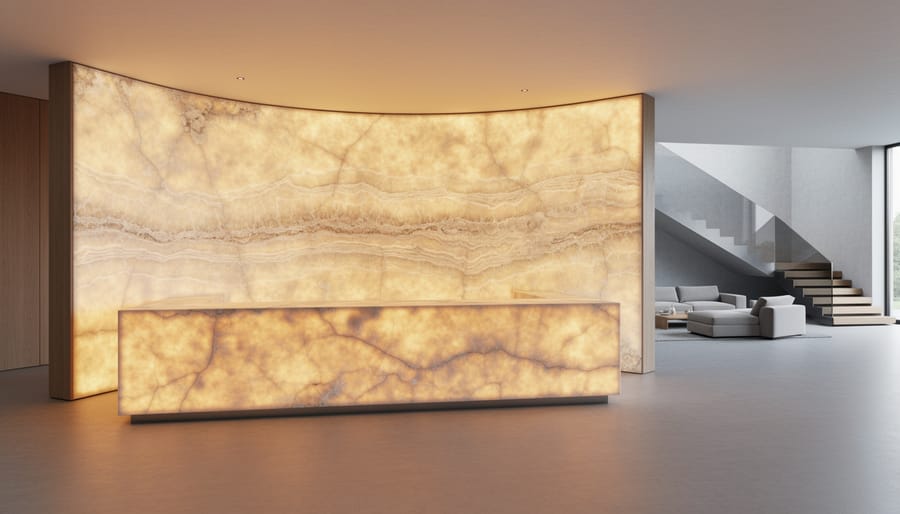
Light becomes architecture when natural stone transforms from solid barrier to luminous canvas. Translucent stone applications—onyx, alabaster, quartzite, and select marbles—reveal nature’s hidden artistry through strategic backlighting, creating spaces where mineral veining, crystalline structures, and color gradations become three-dimensional installations. This convergence of geological formation and human craftsmanship produces surfaces that simultaneously conceal and reveal, offering designers a medium that performs as both functional material and sculptural element.
The phenomenon relies on stone’s microcrystalline structure. Where opaque stones block light completely, translucent varieties allow photons to penetrate 10 to 40 millimeters, depending on composition and thickness. This optical property, combined with natural color variations and veining patterns unique to each slab, creates effects impossible to replicate with manufactured materials. No two installations appear identical—the same stone species backlit differently yields distinct visual results based on LED color temperature, positioning, and intensity.
Modern fabrication techniques have expanded possibilities beyond traditional bookmatched panels. CNC precision cutting enables curved applications, feature walls, countertops, and furniture pieces where light emanates through carefully calibrated thicknesses. Installation complexity varies considerably: simple panel systems with LED strips offer straightforward residential applications, while large-scale commercial projects require structural engineering, thermal management, and electrical integration. Understanding these variables—from quarry selection through final installation—determines whether translucent stone elevates a space or becomes an expensive design compromise.
What Makes Stone Translucent: The Science Behind the Beauty
Natural Stones That Sculpt Light Best
Not all natural stones possess the crystalline structure necessary to transform ambient light into ethereal displays. Understanding which materials excel at light transmission helps designers select the perfect medium for their vision.
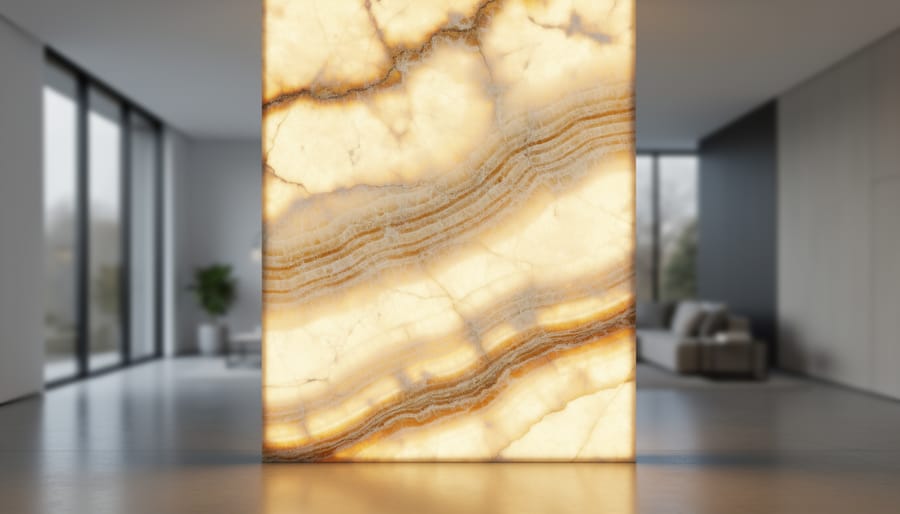
Onyx stands as the crown jewel of translucent stone applications. This calcium carbonate-based material features distinctive banding patterns that create dramatic visual depth when backlit. Honey onyx radiates warm amber glows, while white onyx produces cooler, more ethereal effects. The stone’s relatively thin veining allows light to penetrate depths of 20-30mm, making it ideal for feature walls, bar fronts, and decorative panels. Each slab tells a unique story through its natural striations, ensuring no two installations appear identical.
Alabaster, prized since ancient civilizations, offers unparalleled softness in light diffusion. This fine-grained gypsum or calcite stone produces a gentle, cloud-like luminosity that creates intimate, calming atmospheres. Unlike onyx’s bold patterns, alabaster presents subtler variations in milky whites, soft pinks, and pale yellows. Its workability makes it excellent for custom sculptural elements, though its softness requires careful consideration for high-traffic applications.
Quartzite represents a more durable option for translucent installations. This metamorphic stone combines the elegance of marble with superior hardness and resistance to etching. Certain quartzite varieties, particularly those with lighter base colors and minimal mineral inclusions, allow impressive light transmission. White Princess and Taj Mahal quartzites have gained popularity for backlit applications where both beauty and longevity matter.
Marble varieties offer selective translucency depending on their composition. Calacatta and Statuario marbles, with their predominantly white crystalline structures, permit light passage through thinner sections, typically 10-20mm. The interplay between translucent white backgrounds and opaque gray veining creates sophisticated contrast when illuminated, though marble generally transmits less light than onyx or alabaster.
The selection ultimately depends on desired aesthetic impact, functional requirements, and budget considerations, with each material offering distinct character to sculpted light installations.
The Craftsmanship: From Quarry to Illuminated Masterpiece
Selecting the Right Slab
Selecting stone for translucent applications requires a trained eye and deep understanding of material characteristics. Expert fabricators evaluate multiple factors to determine whether a slab will successfully transmit light while maintaining structural integrity and visual appeal.
The selection process begins with assessing the stone’s crystalline structure. Marble and onyx varieties with fine, uniform grain patterns typically offer superior translucency compared to coarser stones. Craftsmen examine how light penetrates the material by holding samples up to strong illumination, looking for even distribution without excessive dark spots or opaque areas that could create unwanted shadows when backlit.
Vein patterns play a crucial role in the final aesthetic. While dramatic veining can create stunning visual effects when illuminated, fabricators must ensure veins don’t compromise structural stability or create jarring contrast levels. The goal is balance—patterns that enhance rather than overwhelm the luminous quality.
Thickness considerations are equally important. Slabs typically range from three-eighths to three-quarters of an inch for backlit applications. Thinner materials allow more light transmission but require careful handling and reinforcement. Thicker slabs offer greater durability but may need more powerful lighting systems to achieve the desired glow.
Quality assessment draws on stone craftsmanship traditions refined over generations. Fabricators inspect for natural fissures, color consistency, and mineral composition. They also consider the intended application—a residential feature wall has different requirements than a commercial reception desk. This meticulous evaluation ensures each selected slab will perform beautifully when transformed into a luminous installation.
Cutting and Finishing Techniques
Achieving the delicate balance between translucency and structural integrity requires precision and expertise. The process begins with specialized stone cutting techniques that reduce natural stone to its optimal thickness—typically between 10 and 30 millimeters. This range allows sufficient light transmission while maintaining the strength necessary for architectural applications.
Diamond wire saws and advanced CNC machinery enable craftsmen to achieve consistent thickness across large slabs, a critical factor for uniform light diffusion. The cutting process must account for the stone’s natural veining patterns, as these features become dramatically enhanced when backlit. Skilled artisans orient cuts to maximize the visual impact of mineral deposits and color variations.
Following the initial cut, surface treatments and finishing play an equally vital role in the final result. Polishing techniques can significantly affect light transmission—highly polished surfaces reflect more light and create dramatic contrast with translucent areas, while honed finishes produce softer, more diffused illumination. Some applications benefit from bookmatching, where two consecutive slabs are mirrored to create symmetrical patterns that appear to unfold when lit from behind.
Quality control throughout the finishing process ensures uniform thickness tolerance, typically within 1-2 millimeters. Any variation can create uneven light distribution, compromising the ethereal effect. Edge treatments also require careful attention, as they frame the illuminated stone and must be finished to complement the overall design vision. The culmination of these techniques transforms raw stone into luminous architectural elements that redefine spatial boundaries.

Designing With Light: Architectural Applications
Interior Features That Shine
Backlit translucent stone transforms ordinary architectural elements into extraordinary design statements. From residential spaces to commercial venues, strategic placement of illuminated stone creates focal points that captivate while serving functional purposes.
Kitchen islands and countertops benefit dramatically from backlighting. Translucent onyx or quartzite surfaces create warm, inviting gathering spaces while providing ambient illumination. A recent Manhattan penthouse project featured a honey-colored onyx island that serves as both workspace and sculptural centerpiece, casting a golden glow throughout the kitchen during evening hours.
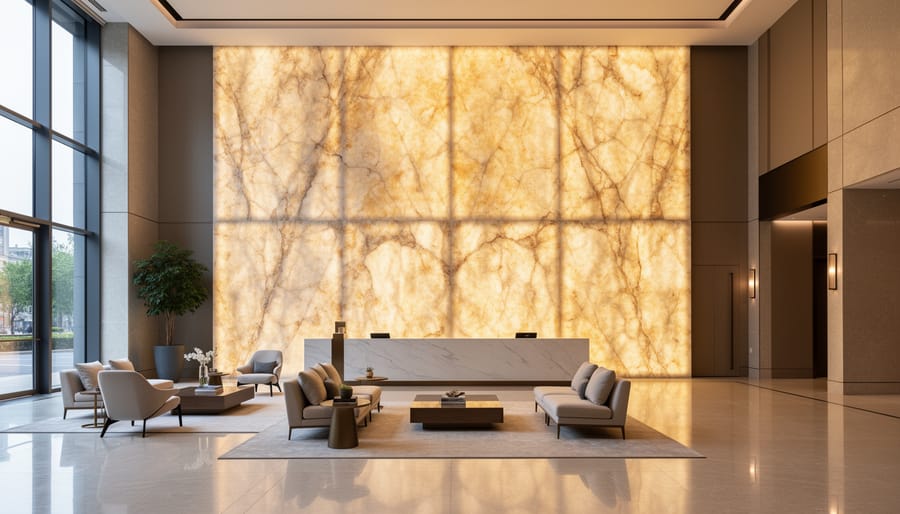
Feature walls offer perhaps the most dramatic application. Reception areas, living rooms, and hotel lobbies gain instant visual impact when floor-to-ceiling stone panels are illuminated from behind. The Aria Resort in Las Vegas showcases massive backlit onyx walls in its lobby, demonstrating how stone can define a brand’s luxury positioning.
Partitions and room dividers serve dual purposes when crafted from translucent stone. They maintain spatial definition while allowing light transmission, creating privacy without isolation. Corporate offices increasingly specify backlit stone partitions for executive suites, where the material conveys sophistication while diffusing natural daylight throughout interior spaces.
Bar fronts and retail displays leverage backlit stone’s attention-commanding properties. Restaurants and boutique hotels use illuminated stone bars as signature design elements, with the translucent material creating memorable experiences that encourage social media sharing and repeat visits.
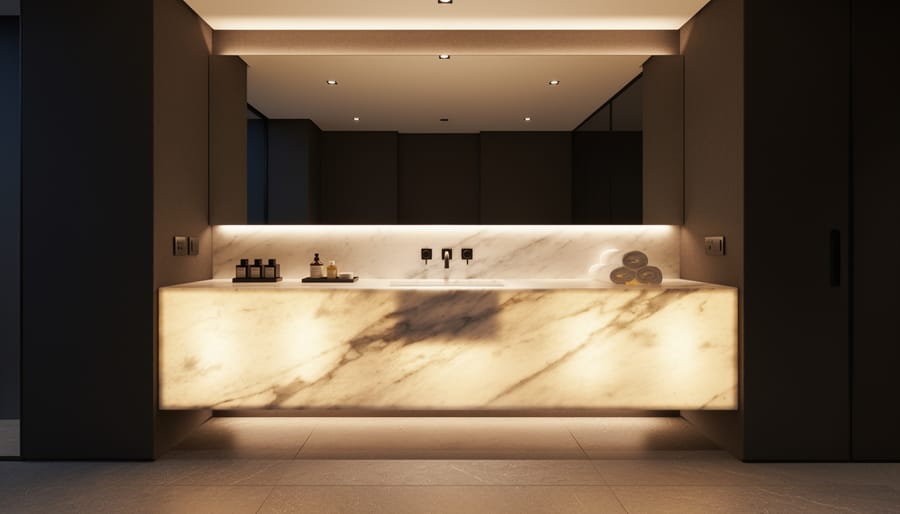
Bathroom vanities achieve spa-like ambiance through backlit applications. Translucent marble or onyx vanity tops paired with undermounted lighting create serene environments perfect for personal sanctuaries. The natural veining patterns become artwork, eliminating the need for additional wall decoration.
Decorative panels extend beyond traditional decorative stone applications by incorporating custom sizing and framing. Designers specify backlit stone panels as headboards, cabinet inserts, and ceiling features, proving that sculptural lighting can enhance virtually any interior surface where visual impact matters.
Lighting Systems and Technical Considerations
Modern LED systems have revolutionized the illumination of translucent stone, offering precise control, energy efficiency, and longevity that traditional lighting sources cannot match. These systems typically feature modular panels or strips that distribute light evenly across the stone surface, eliminating hot spots and creating uniform luminosity. Professional-grade installations utilize LED modules with color rendering indices (CRI) of 90 or above, ensuring that the stone’s natural veining and mineral variations appear true to life.
Color temperature selection significantly impacts the mood and aesthetic effect of backlit stone installations. Warm white LEDs (2700-3000K) create inviting, intimate atmospheres ideal for residential spaces and hospitality settings, enhancing honey-toned onyxes and amber-hued quartzites. Neutral white (3500-4100K) provides balanced illumination suitable for commercial applications, while cool white (5000-6500K) accentuates blue and gray tones in stones like certain marble varieties, lending a contemporary, crisp appearance.
Installation requires careful attention to several technical factors. Adequate spacing between the light source and stone surface prevents uneven illumination and allows proper heat dissipation, typically maintaining a minimum gap of 1-2 inches. Dimming capabilities add versatility, enabling transitions from subtle accent lighting to dramatic focal points throughout the day. Proper thermal management through ventilation or heat sinks extends LED lifespan and maintains consistent color output.
Achieving specific effects involves layering techniques and strategic placement. Edge-lit applications create ethereal glows around stone panels, while backlighting from behind produces full-surface illumination. Dynamic white-tuning systems allow color temperature adjustments to match circadian rhythms or special occasions. For complex installations, working with lighting designers ensures optimal technical specifications and transformer capacity calculations, delivering reliable performance that showcases the stone’s natural beauty for decades.
The Visual Impact: Why Designers Choose Translucent Stone
Translucent stone offers designers a unique medium that transforms architecture from static structure into dynamic art. Unlike traditional opaque materials, backlit stone creates visual experiences that shift throughout the day, responding to both natural and artificial light sources. This quality makes it an increasingly popular choice for projects seeking to make memorable statements.
The primary appeal lies in the material’s ability to create dramatic focal points. When illuminated from behind, translucent stone varieties like onyx, alabaster, and certain marbles reveal intricate veining patterns and color variations invisible to the naked eye under standard lighting. These organic patterns become luminous artwork, drawing the eye and establishing visual hierarchy within a space. Reception areas, feature walls, and partition screens benefit particularly from this effect, offering both function and aesthetic impact.
Beyond creating focal points, translucent stone profoundly influences spatial ambiance. The warm glow emanating through the stone generates an inviting atmosphere that feels both luxurious and organic. Different stone types produce distinct lighting qualities: honey onyx radiates golden warmth, white marble offers clean luminescence, and green onyx provides serene, jewel-like tones. This versatility allows designers to craft specific moods aligned with project intentions.
The depth translucent stone adds to interiors addresses a common design challenge in contemporary architecture. Modern spaces often risk feeling flat or sterile, but backlit stone introduces layers of visual interest through its natural variation and dimensional quality. The interplay of light and shadow within the stone’s crystalline structure creates subtle gradations that change with viewing angles, making spaces feel more dynamic and engaging.
From a practical perspective, translucent stone installations serve dual purposes. They provide functional lighting while simultaneously acting as sculptural elements. This efficiency appeals to designers working within spatial or budgetary constraints, delivering maximum impact from a single design element. The material’s natural origins also satisfy growing demands for authentic, sustainable materials that connect occupants with the natural world.
Practical Considerations: Cost, Durability, and Maintenance
Translucent stone installations represent a premium architectural investment, typically commanding prices 2-3 times higher than standard stone applications. The cost reflects specialized quarrying techniques, careful slab selection for optimal translucency, and expert fabrication requirements. Backlighting systems add another layer of expense, with LED installations ranging from basic panels to sophisticated color-changing systems. However, when compared to custom art installations or high-end decorative glass, translucent stone often provides comparable pricing with superior natural beauty.
The durability and longevity of translucent stone installations significantly outperform many alternative materials. Onyx, alabaster, and thin marble maintain their translucent properties indefinitely when properly installed. Unlike acrylic or resin panels that can yellow or degrade under constant lighting, natural stone remains stable. The primary durability concern involves physical impact resistance, particularly with softer stones like alabaster, making strategic placement crucial for high-traffic areas.
Maintenance requirements remain refreshingly straightforward. Regular cleaning with pH-neutral stone cleaners preserves appearance without compromising translucency. Sealed surfaces resist staining and moisture infiltration, though resealing every 1-2 years ensures optimal protection. The backlighting system requires more attention than the stone itself, with LED components needing occasional replacement after 50,000+ hours of operation.
Long-term value considerations favor translucent stone. While initial costs exceed standard materials, these installations become architectural signatures that enhance property value and rarely require replacement. Compare this to decorative glass or manufactured panels that may need updating as styles evolve or materials degrade.
Energy efficiency deserves mention, as LED backlighting systems consume minimal power, often equivalent to standard ambient lighting. This operational cost remains negligible compared to the dramatic visual impact achieved.
For commercial applications, the investment typically justifies itself through distinctive branding and elevated customer perception. Residential installations become permanent design statements that outlast trends. Understanding these practical factors helps stakeholders make informed decisions about incorporating translucent stone into their projects, balancing upfront investment against decades of maintenance-free beauty.
The art of sculpting light through translucent stone represents far more than a design trend—it embodies the profound connection between natural beauty and human creativity. When stone is carefully selected, precisely sliced, and thoughtfully illuminated, it transforms from a static material into a living canvas that breathes warmth and character into any space. This centuries-old craft has evolved alongside modern technology, making it more accessible and versatile than ever before.
For those considering translucent stone in their next project, the journey begins with understanding your vision and space requirements. Consider the mood you wish to create, the amount of natural versus artificial light available, and how the stone will interact with surrounding materials. Consulting with experienced fabricators early in the design phase ensures proper stone selection, adequate structural support, and appropriate lighting design.
Whether you’re an architect planning a commercial installation, a designer seeking a statement piece, or a homeowner dreaming of a luminous feature wall, the possibilities are limitless. Start by gathering inspiration from completed projects, requesting material samples to evaluate translucency levels, and working with professionals who understand both the technical requirements and artistic potential of backlit stone.
The magic of translucent stone lies in its ability to transform ordinary spaces into extraordinary experiences. As you embark on your project, remember that successful execution balances technical precision with artistic vision, creating timeless beauty that honors both the stone’s natural origins and human ingenuity.