Butcher block countertops bring warmth and character to kitchens, but their high-maintenance demands and vulnerability to water damage often catch homeowners off guard. Before you commit to that beautiful wood surface, understanding both the genuine advantages and the daily realities of ownership will save you from costly regrets.
These natural wood surfaces have earned their place in kitchen design through centuries of use. Professional chefs favor them for food preparation, home cooks appreciate their organic aesthetic, and designers value their ability to soften modern spaces. Yet the Pinterest-perfect images rarely show the rings from water glasses, the inevitable scratches, or the monthly oiling routine required to keep them looking fresh.
The decision isn’t simply about aesthetics. Comparing countertop materials reveals stark differences in durability, maintenance requirements, and long-term value. While granite and marble offer permanent solutions with minimal upkeep, butcher block demands ongoing attention and accepts certain limitations around sinks and stoves.
This evaluation examines the practical realities of living with wood countertops. You’ll discover which woods perform best, what maintenance actually entails beyond the sales pitch, where butcher block genuinely excels, and the specific scenarios where stone alternatives deliver better performance. The goal isn’t to discourage your interest in wood surfaces but to ensure your expectations align with reality, particularly regarding the care commitment and functional trade-offs that come with choosing this traditional material over more resilient options.
Understanding Butcher Block Countertops
Butcher block countertops are solid wood surfaces constructed from strips of hardwood bonded together to create a durable work surface. Unlike natural stone countertops that are quarried from the earth as single slabs, butcher block is a manufactured product that assembles individual wood pieces into larger functional surfaces through precise gluing and finishing techniques.
The construction of butcher block involves arranging wood strips in specific patterns that maximize strength and visual appeal. This modular approach allows for customization in size and shape, contrasting sharply with stone’s limitations to quarried slab dimensions and the precision cutting required for installation.
- End-Grain Construction
- Wood fibers stand vertically, exposing the ends of the wood pieces on the surface. This arrangement creates a self-healing surface ideal for cutting boards but requires more maintenance than edge-grain.
- Edge-Grain Construction
- Wood strips are positioned with their long edges facing up, creating horizontal grain patterns. This more stable configuration is standard for countertops and resists warping better than end-grain.
- Food-Safe Finishes
- Non-toxic sealants like mineral oil, beeswax blends, or specialized wood oils that protect the surface while remaining safe for direct food contact. These require regular reapplication, unlike stone’s permanent sealing options.
- Hard Maple
- The most popular wood species for butcher block due to its tight grain, hardness rating, and light color that brightens kitchen spaces. Offers better scratch resistance than softer woods like cherry or walnut.
Common wood species include hard maple, walnut, cherry, oak, and teak. Each brings distinct color tones and grain patterns, from maple’s pale cream to walnut’s rich chocolate brown. The fundamental difference from natural stone lies in butcher block’s organic, living nature: wood responds to humidity by expanding and contracting, requires ongoing conditioning with oils, and develops a patina over time. Stone remains dimensionally stable, needs minimal maintenance after sealing, and maintains its original appearance indefinitely with proper care.
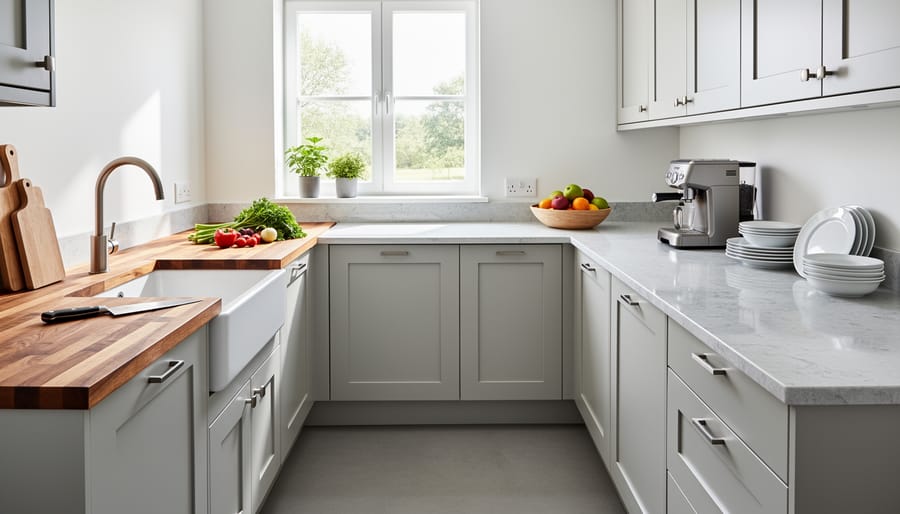
The Advantages of Butcher Block Countertops
Aesthetic and Design Flexibility
Butcher block brings an organic warmth to kitchens that stone surfaces simply cannot match. The visible wood grain patterns create visual interest and textural depth, with each board displaying unique variations in tone and figure. This natural character makes every installation genuinely one-of-a-kind.
The design versatility proves remarkable across kitchen styles. Butcher block complements rustic farmhouse aesthetics naturally, yet works equally well in modern spaces where it softens industrial elements like stainless steel and concrete. In traditional kitchens, it adds approachable warmth without competing with detailed cabinetry. Scandinavian and minimalist designs particularly benefit from butcher block’s clean, organic presence.
Customization options extend beyond standard slabs. You can choose wood species, walnut for rich chocolate tones, maple for light honey hues, cherry for reddish warmth, or oak for pronounced grain. Edge profiles range from simple square cuts to decorative roundovers and bevels. Finish options include natural oils that enhance grain or polyurethane for higher protection.
Unlike stone’s permanent appearance, butcher block evolves gracefully over time. The patina that develops tells the story of a well-used kitchen, and you can refinish the surface to restore its original look whenever desired. This adaptability lets your countertops grow with changing design preferences.
Functional Benefits
Butcher block delivers practical advantages that make daily kitchen work easier. Unlike stone surfaces that show every knife mark permanently, wood accepts cuts and light scratches as part of its character. These minor imperfections actually disappear over time as the wood fibers compress and expand with humidity changes, creating a naturally self-healing surface that looks better with use rather than worse.
The knife-friendly surface protects your blade edges far better than hard stone countertops. Professional chefs appreciate this quality because it reduces sharpening frequency and extends the life of expensive knives. You can chop vegetables, slice bread, or break down proteins directly on the surface without damaging either the counter or your tools.
The practical functional advantages include:
- Sand and refinish the surface multiple times to remove deep scratches, burns, or stains
- Restore the original appearance with basic tools and mineral oil
- Eliminate cutting boards for most prep work, saving counter space
- Repair localized damage without replacing entire sections
- Customize thickness and edge profiles to suit specific tasks
This repairability sets wood apart from stone, which chips or cracks permanently. When your butcher block develops wear patterns after years of service, a weekend sanding project brings it back to near-original condition. Natural stone surfaces require professional restoration for comparable damage, often at significant expense. The ability to work directly on butcher block also streamlines meal preparation, eliminating the constant shuffle of moving cutting boards around your workspace.
Cost and Installation Advantages
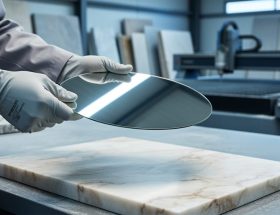
Butcher block typically costs $40 to $100 per square foot installed, making it one of the more affordable countertop options compared to premium granite ($100-$250) or marble ($75-$200). This price advantage extends beyond materials: butcher block weighs roughly 10 pounds per square foot versus 18-20 pounds for granite, eliminating expensive structural reinforcement that stone often requires. Installation costs drop further because skilled woodworkers are more common than certified stone fabricators, and motivated homeowners can handle butcher block installation themselves with standard carpentry tools. The sections can be cut on-site without specialized equipment, joins are manageable with wood glue and clamps, and mistakes won’t shatter an entire slab. Natural stone demands professional templating, CNC cutting, and careful transportation. For kitchen remodels on tight budgets or island projects where you’re willing to trade long-term durability for upfront savings, butcher block delivers functional workspace at half the initial investment of comparable stone surfaces.
Environmental and Sustainability Factors
Wood countertops offer legitimate environmental advantages that deserve consideration when evaluating butcher block countertops pros and cons. Trees are a renewable resource that absorb carbon dioxide during growth, and responsibly harvested wood surfaces can qualify as carbon-neutral or even carbon-negative over their lifecycle. This contrasts with natural stone, which requires energy-intensive quarrying, transportation from distant locations, and processing that generates significant carbon emissions without the offsetting benefit of carbon capture during material formation.
The sustainability case for butcher block strengthens when sourced from certified sustainable forests or reclaimed wood. Unlike granite or marble that takes millennia to form, new trees can be grown within decades. Research on biomass building materials shows that wood products can sequester carbon for their entire useful life, effectively removing CO2 from the atmosphere while serving as a functional countertop.
At end-of-life, butcher block biodegrades naturally or can be composted, recycled into mulch, or even burned for energy recovery. Stone countertops become permanent landfill additions or require energy for repurposing. However, these environmental benefits assume proper sourcing and adequate lifespan. A butcher block countertop requiring replacement after 15 years may ultimately prove less sustainable than granite lasting 50-plus years, particularly when you factor in repeated manufacturing, finishing products, and transportation cycles. The environmental equation isn’t straightforward, and longevity matters as much as renewability when calculating true sustainability.
The Disadvantages of Butcher Block Countertops
Maintenance and Care Requirements
Butcher block demands consistent attention that can catch new owners off guard. You’ll need to oil the surface monthly during the first year, then every few months thereafter, using food-safe mineral oil or specialized wood conditioner. Each oiling session requires cleaning the surface, applying oil generously, letting it soak for 15-20 minutes, then wiping away the excess. Miss a few treatments and the wood begins to dry out, leading to cracks and warping.
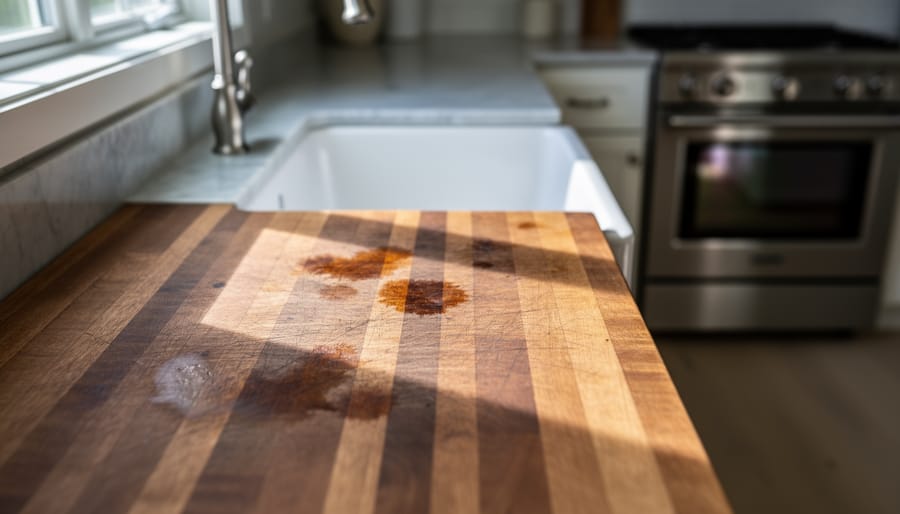
Beyond regular oiling, butcher block requires immediate response to spills. Water left sitting for even an hour can leave dark stains or raise the grain. Coffee, wine, and acidic foods demand quick action. You’ll also need to sand and refinish high-traffic areas every few years, a project that takes an afternoon and leaves your kitchen unusable during drying time.
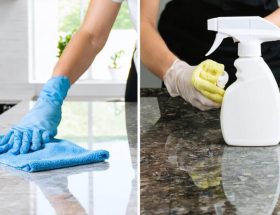
Compare this to granite or quartzite, which need only soap and water for daily cleaning and perhaps an annual sealer application that takes ten minutes. Natural stone forgives neglect; butcher block punishes it. The maintenance gap widens further if you have small children, frequent entertainers, or simply prefer low-maintenance surfaces. While some homeowners enjoy the ritual of caring for wood, others find the time commitment incompatible with busy lifestyles.
Durability and Performance Concerns
Wood countertops face serious durability challenges that rarely affect the most durable countertops like granite or quartzite. Water poses the biggest threat. Unsealed or improperly maintained butcher block absorbs moisture rapidly, causing warping, cupping, and even rot around sink areas. A single night of standing water can leave permanent damage.
Scratches and dents accumulate quickly on wood surfaces. While manufacturers tout this as character, dropped pans, dragged appliances, and everyday use create divots that trap food particles and moisture. You can sand these out, but repeated refinishing gradually thins the countertop.
Heat tolerance is another weak point. Setting a hot pot directly on butcher block leaves scorch marks and can crack the finish, forcing you to use trivets constantly. Natural stone withstands heat without protection.
The bacterial safety question remains debated. Bacterial contamination studies show wood can harbor pathogens in scratches and unsealed areas, particularly when oiling schedules lapse. Unlike non-porous stone that wipes clean, wood’s porous nature creates microscopic hiding spots for bacteria. Proper sealing and maintenance reduce this risk significantly, but the margin for error is smaller than with stone surfaces that naturally resist bacterial growth.
Practical Limitations in Kitchen Environments
Kitchen reality introduces challenges that become evident with daily use. Standing water poses perhaps the most immediate threat to butcher block. A glass of condensation left overnight or a slow leak from a faucet penetrates the wood fibers within hours, causing dark stains and raising the grain. Where natural stone simply needs wiping dry, wood demands immediate attention to every spill.
Acidic substances create permanent marks if not cleaned promptly. Lemon juice, tomato sauce, and wine soak into the porous surface, leaving discoloration that deepens over time. Red wine spills become particularly problematic, often requiring sanding to remove the stain completely. These same liquids bead harmlessly on sealed granite or marble.
Humidity fluctuations trigger continuous wood movement and moisture absorption that affect the entire countertop. During humid summer months, the wood expands slightly, then contracts when winter heating dries indoor air. This seasonal cycling creates gaps at seams or causes boards to cup and warp, especially in homes without consistent climate control.
Placement restrictions limit design flexibility. Installing butcher block directly adjacent to sinks invites chronic water exposure and inevitable damage. The area around cooktops faces similar constraints, as hot pots placed directly on wood scorch the surface and break down protective finishes. These high-activity zones where you need countertop space most become precisely where butcher block proves least practical, requiring homeowners to incorporate stone or other heat-resistant materials as protective zones.
Long-Term Value Considerations
Butcher block typically lasts 10-20 years with diligent maintenance, while natural stone countertops routinely exceed 50 years or a lifetime. This longevity gap becomes financially significant when you factor replacement costs. A full countertop cost comparison reveals that butcher block’s lower upfront price advantage diminishes when you account for refinishing expenses every few years and eventual replacement. Real estate professionals note that premium natural stone countertops often increase home resale value, whereas butcher block is typically viewed as a mid-range option that may prompt buyers to budget for upgrades. Homeowners planning to stay long-term should calculate total cost of ownership, not just installation price.
Butcher Block vs. Natural Stone: A Direct Comparison
When choosing between butcher block and natural stone countertops, homeowners face fundamentally different material properties that affect daily use, maintenance, and longevity. Direct comparison reveals where each material truly excels and where compromises become necessary.
| Feature | Butcher Block | Natural Stone (Granite/Quartzite) |
|---|---|---|
| Durability | Moderate; scratches and dents easily | Excellent; highly scratch and impact resistant |
| Maintenance | High; monthly oiling required | Low; annual sealing sufficient |
| Water Resistance | Poor; requires immediate cleanup | Excellent when properly sealed |
| Heat Resistance | Low; scorches above 300°F | Excellent; withstands hot pans safely |
| Expected Lifespan | 10-20 years with careful maintenance | Lifetime; often outlasts the home |
| Initial Cost | $40-$100 per square foot installed | $60-$200+ per square foot installed |
The performance gap widens significantly in real kitchen conditions. Natural stone handles the chaos of meal preparation without complaint. Spilled wine, dropped knives, hot pans straight from the oven, granite and quartzite absorb these daily assaults with minimal consequence. Butcher block demands immediate attention to every spill and requires protective trivets for anything warm.
Maintenance rhythms differ dramatically. Stone countertops need sealing once or twice yearly, a fifteen-minute task most homeowners manage themselves. Butcher block requires food-safe mineral oil application every four to six weeks, plus periodic deep conditioning and sanding to address wear. This time investment compounds over years of ownership.
Heat tolerance alone separates these materials decisively. You can place a sheet pan directly from a 500°F oven onto granite without concern. The same action on butcher block leaves permanent scorch marks and requires sanding to repair. Similarly, understanding quartz pros and cons reveals another engineered option that shares stone’s heat resistance advantages.
Cost calculations must account for longevity. Butcher block’s lower entry price appears attractive initially, but replacement every fifteen years versus stone’s multi-generational lifespan shifts the economic equation. A granite countertop installed today will likely serve your grandchildren. Butcher block won’t.
The aesthetic choice matters, certainly. Butcher block brings organic warmth that stone cannot replicate. Yet this warmth comes with functional trade-offs that affect daily kitchen use, particularly in high-traffic households where durability and low maintenance outweigh visual softness.
When Butcher Block Makes Sense (And When It Doesn’t)
Butcher block performs best as a specialized work surface rather than as your kitchen’s primary countertop material. The wood’s unique properties create specific scenarios where it genuinely excels and others where it becomes a maintenance burden.
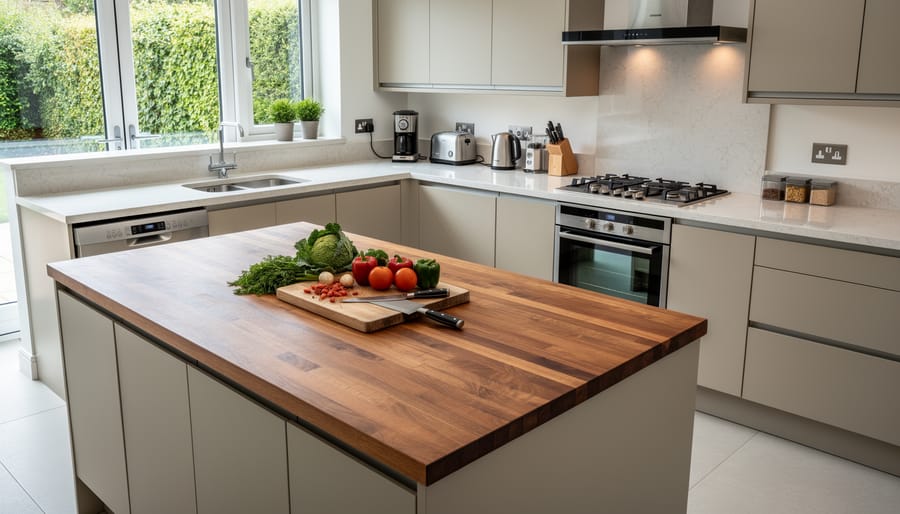
Kitchen islands designed for prep work represent butcher block’s sweet spot. The elevated surface keeps water exposure minimal while providing a comfortable, warm workspace for rolling dough, kneading bread, and assembling ingredients. You can use knives directly on the surface without dulling blades or damaging the wood, something impossible with stone. A standalone island also simplifies the oiling routine since you’re treating one contained surface rather than wrapping around sinks and cooktops.
Dedicated baking stations benefit enormously from wood’s natural properties. Pastry dough releases more easily from wood than cold stone, and the slightly yielding surface provides better tactile feedback when working with delicate preparations. Positioning a butcher block section next to your mixer creates an efficient workflow without the durability demands of a full perimeter installation.
Avoid butcher block in high-moisture zones. The six inches on either side of your sink will show water damage within months despite diligent sealing. One forgotten puddle around the faucet base leads to warping and dark staining that sanding cannot fully remove. Similarly, placement directly beside cooktops exposes the wood to heat damage and grease accumulation that penetrates beyond surface treatments.
Natural stone makes more sense for full-perimeter installations in busy kitchens. Granite and quartzite handle standing water, hot pans, and acidic spills without the constant vigilance butcher block demands. If your cooking style involves frequent washing, multiple cooks, or you simply want a surface you can ignore between weekly cleanings, stone’s resilience justifies its higher cost.
Consider your honest maintenance threshold before committing to butcher block. If monthly oiling feels like an enjoyable ritual and you value the wood’s warmth, a strategically placed section adds genuine functionality. If that same maintenance sounds tedious, choose stone and gain decades of worry-free service.
Choosing between butcher block and natural stone countertops ultimately comes down to understanding your kitchen habits, maintenance tolerance, and long-term expectations. Butcher block brings undeniable warmth to kitchen design, offers knife-friendly work surfaces, and presents an accessible price point that appeals to budget-conscious renovators. The material’s sandable nature means minor damage doesn’t spell replacement, and for dedicated home cooks who value tactile warmth and a forgiving cutting surface, these advantages carry real weight.
However, the comprehensive evaluation of butcher block countertops pros and cons reveals significant trade-offs that homeowners must accept. The weekly oiling regimen, vulnerability to water damage near sinks, and susceptibility to heat, stains, and scratches demand vigilance that many modern lifestyles can’t accommodate. A wine spill left overnight or a hot pan placed thoughtlessly can create permanent damage that requires professional sanding to repair.
Natural stone countertops, by contrast, deliver performance that aligns with how most people actually use their kitchens. Granite, quartzite, and properly sealed marble withstand heat, resist moisture damage, require minimal maintenance beyond routine cleaning, and maintain their appearance for decades. The higher initial investment translates to lower lifetime cost when you factor in longevity and preservation of home value.
For those drawn to butcher block’s aesthetic, consider limiting it to islands, baking stations, or secondary prep areas where its advantages shine without exposing your entire kitchen to its vulnerabilities. Primary countertop real estate near sinks, stoves, and high-traffic zones performs better in stone. Match your countertop choice to your reality, not an idealized version of kitchen life you might not actually live.