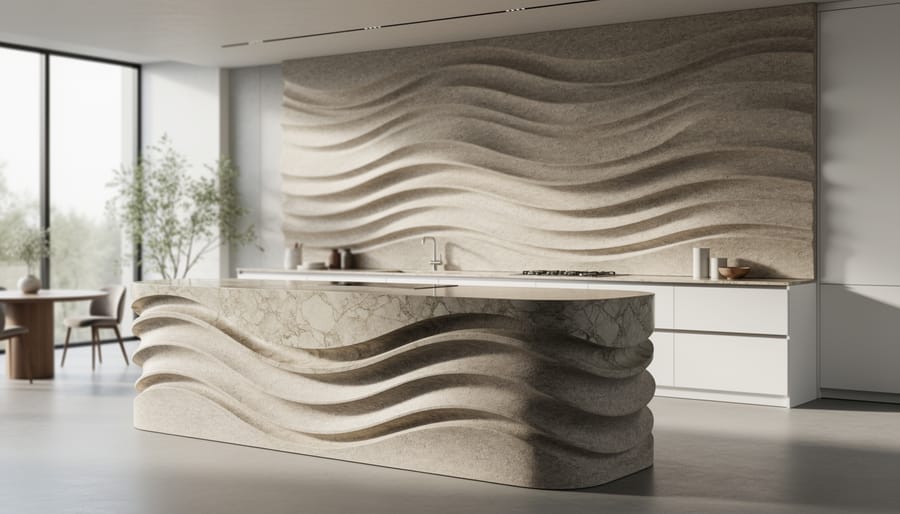
Organic shapes in three-dimensional stone design transform rigid architectural elements into flowing, natural forms that echo landscapes, water movement, and biological structures. These curved, asymmetrical designs—ranging from sinuous countertops to wave-inspired wall cladding—require mastering fundamental drawing techniques before fabrication begins.
Start by sketching flowing contours using continuous line exercises, allowing your hand to trace smooth, uninterrupted curves that mimic natural erosion patterns and biological growth. Study reference materials like river rocks, shells, and wind-carved formations to understand how nature creates balanced asymmetry without perfect geometric repetition.
Develop three-dimensional awareness by drawing your organic shapes from multiple viewpoints—plan, elevation, and perspective—ensuring the design maintains visual interest from every angle. Use cross-sectional drawings to map thickness variations and depth changes, which become critical specifications during CNC programming and hand-fabrication stages.
Translate two-dimensional sketches into workable stone designs by considering material properties: certain stones split along natural veining, while others allow dramatic cantilevers and thin sections. The transition from artistic concept to physical installation demands understanding both creative vision and technical constraints, where drawing serves as the essential bridge between inspiration and execution in natural stone applications.
Understanding 3D Organic Shapes in Stone Design
What Makes a Shape ‘Organic’
Organic shapes in three-dimensional drawing refer to irregular, asymmetrical forms that mirror patterns found in nature—think flowing water, smooth river stones, cloud formations, or the gentle curves of hills and valleys. Unlike geometric shapes with their precise angles and uniform measurements, organic forms embrace irregularity and fluid transitions. These natural contours lack the rigid structure of squares, circles, or triangles, instead featuring soft edges, gradual curves, and unpredictable variations that make each design unique.
In stone applications, organic shapes create visual comfort because they align with biophilic design principles—our innate human attraction to natural forms. The human eye naturally gravitates toward these shapes, finding them more calming and inviting than harsh geometric patterns. When drawing 3D organic shapes for curved stone installations, artists and designers capture the essence of natural movement and flow, translating the tactile quality of nature into architectural elements. This approach transforms rigid spaces into environments that feel alive, dynamic, and inherently connected to the natural world, making organic shapes particularly powerful in contemporary stone design.
The Three-Dimensional Advantage
Three-dimensional organic shapes in stone possess an inherent advantage over flat surfaces: they engage viewers from every angle. Unlike traditional two-dimensional applications, curved and sculpted stone surfaces create depth that transforms throughout the day as natural and artificial light shifts across their contours. A concave stone wall captures shadows differently than a convex surface, while undulating textures catch light in ways that flat polished stone cannot replicate.
This dimensional quality makes 3D stone applications particularly effective in creating focal points within architectural spaces. The interplay between light and shadow accentuates the natural veining and color variations inherent in materials like marble, limestone, and travertine. As viewers move through a space, their perspective changes, revealing new details and visual interest that static installations lack.
Textured surfaces also respond uniquely to ambient conditions. Morning light may emphasize certain curves while evening illumination highlights different aspects of the same stone element. This dynamic quality ensures that organic stone designs remain visually engaging over time, offering fresh perspectives with each viewing and enhancing the overall sensory experience of interior and exterior environments.
Natural Stone Properties That Enable Fluid Designs
Stone Types Ideal for Curved Applications
Not all stone types adapt equally well to curved and organic designs. Understanding the physical properties and workability of different materials helps ensure successful execution of flowing forms.
Marble stands as the premier choice for curved applications due to its relatively soft composition and fine grain structure. This metamorphic stone can be carved, shaped, and polished into smooth, flowing forms without fracturing. Varieties like Carrara and Calacatta offer the added benefit of natural veining that enhances organic movement in three-dimensional designs. Marble’s calcium carbonate composition allows for detailed sculpting while maintaining structural integrity in applications like curved countertops, decorative columns, and wall panels.
Limestone offers similar workability to marble with a more uniform appearance. Its sedimentary nature and homogeneous texture make it predictable during fabrication, particularly valuable for large-scale curved installations. Limestone accepts curves gracefully and provides excellent durability for both interior and exterior applications, from sweeping staircases to undulating facade elements.
Soapstone represents the most workable option for complex curves due to its high talc content. This metamorphic stone can be carved almost like wood, making it ideal for intricate organic shapes and tight radius curves. While softer than marble or limestone, soapstone develops a natural patina that enhances its visual appeal over time.
Travertine, with its porous structure and layered formation, works well for gentle curves and flowing designs. Its natural holes and channels create interesting textural variations that complement organic aesthetics. However, its directional grain requires careful planning during fabrication to prevent splitting along bedding planes.
Veining Patterns and Visual Flow
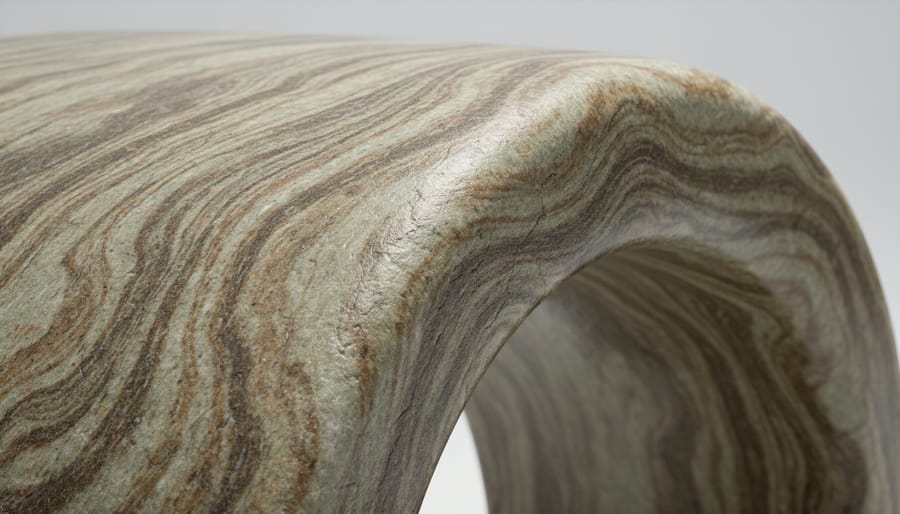
Natural stone’s inherent veining patterns serve as dynamic visual guides that enhance the perception of movement in three-dimensional organic designs. These naturally occurring mineral deposits create lines that flow through the material, subtly directing the eye along curved surfaces and emphasizing the sculptural quality of the installation.
When selecting stone for curved applications, consider how veining direction interacts with the design’s contours. Veins that follow the arc of a curved wall or flow along the undulations of a sculptural element amplify the sense of organic fluidity. Conversely, veins running perpendicular to the curve can create visual tension that adds interest and dimension.
Marble varieties like Calacatta and Statuario offer dramatic, bold veining that creates striking visual pathways across curved surfaces. For subtler effects, stones with delicate, cloud-like patterns provide texture without overwhelming the form itself. The key is book-matching or sequence-matching slabs to create continuous veining flows that enhance rather than interrupt the three-dimensional form.
During the design phase, work with your fabricator to map vein patterns across the intended curved surface. Digital visualization tools can preview how natural veining will translate onto complex geometries, ensuring the final installation achieves the desired organic movement and visual harmony that makes curved stone designs so captivating.
Where Curved Stone Designs Make the Greatest Impact
Curved Kitchen Islands and Countertops
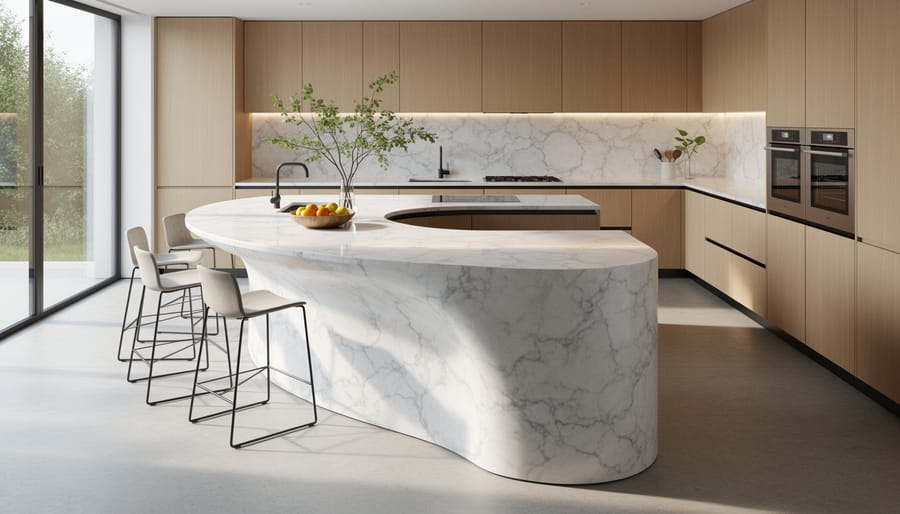
Curved kitchen islands and countertops represent one of the most practical applications of 3D organic shape principles in residential design. These flowing surfaces soften the traditionally angular kitchen environment while creating more functional and inviting spaces for gathering and food preparation.
From a design perspective, rounded countertop edges eliminate harsh corners, making kitchens feel more spacious and welcoming. The continuous curves guide movement naturally through the space, improving traffic flow in high-use areas. Waterfall edges that wrap seamlessly around islands exemplify how organic forms can integrate multiple surfaces into a cohesive visual statement.
Beyond aesthetics, curved designs offer tangible safety benefits by reducing impact injuries, particularly valuable in households with children. The absence of sharp 90-degree corners also simplifies cleaning and maintenance, as curved edges accumulate less debris and are easier to wipe down.
Modern CNC technology enables fabricators to create precise curved profiles from stone slabs, transforming complex 3D drawings into reality. Designers can specify gentle radius curves for subtle sophistication or dramatic sweeping arcs for bold focal points. Popular materials include marble, quartzite, and granite, each offering unique veining patterns that emphasize the organic flow of curved forms. When properly executed, these installations demonstrate how technical precision and artistic vision combine to elevate everyday spaces.
Sculptural Bathroom Features
Bathrooms have become prime canvases for 3D organic stone designs, transforming functional spaces into spa-like retreats. Freestanding tubs carved from single marble blocks exemplify this trend, featuring flowing exteriors that mimic natural river stones or cocoon-like forms. These sculptural centerpieces anchor the room while showcasing stone’s versatility in creating soft, touchable surfaces.
Curved vanities represent another popular application, where fabricators use CNC technology and hand-finishing to craft continuous, wave-like countertops that appear to float. These designs eliminate harsh angles, incorporating gentle undulations that guide the eye throughout the space. Marble and onyx work particularly well for vanities due to their translucency, allowing for dramatic backlighting effects.
Organic shower walls push boundaries further with 3D relief patterns inspired by natural formations like canyon walls, ocean waves, or cellular structures. Modern waterjet cutting enables these intricate textures while maintaining water-resistant functionality. The dimensional surfaces create visual interest through shadow play and tactile variation, elevating the daily shower experience.
When planning these features, consider stone selection carefully. Lighter stones suit smaller bathrooms, while dramatic dark varieties create bold statements in larger spaces. Professional fabrication ensures proper sealing and structural integrity for moisture-heavy environments.
Architectural Elements and Statement Pieces
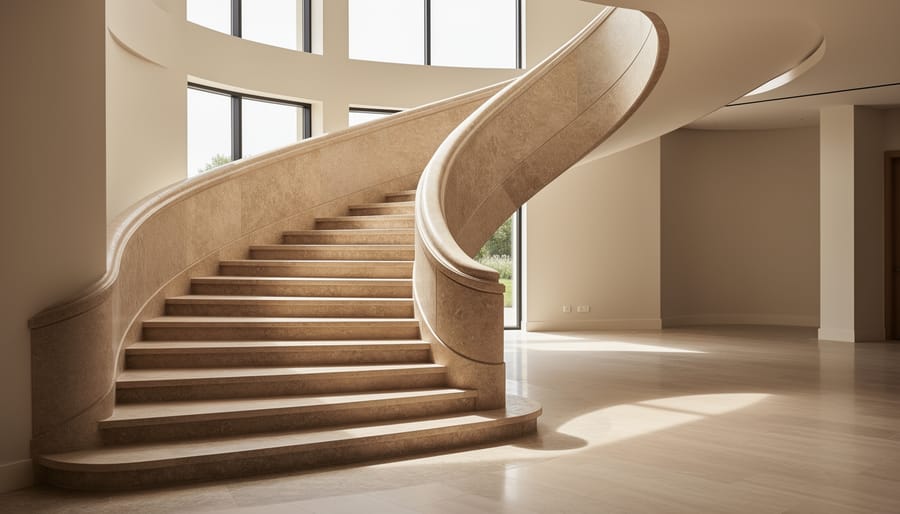
Three-dimensional organic shapes transform functional architectural elements into extraordinary design statements that redefine spatial experiences. Curved staircases represent perhaps the most dramatic application of this concept, where flowing stone treads spiral gracefully through vertical space, creating sculptural connections between levels. These helical designs require precise digital modeling to ensure each step maintains proper dimensions while following the organic curve, with materials like marble and limestone particularly suited to achieving smooth, continuous forms.
Flowing wall panels have emerged as transformative architectural features, where flat surfaces give way to undulating stone reliefs that play with light and shadow throughout the day. These three-dimensional surfaces can incorporate wave patterns, ripple effects, or biomorphic forms that echo natural phenomena. Digital fabrication allows designers to create seamless installations where individual panels connect perfectly, forming cohesive organic compositions that span entire walls.
Columns designed with organic principles move beyond traditional cylindrical forms to become twisting, tapering, or bulbous elements that serve dual purposes as structural supports and artistic focal points. Contemporary stone fabrication enables the creation of columns that appear to grow from floor to ceiling, mimicking natural forms like tree trunks or stalactites.
Standalone sculptural pieces function as architectural anchors within interior and exterior spaces. These statement elements, whether abstract forms in building lobbies or figurative works in gardens, demonstrate the full potential of organic shape drawing translated into three-dimensional stone reality. Such pieces often become defining features of their environments, establishing visual identity and creating memorable spatial experiences that engage viewers from multiple perspectives.
The Fabrication Process: From Concept to Curved Reality
Modern CNC Technology and Traditional Craftsmanship
Today’s custom stone fabrication merges advanced digital technology with time-honored handcrafting methods to achieve flowing, organic forms that would be nearly impossible through manual techniques alone. The process begins with 3D modeling software, where designers create precise digital representations of curved surfaces and sculptural elements. These digital files guide CNC (Computer Numerical Control) machines that use diamond-tipped tools to cut stone with exceptional accuracy, following complex curves and contours programmed into the system.
However, technology alone cannot capture the nuanced beauty of organic shapes. Skilled artisans step in after machine cutting to refine surfaces through hand-finishing techniques. They carefully smooth transitions, enhance texture variations, and ensure that each curve flows naturally into the next. This hybrid approach allows fabricators to achieve the mathematical precision needed for proper installation while preserving the tactile quality and visual warmth that only human touch can provide. The combination results in stone pieces that feel both contemporary and timeless, with organic shapes that appear effortlessly natural despite their technical complexity.
Considerations for Structural Integrity
Creating three-dimensional organic shapes in stone requires careful engineering to ensure both beauty and durability. While flowing curves appear effortless, they demand precise calculations to withstand structural forces over time.
Thickness becomes a critical factor when designing curved stone elements. Unlike flat panels that distribute weight evenly, curved pieces create varying stress points along their contours. Minimum thickness requirements typically range from 1.25 to 2 inches for most residential applications, though complex curves may require additional material to prevent fracturing. Thinner sections along pronounced curves need reinforcement through strategic material placement or backing systems.
Support structures play an essential role in maintaining the integrity of organic stone installations. Hidden steel armatures, mounting brackets, and anchoring systems must be engineered to accommodate the unique geometry of each piece. For vertical applications like curved wall cladding, mechanical fastening systems work in conjunction with adhesives to create redundant support. Countertops with dramatic overhangs or flowing edges often incorporate steel rods or mesh reinforcement embedded during fabrication.
Installation methods for curved stone differ significantly from traditional applications. Professional installers use specialized templates and digital measurements to ensure proper fit, as organic shapes leave little margin for adjustment. Epoxy systems formulated for natural stone provide the flexibility needed to accommodate subtle variations while maintaining strong bonds throughout the entire curved surface.
Design Principles for Incorporating Organic Stone Fluidity
Balancing Curves with Straight Lines
Successful organic stone designs achieve visual balance by thoughtfully combining curved elements with straight lines and angular features. When planning a space with flowing stone forms, consider how these shapes interact with existing architectural components like windows, doorframes, and floor patterns. A curved marble reception desk, for example, gains definition when positioned against linear wall panels or rectangular flooring tiles.
The interplay between organic and geometric elements creates dynamic tension that draws the eye while maintaining cohesion. In residential settings, a sinuous stone kitchen island pairs beautifully with straight-edged cabinetry, where the curves provide softness without overwhelming the space. Similarly, undulating stone wall cladding becomes more impactful when framed by clean, rectangular borders or baseboards.
Consider the 70-30 rule as a starting point: if 70 percent of your design features organic curves, balance it with 30 percent straight lines, and vice versa. This ratio prevents visual chaos while allowing either element to dominate intentionally. Pay attention to sightlines and how curves guide movement through a space, using straight elements to anchor focal points and provide visual rest areas. Professional designers often sketch multiple iterations, testing various curve-to-line ratios before finalizing three-dimensional renderings for fabrication.
Scale and Proportion in Organic Design
Achieving the right scale and proportion in organic stone designs requires careful consideration of the relationship between the installation and its surrounding space. A curved stone feature that works beautifully in a spacious hotel lobby may overwhelm a residential foyer, while an undersized organic element can get lost in a large commercial setting.
Start by measuring the dimensions of your space, paying particular attention to ceiling height, wall length, and sight lines. As a general guideline, curved stone features should occupy between 25-40 percent of the wall or floor area they’re meant to anchor. In rooms with ceiling heights above 10 feet, you can scale up proportionally to maintain visual balance.
Consider the viewer’s distance from the installation. Reception areas and lobbies where people stand farther back can accommodate larger, more dramatic organic forms. In intimate spaces like bathrooms or residential entries, opt for gentler curves with a smaller footprint to avoid claustrophobic effects.
Test your design using 3D rendering software or physical mockups before fabrication begins. This step reveals proportion issues that drawings alone might miss. Remember that organic shapes naturally draw the eye, so even moderately sized installations create significant visual impact when executed with thoughtful proportions.
Sustainability and Longevity of Curved Stone Installations
Durability of Curved Versus Flat Stone
Curved stone installations often demonstrate superior durability compared to their flat counterparts due to their inherent structural advantages. The three-dimensional nature of organic shapes distributes stress more evenly across the surface, reducing concentration points where cracks typically develop. This natural load distribution makes curved designs particularly resilient in high-traffic applications.
Maintenance requirements for organic stone forms are generally straightforward. The flowing contours actually shed water more effectively than flat surfaces with grout lines, minimizing moisture penetration and reducing the risk of staining or deterioration. However, curved edges may require slightly more attention during cleaning to ensure debris doesn’t accumulate in concave areas.
Wear patterns on curved stone surfaces tend to be less noticeable than on flat installations. The varied angles and depths of organic shapes create natural visual interest that helps camouflage minor scratches or etching that might stand out on uniform flat surfaces. This forgiving quality extends the aesthetic lifespan of the installation.
Perhaps most significantly, organic stone designs possess a timeless quality that transcends passing trends. Unlike geometric patterns that can date an interior, flowing natural forms echo shapes found in nature, creating connections that feel inherently harmonious across decades. This enduring appeal makes curved stone installations a sound long-term investment for both residential and commercial projects.
Responsible Sourcing for Custom Projects
When designing custom projects featuring 3D organic shapes in natural stone, responsible sourcing becomes particularly important due to the material intensity of these sculptural installations. Sustainable stone sourcing begins with selecting quarries that employ environmentally conscious extraction methods, including water recycling systems, land rehabilitation programs, and reduced energy consumption during processing.
For curved stone designs, consider quarries certified by environmental standards that demonstrate commitment to ecosystem preservation and community welfare. Ethically sourced stone ensures your organic design project aligns with broader sustainability goals while maintaining the quality necessary for complex fabrication. Many suppliers now provide transparent documentation of their quarrying practices, allowing you to trace the stone’s journey from extraction to installation. This transparency supports informed decisions that honor both design vision and environmental stewardship, particularly crucial when substantial stone volumes are required for dramatic three-dimensional forms.
Curved stone designs represent more than an aesthetic choice—they embody a fundamental shift toward spaces that resonate with our innate connection to nature. The transformative power of organic shapes in natural stone creates environments that feel instinctively welcoming, moving beyond stark geometric forms to embrace the flowing contours found throughout the natural world. From sculptural walls that ripple like water to countertops with gentle undulating edges, these fluid designs bring timeless elegance and warmth to any setting.
Natural stone stands as the ideal medium for achieving these organic forms. Its inherent variation in color, texture, and veining enhances the three-dimensional qualities of curved designs, while its durability ensures these sculptural elements maintain their beauty for generations. The material’s authenticity adds depth that synthetic alternatives simply cannot replicate.
As you plan your next stone project, consider the possibilities that organic fluidity offers. Whether designing a residential sanctuary or a commercial statement piece, curved stone elements create memorable spaces that transcend fleeting trends. The marriage of natural stone’s timeless appeal with flowing, biomorphic forms results in installations that feel both contemporary and eternal—spaces where design and nature seamlessly converge.