
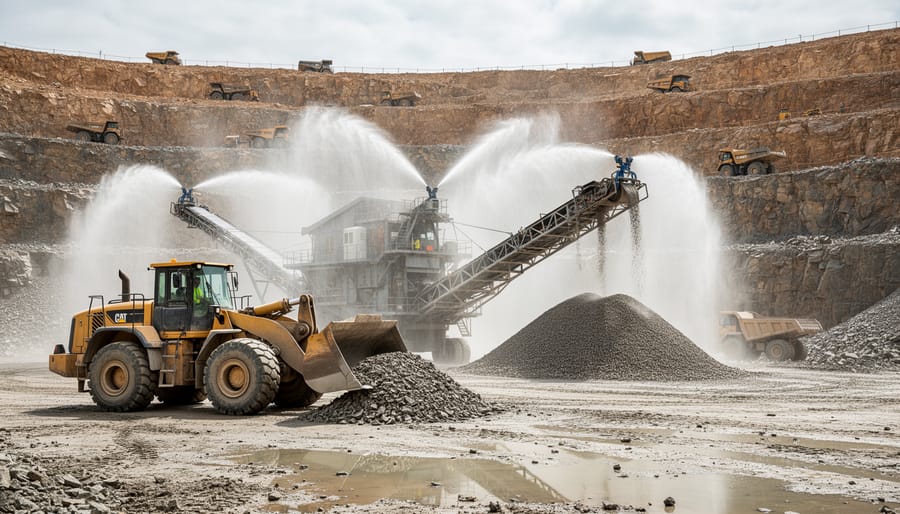
Construction site dust poses serious health risks, regulatory compliance challenges, and operational disruptions that demand immediate attention. Airborne particulate matter from stone cutting, grinding, and material handling can cause respiratory diseases among workers, reduce visibility for heavy equipment operators, and trigger costly citations from OSHA and EPA inspectors. Stone operations face particularly acute dust control challenges due to the crystalline silica content in materials like granite, marble, and limestone, which generates respirable dust particles capable of causing silicosis with prolonged exposure.
Effective dust suppression requires a multi-layered approach combining engineering controls, water-based suppression systems, and administrative practices. Water sprays and misting systems applied at cutting and grinding points capture dust at the source before it becomes airborne. Enclosing high-dust operations within barriers or using local exhaust ventilation systems prevents particle dispersion across the site. Regular sweeping with vacuum-equipped machines rather than dry brooms prevents settled dust from re-entering the air. Site perimeter monitoring helps verify that control measures keep particulate levels within permissible exposure limits.
The financial and legal stakes are substantial. OSHA’s respirable crystalline silica standard mandates strict exposure limits, with violations carrying penalties exceeding tens of thousands of dollars. Beyond compliance, proper dust control protects worker health, maintains positive community relations with neighbors, and preserves equipment longevity by reducing abrasive wear. Implementing proven dust suppression strategies transforms these challenges into manageable operational practices that safeguard both people and profitability.
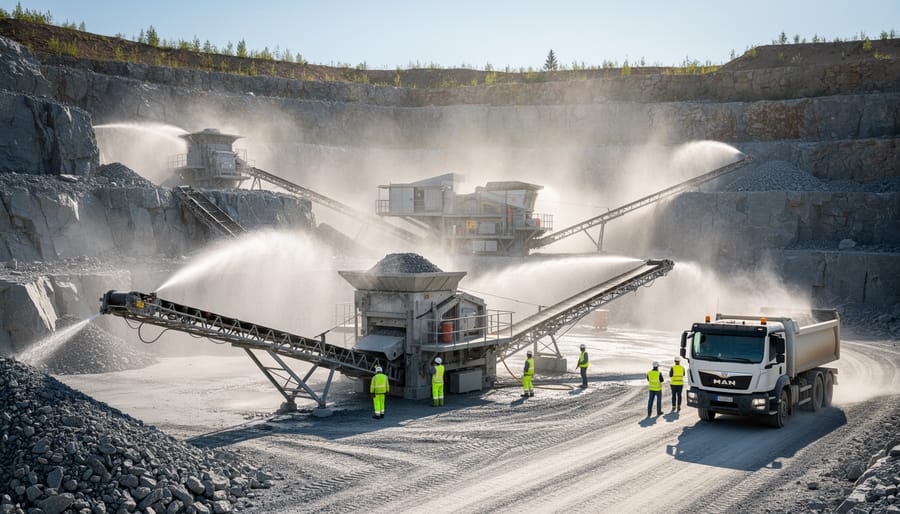
The Unique Dust Challenge in Stone Operations
Silica Dust: The Hidden Hazard
Crystalline silica dust represents one of the most serious health hazards in stone operations and construction sites. When materials like granite, sandstone, concrete, or brick are cut, ground, or drilled, they release respirable crystalline silica—microscopic particles small enough to penetrate deep into lung tissue. Prolonged exposure can cause silicosis, an incurable and potentially fatal lung disease, as well as lung cancer, chronic obstructive pulmonary disease, and kidney disease.
Stone operations produce particularly high concentrations of silica dust because natural stone inherently contains significant amounts of crystalline silica. Activities such as cutting slabs, polishing surfaces, and dry grinding generate airborne particles at levels that can quickly exceed safe exposure limits. Unlike general construction dust, silica particles are often invisible to the naked eye, making the hazard easy to underestimate.
In response to these risks, OSHA established the Respirable Crystalline Silica Standard for Construction (29 CFR 1926.1153), which set the permissible exposure limit at 50 micrograms per cubic meter of air as an eight-hour time-weighted average. The regulation requires employers to implement engineering controls, provide respiratory protection when necessary, establish written exposure control plans, and offer medical surveillance to workers with high exposure levels. Compliance isn’t merely a legal obligation—it’s essential for protecting worker health in an industry where silica exposure has historically caused preventable disease and death.

How Stone Dust Differs from General Construction Debris
Stone dust produced during quarrying, cutting, and fabrication operations presents distinct characteristics that set it apart from typical construction site particulates. While general construction debris includes a mixture of wood fibers, drywall particles, concrete fragments, and various synthetic materials, stone dust consists primarily of fine crystalline silica particles ranging from 0.1 to 100 micrometers in diameter. This smaller particle size makes stone dust particularly prone to becoming airborne and remaining suspended in the air for extended periods.
The composition of stone dust is notably uniform compared to mixed construction debris. When working with materials like granite, marble, or limestone, the dust maintains consistent mineral properties throughout cutting and processing operations. This homogeneity affects how the particles interact with moisture and settle on surfaces, requiring specialized control approaches.
Dispersal patterns also differ significantly. Stone dust generated from high-speed cutting and grinding operations can travel considerable distances from the source point, with fine particles capable of drifting hundreds of feet in windy conditions. In contrast, general construction debris tends to settle more quickly due to larger particle sizes and irregular shapes. The respirable fraction of stone dust poses particular health concerns, as particles under 10 micrometers can penetrate deep into lung tissue, making effective containment crucial at stone operation sites.
Regulatory Requirements and Compliance Standards
EPA Air Quality Standards for Stone Quarries
Stone quarry operations must comply with EPA air quality standards designed to protect public health and the environment. The National Ambient Air Quality Standards (NAAQS) establish maximum allowable concentrations for six criteria pollutants, with particulate matter (PM10 and PM2.5) being the primary concern for quarry operations. These microscopic particles generated during drilling, blasting, crushing, and material handling can travel significant distances and pose serious respiratory health risks.
Quarries classified as major sources must obtain operating permits that specify emission limits, control technology requirements, and compliance timelines. The permitting process requires detailed air quality modeling to demonstrate that operations will not cause or contribute to NAAQS violations in surrounding communities. Once operational, facilities face ongoing monitoring obligations that typically include ambient air quality monitoring at fence lines, visible emission observations, and detailed record-keeping of all dust control activities.
Many states have adopted even more stringent requirements than federal standards, requiring quarries to implement best management practices and maintain continuous dust suppression systems. Failure to meet these standards can result in enforcement actions, significant fines, operational restrictions, or permit revocation, making proactive dust control essential for sustainable stone operations.
OSHA Worker Safety Requirements
The Occupational Safety and Health Administration (OSHA) establishes strict standards to protect construction workers from harmful dust exposure, particularly crystalline silica—a component found in natural stone, concrete, and masonry materials.
OSHA’s permissible exposure limit (PEL) for respirable crystalline silica is 50 micrograms per cubic meter of air, averaged over an 8-hour shift. This limit, established in 2016 and enforced since 2018, represents a significant reduction from previous standards and reflects growing understanding of silica’s health risks, including silicosis, lung cancer, and chronic obstructive pulmonary disease.
Construction sites must implement exposure control plans that include engineering controls (water suppression, ventilation systems), administrative controls (limiting worker exposure time), and respiratory protection when exposure cannot be adequately controlled through other means. Employers are required to provide appropriate respirators at no cost to workers when dust levels exceed the PEL.
Workplace monitoring is essential for compliance. Initial air sampling must occur to assess exposure levels, followed by periodic monitoring if exposure approaches the action level of 25 micrograms per cubic meter. Sites performing high-exposure tasks like cutting, grinding, or breaking stone require more frequent monitoring.
Medical surveillance programs, including baseline and periodic chest X-rays and lung function tests, are mandatory for workers exposed above the action level for 30 or more days per year. Comprehensive training on dust hazards and control methods must be provided to all potentially exposed workers.
Primary Dust Generation Points in Stone Operations
Extraction and Blasting Operations
Quarry operations represent the most intensive dust-generating phase of stone extraction. When drilling equipment penetrates rock faces to create blast holes, the mechanical action pulverizes stone into fine particles that become airborne immediately. These drilling operations can generate significant dust clouds, particularly in dry conditions or when working with softer sedimentary stones.
Blasting activities create massive, instantaneous dust releases as explosive forces fracture rock and propel fragmented material outward. The shockwave disperses accumulated dust across wide areas, often creating visibility hazards and affecting air quality miles beyond the quarry perimeter. Wind patterns can carry this dust into neighboring communities or sensitive environmental areas.
Primary extraction following blasts continues generating dust as heavy equipment loads fractured stone. Effective control at this stage requires water suppression systems on drill rigs, controlled blasting techniques that minimize fragmentation, and immediate application of water sprays post-blast. Some operations implement blast blankets or foam systems to contain initial dust plumes. Timing blasts according to favorable weather conditions and establishing adequate buffer zones also reduces off-site impacts while maintaining productive extraction rates.
Crushing and Screening Processes
Mechanical crushing and screening operations represent the most intensive dust-generating activities at stone processing facilities. These processes fracture and separate aggregate materials through impact, compression, and abrasion, releasing massive quantities of fine particulates into the air. Primary crushers handling quarried stone blocks can generate visible dust plumes extending hundreds of feet without proper controls, while secondary and tertiary crushing stages produce progressively finer particles that remain airborne longer.
Screening equipment adds another layer of complexity, as vibratory action continuously agitates material while separating size fractions. The combination of mechanical energy and material movement creates multiple emission points including feed hoppers, discharge chutes, conveyor transfer points, and screen decks. Dust generation intensifies with drier materials and increases proportionally with processing speed. Enclosed crushing systems with integrated water suppression and localized exhaust ventilation provide the most effective control, reducing emissions by up to 95 percent compared to open operations. Strategic placement of misting nozzles at crusher throats and screen feeds captures particles at their source before dispersal occurs.
Cutting, Polishing, and Finishing
Fabrication facilities face some of the most intense dust control challenges in stone operations due to the concentration of cutting, grinding, and polishing activities. When saws slice through granite, marble, or limestone slabs, they generate fine crystalline silica particles that can remain airborne for hours without proper containment. These indoor environments require multi-layered control strategies to protect workers and maintain air quality.
Wet cutting methods serve as the primary defense, using water to suppress dust at the source. Modern bridge saws and CNC machines incorporate integrated water delivery systems that continuously flush cutting surfaces. However, water alone isn’t sufficient—fabricators must also implement local exhaust ventilation at each workstation. Downdraft tables and flexible extraction arms capture dust particles before they disperse throughout the facility.
Polishing operations present additional complications, as dry polishing pads can release respirable dust even when wet methods are used initially. Enclosed polishing booths with dedicated ventilation systems help isolate these processes. Regular maintenance of water filtration systems prevents recirculation of contaminated water, while HEPA-filtered air cleaners provide supplementary protection in work areas where point-source extraction isn’t feasible.
Facility-wide housekeeping protocols are equally critical. Vacuum systems with HEPA filters should replace compressed air or dry sweeping methods, preventing settled dust from becoming airborne again during cleanup.
Proven Dust Control Methods for Stone Sites
Water-Based Suppression Systems
Water remains the most effective and widely used method for controlling dust at stone construction sites. When properly implemented, water-based suppression systems can reduce airborne particles by 90% or more while supporting safer working conditions.
Wet drilling represents the primary defense against respirable dust during cutting operations. By introducing water directly at the point of contact between blade and stone, this technique prevents dust particles from becoming airborne. Modern wet saws incorporate integrated water delivery systems that continuously flush cutting zones, capturing silica dust before it disperses into the work environment.
Misting systems offer comprehensive coverage for larger work areas and material stockpiles. These automated installations create fine water droplets that bind with suspended dust particles, causing them to settle. Strategic placement around perimeters, haul roads, and crushing equipment provides continuous suppression throughout active operations. Adjustable nozzles allow operators to customize spray patterns based on wind conditions and specific dust sources.
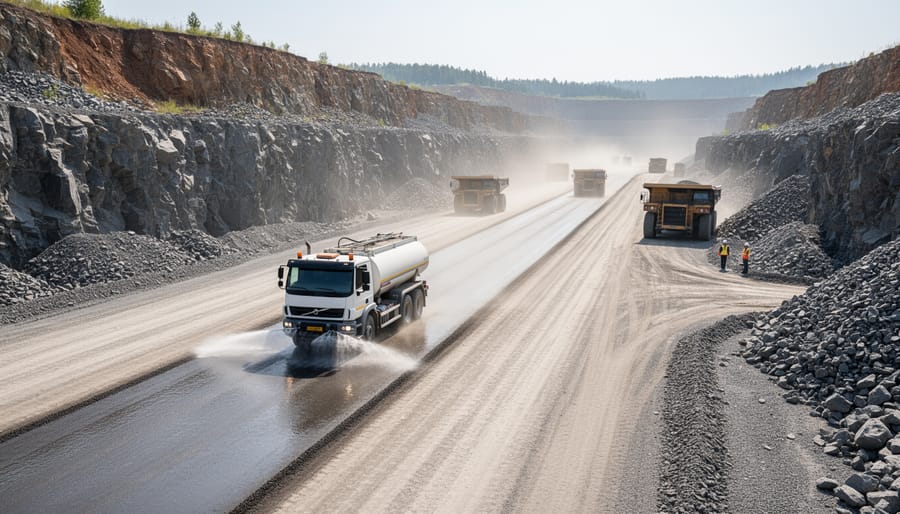
Water trucks and mobile spray bars address temporary needs and large open areas. Application rates should match dust generation levels without creating muddy conditions or runoff issues. A light, frequent misting approach typically proves more effective than heavy intermittent soaking, as it maintains optimal moisture content while conserving water resources.
Success depends on consistent application and proper technique. Water pressure, droplet size, and timing must align with specific operations to maximize dust capture while minimizing waste. Regular monitoring ensures systems function effectively throughout changing site conditions.
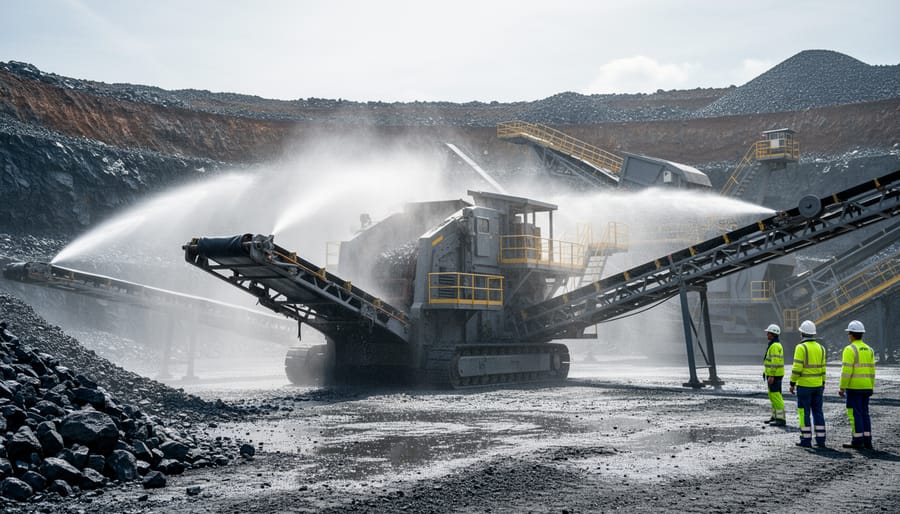
Ventilation and Dust Collection Equipment
When passive dust control measures prove insufficient, active ventilation and dust collection equipment becomes essential for stone processing operations. These engineered systems capture airborne particles at their source, preventing dust from dispersing throughout the worksite and surrounding areas.
Local exhaust ventilation (LEV) systems represent the first line of defense for stationary processing equipment. These systems use strategically positioned hoods and ducts to capture dust directly at cutting, grinding, or polishing stations. By creating negative pressure at the point of generation, LEV systems pull contaminated air away from workers and channel it through filtration systems before releasing clean air back into the environment.
Baghouse collectors serve as workhorses for high-volume dust collection in stone fabrication facilities. These systems use fabric filter bags to trap particles as contaminated air passes through, achieving filtration efficiencies exceeding 99 percent for most stone dust applications. Regular bag replacement and proper maintenance ensure consistent performance and prevent system failures that could result in dust releases.
Wet scrubbers offer an alternative approach by using water sprays to capture airborne particles within enclosed chambers. This technology proves particularly effective for operations generating fine silica dust, as the moisture binds particles together and prevents re-entrainment. The resulting slurry requires proper disposal, but eliminates dry dust accumulation within collection systems.
Enclosed processing areas equipped with integrated ventilation systems provide comprehensive dust control for complex fabrication operations, creating negative pressure environments that contain emissions while maintaining worker access and visibility.
Chemical Dust Suppressants and Additives
Chemical dust suppressants offer targeted solutions for controlling particulate emissions on haul roads, stockpiles, and high-traffic areas where water alone proves insufficient. Surfactants, or wetting agents, reduce water’s surface tension, allowing deeper penetration into dust particles and extending moisture retention. These products require less frequent application than water, reducing operational costs and water consumption.
Binding agents create temporary crusts on exposed surfaces by forming bonds between particles. Polymer-based binders prove particularly effective on stockpiles and unpaved roads, maintaining dust control for weeks or months depending on traffic and weather conditions. Calcium chloride and magnesium chloride products attract atmospheric moisture, keeping road surfaces damp longer than water applications.
Specialized formulations designed for stone operations address specific challenges like alkaline dust or high mineral content. These chemicals typically dilute with water at ratios between 1:10 and 1:100, making them economical for large-scale applications. Application methods range from truck-mounted sprayers for roads to misting systems for stationary sources. When selecting chemical suppressants, consider environmental regulations, groundwater protection requirements, and compatibility with specific stone materials to ensure both effectiveness and compliance.
Site Management and Operational Controls
Haul Road and Traffic Management
Transportation routes require strategic management to minimize dust generation during material movement. Haul roads should receive regular surface treatments with water or chemical stabilizers to bind loose particles and maintain moisture content. Application frequency depends on weather conditions, with increased treatments during dry periods or high-wind days.
Implementing and enforcing speed limits represents one of the most cost-effective dust control measures. Slower vehicle speeds reduce the mechanical disturbance that lifts particles into the air. Most stone operations establish speed limits between 10-15 mph on unpaved surfaces, with clearly posted signage throughout the site.
Route planning optimizes traffic patterns by consolidating vehicle movements and avoiding unnecessary trips through sensitive areas. Designating specific paths for material transport keeps dust-generating activities away from site boundaries and neighboring properties. Well-maintained road surfaces with proper grading and drainage reduce the formation of dust-producing potholes and ruts.
Vehicle washing stations at site exits prevent dust and debris from reaching public roads. These facilities clean truck tires and undercarriages before vehicles leave the construction area, protecting both air quality and community relations. Combined with paved transition zones near exits, washing stations effectively contain dust within the work site while demonstrating environmental responsibility to regulatory agencies and local communities.
Stockpile and Material Handling Strategies
Effective material management begins with strategic stockpile placement and protection. Position aggregate and stone material piles away from property boundaries and prevailing wind directions when possible. Installing wind fences or barrier walls around storage areas creates physical barriers that significantly reduce wind-driven dust dispersion, particularly effective for long-term stockpiles.
Covering stockpiles with tarps, geotextile fabrics, or applying chemical stabilizers prevents surface material from becoming airborne during high winds or extended storage periods. For active stockpiles, partial covering of inactive portions balances operational access with dust suppression needs.
Minimizing drop heights during loading and unloading operations is critical for reducing dust generation. Material transfers should occur at the lowest practical height, ideally below six feet. Consider using chutes, conveyors with enclosed transfer points, or telescoping load-out systems that maintain minimal clearance between the discharge point and receiving surface.
Maintaining proper moisture content in stored materials through periodic water application helps bind particles together. However, avoid over-watering, which creates runoff issues and operational challenges. Strategic stockpile design with compacted surfaces and gentle slopes further reduces erosion and airborne dust while facilitating drainage management.
Vegetation and Rehabilitation
Natural vegetation serves as an effective dust barrier at stone construction sites. Planting native grasses, shrubs, and trees around site perimeters creates windbreaks that reduce dust migration to surrounding areas. These green buffers can decrease airborne particulates by 30-50% when properly positioned.
Revegetating disturbed areas quickly minimizes exposed soil surfaces that generate dust. Hydroseeding with erosion-control blankets establishes ground cover within weeks, stabilizing soils between operational zones. This approach proves particularly effective in quarry areas where extraction has temporarily ceased.
Progressive restoration integrates rehabilitation into ongoing operations rather than waiting until site closure. As sections complete extraction, immediate revegetation reduces active dust sources while supporting environmental stewardship. This strategy not only controls emissions but also demonstrates responsible land management to regulatory agencies and local communities.
Real-World Case Study: Successful Dust Management Implementation
A limestone quarry and processing facility in Arizona faced significant dust control challenges that threatened both regulatory compliance and community relations. The 50-acre operation was generating visible dust plumes during cutting, crushing, and loading operations, resulting in air quality complaints from nearby residential areas and a notice of violation from state environmental regulators.
The company implemented a comprehensive three-phase approach to address the problem. First, they conducted a complete site assessment identifying twelve primary dust generation points, including haul roads, material transfer points, and storage piles. Second, they invested $180,000 in a multi-layered control system featuring automated water spray systems at crusher discharge points, enclosed conveyors for material transfer, and a reclaimed water system that reduced freshwater consumption by 60 percent.
The third phase focused on haul road management, historically the largest dust source. The facility installed a weather monitoring station that triggered automatic watering when wind speeds exceeded 15 mph and humidity dropped below 30 percent. They also applied a polymer-based dust suppressant on primary roads, reducing watering frequency from eight times daily to twice weekly.
Results were measurable within six months. Perimeter air monitoring showed particulate matter reductions of 73 percent compared to baseline levels. Visible emissions that previously occurred during 40 percent of operating hours dropped to less than 5 percent. The facility achieved full regulatory compliance and eliminated community complaints entirely.
The operation’s environmental manager noted that proactive communication with neighbors throughout implementation proved as valuable as the technical solutions. Publishing monthly dust monitoring results and inviting community members for site tours built trust and demonstrated commitment to environmental responsibility.
Key lessons learned included the importance of real-time monitoring, redundant control systems during equipment maintenance, and employee training on proper dust control equipment operation. The initial investment paid for itself within three years through reduced water costs, avoided penalties, and improved operational efficiency.
Cost-Benefit Analysis: Investing in Dust Control
Implementing comprehensive dust control systems requires upfront investment, but the financial returns extend well beyond regulatory compliance. Understanding the complete cost-benefit picture helps construction site managers make informed decisions about dust management strategies.
Initial investment costs typically include equipment purchases such as water trucks, misting systems, vacuum sweepers, and containment barriers. For a mid-sized stone fabrication or construction site, initial setup ranges from $15,000 to $75,000 depending on operation scale and control methods selected. Ongoing operational costs include water consumption, equipment maintenance, replacement filters, and labor for system monitoring.
However, these expenses are offset by substantial savings. Non-compliance penalties for dust violations can reach $25,000 per day in many jurisdictions, making prevention far more economical than remediation. Sites with effective dust control report 60-80% reductions in regulatory inspection violations, translating directly to avoided fines and legal costs.
Health-related savings prove equally significant. Reduced respiratory illness claims lower workers’ compensation insurance premiums by 15-30% for operations with documented dust control programs. The construction industry sees approximately $4 billion annually in silica-related health claims, making prevention a critical cost-avoidance strategy.
Community relations benefits, while harder to quantify, prevent costly project delays. Sites with poor dust control face neighbor complaints leading to work stoppages, legal challenges, and damaged reputations. Proactive dust management maintains community goodwill and project timelines.
Long-term ROI analysis shows most sustainable stone operations recover their dust control investment within 18-36 months through combined compliance savings, reduced health claims, and operational efficiency improvements. Water-based suppression systems demonstrate particularly strong returns, with payback periods often under two years when factoring in avoided penalties and insurance reductions.
Effective dust control at construction sites, particularly in stone operations, represents far more than a regulatory checkbox—it’s a fundamental commitment to worker health, environmental stewardship, and the long-term viability of the natural stone industry. The strategies outlined in this guide demonstrate that comprehensive dust management is achievable through proper planning, investment in appropriate technologies, and consistent implementation of control measures. Rather than viewing dust control as a financial burden, industry professionals should recognize it as a strategic investment that protects their workforce, minimizes environmental impact, ensures compliance with evolving regulations, and ultimately strengthens their market position. Companies that proactively address dust emissions position themselves as responsible industry leaders while avoiding costly penalties, work stoppages, and potential health liabilities. As environmental awareness continues to grow among consumers and specifiers, demonstrating strong dust control practices becomes a competitive advantage that enhances reputation and opens doors to projects requiring rigorous sustainability credentials. The future of natural stone operations depends on our collective commitment to protecting both people and environment.