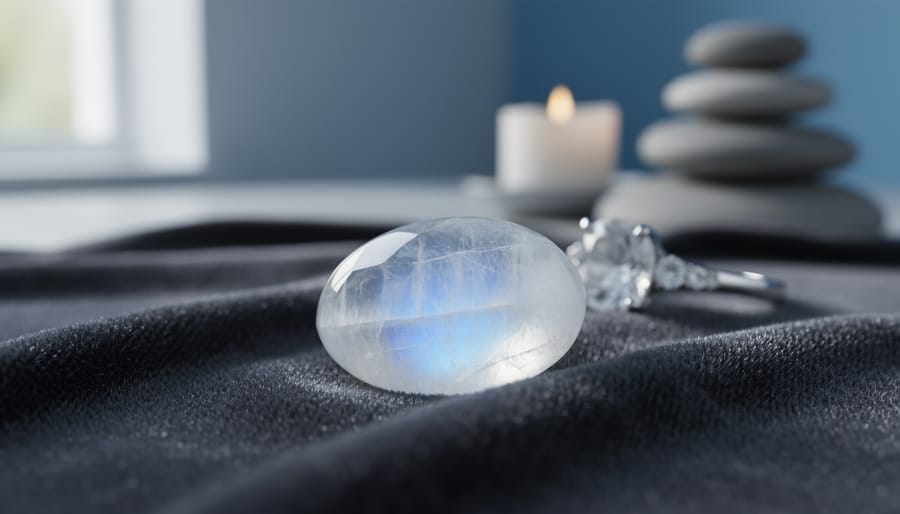
Moonstone symbolism refers to the spiritual, cultural, and metaphysical meanings attributed to this luminous gemstone across civilizations, most commonly representing intuition, feminine energy, new beginnings, and emotional balance. The stone’s distinctive adularescence, a soft glow that appears to float beneath its surface, has inspired centuries of symbolic interpretation connecting it to lunar cycles, divine feminine power, and inner wisdom.
For designers, architects, and consumers selecting natural stone materials in 2026, understanding moonstone’s rich symbolic heritage adds depth to aesthetic choices. This knowledge transforms moonstone from a merely attractive material into a culturally resonant design element that carries intentional meaning in residential spaces, commercial environments, and decorative applications.
Moonstone’s symbolic significance varies dramatically across cultures. Ancient Romans believed the stone formed from solidified moonlight and would bring good fortune to its wearer. Hindu mythology associates moonstone with sacred moon deities and considers it especially powerful when set in silver. European folklore during the Middle Ages connected the stone to love and reconciliation, while modern metaphysical traditions emphasize its role in enhancing intuition and calming emotional turbulence.
The symbolism isn’t purely historical. Contemporary architects and interior designers deliberately incorporate moonstone into projects where the material’s associations with tranquility, reflection, and renewal align with the intended atmosphere. Wellness centers, meditation spaces, and hospitality environments frequently feature moonstone elements precisely because clients and visitors respond to both its visual softness and its cultural connotations of peace and emotional clarity.
This article examines how moonstone developed its symbolic meanings, explores the specific associations tied to different moonstone varieties, and provides practical guidance for incorporating this symbolically rich natural stone into modern design projects where cultural depth enhances visual impact.
What Is Moonstone and Its Symbolic Foundation
Moonstone is a translucent to semi-transparent feldspar mineral prized for its ethereal glow and shimmering light effect. As stone formed over time through geological processes, moonstone develops microscopic layers of orthoclase and albite feldspars that create its signature optical phenomenon. This interplay of light and structure has made moonstone both a gemological curiosity and a symbol laden with meaning across civilizations.
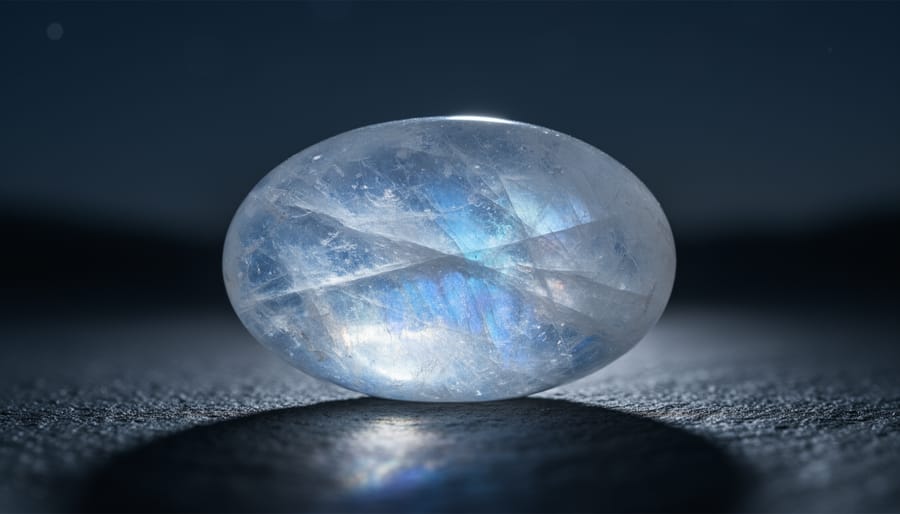
The stone’s most distinctive feature is adularescence in moonstone a billowy, blue-white sheen that appears to float beneath the surface when light hits it at certain angles. This otherworldly glow, reminiscent of moonlight on water, directly shaped the symbolic associations that emerged around the gem. Ancient observers saw this luminous quality as evidence of captured moonbeams or lunar energy crystallized in physical form.
- Adularescence
- The soft, floating light effect created by light scattering between microscopic layers within moonstone’s structure. This optical phenomenon is responsible for the stone’s mystical appearance and moon-like glow.
- Feldspar
- A group of rock-forming minerals that make up roughly 60% of the Earth’s crust. Moonstone is a variety of feldspar characterized by its layered internal structure and light-scattering properties.
- Orthoclase
- The primary feldspar mineral component in moonstone, forming alternating microscopic layers with albite. These layers create the structural foundation for adularescence.
- Schiller Effect
- The broader term for light phenomena in gemstones caused by internal structures. In moonstone, this manifests as the characteristic blue or white sheen that moves across the stone’s surface.
Beyond its physical composition, moonstone’s symbolism stems from the intersection of appearance and human interpretation. The stone’s pale coloring, translucent quality, and shifting light recalled the moon’s changing phases and reflected glow. Cultures that observed lunar cycles closely, tracking planting seasons, tides, and religious calendars, naturally extended the moon’s symbolic associations to this earthbound stone. The gem became a physical anchor for concepts of femininity, intuition, cycles, and hidden knowledge. Its fragile appearance (moonstone ranks 6-6.5 on the Mohs hardness scale) reinforced associations with sensitivity and receptivity, while its durability despite apparent delicacy suggested inner strength beneath a gentle exterior.
How Moonstone Symbolism Works in Cultural Context
The Lunar Connection
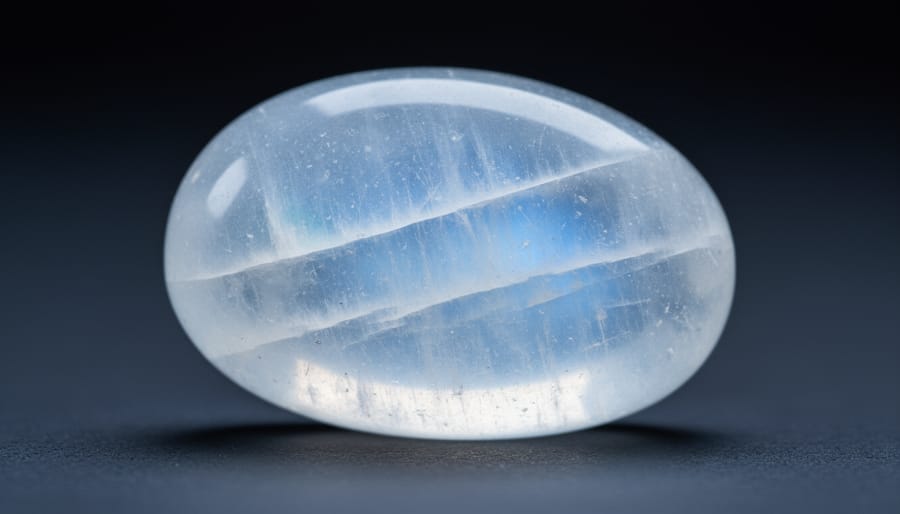
The visual parallel between moonstone’s soft, ethereal glow and the moon’s silvery light sparked reverence across ancient civilizations. When light enters the stone, internal layers scatter it into a floating shimmer called adularescence, a phenomenon that mimics moonlight filtering through clouds. This optical echo was too striking to ignore.
Cultures from Rome to India independently linked moonstone to lunar deities. Romans believed the stone contained frozen moonbeams and connected it to Diana, goddess of the moon and hunt. Hindu tradition considered moonstone sacred to Chandra, the moon god, claiming it was formed from solidified moonlight. These weren’t arbitrary associations; the stone’s appearance genuinely evokes lunar qualities.
The moon’s cyclical nature, waxing, full, waning, new, became central to moonstone’s symbolism. Ancient observers tied the stone to renewal, fertility, and feminine rhythms. Its luminous quality suggested hidden knowledge and intuition, qualities culturally attributed to the moon. The stone became a physical token of lunar energy, worn to harness the moon’s perceived powers during specific phases.
This wasn’t mere superstition. The visual connection provided a tangible link to celestial observation, embedding moonstone deeply into spiritual practices and decorative traditions that persist today.
Physical Properties as Metaphor
Moonstone’s symbolic power stems directly from its most distinctive physical characteristic: adularescence, the billowing blue-white glow that seems to float beneath the stone’s surface. This optical phenomenon occurs when light scatters between microscopic layers of orthoclase and albite feldspar, creating an effect that ancient observers found both mesmerizing and mysterious. The glow shifts and moves as you rotate the stone, appearing to emerge from within rather than reflecting from the surface, a property that naturally suggested hidden depths and concealed knowledge.
This interplay of light and structure became a perfect metaphor for intuition. Just as the stone’s luminous quality reveals itself gradually through changing angles and perspectives, intuitive knowledge was understood to emerge through shifting awareness rather than direct observation. The stone’s ability to display different colors and intensities depending on how light strikes it reinforced associations with transformation and change. Understanding how adularescence appears helps explain why this particular optical effect, unlike simple transparency or reflection, captured imaginations across cultures.
The fact that moonstone’s glow is neither fully visible nor completely hidden, existing in a liminal state between surface and depth, made it an ideal symbol for accessing truths that lie beneath ordinary perception. This physical ambiguity translated into spiritual and psychological metaphors that persist in contemporary interpretations of the stone’s meaning.
Types and Varieties of Moonstone Symbolism
White and Rainbow Moonstone
White moonstone has carried symbolic weight for millennia, representing purity, new beginnings, and the cyclical nature of transformation. Ancient cultures prized its milky translucence and blue sheen, the result of light scattering between microscopic feldspar layers, as a physical manifestation of lunar energy. This made white moonstone one of the most revered symbolic gemstones in traditions ranging from Vedic astrology to Roman mythology, where it signified fresh starts, feminine intuition, and emotional balance.
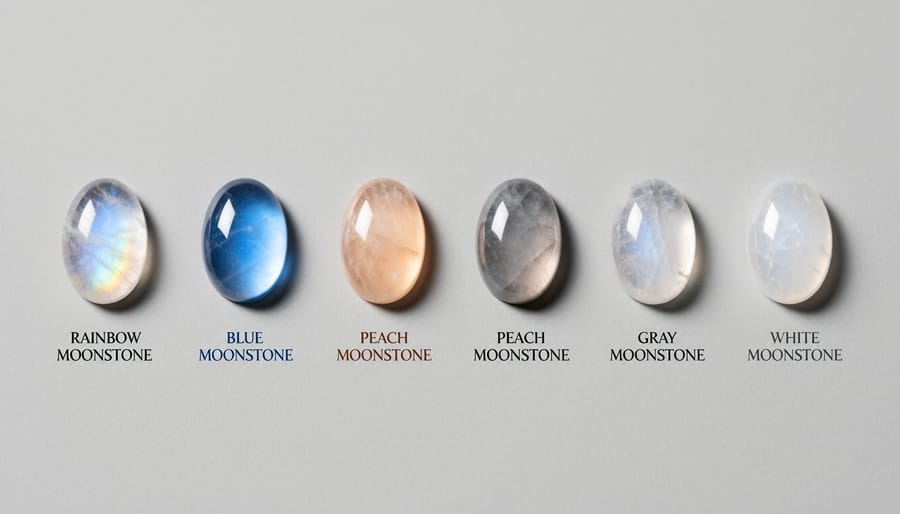
Rainbow moonstone, technically a white labradorite feldspar with pronounced color play, emerged as a distinct variety in modern gemstone markets. Its flashes of blue, peach, and violet carry layered symbolic meaning: the full spectrum represents wholeness, spiritual awakening, and the integration of multiple energies. Contemporary practitioners associate rainbow moonstone with heightened perception and creative expansion, while retaining white moonstone’s traditional connections to renewal and inner clarity. Both varieties share the core symbolism of cyclical growth and emotional receptivity that defines moonstone across cultures.
Blue and Peach Moonstone
Blue moonstone carries associations with mental acuity, clear communication, and intellectual balance. Its cool, ethereal glow, reminiscent of ice or winter moonlight, has made it a symbol of focus and rational thought in crystal healing traditions. Practitioners believe it activates higher consciousness while maintaining emotional equilibrium, making it valuable for decision-making and meditation practices. The stone’s crisp blue sheen suggests transparency and truth-telling.
Peach moonstone presents warmer symbolism centered on emotional healing and heart-centered energy. Its gentle apricot or coral tones evoke comfort, compassion, and feminine nurturing, different from white moonstone’s lunar mysticism. This variety connects to self-love, acceptance, and the release of emotional trauma. Like colored stones featured in ancient stone art and ancient architecture where specific hues carried distinct cultural meanings, peach moonstone’s color determines its symbolic function. Designers selecting moonstone for wellness spaces often choose blue for study or work environments, peach for therapy rooms or bedrooms where emotional safety matters most.
Regional Symbolic Variations
Moonstone’s symbolic meanings shift subtly across different geographic origins, reflecting the cultural contexts where these stones are found and valued. Indian moonstone, primarily sourced from regions around Rajasthan and Tamil Nadu, carries the deepest spiritual associations, revered as a sacred stone connected to Chandra, the moon deity. In traditional Indian belief, wearing Indian moonstone enhances intuition and brings divine blessings, particularly for women seeking fertility or emotional balance. The stone’s placement in jewelry follows specific Vedic traditions that maximize its protective and harmonizing properties.
Sri Lankan moonstone, historically the most prized variety for its intense blue sheen, became synonymous with royalty and spiritual authority in Buddhist traditions. The culture views this translucent gem as a symbol of enlightenment and inner wisdom, often incorporated into ceremonial objects and temple decorations. Its rarity elevated its status as a stone of exceptional spiritual power.
Madagascar moonstone, a more recent market addition, developed associations with transformation and adaptability, metaphors drawn from the island’s unique evolutionary isolation. Contemporary crystal practitioners attribute grounding properties to these stones alongside traditional lunar symbolism.
Australian and Norwegian sources introduced cooler-toned varieties that local cultures associate with clarity, focus, and connection to northern landscapes rather than tropical mysticism. These regional variations demonstrate how geographic context shapes symbolic interpretation even within a single gemstone family.
Cultural and Historical Meanings Across Traditions
Eastern Traditions
In Hindu tradition, moonstone holds profound sacred significance as a physical embodiment of lunar divinity. Ancient texts describe the stone as solidified moonbeams, created from the ethereal light of Chandra, the moon god who rides across the night sky in a chariot pulled by white horses. This celestial origin story elevated moonstone beyond mere ornamental status to a sacred object worthy of temple offerings and spiritual devotion.
Traditional Indian astrology considers moonstone a powerful talisman for balancing emotions and enhancing intuition, particularly for those born under moon-influenced zodiac signs. Vedic practitioners have long sewn moonstone into clothing or set it in silver jewelry worn close to the skin to maximize its perceived spiritual benefits. The stone appears frequently in classical Indian jewelry designs, from ornate necklaces to forehead ornaments, where its soft shimmer complements the spiritual symbolism embedded in traditional adornment practices.
In tantric traditions, moonstone connects to the sacral chakra and crown chakra, serving as a meditation focus for practitioners seeking emotional balance and spiritual clarity. The stone’s association with feminine energy and lunar cycles makes it especially significant in rituals honoring goddesses and celebrating life transitions for women.
Western Historical Context
Ancient Romans believed moonstone was formed from frozen moonlight, linking it directly to Diana, goddess of the moon and the hunt. They valued the stone as a protective talisman for travelers, particularly those journeying at night, and considered it a gift from Luna herself that could bring good fortune and enhance prophetic abilities.
During the Art Nouveau movement of the late 1800s and early 1900s, moonstone experienced a symbolic renaissance. Designers like René Lalique elevated the gem beyond its protective associations, using it to represent the era’s fascination with nature, mystery, and the feminine mystique. The stone’s ethereal glow perfectly embodied Art Nouveau’s aesthetic of organic forms and dreamlike beauty, appearing in elaborate jewelry pieces that celebrated emotional depth and artistic expression.
European gemstone lore through the Middle Ages and Renaissance attributed moonstone with the power to reconcile estranged lovers and promote peaceful sleep. Medieval lapidaries, gemstone reference texts, described it as a “lover’s stone” that could reveal the future by being held in the mouth during a full moon, a practice that merged Roman lunar worship with evolving Christian mysticism across the continent.
Contemporary Symbolic Applications
Moonstone’s symbolic resonance extends well beyond historical traditions into contemporary contexts where its meaning has adapted to modern spiritual and cultural frameworks.
In crystal healing practices, moonstone has become central to work involving emotional balance and intuitive development. Practitioners attribute specific energetic properties to the stone, calming emotional turbulence, enhancing receptivity to subtle information, and supporting transitions. Though these applications lack scientific validation, they reflect moonstone’s persistent association with lunar cycles and transformation. The stone appears prominently in meditation practices, often placed on the body or held during new moon and full moon rituals.
As June’s birthstone, moonstone carries celebratory symbolism beyond its metaphysical associations. This designation, formalized by the American Gem Society in 1952, positions moonstone as a meaningful gift for June-born individuals, connecting personal milestones to the stone’s traditional associations with new beginnings and emotional growth.
New age spiritual communities have woven moonstone into practices ranging from chakra work (particularly the third eye and crown chakras) to manifestation rituals. Contemporary interpretations often blend historical lunar symbolism with modern psychological concepts, framing moonstone as a tool for self-discovery and personal transformation rather than divine intervention.
Practical Uses and Applications in Design
Jewelry and Personal Adornment
Moonstone’s symbolic associations with new beginnings, intuition, and feminine energy make it a popular choice for engagement rings and wedding jewelry. Many couples select moonstone specifically for its representation of emotional balance and new cycles, values that align with marriage commitments. The stone’s association with love and fertility in ancient traditions carries forward into modern bridal jewelry, where its ethereal glow offers a distinctive alternative to conventional diamonds.
In personal adornment beyond bridal pieces, moonstone appears frequently in statement rings, pendants, and earrings where wearers seek connection to its calming and protective symbolism. June birthstone jewelry incorporates moonstone for those born in that month, linking personal identity to the stone’s traditional meanings. Designers often feature rainbow moonstone in bohemian and spiritual jewelry collections, capitalizing on its associations with creativity and self-discovery.
Ceremonial pieces, from coming-of-age gifts to anniversary jewelry, leverage moonstone’s symbolic connection to life transitions and personal growth. The stone’s affordability compared to precious gems makes symbolically meaningful jewelry accessible while maintaining visual impact through its distinctive adularescence.
Interior Design and Architectural Applications
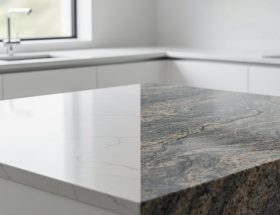
Moonstone and stones that echo its ethereal luminescence are finding their way into residential and commercial interiors where designers want more than visual appeal, they’re seeking materials that carry meaning. Translucent white marbles with subtle veining, like certain Calacatta varieties, can evoke moonstone’s serene glow when backlit in feature walls or bathroom vanities. These installations work particularly well in meditation rooms, master suites, and entryways where the stone’s calming symbolism reinforces the space’s intended atmosphere.
In contemporary projects, designers specify moonstone-inspired materials for powder room countertops, fireplace surrounds, and accent panels in wellness-focused homes. The key is leveraging the stone’s soft, shifting appearance to create focal points that feel contemplative rather than static. When backlit or positioned to catch natural light throughout the day, these stones mirror moonstone’s adularescence, bringing that symbolic connection to new beginnings and emotional balance into the built environment. The most successful applications pair the material’s aesthetic with spaces designed for reflection, transition, or renewal, places where symbolic intention and functional design merge naturally.
Commercial and Wellness Spaces
Moonstone-inspired surfaces transform commercial wellness environments by embedding symbolic meaning directly into the spatial experience. High-end spas increasingly specify polished quartzite with moonstone-like adularescence for reception desks and treatment room accent walls, where the stone’s association with emotional balance and renewal reinforces the brand promise before any service begins. Yoga studios use backlit translucent panels mimicking moonstone’s glow to create meditative focal points that support practitioners’ intention-setting rituals.
In hospitality design, boutique hotels targeting wellness-conscious travelers incorporate moonstone symbolism through carefully selected natural stone applications, lobby feature walls in shimmering white quartzite, bathroom vanities in pearlescent marble, or spa areas with iridescent mosaic installations. These choices signal a commitment to holistic experience design where material selection carries intentional meaning. The symbolic dimension adds perceived value: guests don’t just see beautiful stone, they experience an environment purposefully designed to promote calm, introspection, and restoration aligned with moonstone’s centuries-old associations.
Selecting and Working with Moonstone in Projects
When integrating moonstone or moonstone-inspired natural stone into a design project, the symbolic significance you seek must align with practical considerations of quality, durability, and maintenance. Authentic moonstone’s relative softness, rating 6 to 6.5 on the Mohs scale, makes it suitable for decorative applications but less ideal for high-traffic surfaces or exposed countertops where harder stones would perform better. For projects requiring moonstone’s ethereal aesthetic with greater durability, consider alternatives like labradorite or white granite with similar optical effects.
Quality assessment begins with examining adularescence, the distinctive light phenomenon that defines authentic moonstone. High-quality specimens display a smooth, billowy blue or white sheen that moves across the surface when viewed from different angles. Look for even color distribution, minimal inclusions, and strong light play. In commercial settings, request certification from reputable gemological laboratories to verify authenticity, as synthetic moonstones and lookalikes have flooded the market.
- Adularescence quality: strong, centered light play indicates premium grade
- Transparency and clarity: fewer inclusions and cracks mean better durability
- Origin verification: request documentation for Sri Lankan, Indian, or Madagascar sources
- Size and application match: reserve genuine moonstone for protected decorative elements, not worksurfaces
- Sealing requirements: porous moonstone needs regular sealing to prevent staining and moisture damage
Maintenance protocols for moonstone differ significantly from harder natural stones. The material scratches easily, so specify it only for wall cladding, inlay work, or accent pieces rather than floor tiles or kitchen counters. Clean with pH-neutral solutions and soft cloths; acidic cleaners will etch the surface. Proper stone preservation techniques become critical in installations where moonstone serves ceremonial or symbolic functions, wellness centers, meditation spaces, or residential feature walls where longevity matters.
Environmental factors also affect moonstone’s performance. Direct sunlight can fade some varieties over time, and temperature fluctuations may stress the material. In outdoor or semi-exposed applications, protect moonstone from climate damage through proper installation details, awnings, or climate-controlled environments. For architects and designers, incorporating moonstone’s symbolism often works best through strategic accents, a backlit feature panel, inlaid borders, or carefully placed decorative elements, rather than attempting whole-surface applications where practicality conflicts with the stone’s inherent characteristics.
Common Questions About Moonstone Symbolism
Separating authentic cultural symbolism from modern marketing requires understanding moonstone’s historical roots versus contemporary attribution. While moonstone genuinely carries deep meaning in Hindu tradition and appears in Roman historical texts, many “healing properties” and spiritual claims emerged only in recent decades alongside the crystal wellness movement. Authentic symbolism ties directly to the stone’s physical appearance, its lunar glow inspired moon deity associations, while its shifting light suggested mystery and intuition. Marketing claims often extend far beyond these documented traditions, attributing specific powers without cultural or historical basis.
What does moonstone symbolize across different traditions?
Moonstone primarily symbolizes lunar energy, feminine power, and new beginnings in Eastern traditions, while Western cultures historically associated it with love, intuition, and protection during travel. The core symbolic thread across cultures connects to its moon-like appearance and changing light.
Is moonstone appropriate for engagement rings or everyday wear?
Moonstone ranks 6-6.5 on the Mohs scale, making it softer than sapphire or diamond and more prone to scratching with daily wear. While symbolically meaningful for engagement rings representing new beginnings, it requires careful setting and conscious wear to avoid damage.
How do I distinguish between moonstone’s symbolic meaning and its physical properties?
Physical properties, adularescence, color, hardness, are measurable and scientifically documented. Symbolic meanings are cultural interpretations of these physical traits, varying by tradition and era rather than being inherent to the stone itself.
Does moonstone color affect its symbolic meaning?
Yes, different colors carry distinct associations: white moonstone connects to purity and spiritual growth, blue to mental clarity, and peach to emotional healing. However, these color-specific meanings are less historically established than the general lunar symbolism shared across all varieties.
When specifying moonstone for design projects, clarify whether you’re drawn to documented cultural symbolism or personal interpretation. A wellness center might legitimately incorporate moonstone based on its established calming associations and lunar mythology. A residential project might choose it for aesthetic qualities while appreciating symbolic resonance as secondary. Either approach works, the key is recognizing which meanings have cultural depth versus which represent modern creative extension. Quality gemological certification matters more than unverifiable metaphysical claims when evaluating actual moonstone pieces or natural stone selections with similar visual characteristics.
Types or components
Understanding moonstone’s symbolic significance requires recognizing four fundamental components that work together to create its cultural meaning.
Physical Foundation: The stone’s mineralogical properties, specifically adularescence and color variations, form the basis for all symbolic interpretation. Without these optical phenomena, moonstone would carry no more metaphorical weight than any other feldspar.
Cultural Association: Historical connections to lunar deities, feminine energy, and cyclical transformation provide the framework for meaning. These associations developed independently across cultures yet show remarkable consistency.
Metaphorical Translation: The process by which physical characteristics become symbolic concepts, translucence representing clarity, shifting light suggesting hidden knowledge, soft glow evoking calm. This translation bridges the tangible and intangible.
Contemporary Application: Modern reinterpretation through wellness practices, design philosophy, and personal meaning-making. Today’s symbolic uses build on traditional frameworks while adapting to current values and contexts.
These components interact rather than exist separately. Physical properties enable cultural associations, which generate metaphors, which inform contemporary applications. Remove any component, and moonstone becomes either just geology or pure abstraction, neither particularly useful for design decisions.
Moonstone’s symbolic journey, from ancient lunar worship to contemporary design applications, demonstrates how cultural meaning can deepen our connection to natural materials. This gemstone’s association with intuition, transformation, and cyclical renewal has persisted precisely because its physical properties mirror these concepts so effectively. The interplay of light beneath its surface continues to captivate, whether viewed through the lens of Hindu mythology, Art Nouveau aesthetics, or modern wellness design.
For architects, designers, and consumers selecting natural stone, understanding moonstone’s symbolic heritage offers more than historical curiosity. It provides a framework for creating spaces that resonate on multiple levels. A moonstone-inspired feature wall in a meditation room doesn’t just deliver visual appeal; it carries millennia of associations with calm introspection. An engagement ring set with rainbow moonstone communicates specific intentions about partnership and growth that transcend the stone’s market value.
The revival of interest in moonstone symbolism reflects a broader recognition that materials carry stories. In an era of mass production and synthetic alternatives, natural stones with documented cultural significance offer authenticity and depth. They connect contemporary projects to larger human narratives about beauty, meaning, and our relationship with the natural world.
When you choose moonstone, or any natural stone, with awareness of its symbolic dimensions, you’re not just specifying a surface material. You’re weaving cultural wisdom into functional design, creating environments that speak to both practical needs and deeper human aspirations.